MERCHANT BANKING
CONTENTS
 Definition
 Origin
 About
 Services
 Scope in India
 Merchant Banking Structure in India
 Main Merchant Banking Companies
 Commercial Banking Vs Merchant Banking
 Merchant Account
 Methods of processing credit cards
 How to start a merchant account
 Required documents
 How to apply for merchant account
 Merchant banker
 Categories of Merchant Bankers
 Qualities of Merchant Bankers
DEFINITIONS
A merchant bank is a financial institution
providing capital to companies in the form of
share ownership instead of loans. A merchant
bank also provides advisory on corporate
matters to the firms in which they invest.
ORIGIN
Merchant Banking started in Italy in the
middle ages.
Reached in France during 17th century
In England, Merchant Banking was introduced
in 18th century.
Merchant banking came to India through
Grindlays Bank in 1967 and City bank in 1970.
SBI started the merchant banking division in
1972.
SERVICES
Corporate counselling
Project counselling
Working capital finance
Portfolio management
Restructuring strategies
Credit syndication
Lease financing
Other services
SCOPE IN INDIA
Growth of new issue market
Entry of foreign investors
Changing policy of Financial Institutions
Development of debt market
MERCHANT BANKING STRUCTURE IN
INDIA
MERCHANT BANKS
PUBLIC SECTOR PRIVATE SECTOR
INTERNATIONAL
BANKS(10)
COMMERCIAL
BANKS (24)
FINANCIAL
INSTITUTION (6)
STATE INSTITUTIONS (4)
BANKS (10)
FINANCE AND
INVESTMENT (231)
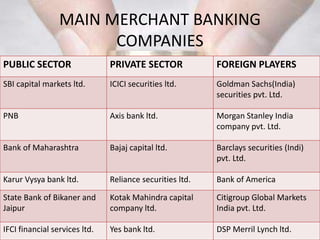
MAIN MERCHANT BANKING
COMPANIES
PUBLIC SECTOR PRIVATE SECTOR FOREIGN PLAYERS
SBI capital markets ltd. ICICI securities ltd. Goldman Sachs(India)
securities pvt. Ltd.
PNB Axis bank ltd. Morgan Stanley India
company pvt. Ltd.
Bank of Maharashtra Bajaj capital ltd. Barclays securities (Indi)
pvt. Ltd.
Karur Vysya bank ltd. Reliance securities ltd. Bank of America
State Bank of Bikaner and
Jaipur
Kotak Mahindra capital
company ltd.
Citigroup Global Markets
India pvt. Ltd.
IFCI financial services ltd. Yes bank ltd. DSP Merril Lynch ltd.
COMMERCIAL BANKING Vs
MERCHANT BANKING
COMMERCIAL BANKING MERCHANT BANKING
Catering needs of common man Catering needs of corporate firms
Anyone can open an account It cannot be done
Less exposed to risk More exposed to risk
Related to secondary market Related to primary markets
It’s asset oriented It’s management oriented
Plays the role of financers Plays different roles like underwriting,
portfolio etc.
MERCHANT ACCOUNT
A Merchant Account is a type of bank account
that allows businesses to accept payments in
multiple ways, typically debit or credit cards.
METHODS OF PROCESSING CREDIT
CARDS
Credit card terminal
Automated response unit
Payment gateway
Level 2 or 3 processing
Merchant account marketing
Marketing by banks
Marketing by Independent Sales
Organization(ISO)
HOW TO START A MERCHANT
ACCOUNT
 STEP 1: Research merchant account options from banks
in local area.
 STEP 2: Apply for the merchant account, providing all
necessary documentation and information.
 STEP 3: Submit to the bank a detailed list of the type of
business activities you conduct.
 STEP 4: Show proof of a website to the bank, if you are
conducting business online.
 STEP 5: Pay the application fee and any other required
upfront fees for setting up the merchant account.
REQUIRED DOCUMENTS
Business checking account
Proof of identification
Social security number or federal employer
identification number
Detailed statement of business activities
Tax returns and financial statements for business
Website(for online business)
Secure check out system(for online business)
HOW TO APPLY FOR MERCHANT
ACCOUNT
 STEP 1: Check your credit history and rating before
applying for a merchant.
 STEP 2: Apply for an internet merchant account, if you
want to process transactions online.
 STEP 3: Enter your business name, address and phone
numbers.
 STEP 4: Provide your company details.
 STEP 5: List the type of services provided.
 STEP 6: Provide information about yourself as the
business owner.
 STEP 7: Enter references, if required.
 STEP 8: Submit your application to the processor and
await a decision.
CATEGORIES OF MERCHANT BANKERS
CATEGORY ROLE
CATEGORY 1 •Issue management
•Advisor
•Consultant
•Manager
•Underwriter
•Portfolio manager
CATEGORY 2 •Advisor
•Consultant
•Manager
•Underwriter
•Co-manager
CATEGORY 3 •Underwriter
•Advisor
•Consultant
CATEGORY 4 •Advisor
•Consultant
QUALITIES OF MERCHANT BANKERS
Ability to analyse
Abundant knowledge
Ability to build up relationship
Innovative approach
Merchant banking

Merchant banking

  • 1.
  • 2.
    CONTENTS  Definition  Origin About  Services  Scope in India  Merchant Banking Structure in India  Main Merchant Banking Companies  Commercial Banking Vs Merchant Banking  Merchant Account  Methods of processing credit cards  How to start a merchant account  Required documents  How to apply for merchant account  Merchant banker  Categories of Merchant Bankers  Qualities of Merchant Bankers
  • 3.
    DEFINITIONS A merchant bankis a financial institution providing capital to companies in the form of share ownership instead of loans. A merchant bank also provides advisory on corporate matters to the firms in which they invest.
  • 4.
    ORIGIN Merchant Banking startedin Italy in the middle ages. Reached in France during 17th century In England, Merchant Banking was introduced in 18th century. Merchant banking came to India through Grindlays Bank in 1967 and City bank in 1970. SBI started the merchant banking division in 1972.
  • 5.
    SERVICES Corporate counselling Project counselling Workingcapital finance Portfolio management Restructuring strategies Credit syndication Lease financing Other services
  • 6.
    SCOPE IN INDIA Growthof new issue market Entry of foreign investors Changing policy of Financial Institutions Development of debt market
  • 7.
    MERCHANT BANKING STRUCTUREIN INDIA MERCHANT BANKS PUBLIC SECTOR PRIVATE SECTOR INTERNATIONAL BANKS(10) COMMERCIAL BANKS (24) FINANCIAL INSTITUTION (6) STATE INSTITUTIONS (4) BANKS (10) FINANCE AND INVESTMENT (231)
  • 8.
    MAIN MERCHANT BANKING COMPANIES PUBLICSECTOR PRIVATE SECTOR FOREIGN PLAYERS SBI capital markets ltd. ICICI securities ltd. Goldman Sachs(India) securities pvt. Ltd. PNB Axis bank ltd. Morgan Stanley India company pvt. Ltd. Bank of Maharashtra Bajaj capital ltd. Barclays securities (Indi) pvt. Ltd. Karur Vysya bank ltd. Reliance securities ltd. Bank of America State Bank of Bikaner and Jaipur Kotak Mahindra capital company ltd. Citigroup Global Markets India pvt. Ltd. IFCI financial services ltd. Yes bank ltd. DSP Merril Lynch ltd.
  • 9.
    COMMERCIAL BANKING Vs MERCHANTBANKING COMMERCIAL BANKING MERCHANT BANKING Catering needs of common man Catering needs of corporate firms Anyone can open an account It cannot be done Less exposed to risk More exposed to risk Related to secondary market Related to primary markets It’s asset oriented It’s management oriented Plays the role of financers Plays different roles like underwriting, portfolio etc.
  • 10.
    MERCHANT ACCOUNT A MerchantAccount is a type of bank account that allows businesses to accept payments in multiple ways, typically debit or credit cards.
  • 11.
    METHODS OF PROCESSINGCREDIT CARDS Credit card terminal Automated response unit Payment gateway Level 2 or 3 processing Merchant account marketing Marketing by banks Marketing by Independent Sales Organization(ISO)
  • 12.
    HOW TO STARTA MERCHANT ACCOUNT  STEP 1: Research merchant account options from banks in local area.  STEP 2: Apply for the merchant account, providing all necessary documentation and information.  STEP 3: Submit to the bank a detailed list of the type of business activities you conduct.  STEP 4: Show proof of a website to the bank, if you are conducting business online.  STEP 5: Pay the application fee and any other required upfront fees for setting up the merchant account.
  • 13.
    REQUIRED DOCUMENTS Business checkingaccount Proof of identification Social security number or federal employer identification number Detailed statement of business activities Tax returns and financial statements for business Website(for online business) Secure check out system(for online business)
  • 14.
    HOW TO APPLYFOR MERCHANT ACCOUNT  STEP 1: Check your credit history and rating before applying for a merchant.  STEP 2: Apply for an internet merchant account, if you want to process transactions online.  STEP 3: Enter your business name, address and phone numbers.  STEP 4: Provide your company details.  STEP 5: List the type of services provided.  STEP 6: Provide information about yourself as the business owner.  STEP 7: Enter references, if required.  STEP 8: Submit your application to the processor and await a decision.
  • 15.
    CATEGORIES OF MERCHANTBANKERS CATEGORY ROLE CATEGORY 1 •Issue management •Advisor •Consultant •Manager •Underwriter •Portfolio manager CATEGORY 2 •Advisor •Consultant •Manager •Underwriter •Co-manager CATEGORY 3 •Underwriter •Advisor •Consultant CATEGORY 4 •Advisor •Consultant
  • 16.
    QUALITIES OF MERCHANTBANKERS Ability to analyse Abundant knowledge Ability to build up relationship Innovative approach