Power Point Presentation
on
Mumps—a Contagious Disease
Presented by
Mr. Reyaz AhmadWani
Assistant Professor
School of Education
Central University of Kashmir
Contents
 1. Concept of Mumps
 2. Signs & Symtoms associated with Mumps
 3. Complications associated with Mumps
 4. Causes of Mumps
 5. Mode ofTransmission
 6. Diagnosis
 7. Prevention
 8.Treatment (Management)
What is Mumps?
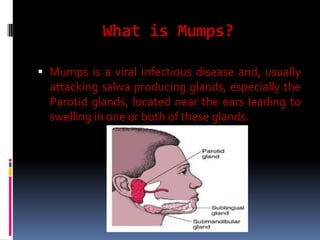
 Mumps is a viral infectious disease and, usually
attacking saliva producing glands, especially the
Parotid glands, located near the ears leading to
swelling in one or both of these glands.
Signs & Symtoms of Mumps
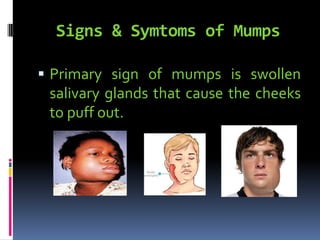
 Primary sign of mumps is swollen
salivary glands that cause the cheeks
to puff out.
Signs & Symtoms of Mumps
 Other signs & symtoms may include:
 Pain in swollen salivary glands
 Pain while chewing or swallowing
 Low grade fever
 Headache
 Muscle Ache
 Loss of Appetite
 Weakness & Fatigue
Complications
 1. PainfulTesticular Inflammation (Orchitis)
 2. Increased risk of spontaneous abortion
during first stage of trimester.
 3. Encephalitis & Meningitis
 4. Hearing loss (Deafness in extreme cases)
 5. Ovarian Inflammation
 6. Acute Pancreatic Inflammation
(Pancreatitis)
 7. Heart Problems
Causes
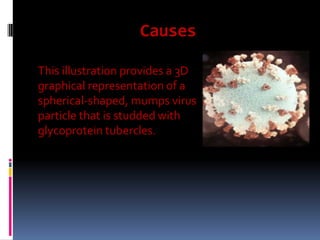
This illustration provides a 3D
graphical representation of a
spherical-shaped, mumps virus
particle that is studded with
glycoprotein tubercles.
Mode of Transmission
 Mumps is highly contagious for about nine
days after symptoms appear.
 Saliva from the infected person through
sneezing, coughing (aerolization) or kissing
the non-infected/non-immune/unvaccinated
individual.
 Group gathering at schools, colleges and
universities favours the spreading/outbreaks
of mumps.
Diagnosis
 Physical examination confirms the presence of
the swollen glands.
 Usually, the disease is diagnosed on clinical
grounds, and no confirmatory laboratory testing
is needed.
 If uncertainty exists, a test of saliva or blood may
be carried out; a newer diagnostic confirmation,
using real-time nested polymerase chain
reaction technology, has also been developed.
 As with any inflammation of the salivary glands,
the serum level of the enzyme amylase is often
elevated.
Prevention
 Vaccination against the disease preferably
two doses of Measles Mumps Rubella (MMR)
Vaccine during:
the ages of 12 and 15 months &
the ages of 4 and 6 years
Treatment (Management)
 There's no specific treatment for mumps.
 Rest as much as possible
 Try to ease symptoms with cold compresses
and over-the-counter pain relievers such as
ibuprofen (Advil, Motrin IB, others) and
acetaminophen (Tylenol, others)
THANK
YOU!

Ppt on mumps--a contagious disease

  • 1.
    Power Point Presentation on Mumps—aContagious Disease Presented by Mr. Reyaz AhmadWani Assistant Professor School of Education Central University of Kashmir
  • 2.
    Contents  1. Conceptof Mumps  2. Signs & Symtoms associated with Mumps  3. Complications associated with Mumps  4. Causes of Mumps  5. Mode ofTransmission  6. Diagnosis  7. Prevention  8.Treatment (Management)
  • 3.
    What is Mumps? Mumps is a viral infectious disease and, usually attacking saliva producing glands, especially the Parotid glands, located near the ears leading to swelling in one or both of these glands.
  • 4.
    Signs & Symtomsof Mumps  Primary sign of mumps is swollen salivary glands that cause the cheeks to puff out.
  • 5.
    Signs & Symtomsof Mumps  Other signs & symtoms may include:  Pain in swollen salivary glands  Pain while chewing or swallowing  Low grade fever  Headache  Muscle Ache  Loss of Appetite  Weakness & Fatigue
  • 6.
    Complications  1. PainfulTesticularInflammation (Orchitis)  2. Increased risk of spontaneous abortion during first stage of trimester.  3. Encephalitis & Meningitis  4. Hearing loss (Deafness in extreme cases)  5. Ovarian Inflammation  6. Acute Pancreatic Inflammation (Pancreatitis)  7. Heart Problems
  • 7.
    Causes This illustration providesa 3D graphical representation of a spherical-shaped, mumps virus particle that is studded with glycoprotein tubercles.
  • 8.
    Mode of Transmission Mumps is highly contagious for about nine days after symptoms appear.  Saliva from the infected person through sneezing, coughing (aerolization) or kissing the non-infected/non-immune/unvaccinated individual.  Group gathering at schools, colleges and universities favours the spreading/outbreaks of mumps.
  • 9.
    Diagnosis  Physical examinationconfirms the presence of the swollen glands.  Usually, the disease is diagnosed on clinical grounds, and no confirmatory laboratory testing is needed.  If uncertainty exists, a test of saliva or blood may be carried out; a newer diagnostic confirmation, using real-time nested polymerase chain reaction technology, has also been developed.  As with any inflammation of the salivary glands, the serum level of the enzyme amylase is often elevated.
  • 10.
    Prevention  Vaccination againstthe disease preferably two doses of Measles Mumps Rubella (MMR) Vaccine during: the ages of 12 and 15 months & the ages of 4 and 6 years
  • 11.
    Treatment (Management)  There'sno specific treatment for mumps.  Rest as much as possible  Try to ease symptoms with cold compresses and over-the-counter pain relievers such as ibuprofen (Advil, Motrin IB, others) and acetaminophen (Tylenol, others)
  • 12.