MUGHAL
EMPERORS
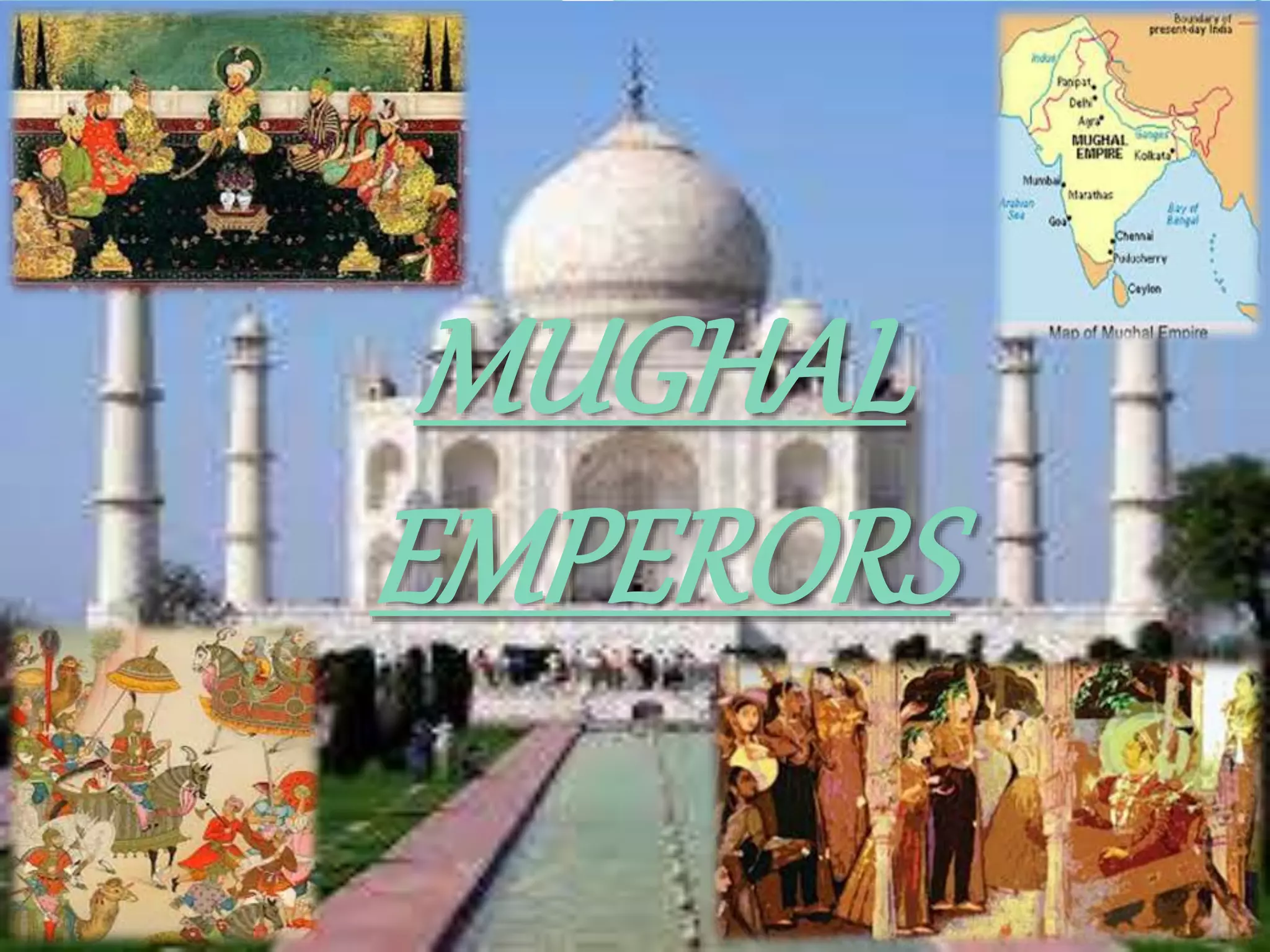
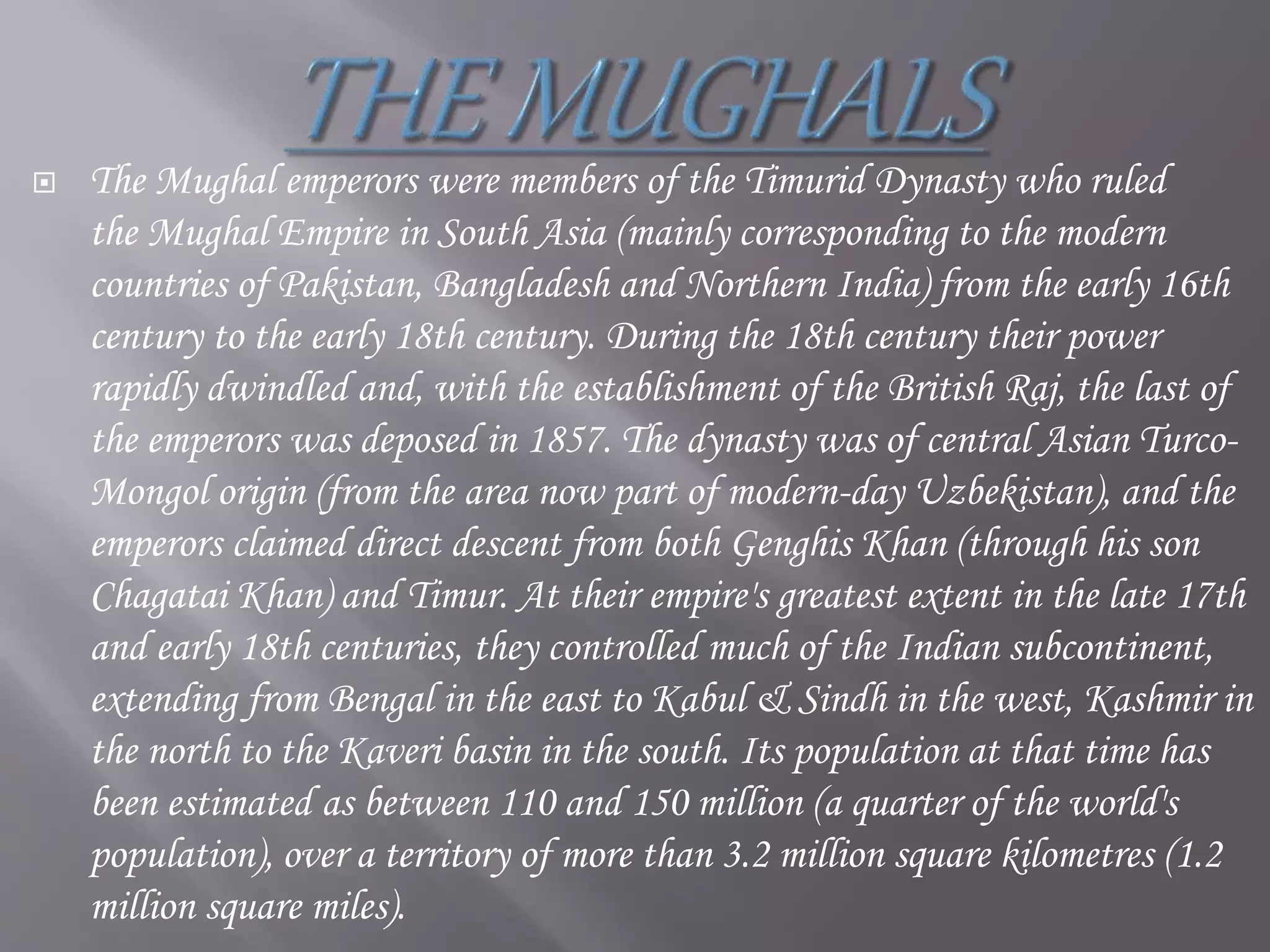
 The Mughal emperors were members of the Timurid Dynasty who ruled
the Mughal Empire in South Asia (mainly corresponding to the modern
countries of Pakistan, Bangladesh and Northern India) from the early 16th
century to the early 18th century. During the 18th century their power
rapidly dwindled and, with the establishment of the British Raj, the last of
the emperors was deposed in 1857. The dynasty was of central Asian Turco-
Mongol origin (from the area now part of modern-day Uzbekistan), and the
emperors claimed direct descent from both Genghis Khan (through his son
Chagatai Khan) and Timur. At their empire's greatest extent in the late 17th
and early 18th centuries, they controlled much of the Indian subcontinent,
extending from Bengal in the east to Kabul & Sindh in the west, Kashmir in
the north to the Kaveri basin in the south. Its population at that time has
been estimated as between 110 and 150 million (a quarter of the world's
population), over a territory of more than 3.2 million square kilometres (1.2
million square miles).
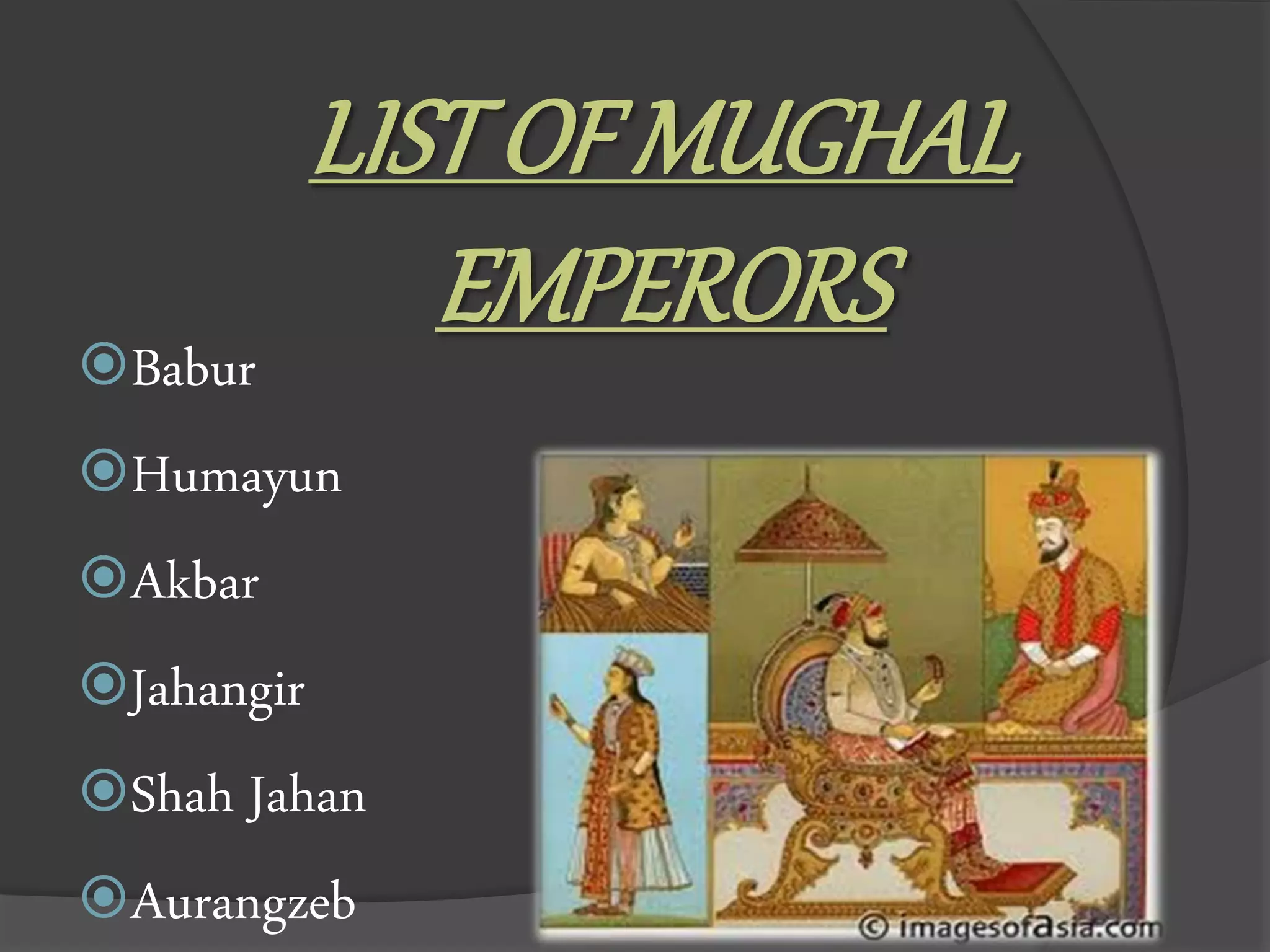
LIST OF MUGHAL
EMPERORS
Babur
Humayun
Akbar
Jahangir
Shah Jahan
Aurangzeb
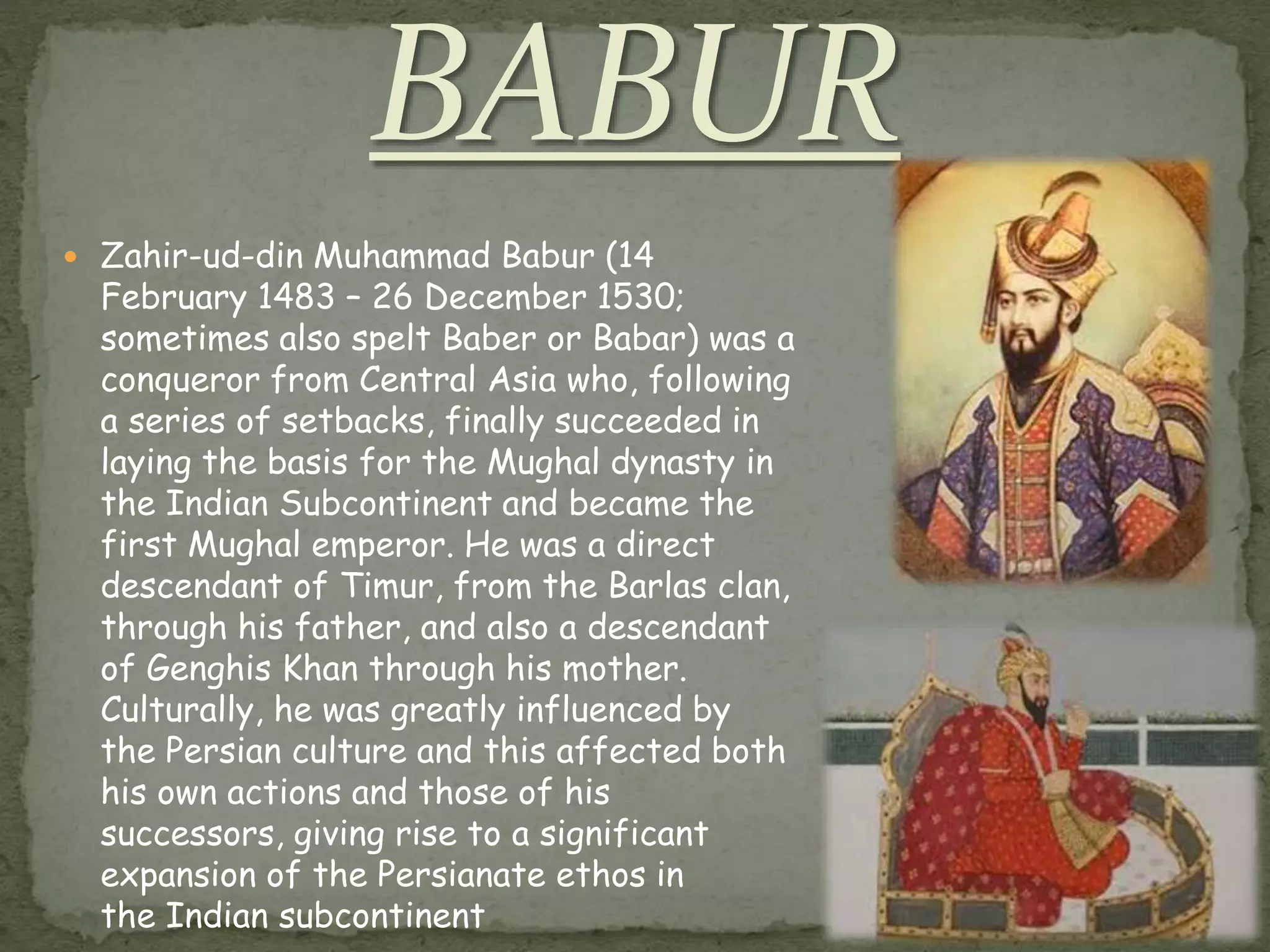
 Zahir-ud-din Muhammad Babur (14
February 1483 – 26 December 1530;
sometimes also spelt Baber or Babar) was a
conqueror from Central Asia who, following
a series of setbacks, finally succeeded in
laying the basis for the Mughal dynasty in
the Indian Subcontinent and became the
first Mughal emperor. He was a direct
descendant of Timur, from the Barlas clan,
through his father, and also a descendant
of Genghis Khan through his mother.
Culturally, he was greatly influenced by
the Persian culture and this affected both
his own actions and those of his
successors, giving rise to a significant
expansion of the Persianate ethos in
the Indian subcontinent
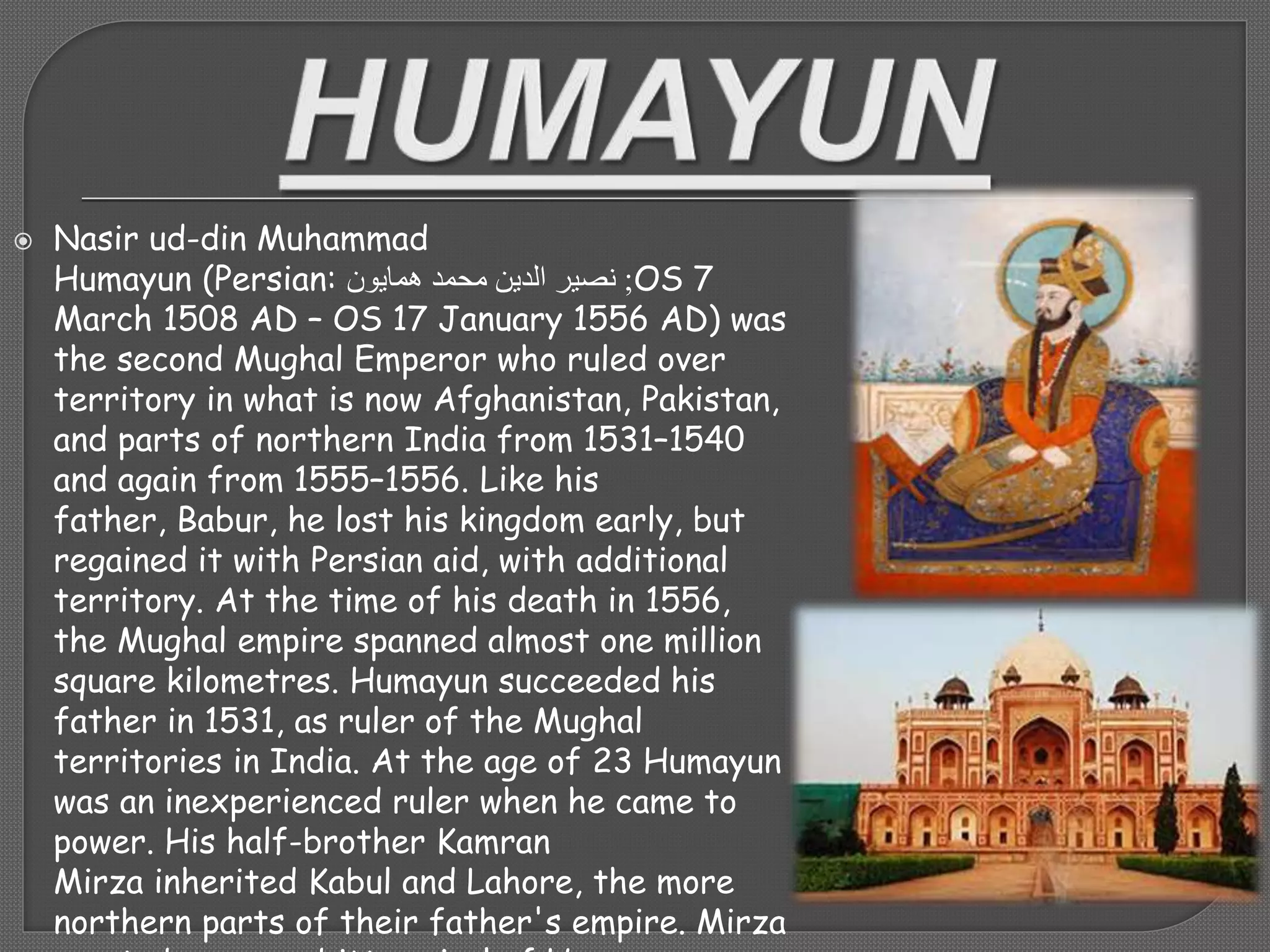
 Nasir ud-din Muhammad
Humayun (Persian: ‫همایون‬ ‫محمد‬ ‫الدین‬ ‫نصیر‬ ;OS 7
March 1508 AD – OS 17 January 1556 AD) was
the second Mughal Emperor who ruled over
territory in what is now Afghanistan, Pakistan,
and parts of northern India from 1531–1540
and again from 1555–1556. Like his
father, Babur, he lost his kingdom early, but
regained it with Persian aid, with additional
territory. At the time of his death in 1556,
the Mughal empire spanned almost one million
square kilometres. Humayun succeeded his
father in 1531, as ruler of the Mughal
territories in India. At the age of 23 Humayun
was an inexperienced ruler when he came to
power. His half-brother Kamran
Mirza inherited Kabul and Lahore, the more
northern parts of their father's empire. Mirza
AKBAR Abu'l-Fath Jalal ud-din MuhammadAkbar,
known popularly as Akbar (IPA: [əkbər], literally
"the great"; 14 October 1542 – 27 October
1605), also known as Akbar the Great or Akbar
I, was Mughal Emperor from 1556 until his
death. He was the third and one of the greatest
rulers of the Mughal Dynasty in India. Akbar
succeeded his father, Humayun, under a
regent, Bairam Khan, who helped the young
emperor expand and consolidate Mughal
domains in India. A strong personality and a
successful general, Akbar gradually enlarged
the Mughal Empire to include nearly all of
the Indian Subcontinent north of
the Godavari river. His power and influence,
however, extended over the entire country
because of Mughal military, political, cultural,
and economic dominance.
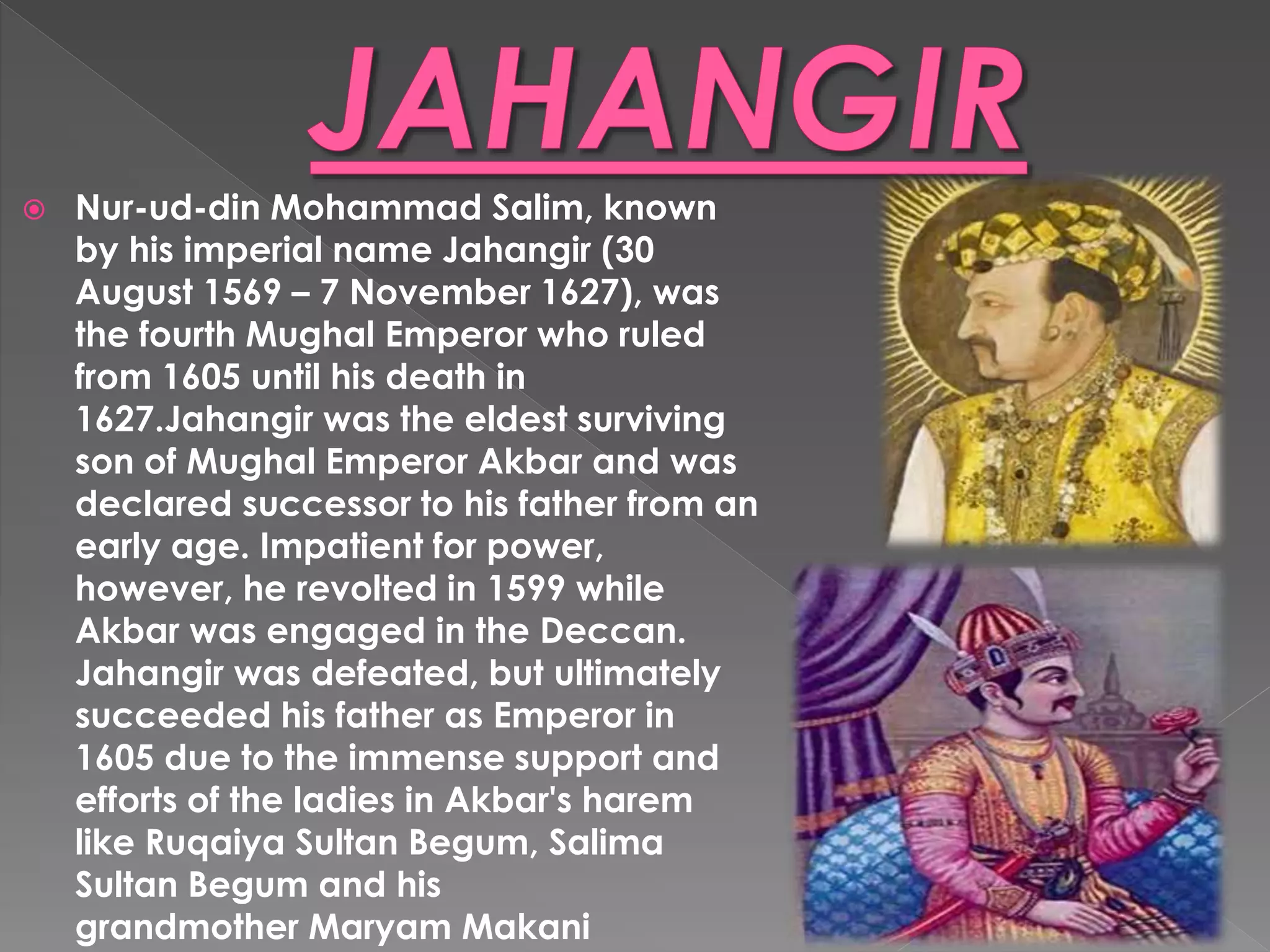
 Nur-ud-din Mohammad Salim, known
by his imperial name Jahangir (30
August 1569 – 7 November 1627), was
the fourth Mughal Emperor who ruled
from 1605 until his death in
1627.Jahangir was the eldest surviving
son of Mughal Emperor Akbar and was
declared successor to his father from an
early age. Impatient for power,
however, he revolted in 1599 while
Akbar was engaged in the Deccan.
Jahangir was defeated, but ultimately
succeeded his father as Emperor in
1605 due to the immense support and
efforts of the ladies in Akbar's harem
like Ruqaiya Sultan Begum, Salima
Sultan Begum and his
grandmother Maryam Makani
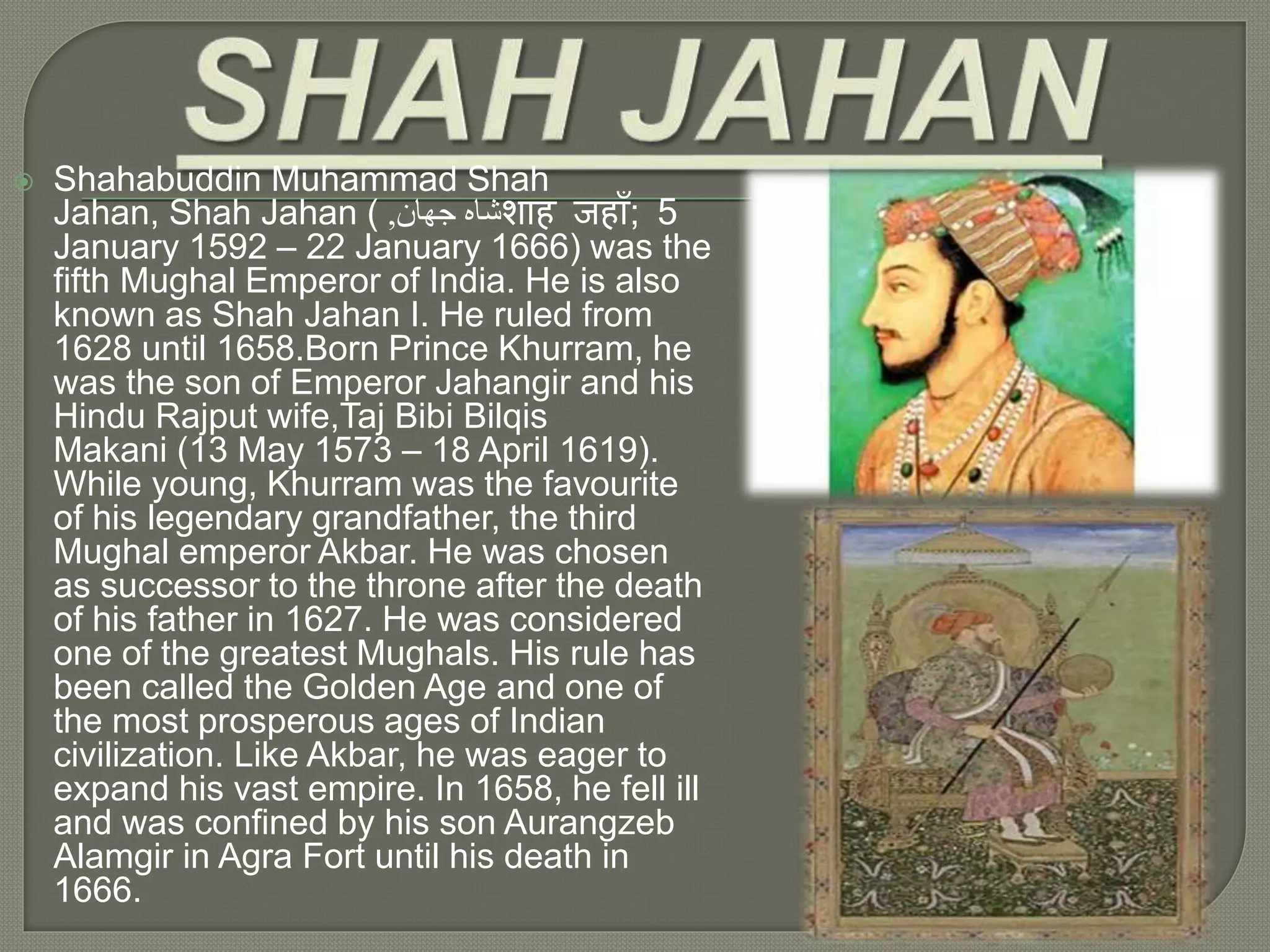
 Shahabuddin Muhammad Shah
Jahan, Shah Jahan ( ‫جهان‬ ‫شاه‬, शाह जहााँ; 5
January 1592 – 22 January 1666) was the
fifth Mughal Emperor of India. He is also
known as Shah Jahan I. He ruled from
1628 until 1658.Born Prince Khurram, he
was the son of Emperor Jahangir and his
Hindu Rajput wife,Taj Bibi Bilqis
Makani (13 May 1573 – 18 April 1619).
While young, Khurram was the favourite
of his legendary grandfather, the third
Mughal emperor Akbar. He was chosen
as successor to the throne after the death
of his father in 1627. He was considered
one of the greatest Mughals. His rule has
been called the Golden Age and one of
the most prosperous ages of Indian
civilization. Like Akbar, he was eager to
expand his vast empire. In 1658, he fell ill
and was confined by his son Aurangzeb
Alamgir in Agra Fort until his death in
1666.
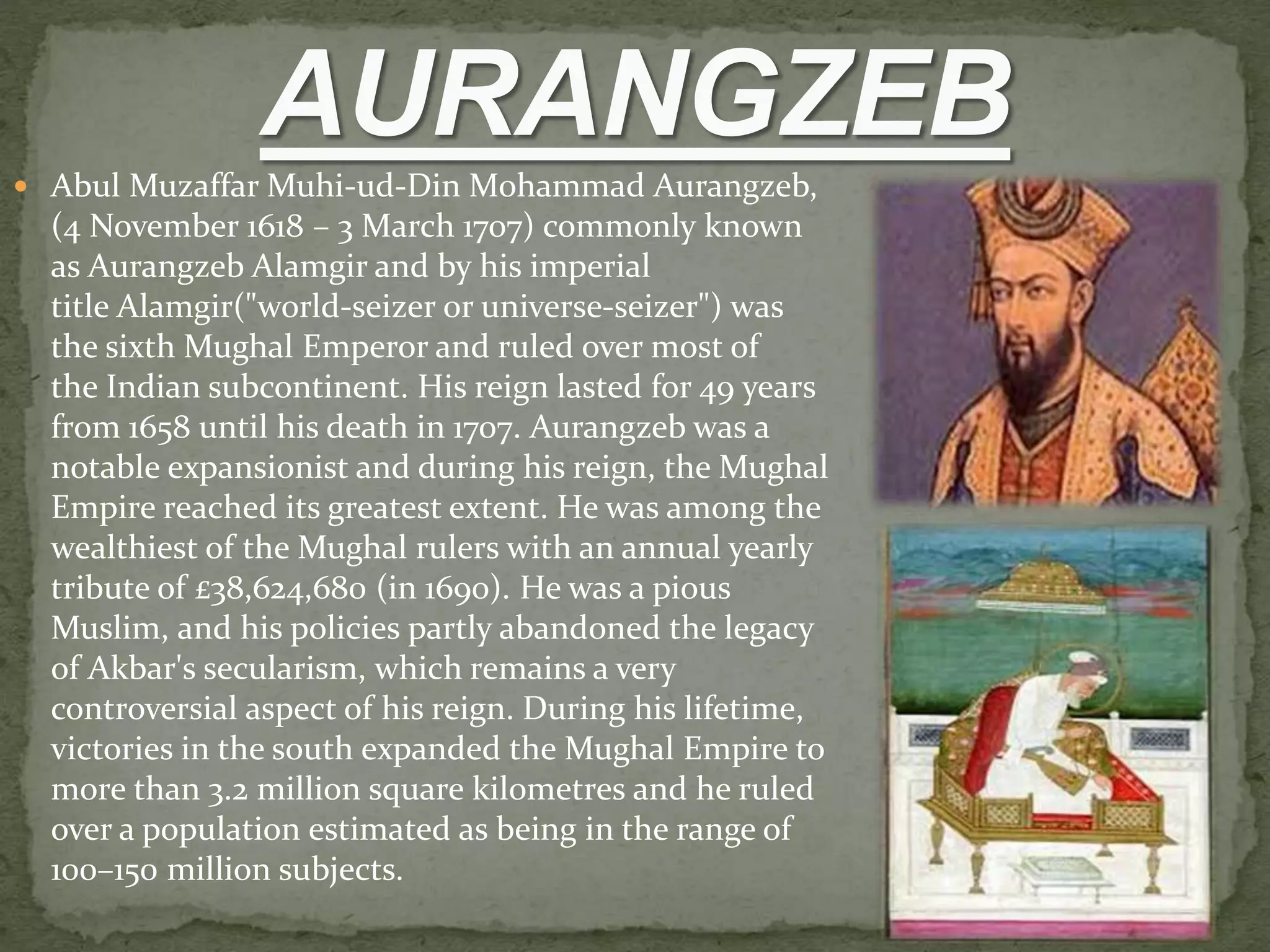
 Abul Muzaffar Muhi-ud-Din Mohammad Aurangzeb,
(4 November 1618 – 3 March 1707) commonly known
as Aurangzeb Alamgir and by his imperial
title Alamgir("world-seizer or universe-seizer") was
the sixth Mughal Emperor and ruled over most of
the Indian subcontinent. His reign lasted for 49 years
from 1658 until his death in 1707. Aurangzeb was a
notable expansionist and during his reign, the Mughal
Empire reached its greatest extent. He was among the
wealthiest of the Mughal rulers with an annual yearly
tribute of £38,624,680 (in 1690). He was a pious
Muslim, and his policies partly abandoned the legacy
of Akbar's secularism, which remains a very
controversial aspect of his reign. During his lifetime,
victories in the south expanded the Mughal Empire to
more than 3.2 million square kilometres and he ruled
over a population estimated as being in the range of
100–150 million subjects.
Made by:-
Harshit Gupta
VII-C
13

Ppt on mughal emperors

  • 1.
  • 2.
     The Mughalemperors were members of the Timurid Dynasty who ruled the Mughal Empire in South Asia (mainly corresponding to the modern countries of Pakistan, Bangladesh and Northern India) from the early 16th century to the early 18th century. During the 18th century their power rapidly dwindled and, with the establishment of the British Raj, the last of the emperors was deposed in 1857. The dynasty was of central Asian Turco- Mongol origin (from the area now part of modern-day Uzbekistan), and the emperors claimed direct descent from both Genghis Khan (through his son Chagatai Khan) and Timur. At their empire's greatest extent in the late 17th and early 18th centuries, they controlled much of the Indian subcontinent, extending from Bengal in the east to Kabul & Sindh in the west, Kashmir in the north to the Kaveri basin in the south. Its population at that time has been estimated as between 110 and 150 million (a quarter of the world's population), over a territory of more than 3.2 million square kilometres (1.2 million square miles).
  • 3.
  • 4.
     Zahir-ud-din MuhammadBabur (14 February 1483 – 26 December 1530; sometimes also spelt Baber or Babar) was a conqueror from Central Asia who, following a series of setbacks, finally succeeded in laying the basis for the Mughal dynasty in the Indian Subcontinent and became the first Mughal emperor. He was a direct descendant of Timur, from the Barlas clan, through his father, and also a descendant of Genghis Khan through his mother. Culturally, he was greatly influenced by the Persian culture and this affected both his own actions and those of his successors, giving rise to a significant expansion of the Persianate ethos in the Indian subcontinent
  • 5.
     Nasir ud-dinMuhammad Humayun (Persian: ‫همایون‬ ‫محمد‬ ‫الدین‬ ‫نصیر‬ ;OS 7 March 1508 AD – OS 17 January 1556 AD) was the second Mughal Emperor who ruled over territory in what is now Afghanistan, Pakistan, and parts of northern India from 1531–1540 and again from 1555–1556. Like his father, Babur, he lost his kingdom early, but regained it with Persian aid, with additional territory. At the time of his death in 1556, the Mughal empire spanned almost one million square kilometres. Humayun succeeded his father in 1531, as ruler of the Mughal territories in India. At the age of 23 Humayun was an inexperienced ruler when he came to power. His half-brother Kamran Mirza inherited Kabul and Lahore, the more northern parts of their father's empire. Mirza
  • 6.
    AKBAR Abu'l-Fath Jalalud-din MuhammadAkbar, known popularly as Akbar (IPA: [əkbər], literally "the great"; 14 October 1542 – 27 October 1605), also known as Akbar the Great or Akbar I, was Mughal Emperor from 1556 until his death. He was the third and one of the greatest rulers of the Mughal Dynasty in India. Akbar succeeded his father, Humayun, under a regent, Bairam Khan, who helped the young emperor expand and consolidate Mughal domains in India. A strong personality and a successful general, Akbar gradually enlarged the Mughal Empire to include nearly all of the Indian Subcontinent north of the Godavari river. His power and influence, however, extended over the entire country because of Mughal military, political, cultural, and economic dominance.
  • 7.
     Nur-ud-din MohammadSalim, known by his imperial name Jahangir (30 August 1569 – 7 November 1627), was the fourth Mughal Emperor who ruled from 1605 until his death in 1627.Jahangir was the eldest surviving son of Mughal Emperor Akbar and was declared successor to his father from an early age. Impatient for power, however, he revolted in 1599 while Akbar was engaged in the Deccan. Jahangir was defeated, but ultimately succeeded his father as Emperor in 1605 due to the immense support and efforts of the ladies in Akbar's harem like Ruqaiya Sultan Begum, Salima Sultan Begum and his grandmother Maryam Makani
  • 8.
     Shahabuddin MuhammadShah Jahan, Shah Jahan ( ‫جهان‬ ‫شاه‬, शाह जहााँ; 5 January 1592 – 22 January 1666) was the fifth Mughal Emperor of India. He is also known as Shah Jahan I. He ruled from 1628 until 1658.Born Prince Khurram, he was the son of Emperor Jahangir and his Hindu Rajput wife,Taj Bibi Bilqis Makani (13 May 1573 – 18 April 1619). While young, Khurram was the favourite of his legendary grandfather, the third Mughal emperor Akbar. He was chosen as successor to the throne after the death of his father in 1627. He was considered one of the greatest Mughals. His rule has been called the Golden Age and one of the most prosperous ages of Indian civilization. Like Akbar, he was eager to expand his vast empire. In 1658, he fell ill and was confined by his son Aurangzeb Alamgir in Agra Fort until his death in 1666.
  • 9.
     Abul MuzaffarMuhi-ud-Din Mohammad Aurangzeb, (4 November 1618 – 3 March 1707) commonly known as Aurangzeb Alamgir and by his imperial title Alamgir("world-seizer or universe-seizer") was the sixth Mughal Emperor and ruled over most of the Indian subcontinent. His reign lasted for 49 years from 1658 until his death in 1707. Aurangzeb was a notable expansionist and during his reign, the Mughal Empire reached its greatest extent. He was among the wealthiest of the Mughal rulers with an annual yearly tribute of £38,624,680 (in 1690). He was a pious Muslim, and his policies partly abandoned the legacy of Akbar's secularism, which remains a very controversial aspect of his reign. During his lifetime, victories in the south expanded the Mughal Empire to more than 3.2 million square kilometres and he ruled over a population estimated as being in the range of 100–150 million subjects.
  • 10.