WHAT WAS MUGHAL
       EMPIRE?
   THE MUGHAL EMPIRE was an
    imperial power in the Indian
    subcontinent from about 1526 to 1757
    (though it lingered for another
    century). The Mughal emperors were
    Muslims and direct descendants
    of Genghis Khan through Chagatai
    Khan and Timur. At the height of their
    power in the late 17th and early 18th
    centuries, they controlled most of the
THE GREAT MUGHALS
     THE LATER MUGHALS

 The great mughals were rulers of
  mughal empire till Aurangzeb.
 After him came the later mughals.
 There are six great mughals.
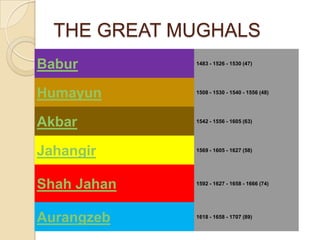
THE GREAT MUGHALS
Babur        1483 - 1526 - 1530 (47)


Humayun      1508 - 1530 - 1540 - 1556 (48)


Akbar        1542 - 1556 - 1605 (63)


Jahangir     1569 - 1605 - 1627 (58)


Shah Jahan   1592 - 1627 - 1658 - 1666 (74)


Aurangzeb    1618 - 1658 - 1707 (89)
BABU
          R
   The first of the Great Mughals was
    Babur ("The Tiger"), who invaded
    and conquered India in 1526. He
    was also a diarist, an enthusiastic
    hunter and lover of gardens.

   He died in the Ram Bagh gardens in
    Agra, and his tomb lies in gardens
    bearing his name in Kabul,
    Afghanistan.
HUMAYUN
 Born in Kabul, Humayun was the
  eldest of Babur's sons, and had
  helped his father with the conquest
  of India. He ascended the throne
  at Agra on December 30 1530 at the
  age of 23, but did not have the
  skills to manage the immature
  empire, Afghan warlords
 In 1540 he lost his empire to Afghan
  leader Sher Shah, but he hung in
  and managed to get it back 16
AKBAR
   The greatest of the Mughal Emperors,
    Akbar, was born in exile and
    ascended the throne at the age of 13
    after his father's short restoration.

   In many ways Akbar was the Indian
    equivalent of Suleiman the
    Magnificent (1494 - 1520 - 1566). He
    conquered massive new territories
    including much of Rajasthan, created
    a long lasting civil and military
    administrative system (called
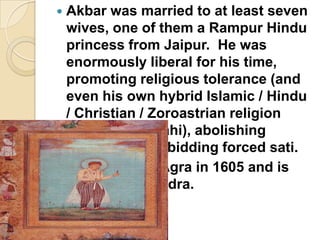
 Akbar was married to at least seven
  wives, one of them a Rampur Hindu
  princess from Jaipur. He was
  enormously liberal for his time,
  promoting religious tolerance (and
  even his own hybrid Islamic / Hindu
  / Christian / Zoroastrian religion
  called Din - i llahi), abolishing
  slavery and forbidding forced sati.
 Akbar died in Agra in 1605 and is
  buried in Sikandra.
JAHANGIR
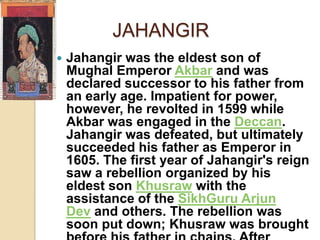
   Jahangir was the eldest son of
    Mughal Emperor Akbar and was
    declared successor to his father from
    an early age. Impatient for power,
    however, he revolted in 1599 while
    Akbar was engaged in the Deccan.
    Jahangir was defeated, but ultimately
    succeeded his father as Emperor in
    1605. The first year of Jahangir's reign
    saw a rebellion organized by his
    eldest son Khusraw with the
    assistance of the SikhGuru Arjun
    Dev and others. The rebellion was
    soon put down; Khusraw was brought
SHAH
              JAHAN
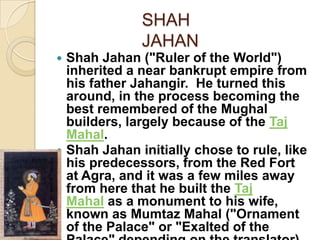
 Shah Jahan ("Ruler of the World")
  inherited a near bankrupt empire from
  his father Jahangir. He turned this
  around, in the process becoming the
  best remembered of the Mughal
  builders, largely because of the Taj
  Mahal.
 Shah Jahan initially chose to rule, like
  his predecessors, from the Red Fort
  at Agra, and it was a few miles away
  from here that he built the Taj
  Mahal as a monument to his wife,
  known as Mumtaz Mahal ("Ornament
  of the Palace" or "Exalted of the

Mughal dynasty

  • 2.
    WHAT WAS MUGHAL EMPIRE?  THE MUGHAL EMPIRE was an imperial power in the Indian subcontinent from about 1526 to 1757 (though it lingered for another century). The Mughal emperors were Muslims and direct descendants of Genghis Khan through Chagatai Khan and Timur. At the height of their power in the late 17th and early 18th centuries, they controlled most of the
  • 3.
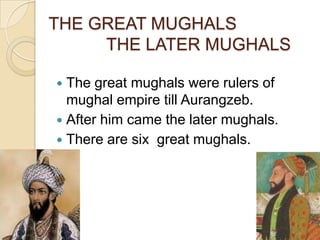
    THE GREAT MUGHALS THE LATER MUGHALS  The great mughals were rulers of mughal empire till Aurangzeb.  After him came the later mughals.  There are six great mughals.
  • 4.
    THE GREAT MUGHALS Babur 1483 - 1526 - 1530 (47) Humayun 1508 - 1530 - 1540 - 1556 (48) Akbar 1542 - 1556 - 1605 (63) Jahangir 1569 - 1605 - 1627 (58) Shah Jahan 1592 - 1627 - 1658 - 1666 (74) Aurangzeb 1618 - 1658 - 1707 (89)
  • 5.
    BABU R  The first of the Great Mughals was Babur ("The Tiger"), who invaded and conquered India in 1526. He was also a diarist, an enthusiastic hunter and lover of gardens.  He died in the Ram Bagh gardens in Agra, and his tomb lies in gardens bearing his name in Kabul, Afghanistan.
  • 6.
    HUMAYUN  Born inKabul, Humayun was the eldest of Babur's sons, and had helped his father with the conquest of India. He ascended the throne at Agra on December 30 1530 at the age of 23, but did not have the skills to manage the immature empire, Afghan warlords  In 1540 he lost his empire to Afghan leader Sher Shah, but he hung in and managed to get it back 16
  • 7.
    AKBAR  The greatest of the Mughal Emperors, Akbar, was born in exile and ascended the throne at the age of 13 after his father's short restoration.  In many ways Akbar was the Indian equivalent of Suleiman the Magnificent (1494 - 1520 - 1566). He conquered massive new territories including much of Rajasthan, created a long lasting civil and military administrative system (called
  • 8.
     Akbar wasmarried to at least seven wives, one of them a Rampur Hindu princess from Jaipur. He was enormously liberal for his time, promoting religious tolerance (and even his own hybrid Islamic / Hindu / Christian / Zoroastrian religion called Din - i llahi), abolishing slavery and forbidding forced sati.  Akbar died in Agra in 1605 and is buried in Sikandra.
  • 9.
    JAHANGIR  Jahangir was the eldest son of Mughal Emperor Akbar and was declared successor to his father from an early age. Impatient for power, however, he revolted in 1599 while Akbar was engaged in the Deccan. Jahangir was defeated, but ultimately succeeded his father as Emperor in 1605. The first year of Jahangir's reign saw a rebellion organized by his eldest son Khusraw with the assistance of the SikhGuru Arjun Dev and others. The rebellion was soon put down; Khusraw was brought
  • 10.
    SHAH JAHAN  Shah Jahan ("Ruler of the World") inherited a near bankrupt empire from his father Jahangir. He turned this around, in the process becoming the best remembered of the Mughal builders, largely because of the Taj Mahal.  Shah Jahan initially chose to rule, like his predecessors, from the Red Fort at Agra, and it was a few miles away from here that he built the Taj Mahal as a monument to his wife, known as Mumtaz Mahal ("Ornament of the Palace" or "Exalted of the