MUGHAL DYNASTY
(1526-1707)
introduction
 The Mughal Empire was an empire that at its
greatest territorial extent ruled most of the Indian
subcontinent, then known as Hindustan.
 It also parts of what is now Afghanistan and
the
Baluchistan region.
 It was established in 1526, enjoyed expansion
and consolidation until about 1707 and survived,
even if in drastically attenuated form, until 1857.
BABUR
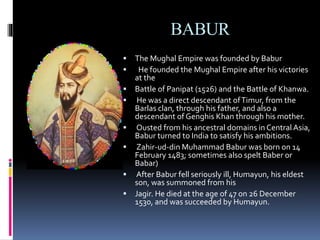
 The Mughal Empire was founded by Babur
 He founded the Mughal Empire after his victories
at the
 Battle of Panipat (1526) and the Battle of Khanwa.
 He was a direct descendant ofTimur, from the
Barlas clan, through his father, and also a
descendant of Genghis Khan through his mother.
 Ousted from his ancestral domains in Central Asia,
Babur turned to India to satisfy his ambitions.
 Zahir-ud-din Muhammad Babur was born on 14
February 1483; sometimes also spelt Baber or
Babar)
 After Babur fell seriously ill, Humayun, his eldest
son, was summoned from his
 Jagir. He died at the age of 47 on 26 December
1530, and was succeeded by Humayun.
HUMAYUN
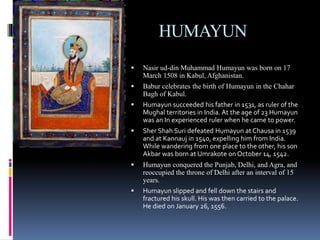
 Nasir ud-din Muhammad Humayun was born on 17
March 1508 in Kabul, Afghanistan.
 Babur celebrates the birth of Humayun in the Chahar
Bagh of Kabul.
 Humayun succeeded his father in 1531, as ruler of the
Mughal territories in India. At the age of 23 Humayun
was an In experienced ruler when he came to power.
 Sher Shah Suri defeated Humayun at Chausa in 1539
and at Kannauj in 1540, expelling him from India.
While wandering from one place to the other, his son
Akbar was born at Umrakote on October 14, 1542.
 Humayun conquered the Punjab, Delhi, and Agra, and
reoccupied the throne of Delhi after an interval of 15
years.
 Humayun slipped and fell down the stairs and
fractured his skull. His was then carried to the palace.
He died on January 26, 1556.
AKBAR
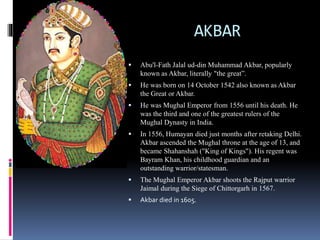
 Abu'l-Fath Jalal ud-din Muhammad Akbar, popularly
known as Akbar, literally "the great”.
 He was born on 14 October 1542 also known as Akbar
the Great or Akbar.
 He was Mughal Emperor from 1556 until his death. He
was the third and one of the greatest rulers of the
Mughal Dynasty in India.
 In 1556, Humayan died just months after retaking Delhi.
Akbar ascended the Mughal throne at the age of 13, and
became Shahanshah ("King of Kings"). His regent was
Bayram Khan, his childhood guardian and an
outstanding warrior/statesman.
 The Mughal Emperor Akbar shoots the Rajput warrior
Jaimal during the Siege of Chittorgarh in 1567.
 Akbar died in 1605.
JAHANGIR
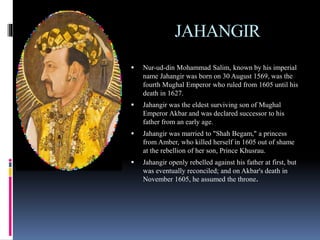
 Nur-ud-din Mohammad Salim, known by his imperial
name Jahangir was born on 30 August 1569, was the
fourth Mughal Emperor who ruled from 1605 until his
death in 1627.
 Jahangir was the eldest surviving son of Mughal
Emperor Akbar and was declared successor to his
father from an early age.
 Jahangir was married to "Shah Begam," a princess
from Amber, who killed herself in 1605 out of shame
at the rebellion of her son, Prince Khusrau.
 Jahangir openly rebelled against his father at first, but
was eventually reconciled; and on Akbar's death in
November 1605, he assumed the throne.
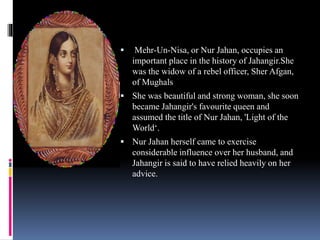
 Mehr-Un-Nisa, or Nur Jahan, occupies an
important place in the history of Jahangir.She
was the widow of a rebel officer, Sher Afgan,
of Mughals
 She was beautiful and strong woman, she soon
became Jahangir's favourite queen and
assumed the title of Nur Jahan, 'Light of the
World‘.
 Nur Jahan herself came to exercise
considerable influence over her husband, and
Jahangir is said to have relied heavily on her
advice.
SHAH JAHAN
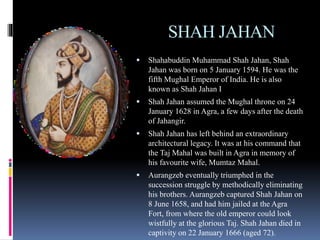
 Shahabuddin Muhammad Shah Jahan, Shah
Jahan was born on 5 January 1594. He was the
fifth Mughal Emperor of India. He is also
known as Shah Jahan I
 Shah Jahan assumed the Mughal throne on 24
January 1628 in Agra, a few days after the death
of Jahangir.
 Shah Jahan has left behind an extraordinary
architectural legacy. It was at his command that
the Taj Mahal was built in Agra in memory of
his favourite wife, Mumtaz Mahal.
 Aurangzeb eventually triumphed in the
succession struggle by methodically eliminating
his brothers. Aurangzeb captured Shah Jahan on
8 June 1658, and had him jailed at the Agra
Fort, from where the old emperor could look
wistfully at the glorious Taj. Shah Jahan died in
captivity on 22 January 1666 (aged 72).
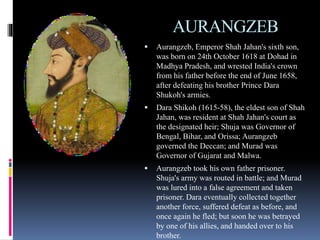
AURANGZEB
 Aurangzeb, Emperor Shah Jahan's sixth son,
was born on 24th October 1618 at Dohad in
Madhya Pradesh, and wrested India's crown
from his father before the end of June 1658,
after defeating his brother Prince Dara
Shukoh's armies.
 Dara Shikoh (1615-58), the eldest son of Shah
Jahan, was resident at Shah Jahan's court as
the designated heir; Shuja was Governor of
Bengal, Bihar, and Orissa; Aurangzeb
governed the Deccan; and Murad was
Governor of Gujarat and Malwa.
 Aurangzeb took his own father prisoner.
Shuja's army was routed in battle; and Murad
was lured into a false agreement and taken
prisoner. Dara eventually collected together
another force, suffered defeat as before, and
once again he fled; but soon he was betrayed
by one of his allies, and handed over to his
brother.
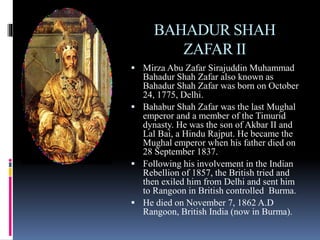
BAHADUR SHAH
ZAFAR II
 Mirza Abu Zafar Sirajuddin Muhammad
Bahadur Shah Zafar also known as
Bahadur Shah Zafar was born on October
24, 1775, Delhi.
 Bahabur Shah Zafar was the last Mughal
emperor and a member of the Timurid
dynasty. He was the son of Akbar II and
Lal Bai, a Hindu Rajput. He became the
Mughal emperor when his father died on
28 September 1837.
 Following his involvement in the Indian
Rebellion of 1857, the British tried and
then exiled him from Delhi and sent him
to Rangoon in British controlled Burma.
 He died on November 7, 1862 A.D
Rangoon, British India (now in Burma).

Mughal Dynasty

  • 1.
  • 2.
    introduction  The MughalEmpire was an empire that at its greatest territorial extent ruled most of the Indian subcontinent, then known as Hindustan.  It also parts of what is now Afghanistan and the Baluchistan region.  It was established in 1526, enjoyed expansion and consolidation until about 1707 and survived, even if in drastically attenuated form, until 1857.
  • 4.
    BABUR  The MughalEmpire was founded by Babur  He founded the Mughal Empire after his victories at the  Battle of Panipat (1526) and the Battle of Khanwa.  He was a direct descendant ofTimur, from the Barlas clan, through his father, and also a descendant of Genghis Khan through his mother.  Ousted from his ancestral domains in Central Asia, Babur turned to India to satisfy his ambitions.  Zahir-ud-din Muhammad Babur was born on 14 February 1483; sometimes also spelt Baber or Babar)  After Babur fell seriously ill, Humayun, his eldest son, was summoned from his  Jagir. He died at the age of 47 on 26 December 1530, and was succeeded by Humayun.
  • 5.
    HUMAYUN  Nasir ud-dinMuhammad Humayun was born on 17 March 1508 in Kabul, Afghanistan.  Babur celebrates the birth of Humayun in the Chahar Bagh of Kabul.  Humayun succeeded his father in 1531, as ruler of the Mughal territories in India. At the age of 23 Humayun was an In experienced ruler when he came to power.  Sher Shah Suri defeated Humayun at Chausa in 1539 and at Kannauj in 1540, expelling him from India. While wandering from one place to the other, his son Akbar was born at Umrakote on October 14, 1542.  Humayun conquered the Punjab, Delhi, and Agra, and reoccupied the throne of Delhi after an interval of 15 years.  Humayun slipped and fell down the stairs and fractured his skull. His was then carried to the palace. He died on January 26, 1556.
  • 6.
    AKBAR  Abu'l-Fath Jalalud-din Muhammad Akbar, popularly known as Akbar, literally "the great”.  He was born on 14 October 1542 also known as Akbar the Great or Akbar.  He was Mughal Emperor from 1556 until his death. He was the third and one of the greatest rulers of the Mughal Dynasty in India.  In 1556, Humayan died just months after retaking Delhi. Akbar ascended the Mughal throne at the age of 13, and became Shahanshah ("King of Kings"). His regent was Bayram Khan, his childhood guardian and an outstanding warrior/statesman.  The Mughal Emperor Akbar shoots the Rajput warrior Jaimal during the Siege of Chittorgarh in 1567.  Akbar died in 1605.
  • 7.
    JAHANGIR  Nur-ud-din MohammadSalim, known by his imperial name Jahangir was born on 30 August 1569, was the fourth Mughal Emperor who ruled from 1605 until his death in 1627.  Jahangir was the eldest surviving son of Mughal Emperor Akbar and was declared successor to his father from an early age.  Jahangir was married to "Shah Begam," a princess from Amber, who killed herself in 1605 out of shame at the rebellion of her son, Prince Khusrau.  Jahangir openly rebelled against his father at first, but was eventually reconciled; and on Akbar's death in November 1605, he assumed the throne.
  • 8.
     Mehr-Un-Nisa, orNur Jahan, occupies an important place in the history of Jahangir.She was the widow of a rebel officer, Sher Afgan, of Mughals  She was beautiful and strong woman, she soon became Jahangir's favourite queen and assumed the title of Nur Jahan, 'Light of the World‘.  Nur Jahan herself came to exercise considerable influence over her husband, and Jahangir is said to have relied heavily on her advice.
  • 9.
    SHAH JAHAN  ShahabuddinMuhammad Shah Jahan, Shah Jahan was born on 5 January 1594. He was the fifth Mughal Emperor of India. He is also known as Shah Jahan I  Shah Jahan assumed the Mughal throne on 24 January 1628 in Agra, a few days after the death of Jahangir.  Shah Jahan has left behind an extraordinary architectural legacy. It was at his command that the Taj Mahal was built in Agra in memory of his favourite wife, Mumtaz Mahal.  Aurangzeb eventually triumphed in the succession struggle by methodically eliminating his brothers. Aurangzeb captured Shah Jahan on 8 June 1658, and had him jailed at the Agra Fort, from where the old emperor could look wistfully at the glorious Taj. Shah Jahan died in captivity on 22 January 1666 (aged 72).
  • 10.
    AURANGZEB  Aurangzeb, EmperorShah Jahan's sixth son, was born on 24th October 1618 at Dohad in Madhya Pradesh, and wrested India's crown from his father before the end of June 1658, after defeating his brother Prince Dara Shukoh's armies.  Dara Shikoh (1615-58), the eldest son of Shah Jahan, was resident at Shah Jahan's court as the designated heir; Shuja was Governor of Bengal, Bihar, and Orissa; Aurangzeb governed the Deccan; and Murad was Governor of Gujarat and Malwa.  Aurangzeb took his own father prisoner. Shuja's army was routed in battle; and Murad was lured into a false agreement and taken prisoner. Dara eventually collected together another force, suffered defeat as before, and once again he fled; but soon he was betrayed by one of his allies, and handed over to his brother.
  • 11.
    BAHADUR SHAH ZAFAR II Mirza Abu Zafar Sirajuddin Muhammad Bahadur Shah Zafar also known as Bahadur Shah Zafar was born on October 24, 1775, Delhi.  Bahabur Shah Zafar was the last Mughal emperor and a member of the Timurid dynasty. He was the son of Akbar II and Lal Bai, a Hindu Rajput. He became the Mughal emperor when his father died on 28 September 1837.  Following his involvement in the Indian Rebellion of 1857, the British tried and then exiled him from Delhi and sent him to Rangoon in British controlled Burma.  He died on November 7, 1862 A.D Rangoon, British India (now in Burma).