AKBAR THE GREAT
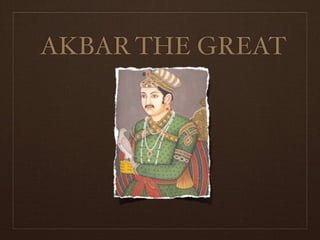
AKBAR THE GREAT
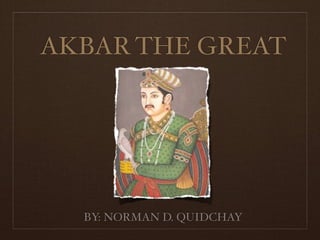
AKBAR THE GREAT


  BY: NORMAN D. QUIDCHAY
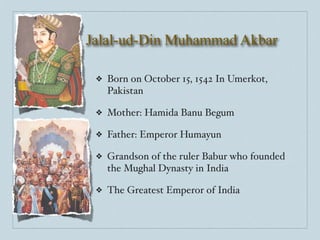
Jalal-ud-Din Muhammad Akbar

 ❖   Born on October 15, 1542 In Umerkot,
     Pakistan

 ❖   Mother: Hamida Banu Begum

 ❖   Father: Emperor Humayun

 ❖   Grandson of the ruler Babur who founded
     the Mughal Dynasty in India

 ❖   The Greatest Emperor of India
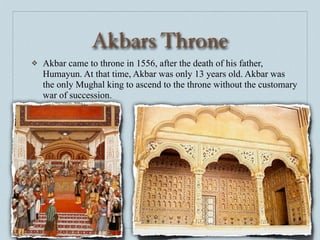
Akbars Throne
❖   Akbar came to throne in 1556, after the death of his father,
    Humayun. At that time, Akbar was only 13 years old. Akbar was
    the only Mughal king to ascend to the throne without the customary
    war of succession.
Akbars Reign

❖   During the first five years of his rule, Akbar was assisted and advised by Bahram
    Khan in running the affairs of the country. Bahram Khan was, however, removed
    and for a few years Akbar ruled under the influence of his nurse Maham Anga. After
    1562, Akbar freed himself from external influences and ruled independently.

❖   Thanks to Akbar's gracious guardian and influence, Akbar survived his father's
    death at a young age and demonstrated his worth as SUPREME. Akbar's reign holds
    a certain prominence in history; he was the ruler who actually protected the
    foundations of the Mughal Empire from attack.

❖   During his reign, the nature of the state changed to a secular and liberal one.

❖   He introduced many social reforms, legalized widowed remarriage and raised the
    age of matrimony.
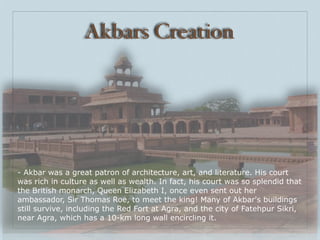
Akbars Creation


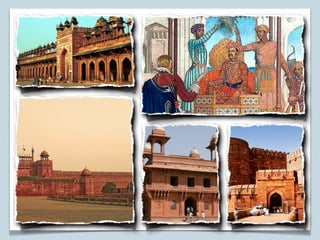
- Akbar was a great patron of architecture, art, and literature. His court
was rich in culture as well as wealth. In fact, his court was so splendid that
the British monarch, Queen Elizabeth I, once even sent out her
ambassador, Sir Thomas Roe, to meet the king! Many of Akbar's buildings
still survive, including the Red Fort at Agra, and the city of Fatehpur Sikri,
near Agra, which has a 10-km long wall encircling it.
Akbars Creation


- Akbar was a great patron of architecture, art, and literature. His court
was rich in culture as well as wealth. In fact, his court was so splendid that
the British monarch, Queen Elizabeth I, once even sent out her
ambassador, Sir Thomas Roe, to meet the king! Many of Akbar's buildings
still survive, including the Red Fort at Agra, and the city of Fatehpur Sikri,
near Agra, which has a 10-km long wall encircling it.
Religion


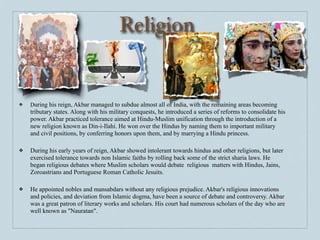
❖   During his reign, Akbar managed to subdue almost all of India, with the remaining areas becoming
    tributary states. Along with his military conquests, he introduced a series of reforms to consolidate his
    power. Akbar practiced tolerance aimed at Hindu-Muslim unification through the introduction of a
    new religion known as Din-i-Ilahi. He won over the Hindus by naming them to important military
    and civil positions, by conferring honors upon them, and by marrying a Hindu princess.

❖   During his early years of reign, Akbar showed intolerant towards hindus and other religions, but later
    exercised tolerance towards non Islamic faiths by rolling back some of the strict sharia laws. He
    began religious debates where Muslim scholars would debate religious matters with Hindus, Jains,
    Zoroastrians and Portuguese Roman Catholic Jesuits.

❖   He appointed nobles and mansabdars without any religious prejudice. Akbar's religious innovations
    and policies, and deviation from Islamic dogma, have been a source of debate and controversy. Akbar
    was a great patron of literary works and scholars. His court had numerous scholars of the day who are
    well known as "Nauratan".
System of Taxation
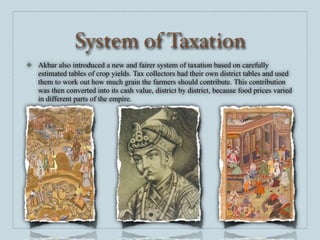
❖   Akbar also introduced a new and fairer system of taxation based on carefully
    estimated tables of crop yields. Tax collectors had their own district tables and used
    them to work out how much grain the farmers should contribute. This contribution
    was then converted into its cash value, district by district, because food prices varied
    in different parts of the empire.
Music


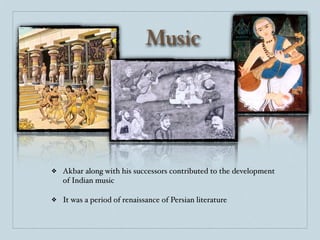
❖   Akbar along with his successors contributed to the development
    of Indian music

❖   It was a period of renaissance of Persian literature
The Great
❖   Akbar had three sons Prince Salim, Murad and Daniyal. Prince Murad and Daniyal
    died in their prime during their father's lifetime. However, Akbar faced problems
    with Prince Salim and the last four years of Akbar's life were consumed in crushing
    Salim's rebellion. Akbar fell ill and died of slow poisoning on October 27, 1605.
    With him ended the greatest Era in Indian history.

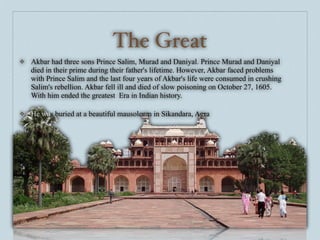
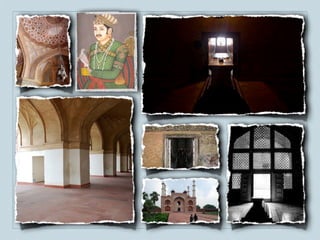
❖   He was buried at a beautiful mausoleum in Sikandara, Agra
!e End...

  Any Questions?


                   1542 - 1605

Akbar the Great

  • 2.
  • 3.
  • 4.
    AKBAR THE GREAT BY: NORMAN D. QUIDCHAY
  • 5.
    Jalal-ud-Din Muhammad Akbar ❖ Born on October 15, 1542 In Umerkot, Pakistan ❖ Mother: Hamida Banu Begum ❖ Father: Emperor Humayun ❖ Grandson of the ruler Babur who founded the Mughal Dynasty in India ❖ The Greatest Emperor of India
  • 6.
    Akbars Throne ❖ Akbar came to throne in 1556, after the death of his father, Humayun. At that time, Akbar was only 13 years old. Akbar was the only Mughal king to ascend to the throne without the customary war of succession.
  • 7.
    Akbars Reign ❖ During the first five years of his rule, Akbar was assisted and advised by Bahram Khan in running the affairs of the country. Bahram Khan was, however, removed and for a few years Akbar ruled under the influence of his nurse Maham Anga. After 1562, Akbar freed himself from external influences and ruled independently. ❖ Thanks to Akbar's gracious guardian and influence, Akbar survived his father's death at a young age and demonstrated his worth as SUPREME. Akbar's reign holds a certain prominence in history; he was the ruler who actually protected the foundations of the Mughal Empire from attack. ❖ During his reign, the nature of the state changed to a secular and liberal one. ❖ He introduced many social reforms, legalized widowed remarriage and raised the age of matrimony.
  • 8.
    Akbars Creation - Akbarwas a great patron of architecture, art, and literature. His court was rich in culture as well as wealth. In fact, his court was so splendid that the British monarch, Queen Elizabeth I, once even sent out her ambassador, Sir Thomas Roe, to meet the king! Many of Akbar's buildings still survive, including the Red Fort at Agra, and the city of Fatehpur Sikri, near Agra, which has a 10-km long wall encircling it.
  • 9.
    Akbars Creation - Akbarwas a great patron of architecture, art, and literature. His court was rich in culture as well as wealth. In fact, his court was so splendid that the British monarch, Queen Elizabeth I, once even sent out her ambassador, Sir Thomas Roe, to meet the king! Many of Akbar's buildings still survive, including the Red Fort at Agra, and the city of Fatehpur Sikri, near Agra, which has a 10-km long wall encircling it.
  • 11.
    Religion ❖ During his reign, Akbar managed to subdue almost all of India, with the remaining areas becoming tributary states. Along with his military conquests, he introduced a series of reforms to consolidate his power. Akbar practiced tolerance aimed at Hindu-Muslim unification through the introduction of a new religion known as Din-i-Ilahi. He won over the Hindus by naming them to important military and civil positions, by conferring honors upon them, and by marrying a Hindu princess. ❖ During his early years of reign, Akbar showed intolerant towards hindus and other religions, but later exercised tolerance towards non Islamic faiths by rolling back some of the strict sharia laws. He began religious debates where Muslim scholars would debate religious matters with Hindus, Jains, Zoroastrians and Portuguese Roman Catholic Jesuits. ❖ He appointed nobles and mansabdars without any religious prejudice. Akbar's religious innovations and policies, and deviation from Islamic dogma, have been a source of debate and controversy. Akbar was a great patron of literary works and scholars. His court had numerous scholars of the day who are well known as "Nauratan".
  • 12.
    System of Taxation ❖ Akbar also introduced a new and fairer system of taxation based on carefully estimated tables of crop yields. Tax collectors had their own district tables and used them to work out how much grain the farmers should contribute. This contribution was then converted into its cash value, district by district, because food prices varied in different parts of the empire.
  • 13.
    Music ❖ Akbar along with his successors contributed to the development of Indian music ❖ It was a period of renaissance of Persian literature
  • 14.
    The Great ❖ Akbar had three sons Prince Salim, Murad and Daniyal. Prince Murad and Daniyal died in their prime during their father's lifetime. However, Akbar faced problems with Prince Salim and the last four years of Akbar's life were consumed in crushing Salim's rebellion. Akbar fell ill and died of slow poisoning on October 27, 1605. With him ended the greatest Era in Indian history. ❖ He was buried at a beautiful mausoleum in Sikandara, Agra
  • 16.
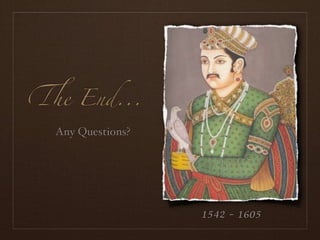
    !e End... Any Questions? 1542 - 1605

Editor's Notes