


THE IMPORTANCE OF MATERIALS FOR
TEACHER EDUCATION AND LANGUAGE
LEARNING
UNIVERSIDAD DE CALDAS
DEPARMENT OF MODERN LANGUAGES
MASTERS IN ENGLISH DIDACTICS
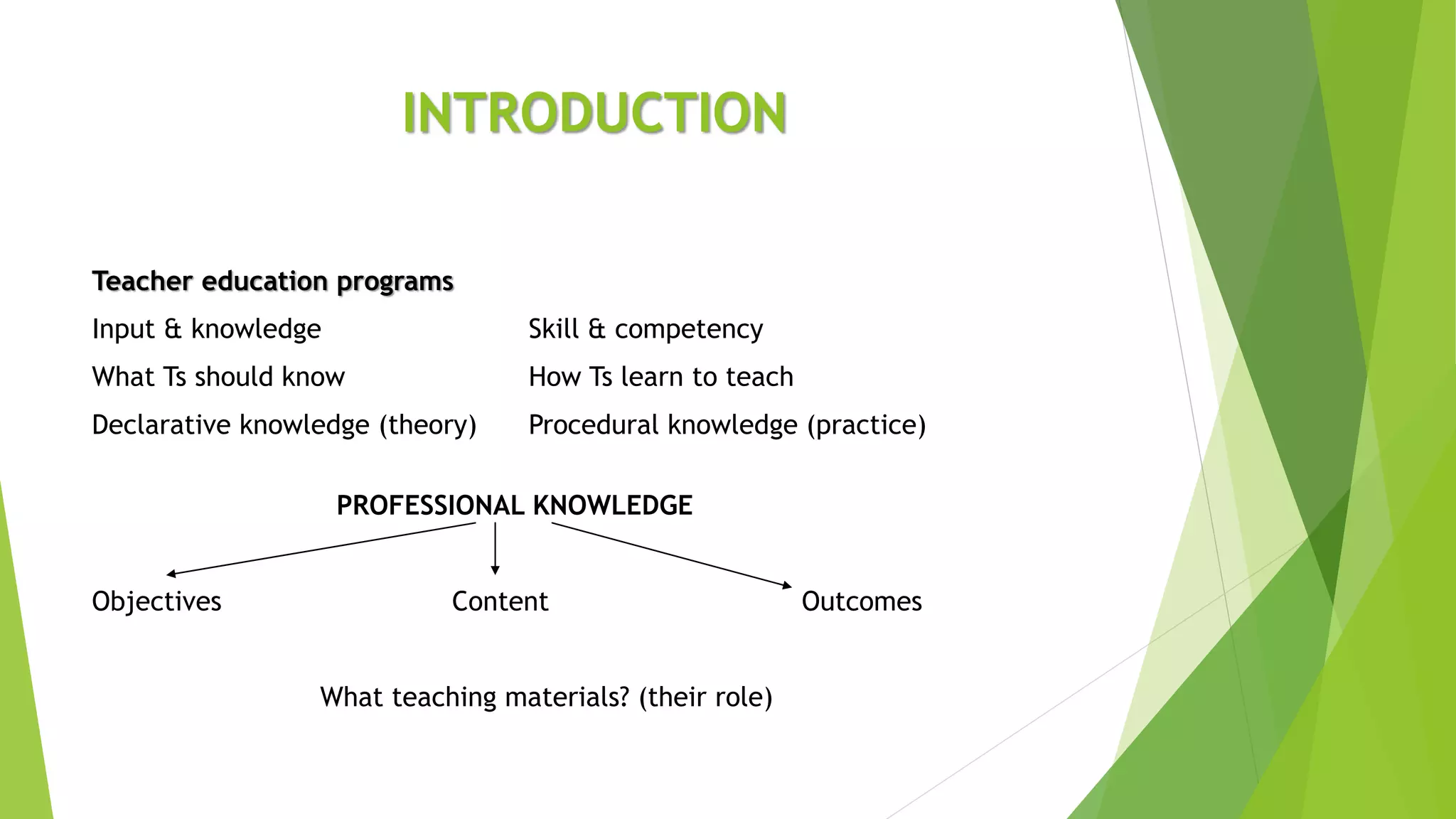
INTRODUCTION
Teacher education programs
Input & knowledge Skill & competency
What Ts should know How Ts learn to teach
Declarative knowledge (theory) Procedural knowledge (practice)
PROFESSIONAL KNOWLEDGE
Objectives Content Outcomes
What teaching materials? (their role)
THE KNOWLEDGE BASE OF EFL
TEACHER EDUCATION
TRADITIONALLY: KNOWLEDGE-TRANSMISSION
• Learning about teaching.
• Transfer from theory to practice.
• Lots of courses on content knowledge and pedagogy.
• Little observation and practice in real contexts.
• Gap bt (knowledge) and reality (competency).
• Knowledge for teachers
THE COMPETENCY BASE OF EFL
TEACHER EDUCATION
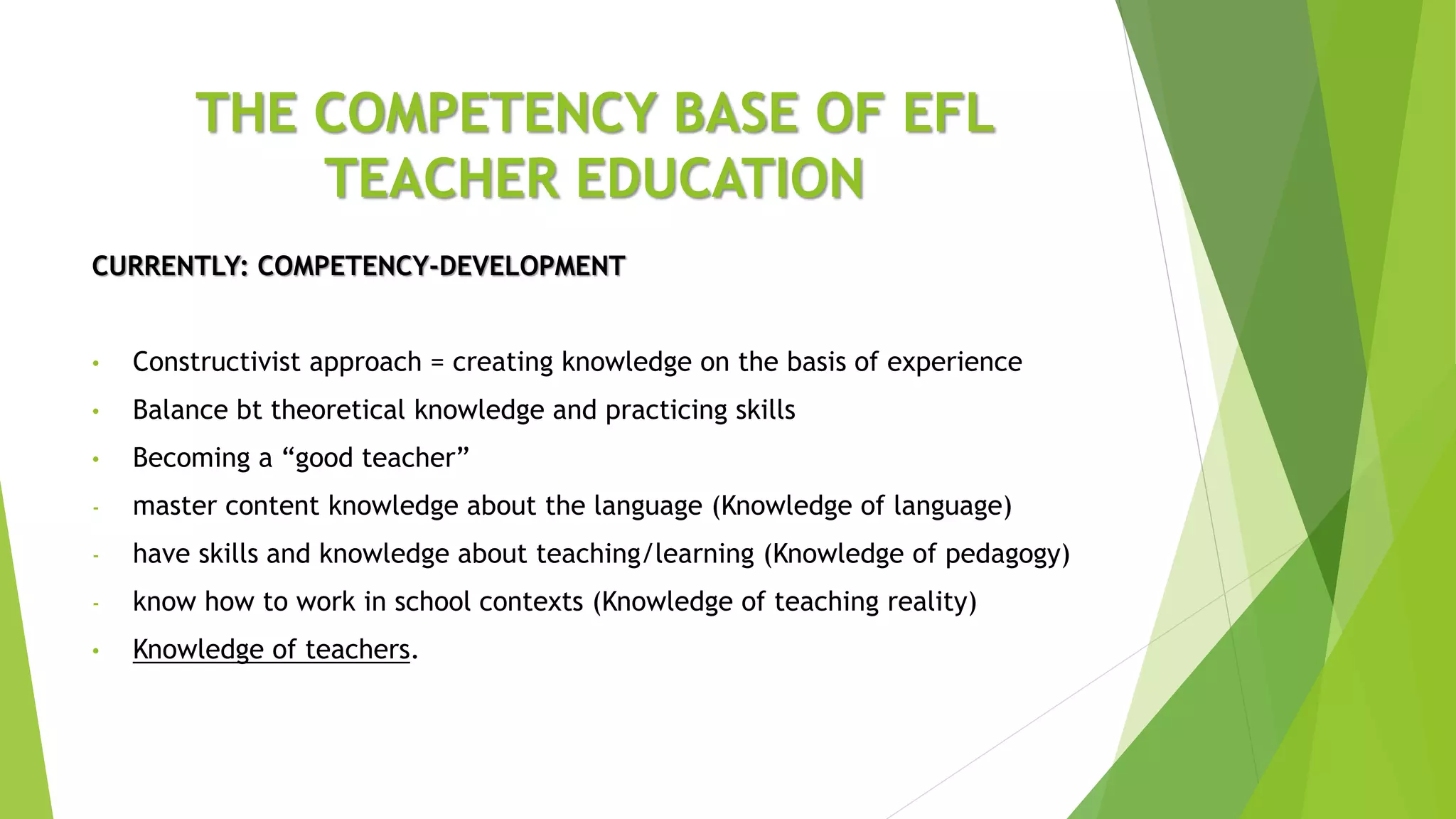
CURRENTLY: COMPETENCY-DEVELOPMENT
• Constructivist approach = creating knowledge on the basis of experience
• Balance bt theoretical knowledge and practicing skills
• Becoming a “good teacher”
- master content knowledge about the language (Knowledge of language)
- have skills and knowledge about teaching/learning (Knowledge of pedagogy)
- know how to work in school contexts (Knowledge of teaching reality)
• Knowledge of teachers.
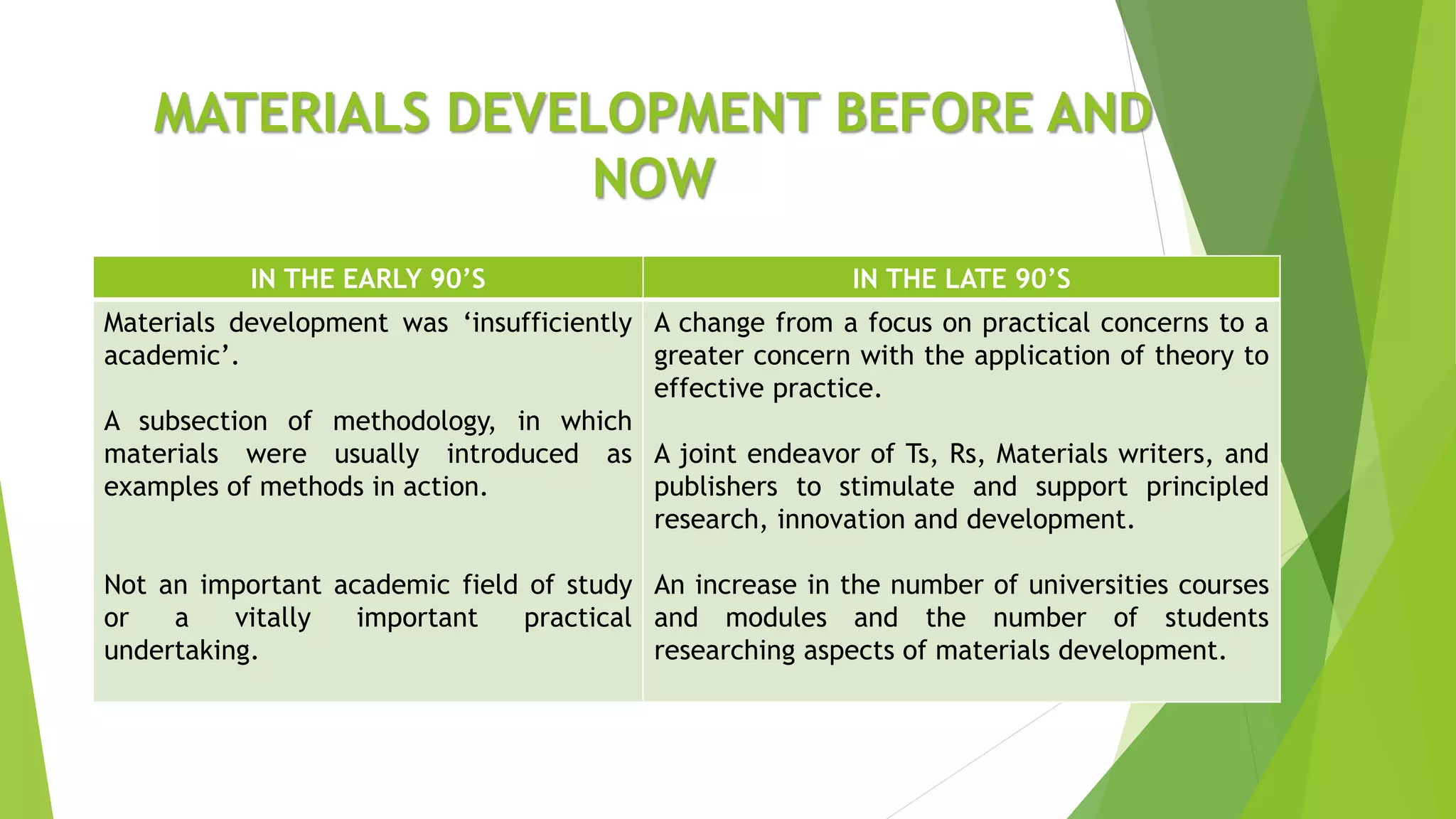
IN THE EARLY 90’S IN THE LATE 90’S
Materials development was ‘insufficiently
academic’.
A subsection of methodology, in which
materials were usually introduced as
examples of methods in action.
Not an important academic field of study
or a vitally important practical
undertaking.
A change from a focus on practical concerns to a
greater concern with the application of theory to
effective practice.
A joint endeavor of Ts, Rs, Materials writers, and
publishers to stimulate and support principled
research, innovation and development.
An increase in the number of universities courses
and modules and the number of students
researching aspects of materials development.
MATERIALS DEVELOPMENT BEFORE AND
NOW
DEFINITIONS
Materials
Anything which can be used to facilitate the learning of a language.
From coursebooks and videos to websites and mobile phone interactions.
Types
 Informative: informing about the TL.
 Instructional: providing guided practice in the TL.
 Experiential: providing experience of the TL in use.
 Eliciting: encouraging the learner to use the TL.
 Exploratory: helping the learner to make discoveries about the TL.
Materials development
o A practical undertaking involving the production, evaluation, adaptation and exploitation of
materials intended to facilitate language acquisition and development.
o A field of academic study investigating the principles and procedures of the design, writing,
implementation, and analysis of learning materials.
IMPORTANCE
 Most lessons are still based on materials in most language classrooms.
 The basis of much of the language input that learners receive and the language
practice that occurs in the classroom.
 Teachers are constantly evaluating the available materials, adapting them,
replacing them, supplementing them and finding effective ways to implement the
materials chosen for classroom use.
 Materials development is central to any course designed to train, educate or
develop pre-service or in-service teachers.
 It is a useful way of helping teachers to understand and apply theories of language
learning and to achieve personal and professional development.
TEACHER TRAINING / DEVELOPMENT /
EDUCATION
 Participating in materials development can:
o increase awareness, criticality, creativity and self-esteem. It can also improve
career prospects too.
o provide the participants with concrete experience as a basis for reflective
observation and conceptualization.
o help participants to become more aware of important issues in language acquisition
and development,
o foster considerable teacher growth.
 Materials development should be:
o practical,
o based on constructive feedback,
o characterized by positive support and stimulus,
o oriented towards linking practice to theory and theory to practice, and
o focused on self-monitoring and self-reflection.
PRACTICING TEACHERS & MATERIALS
WRITERS
In-service teachers
 Stimulating courses to get teachers to think about and try out new approaches.
 Preparation for an institutional or national change.
 Facilitating alternatives to enable language acquisition and development.
 Stimulating options for Ts to re-think their positions and to achieve personal and
professional development.
Materials writers
o Stimulating arena for thought, discussion and innovation.
o Facilitating alternative for the development of awareness and skills relevant to the
writing of the materials.
RESEARCHERS & APPLIED LINGUISTIS
Researchers
 Materials development has become accepted as a respectable academic discipline
and therefore as a legitimate area for research.
 Increasing number of studies about how teachers evaluate coursebooks and how
they adapt and supplement them.
Applied linguists
o Many applied linguists are considering the implications of their specialized research
for materials development and the implications of research in materials
development for their specialty.
- Discourse analysis: models, texts, conversations,
- Second language acquisitions: principles, methods, strategies,
- Intercultural competence: beliefs, values, practices,
- Assessment: exercises, tests, reflection,
- and language teaching pedagogy: students’ roles, teachers’ practices, classroom
activities, etc.
CONCLUSION
Materials development for language teaching is very important both as a practical
undertaking and as an academic field of study.
It is the most applied of all the disciplines in applied linguistics and should be a
compulsory component in all language teacher preparation and support courses.
It is supported with research and observation-based principles.
It is oriented towards studying the effect of our materials on the people who use
them.
REFERENCES
Rahimi, M. (2008). What do we want teaching-materials for in EFL teacher
training programs? Asian EFL Journal, 31, 1-17. Retrieved from
http://www.asian-efl-journal.com/pta_Oct_08.pdf
Tomlinson, B. (2016). The importance of materials development for language
learning. In M. Azarnoosh, M. Zeraatpishe, A. Faravani, & H. Reza (eds.), Issues in
materials development (pp. 1-9). The Netherlands: Sense Publishers.

The importace of materials in TE and LL

  • 1.
    THE IMPORTANCE OFMATERIALS FOR TEACHER EDUCATION AND LANGUAGE LEARNING UNIVERSIDAD DE CALDAS DEPARMENT OF MODERN LANGUAGES MASTERS IN ENGLISH DIDACTICS
  • 2.
    INTRODUCTION Teacher education programs Input& knowledge Skill & competency What Ts should know How Ts learn to teach Declarative knowledge (theory) Procedural knowledge (practice) PROFESSIONAL KNOWLEDGE Objectives Content Outcomes What teaching materials? (their role)
  • 3.
    THE KNOWLEDGE BASEOF EFL TEACHER EDUCATION TRADITIONALLY: KNOWLEDGE-TRANSMISSION • Learning about teaching. • Transfer from theory to practice. • Lots of courses on content knowledge and pedagogy. • Little observation and practice in real contexts. • Gap bt (knowledge) and reality (competency). • Knowledge for teachers
  • 4.
    THE COMPETENCY BASEOF EFL TEACHER EDUCATION CURRENTLY: COMPETENCY-DEVELOPMENT • Constructivist approach = creating knowledge on the basis of experience • Balance bt theoretical knowledge and practicing skills • Becoming a “good teacher” - master content knowledge about the language (Knowledge of language) - have skills and knowledge about teaching/learning (Knowledge of pedagogy) - know how to work in school contexts (Knowledge of teaching reality) • Knowledge of teachers.
  • 5.
    IN THE EARLY90’S IN THE LATE 90’S Materials development was ‘insufficiently academic’. A subsection of methodology, in which materials were usually introduced as examples of methods in action. Not an important academic field of study or a vitally important practical undertaking. A change from a focus on practical concerns to a greater concern with the application of theory to effective practice. A joint endeavor of Ts, Rs, Materials writers, and publishers to stimulate and support principled research, innovation and development. An increase in the number of universities courses and modules and the number of students researching aspects of materials development. MATERIALS DEVELOPMENT BEFORE AND NOW
  • 6.
    DEFINITIONS Materials Anything which canbe used to facilitate the learning of a language. From coursebooks and videos to websites and mobile phone interactions. Types  Informative: informing about the TL.  Instructional: providing guided practice in the TL.  Experiential: providing experience of the TL in use.  Eliciting: encouraging the learner to use the TL.  Exploratory: helping the learner to make discoveries about the TL. Materials development o A practical undertaking involving the production, evaluation, adaptation and exploitation of materials intended to facilitate language acquisition and development. o A field of academic study investigating the principles and procedures of the design, writing, implementation, and analysis of learning materials.
  • 7.
    IMPORTANCE  Most lessonsare still based on materials in most language classrooms.  The basis of much of the language input that learners receive and the language practice that occurs in the classroom.  Teachers are constantly evaluating the available materials, adapting them, replacing them, supplementing them and finding effective ways to implement the materials chosen for classroom use.  Materials development is central to any course designed to train, educate or develop pre-service or in-service teachers.  It is a useful way of helping teachers to understand and apply theories of language learning and to achieve personal and professional development.
  • 8.
    TEACHER TRAINING /DEVELOPMENT / EDUCATION  Participating in materials development can: o increase awareness, criticality, creativity and self-esteem. It can also improve career prospects too. o provide the participants with concrete experience as a basis for reflective observation and conceptualization. o help participants to become more aware of important issues in language acquisition and development, o foster considerable teacher growth.  Materials development should be: o practical, o based on constructive feedback, o characterized by positive support and stimulus, o oriented towards linking practice to theory and theory to practice, and o focused on self-monitoring and self-reflection.
  • 9.
    PRACTICING TEACHERS &MATERIALS WRITERS In-service teachers  Stimulating courses to get teachers to think about and try out new approaches.  Preparation for an institutional or national change.  Facilitating alternatives to enable language acquisition and development.  Stimulating options for Ts to re-think their positions and to achieve personal and professional development. Materials writers o Stimulating arena for thought, discussion and innovation. o Facilitating alternative for the development of awareness and skills relevant to the writing of the materials.
  • 10.
    RESEARCHERS & APPLIEDLINGUISTIS Researchers  Materials development has become accepted as a respectable academic discipline and therefore as a legitimate area for research.  Increasing number of studies about how teachers evaluate coursebooks and how they adapt and supplement them. Applied linguists o Many applied linguists are considering the implications of their specialized research for materials development and the implications of research in materials development for their specialty. - Discourse analysis: models, texts, conversations, - Second language acquisitions: principles, methods, strategies, - Intercultural competence: beliefs, values, practices, - Assessment: exercises, tests, reflection, - and language teaching pedagogy: students’ roles, teachers’ practices, classroom activities, etc.
  • 11.
    CONCLUSION Materials development forlanguage teaching is very important both as a practical undertaking and as an academic field of study. It is the most applied of all the disciplines in applied linguistics and should be a compulsory component in all language teacher preparation and support courses. It is supported with research and observation-based principles. It is oriented towards studying the effect of our materials on the people who use them.
  • 12.
    REFERENCES Rahimi, M. (2008).What do we want teaching-materials for in EFL teacher training programs? Asian EFL Journal, 31, 1-17. Retrieved from http://www.asian-efl-journal.com/pta_Oct_08.pdf Tomlinson, B. (2016). The importance of materials development for language learning. In M. Azarnoosh, M. Zeraatpishe, A. Faravani, & H. Reza (eds.), Issues in materials development (pp. 1-9). The Netherlands: Sense Publishers.