Initial: Step 1 - To Look into for
Designing Teaching Material
JOHNNY ALEXANDER PULIDO ESPINOSA
CODE: 80245233
GROUP: 6
TUTOR: JAIRO GUTIERREZ DE PIÑERES
UNIVERSIDAD NACIONAL ABIERTA Y A DISTANCIA-UNAD
LICENCIATURA EN INGLES COMO LENGUA EXTRANJERA
ESCUELA DE CIENCIAS DE LA EDUCACIÓN
BOGOTÁ
FEBRUARY-2019
¿What should English Language
Learning (ELT) materials have?
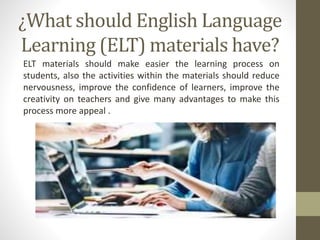
ELT materials should make easier the learning process on
students, also the activities within the materials should reduce
nervousness, improve the confidence of learners, improve the
creativity on teachers and give many advantages to make this
process more appeal .
FEATURES
• Expose the learners to language in authentic use
• Provide the students with opportunities to use the language
to achieve communication purposes
• Stimulate intellectual an emotional involment
• Provide opportunities for feedback
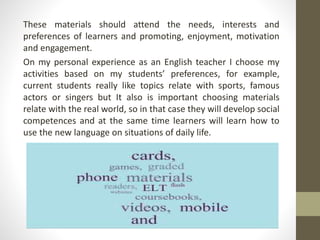
These materials should attend the needs, interests and
preferences of learners and promoting, enjoyment, motivation
and engagement.
On my personal experience as an English teacher I choose my
activities based on my students’ preferences, for example,
current students really like topics relate with sports, famous
actors or singers but It also is important choosing materials
relate with the real world, so in that case they will develop social
competences and at the same time learners will learn how to
use the new language on situations of daily life.
¿Proposals for Principled
Approaches to the
Development of ELT Materials?
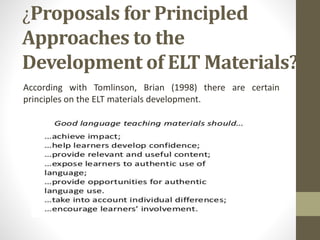
According with Tomlinson, Brian (1998) there are certain
principles on the ELT materials development.
Materials should achieve
impact
Materials have to be appeal to the students by catching their
attention, curiosity and interests.
To achieve this, material developers should know everything
they can about culture target in order to identify learners’
needs.
These materials can be presented in a creative way by using:
photographs, engaging stories, texts from different resources,
etc.
Materials should help
learners to feel at ease
Anxiety is one of the biggest problems learners face at the
moment of learning a second language. Normally, teachers help
to reduce these issues but they can do it through materials too.
Materials should help students by:
• Including media elements like: pictures, images or videos
relate to their own culture
• Including activities where they feel they are learning a not to
be tested
Materials should help learners to
develop confidence
Stimulating learner’s minds and make them to use their extra-
linguistics skills will develop and raise their confidence.
In the words of Tomlinson, Brian (1998), “I prefer to attempt to
build confidence through activities which try to ‘push’ learners
slightly beyond their existing proficiency by engaging them in
tasks which are stimulating, which are problematic, but which
are achievable too”.
Teachers can achieve this if they use activities where learners
can develop their imagination and creativity, for example
creating short stories.
What is being taught should be
perceived by learners as relevant and
useful
In simple words this means that materials should convince
learners that teaching points are useful whereby teachers need
to find what the learners are interested in.
Activities based and extracted from “real-life” will promote this
kind of response on learners.
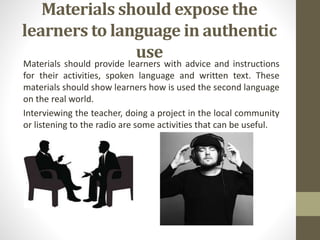
Materials should expose the
learners to language in authentic
use
Materials should provide learners with advice and instructions
for their activities, spoken language and written text. These
materials should show learners how is used the second language
on the real world.
Interviewing the teacher, doing a project in the local community
or listening to the radio are some activities that can be useful.
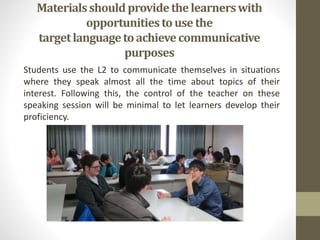
Materialsshould providethelearnerswith
opportunitiestouse the
targetlanguagetoachievecommunicative
purposes
Students use the L2 to communicate themselves in situations
where they speak almost all the time about topics of their
interest. Following this, the control of the teacher on these
speaking session will be minimal to let learners develop their
proficiency.
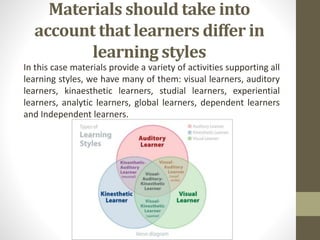
Materials should take into
account that learners differ in
learning styles
In this case materials provide a variety of activities supporting all
learning styles, we have many of them: visual learners, auditory
learners, kinaesthetic learners, studial learners, experiential
learners, analytic learners, global learners, dependent learners
and Independent learners.
Materials should permit a silent
period at the beginning of
instruction
Forcing learners to speak if they are not ready can be really
negative, so it is better give them a time where they process the
grammar and gain confidence. Of course, this should be applied
on early stages (beginners). Materials give learners a time to be
on silent and a time to speak a little bit.
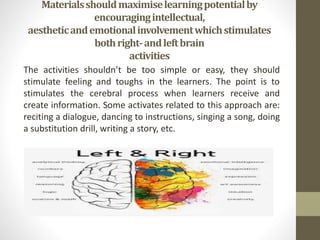
Materialsshouldmaximiselearningpotentialby
encouragingintellectual,
aestheticandemotionalinvolvementwhichstimulates
bothright-andleftbrain
activities
The activities shouldn’t be too simple or easy, they should
stimulate feeling and toughs in the learners. The point is to
stimulates the cerebral process when learners receive and
create information. Some activates related to this approach are:
reciting a dialogue, dancing to instructions, singing a song, doing
a substitution drill, writing a story, etc.
REFERENCES
Tomlinson, B. (2011). Material development in Language
Teaching (2nd Ed.). Cambridge: Cambridge University Press.
Retrieved from
http://www.lenguasvivas.org/campus/files/0_47/Material%20d
evelopment-Tomlinson.pdf

Step 1

  • 1.
    Initial: Step 1- To Look into for Designing Teaching Material JOHNNY ALEXANDER PULIDO ESPINOSA CODE: 80245233 GROUP: 6 TUTOR: JAIRO GUTIERREZ DE PIÑERES UNIVERSIDAD NACIONAL ABIERTA Y A DISTANCIA-UNAD LICENCIATURA EN INGLES COMO LENGUA EXTRANJERA ESCUELA DE CIENCIAS DE LA EDUCACIÓN BOGOTÁ FEBRUARY-2019
  • 2.
    ¿What should EnglishLanguage Learning (ELT) materials have? ELT materials should make easier the learning process on students, also the activities within the materials should reduce nervousness, improve the confidence of learners, improve the creativity on teachers and give many advantages to make this process more appeal .
  • 3.
    FEATURES • Expose thelearners to language in authentic use • Provide the students with opportunities to use the language to achieve communication purposes • Stimulate intellectual an emotional involment • Provide opportunities for feedback
  • 4.
    These materials shouldattend the needs, interests and preferences of learners and promoting, enjoyment, motivation and engagement. On my personal experience as an English teacher I choose my activities based on my students’ preferences, for example, current students really like topics relate with sports, famous actors or singers but It also is important choosing materials relate with the real world, so in that case they will develop social competences and at the same time learners will learn how to use the new language on situations of daily life.
  • 5.
    ¿Proposals for Principled Approachesto the Development of ELT Materials? According with Tomlinson, Brian (1998) there are certain principles on the ELT materials development.
  • 6.
    Materials should achieve impact Materialshave to be appeal to the students by catching their attention, curiosity and interests. To achieve this, material developers should know everything they can about culture target in order to identify learners’ needs. These materials can be presented in a creative way by using: photographs, engaging stories, texts from different resources, etc.
  • 7.
    Materials should help learnersto feel at ease Anxiety is one of the biggest problems learners face at the moment of learning a second language. Normally, teachers help to reduce these issues but they can do it through materials too. Materials should help students by: • Including media elements like: pictures, images or videos relate to their own culture • Including activities where they feel they are learning a not to be tested
  • 8.
    Materials should helplearners to develop confidence Stimulating learner’s minds and make them to use their extra- linguistics skills will develop and raise their confidence. In the words of Tomlinson, Brian (1998), “I prefer to attempt to build confidence through activities which try to ‘push’ learners slightly beyond their existing proficiency by engaging them in tasks which are stimulating, which are problematic, but which are achievable too”. Teachers can achieve this if they use activities where learners can develop their imagination and creativity, for example creating short stories.
  • 9.
    What is beingtaught should be perceived by learners as relevant and useful In simple words this means that materials should convince learners that teaching points are useful whereby teachers need to find what the learners are interested in. Activities based and extracted from “real-life” will promote this kind of response on learners.
  • 10.
    Materials should exposethe learners to language in authentic use Materials should provide learners with advice and instructions for their activities, spoken language and written text. These materials should show learners how is used the second language on the real world. Interviewing the teacher, doing a project in the local community or listening to the radio are some activities that can be useful.
  • 11.
    Materialsshould providethelearnerswith opportunitiestouse the targetlanguagetoachievecommunicative purposes Studentsuse the L2 to communicate themselves in situations where they speak almost all the time about topics of their interest. Following this, the control of the teacher on these speaking session will be minimal to let learners develop their proficiency.
  • 12.
    Materials should takeinto account that learners differ in learning styles In this case materials provide a variety of activities supporting all learning styles, we have many of them: visual learners, auditory learners, kinaesthetic learners, studial learners, experiential learners, analytic learners, global learners, dependent learners and Independent learners.
  • 13.
    Materials should permita silent period at the beginning of instruction Forcing learners to speak if they are not ready can be really negative, so it is better give them a time where they process the grammar and gain confidence. Of course, this should be applied on early stages (beginners). Materials give learners a time to be on silent and a time to speak a little bit.
  • 14.
    Materialsshouldmaximiselearningpotentialby encouragingintellectual, aestheticandemotionalinvolvementwhichstimulates bothright-andleftbrain activities The activities shouldn’tbe too simple or easy, they should stimulate feeling and toughs in the learners. The point is to stimulates the cerebral process when learners receive and create information. Some activates related to this approach are: reciting a dialogue, dancing to instructions, singing a song, doing a substitution drill, writing a story, etc.
  • 15.
    REFERENCES Tomlinson, B. (2011).Material development in Language Teaching (2nd Ed.). Cambridge: Cambridge University Press. Retrieved from http://www.lenguasvivas.org/campus/files/0_47/Material%20d evelopment-Tomlinson.pdf