Nursing shortages aren’t what
they used to be…….
Nursing shortages…
• ..what we know
• How UK has responded in the past
• Current UK situation
• International context
• What next?
Shortages: what we know
• There is no universal definition of a nursing shortage;
increasing evidence of nurse supply/ demand imbalances in
many countries. Imbalances can be organisational, specialty
based, regional, national ……(cyclical-”boom and bust”)
• Supply of nurses in many countries, low income and high
income, is failing to keep pace with increasing demand [e.g.
Sub-Saharan African countries = shortfall of + 600,000 nurses
in relation to Millennium Development Goals targets]
• Gender-based discrimination continues in many countries =
nursing undervalued as “women’s work”.
• There is a link between adequate nurse staffing levels and
positive care outcomes.
UK and nursing shortages
• National policy control [£] of “supply”=
• =How many “new” nurses to train
• =What they are trained in……
• =How many nurses to employ in NHS/ how
much to pay them
• =How much £ to invest in their re-skilling
• =How many non EU nurses to allow into UK
• =when NHS nurses can retire…….
UK: history of nursing shortages
• 1932: Lancet Commission on Nursing
• 1939: Inter-Departmental Committee on
Nursing Services
• 1947: Ministry of Health Working Party on the
Recruitment and Training of Nurses
• 1972: (Briggs) Committee
• 1975 (Halsbury) Commission
• 1983 onward: - Nurses pay review body
• 2009: Prime Ministers Commission Nursing
UK: report on nursing shortages
• demand for care outstripping supply
• nurse staffing difficulties in some regions/
specialties
• increasing competition from other
employers
• “unjustified”/biased news coverage of
conditions in hospitals
• need for increased use of support workers
to “free up” nurses
• need for increased emphasis on staff
retention, attracting “married nurses”
back to the health workforce
UK: report on nursing shortages
• demand for care outstripping supply
• nurse staffing difficulties in some regions/ specialties
• increasing competition from other employers
• “unjustified”/biased news coverage of conditions in
hospitals
• need for increased use of support workers to “free
up” nurses
• need for increased emphasis on staff retention,
attracting “married nurses” back to the health
workforce
• (MINISTRY OF HEALTH, 1947)
Previous UK “solutions” to
shortages: Managing Supply
• Increase numbers in training
• Improve retention (and return)
• International recruitment
• Skill mix change- more support staff
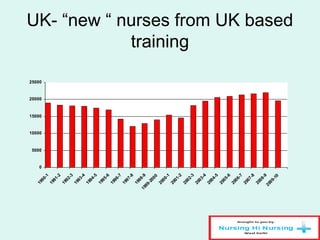
UK- “new “ nurses from UK based
training
0
5000
10000
15000
20000
25000
1990-1
1991-2
1992-3
1993-4
1994-5
1995-6
1996-7
1997-8
1998-91999-2000
2000-1
2001-2
2002-3
2003-4
2004-5
2005-6
2006-7
2007-8
2008-9
2009-10
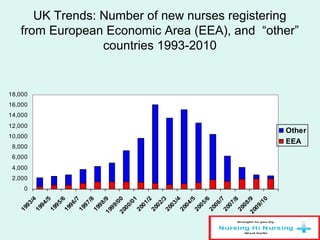
UK Trends: Number of new nurses registering
from European Economic Area (EEA), and “other”
countries 1993-2010
0
2,000
4,000
6,000
8,000
10,000
12,000
14,000
16,000
18,000
1993/4
1994/5
1995/6
1996/7
1997/8
1998/91999/002000/01
2001/2
2002/3
2003/4
2004/5
2005/6
2006/7
2007/8
2008/92009/10
Other
EEA
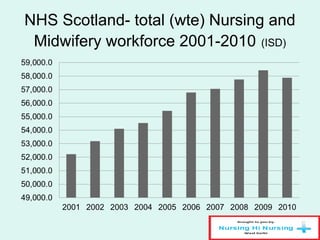
NHS Scotland- total (wte) Nursing and
Midwifery workforce 2001-2010 (ISD)
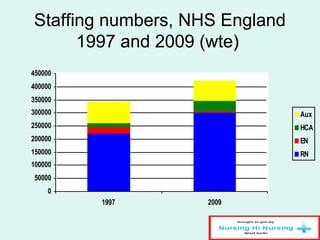
Staffing numbers, NHS England
1997 and 2009 (wte)
0
50000
100000
150000
200000
250000
300000
350000
400000
450000
1997 2009
Aux
HCA
EN
RN
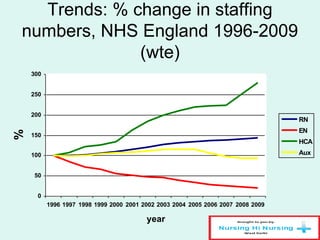
Trends: % change in staffing
numbers, NHS England 1996-2009
(wte)
0
50
100
150
200
250
300
1996 1997 1998 1999 2000 2001 2002 2003 2004 2005 2006 2007 2008 2009
year
%
RN
EN
HCA
Aux
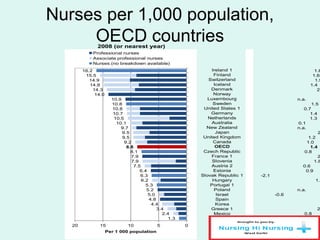
Nurses per 1,000 population,
OECD countries
Ireland 1
Finland
Switzerland
Iceland
Denmark
Norway
Luxembourg
Sweden
United States 1
Germany
Netherlands
Australia
New Zealand
Japan
United Kingdom
Canada
OECD
Czech Republic
France 1
Slovenia
Austria 2
Estonia
Slovak Republic 1
Hungary
Portugal 1
Poland
Israel
Spain
Korea
Greece 1
Mexico
Turkey 1
2008 (or nearest year) Change 2000-08 (or
16.2
15.5
14.9
14.8
14.3
14.0
10.9
10.8
10.8
10.7
10.5
10.1
9.7
9.5
9.5
9.2
8.8
8.1
7.9
7.9
7.5
6.4
6.3
6.2
5.3
5.2
5.0
4.8
4.4
3.4
2.4
1.3
05101520
Per 1 000 population
Professional nurses
Associate professional nurses
Nurses (no breakdown available)
1.8
1.6
1.9
1.4
2.
2
n.a.
1.5
0.7
1.4
1.3
0.1
n.a.
2
1.2
1.0
1.4
0.8
2
1.8
0.6
0.9
-2.1
1.9
n.a.
-0.6
2
0.8
n.a.
-4 0
Average annual gro
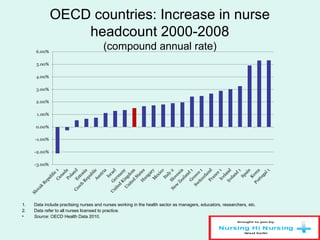
OECD countries: Increase in nurse
headcount 2000-2008
(compound annual rate)
1. Data include practising nurses and nurses working in the health sector as managers, educators, researchers, etc.
2. Data refer to all nurses licensed to practice.
• Source: OECD Health Data 2010.
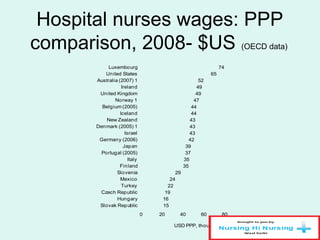
Hospital nurses wages: PPP
comparison, 2008- $US (OECD data)
15
16
19
22
24
29
35
35
37
39
42
43
43
43
44
44
47
49
49
52
65
74
0 20 40 60 80
Slovak Republic
Hungary
Czech Republic
Turkey
Mexico
Slovenia
Finland
Italy
Portugal (2005)
Japan
Germany (2006)
Israel
Denmark (2005) 1
New Zealand
Iceland
Belgium (2005)
Norway 1
United Kingdom
Ireland
Australia (2007) 1
United States
Luxembourg
USD PPP, thousands
What next?
• 1970’s-2000’s- Focus was on supply of
nurses
• Supply side now not the priority (a risk)
• Focus now is on Managing demand and
on Skill mix change
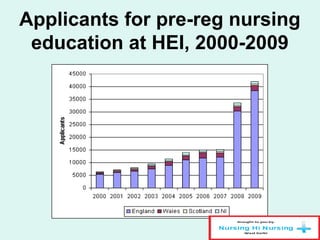
Applicants for pre-reg nursing
education at HEI, 2000-2009
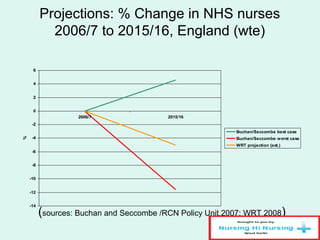
Projections: % Change in NHS nurses
2006/7 to 2015/16, England (wte)
-14
-12
-10
-8
-6
-4
-2
0
2
4
6
2006/7 2015/16
%
Buchan/Seccombe best case
Buchan/Seccombe worst case
WRT projection (est.)
(sources: Buchan and Seccombe /RCN Policy Unit,2007; WRT 2008)
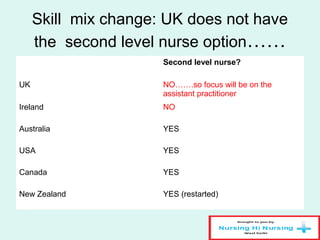
Skill mix change: UK does not have
the second level nurse option……
Second level nurse?
UK NO…….so focus will be on the
assistant practitioner
Ireland NO
Australia YES
USA YES
Canada YES
New Zealand YES (restarted)
What next?: Managing demand
• Emphasis on labour cost containment with
no reduction in quality of care
• Different working patterns: e-rostering
• Adaptive/ flexible staff: re-skilling (CPD)
• Differentiated pay/reward?
What next? Skill mix change
• (Fewer?) graduate nurses, in
“advanced” roles, managing cases and
teams, diagnosing and prescribing
• Increased use of HCA and AP
• Increased emphasis on self care
• = will challenge what we mean by
“nursing”
In conclusion…..
• In the past, nursing shortages have been
“solved” by having “more nurses”
• Over the next 10 years the emphasis will
shift to having “more effective nursing”
Our views have increased the
mark of the 10,000
Thank you viewers
Looking forward to franchise,
collaboration, partners.
This platform has been started by
Parveen Kumar Chadha with the
vision that nobody should suffer
the way he has suffered because
of lack and improper healthcare
facilities in India. We need lots of
funds manpower etc. to make
this vision a reality please contact
us. Join us as a member for a
noble cause.
Contact us:- 011-25464531, 9818569476
E-mail:- nursingnursing@yahoo.in

Nursing shortages

  • 1.
    Nursing shortages aren’twhat they used to be…….
  • 2.
    Nursing shortages… • ..whatwe know • How UK has responded in the past • Current UK situation • International context • What next?
  • 4.
    Shortages: what weknow • There is no universal definition of a nursing shortage; increasing evidence of nurse supply/ demand imbalances in many countries. Imbalances can be organisational, specialty based, regional, national ……(cyclical-”boom and bust”) • Supply of nurses in many countries, low income and high income, is failing to keep pace with increasing demand [e.g. Sub-Saharan African countries = shortfall of + 600,000 nurses in relation to Millennium Development Goals targets] • Gender-based discrimination continues in many countries = nursing undervalued as “women’s work”. • There is a link between adequate nurse staffing levels and positive care outcomes.
  • 5.
    UK and nursingshortages • National policy control [£] of “supply”= • =How many “new” nurses to train • =What they are trained in…… • =How many nurses to employ in NHS/ how much to pay them • =How much £ to invest in their re-skilling • =How many non EU nurses to allow into UK • =when NHS nurses can retire…….
  • 6.
    UK: history ofnursing shortages • 1932: Lancet Commission on Nursing • 1939: Inter-Departmental Committee on Nursing Services • 1947: Ministry of Health Working Party on the Recruitment and Training of Nurses • 1972: (Briggs) Committee • 1975 (Halsbury) Commission • 1983 onward: - Nurses pay review body • 2009: Prime Ministers Commission Nursing
  • 7.
    UK: report onnursing shortages • demand for care outstripping supply • nurse staffing difficulties in some regions/ specialties • increasing competition from other employers • “unjustified”/biased news coverage of conditions in hospitals • need for increased use of support workers to “free up” nurses • need for increased emphasis on staff retention, attracting “married nurses” back to the health workforce
  • 8.
    UK: report onnursing shortages • demand for care outstripping supply • nurse staffing difficulties in some regions/ specialties • increasing competition from other employers • “unjustified”/biased news coverage of conditions in hospitals • need for increased use of support workers to “free up” nurses • need for increased emphasis on staff retention, attracting “married nurses” back to the health workforce • (MINISTRY OF HEALTH, 1947)
  • 9.
    Previous UK “solutions”to shortages: Managing Supply • Increase numbers in training • Improve retention (and return) • International recruitment • Skill mix change- more support staff
  • 10.
    UK- “new “nurses from UK based training 0 5000 10000 15000 20000 25000 1990-1 1991-2 1992-3 1993-4 1994-5 1995-6 1996-7 1997-8 1998-91999-2000 2000-1 2001-2 2002-3 2003-4 2004-5 2005-6 2006-7 2007-8 2008-9 2009-10
  • 11.
    UK Trends: Numberof new nurses registering from European Economic Area (EEA), and “other” countries 1993-2010 0 2,000 4,000 6,000 8,000 10,000 12,000 14,000 16,000 18,000 1993/4 1994/5 1995/6 1996/7 1997/8 1998/91999/002000/01 2001/2 2002/3 2003/4 2004/5 2005/6 2006/7 2007/8 2008/92009/10 Other EEA
  • 12.
    NHS Scotland- total(wte) Nursing and Midwifery workforce 2001-2010 (ISD)
  • 13.
    Staffing numbers, NHSEngland 1997 and 2009 (wte) 0 50000 100000 150000 200000 250000 300000 350000 400000 450000 1997 2009 Aux HCA EN RN
  • 14.
    Trends: % changein staffing numbers, NHS England 1996-2009 (wte) 0 50 100 150 200 250 300 1996 1997 1998 1999 2000 2001 2002 2003 2004 2005 2006 2007 2008 2009 year % RN EN HCA Aux
  • 15.
    Nurses per 1,000population, OECD countries Ireland 1 Finland Switzerland Iceland Denmark Norway Luxembourg Sweden United States 1 Germany Netherlands Australia New Zealand Japan United Kingdom Canada OECD Czech Republic France 1 Slovenia Austria 2 Estonia Slovak Republic 1 Hungary Portugal 1 Poland Israel Spain Korea Greece 1 Mexico Turkey 1 2008 (or nearest year) Change 2000-08 (or 16.2 15.5 14.9 14.8 14.3 14.0 10.9 10.8 10.8 10.7 10.5 10.1 9.7 9.5 9.5 9.2 8.8 8.1 7.9 7.9 7.5 6.4 6.3 6.2 5.3 5.2 5.0 4.8 4.4 3.4 2.4 1.3 05101520 Per 1 000 population Professional nurses Associate professional nurses Nurses (no breakdown available) 1.8 1.6 1.9 1.4 2. 2 n.a. 1.5 0.7 1.4 1.3 0.1 n.a. 2 1.2 1.0 1.4 0.8 2 1.8 0.6 0.9 -2.1 1.9 n.a. -0.6 2 0.8 n.a. -4 0 Average annual gro
  • 16.
    OECD countries: Increasein nurse headcount 2000-2008 (compound annual rate) 1. Data include practising nurses and nurses working in the health sector as managers, educators, researchers, etc. 2. Data refer to all nurses licensed to practice. • Source: OECD Health Data 2010.
  • 17.
    Hospital nurses wages:PPP comparison, 2008- $US (OECD data) 15 16 19 22 24 29 35 35 37 39 42 43 43 43 44 44 47 49 49 52 65 74 0 20 40 60 80 Slovak Republic Hungary Czech Republic Turkey Mexico Slovenia Finland Italy Portugal (2005) Japan Germany (2006) Israel Denmark (2005) 1 New Zealand Iceland Belgium (2005) Norway 1 United Kingdom Ireland Australia (2007) 1 United States Luxembourg USD PPP, thousands
  • 18.
    What next? • 1970’s-2000’s-Focus was on supply of nurses • Supply side now not the priority (a risk) • Focus now is on Managing demand and on Skill mix change
  • 19.
    Applicants for pre-regnursing education at HEI, 2000-2009
  • 20.
    Projections: % Changein NHS nurses 2006/7 to 2015/16, England (wte) -14 -12 -10 -8 -6 -4 -2 0 2 4 6 2006/7 2015/16 % Buchan/Seccombe best case Buchan/Seccombe worst case WRT projection (est.) (sources: Buchan and Seccombe /RCN Policy Unit,2007; WRT 2008)
  • 21.
    Skill mix change:UK does not have the second level nurse option…… Second level nurse? UK NO…….so focus will be on the assistant practitioner Ireland NO Australia YES USA YES Canada YES New Zealand YES (restarted)
  • 22.
    What next?: Managingdemand • Emphasis on labour cost containment with no reduction in quality of care • Different working patterns: e-rostering • Adaptive/ flexible staff: re-skilling (CPD) • Differentiated pay/reward?
  • 23.
    What next? Skillmix change • (Fewer?) graduate nurses, in “advanced” roles, managing cases and teams, diagnosing and prescribing • Increased use of HCA and AP • Increased emphasis on self care • = will challenge what we mean by “nursing”
  • 24.
    In conclusion….. • Inthe past, nursing shortages have been “solved” by having “more nurses” • Over the next 10 years the emphasis will shift to having “more effective nursing”
  • 25.
    Our views haveincreased the mark of the 10,000 Thank you viewers Looking forward to franchise, collaboration, partners.
  • 26.
    This platform hasbeen started by Parveen Kumar Chadha with the vision that nobody should suffer the way he has suffered because of lack and improper healthcare facilities in India. We need lots of funds manpower etc. to make this vision a reality please contact us. Join us as a member for a noble cause.
  • 27.
    Contact us:- 011-25464531,9818569476 E-mail:- nursingnursing@yahoo.in

Editor's Notes

  • #17 Similar picture to above, n.b. Greece, Ireland on the stronger growth side here as well. Estonia: country with virtually no annual increase (0.64%) over the past eight years, overcapacity from transition were reduced first, and now the budget situation led to a wage reduction by 8-10% for doctors and nurses – may pose difficulty to service provision. (Source: Bertelsmann health policy monitor)