A Closer Look at
One
of the PLC Pieces:
FORMATIVE
ASSESSMENT
STRATEGY 4 & 7
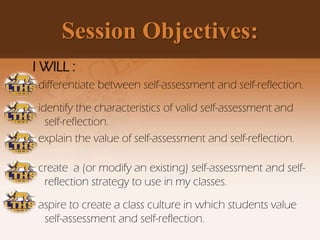
Session Objectives:
I WILL :
differentiate between self-assessment and self-reflection.
identify the characteristics of valid self-assessment and
self-reflection.
explain the value of self-assessment and self-reflection.
create a (or modify an existing) self-assessment and self-
reflection strategy to use in my classes.
aspire to create a class culture in which students value
self-assessment and self-reflection.
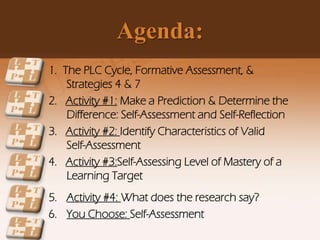
Agenda:
1. The PLC Cycle, Formative Assessment, &
Strategies 4 & 7
2. Activity #1: Make a Prediction & Determine the
Difference: Self-Assessment and Self-Reflection
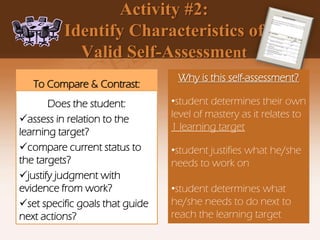
3. Activity #2: Identify Characteristics of Valid
Self-Assessment
4. Activity #3:Self-Assessing Level of Mastery of a
Learning Target
5. Activity #4: What does the research say?
6. You Choose: Self-Assessment
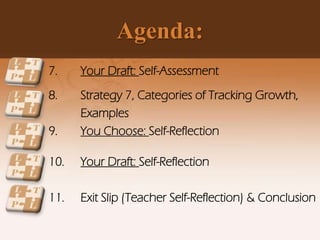
Agenda:
7. Your Draft: Self-Assessment
8. Strategy 7, Categories of Tracking Growth,
Examples
9. You Choose: Self-Reflection
10. Your Draft: Self-Reflection
11. Exit Slip (Teacher Self-Reflection) & Conclusion
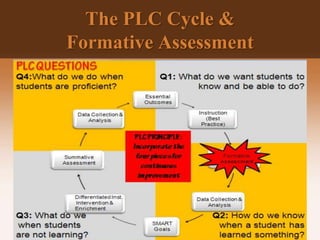
The PLC Cycle &
Formative Assessment
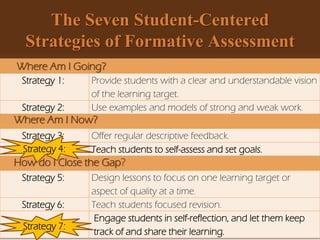
The Seven Student-Centered
Strategies of Formative Assessment
Strategy 1: Provide students with a clear and understandable vision
of the learning target.
Strategy 2: Use examples and models of strong and weak work.
Strategy 3: Offer regular descriptive feedback.
Teach students to self-assess and set goals.
Strategy 5: Design lessons to focus on one learning target or
aspect of quality at a time.
Strategy 6: Teach students focused revision.
Engage students in self-reflection, and let them keep
track of and share their learning.
Strategy 4:
Strategy 7:
Where Am I Going?
Where Am I Now?
How do I Close the Gap?
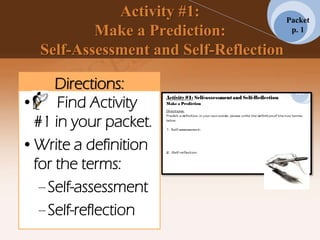
Activity #1:
Make a Prediction:
Self-Assessment and Self-Reflection
Directions:
•. Find Activity
#1 in your packet.
•Write a definition
for the terms:
–Self-assessment
–Self-reflection
Packet
p. 1
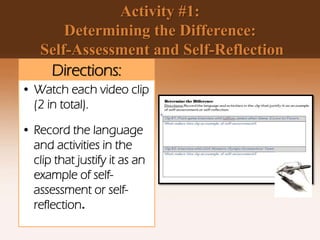
Activity #1:
Determining the Difference:
Self-Assessment and Self-Reflection
Directions:
• Watch each video clip
(2 in total).
• Record the language
and activities in the
clip that justify it as an
example of self-
assessment or self-
reflection.
Clip #1: Self-Assessment
WHAT MAKES THIS CLIP AN EXAMPLE OF
SELF-ASSESSMENT?
Clip #2: Self-Reflection
WHAT MAKES THIS CLIP AN EXAMPLE OF
SELF-REFLECTION?
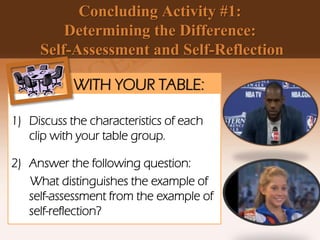
Concluding Activity #1:
Determining the Difference:
Self-Assessment and Self-Reflection
WITH YOUR TABLE:
1) Discuss the characteristics of each
clip with your table group.
2) Answer the following question:
What distinguishes the example of
self-assessment from the example of
self-reflection?
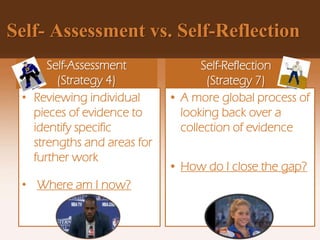
Self- Assessment vs. Self-Reflection
Self-Assessment
(Strategy 4)
• Reviewing individual
pieces of evidence to
identify specific
strengths and areas for
further work
• Where am I now?
Self-Reflection
(Strategy 7)
• A more global process of
looking back over a
collection of evidence
• How do I close the gap?
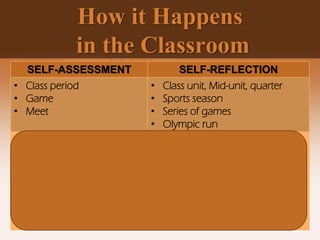
How it Happens
in the Classroom
SELF-ASSESSMENT SELF-REFLECTION
• Class period
• Game
• Meet
• Class unit, Mid-unit, quarter
• Sports season
• Series of games
• Olympic run
Methods:
•Assigning a rating
•Stomp and Clap
•Fist to 5
•Assigning quality level with
a rubric
• or
Methods:
•Tracking, graphing, summarizing
trends about progress
•Using a collection of:
-daily entry/exit slips
-daily assignments
-unit performances
Who is helped by Strategy 4 & 7?
•All students
– Targeted intervention for students not
reaching learning targets
– Differentiated tasks
STRATEGY 4
Teach students to self-assess and set goals.
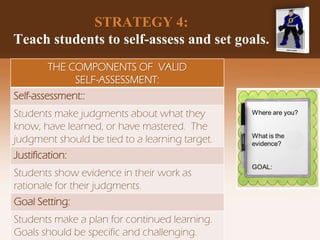
STRATEGY 4:
Teach students to self-assess and set goals.
THE COMPONENTS OF VALID
SELF-ASSESSMENT:
Self-assessment::
Students make judgments about what they
know, have learned, or have mastered. The
judgment should be tied to a learning target.
Justification:
Students show evidence in their work as
rationale for their judgments.
Goal Setting:
Students make a plan for continued learning.
Goals should be specific and challenging.
Gregory, Cameron, & Davies (2000)
Options for Self-Assessment
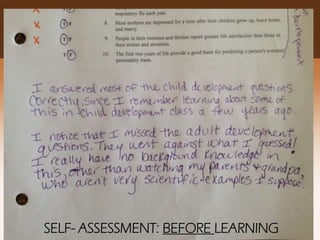
BEFORE LEARNING
“When students are involved in
self-assessment, they provide
themselves with regular and
immediate descriptive feedback
to guide their learning. They
become more actively involved
in a curriculum that otherwise
can seem unrelated to their lives
and personal experiences.”
SELF- ASSESSMENT: BEFORE LEARNING
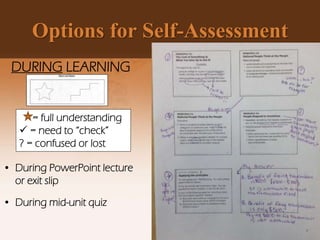
Options for Self-Assessment
• During PowerPoint lecture
or exit slip
• During mid-unit quiz
DURING LEARNING
= full understanding
 = need to “check”
? = confused or lost
Options for Self-Assessment
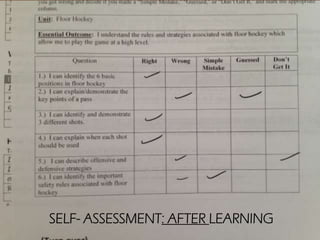
AFTER LEARNING
Using the results of a formative quiz or
assignment
SELF- ASSESSMENT: AFTER LEARNING
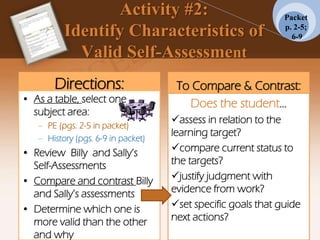
Activity #2:
Identify Characteristics of
Valid Self-Assessment
Directions:
• As a table, select one
subject area:
– PE (pgs. 2-5 in packet)
– History (pgs. 6-9 in packet)
• Review Billy and Sally’s
Self-Assessments
• Compare and contrast Billy
and Sally’s assessments
• Determine which one is
more valid than the other
and why
To Compare & Contrast:
Does the student…
assess in relation to the
learning target?
compare current status to
the targets?
justify judgment with
evidence from work?
set specific goals that guide
next actions?
Packet
p. 2-5;
6-9
Activity #2:
Identify Characteristics of
Valid Self-Assessment
To Compare & Contrast:
Does the student:
assess in relation to the
learning target?
compare current status to
the targets?
justify judgment with
evidence from work?
set specific goals that guide
next actions?
Why is this self-assessment?
•student determines their own
level of mastery as it relates to
1 learning target
•student justifies what he/she
needs to work on
•student determines what
he/she needs to do next to
reach the learning target
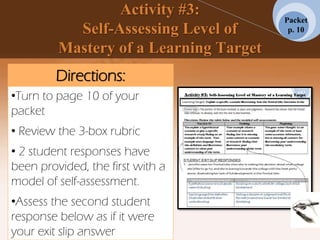
Activity #3:
Self-Assessing Level of
Mastery of a Learning Target
Packet
p. 10
Directions:
•Turn to page 10 of your
packet
• Review the 3-box rubric
• 2 student responses have
been provided, the first with a
model of self-assessment.
•Assess the second student
response below as if it were
your exit slip answer
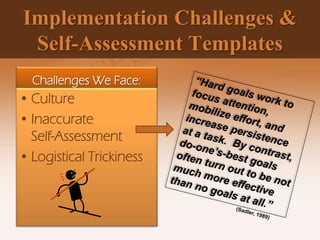
Implementation Challenges &
Self-Assessment Templates
Challenges We Face:
• Culture
• Inaccurate
Self-Assessment
• Logistical Trickiness
Research Says…
•Students will achieve at higher levels
without additional instruction
– Black & Wiliam (1998a): Feedback on oral
reading rates.
– White & Frederiksen (1998) Self-assessment
on scientific inquiry skills.
Activity #4-
Table Discussion:
What does the research say?
Directions:
•Read the eight research
findings (pg. 11).
•Put a check mark next to
the two pieces of
research that you find
most thought-provoking.
•In the space provided
explain why those quotes
catch your eye.
When you are done…
• Walk to the front of the room
and a place a sticky note on
the two pieces of research that
you found thought-provoking.
Packet
p. 11
You Choose:
Self-Assessment
By yourself:
•Review the templates in the self-assessment examples
packet.
•Consider the questions on pg. 12 of your Activity
Packet. Determine:
•Who in your classes would benefit from these strategies?
•When (during a unit) would be a good time to use these
strategies?
•How would you use these strategies for your specific classes?
•Select a template that you could use or adapt
Packet
p. 12
Your Draft:
Self- Assessment
Directions:
• Create a self-
assessment for student
use during your next
instructional unit
• Activity Packet pg. 13
Meaningful & valid
self-assessment:
– Assesses in
relation to the
learning target
– Provides evidence
– Sets specific goal
Packet
p. 13
STRATEGY 7
Engage students in self-reflection, and let them keep
track of and share their learning.
STRATEGY 7:
Engage students in self-reflection, and let them
keep track of and share their learning
Self-Reflection: Students:
•connects students to
their growth.
•is embedded in the
lesson design.
•offers opportunities for
students to share their
progress.
•is a gap-closing strategy
because of its impact on
student motivation and
retention.
•track progress
•reflect on their
learning processes and
growth
•share observations
about achievement or
about themselves as
learners
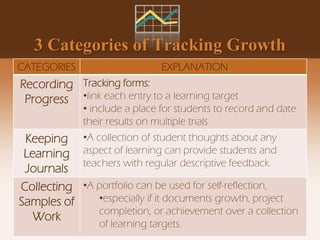
CATEGORIES EXPLANATION
Recording
Progress
Tracking forms:
•link each entry to a learning target
• include a place for students to record and date
their results on multiple trials
Keeping
Learning
Journals
•A collection of student thoughts about any
aspect of learning can provide students and
teachers with regular descriptive feedback.
Collecting
Samples of
Work
•A portfolio can be used for self-reflection,
•especially if it documents growth, project
completion, or achievement over a collection
of learning targets.
3 Categories of Tracking Growth
Tracking Growth must be
Followed by Reflection
• Students must look over their collection of
tracked work and think meta-cognitively
about their learning.
Students should draw conclusions about::
What they have learned
How they have learned it
What worked and didn’t work
What they would do differently
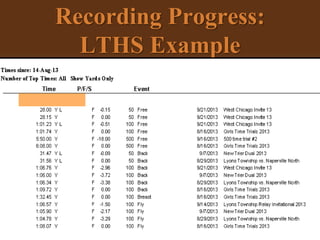
Recording Progress:
LTHS Example
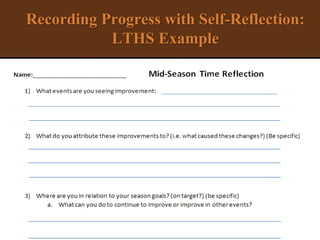
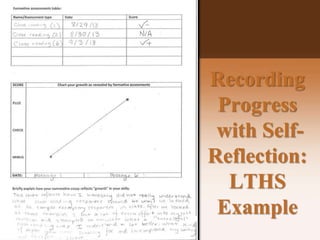
Recording Progress with Self-Reflection:
LTHS Example
Recording
Progress
with Self-
Reflection:
LTHS
Example
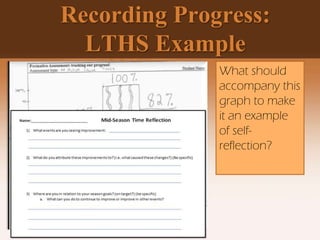
What should
accompany this
graph to make
it an example
of self-
reflection?
Recording Progress:
LTHS Example
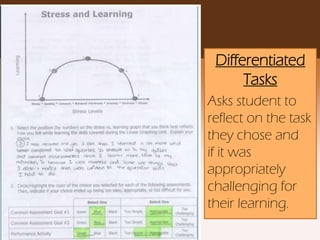
Differentiated
Tasks
Asks student to
reflect on the task
they chose and
if it was
appropriately
challenging for
their learning.
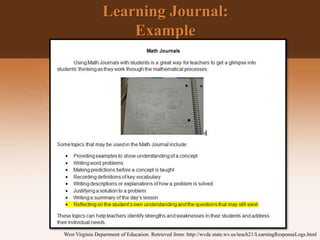
Learning Journal:
Example
West Virginia Department of Education. Retrieved from: http://wvde.state.wv.us/teach21/LearningResponseLogs.html
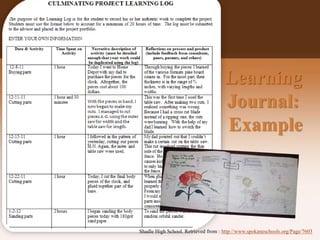
Learning
Journal:
Example
Shadle High School. Retrieved from : http://www.spokaneschools.org/Page/7603
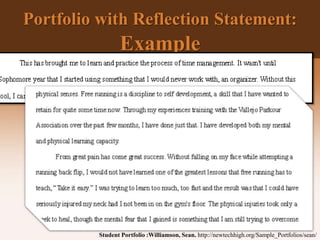
Portfolio with Reflection Statement:
Example
Student Portfolio :Williamson, Sean. http://newtechhigh.org/Sample_Portfolios/sean/
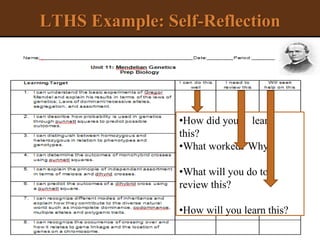
LTHS Example: Self-Reflection
•How did you learn
this?
•What worked? Why?
•What will you do to
review this?
•How will you learn this?
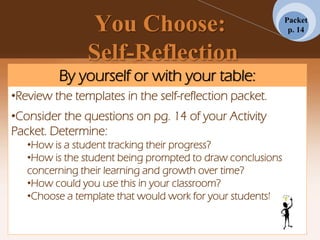
You Choose:
Self-Reflection
By yourself or with your table:
•Review the templates in the self-reflection packet.
•Consider the questions on pg. 14 of your Activity
Packet. Determine:
•How is a student tracking their progress?
•How is the student being prompted to draw conclusions
concerning their learning and growth over time?
•How could you use this in your classroom?
•Choose a template that would work for your students!
Packet
p. 14
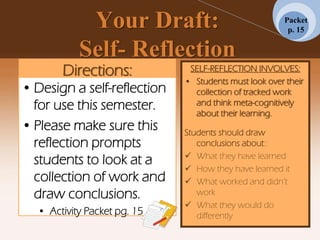
Your Draft:
Self- Reflection
Directions:
• Design a self-reflection
for use this semester.
• Please make sure this
reflection prompts
students to look at a
collection of work and
draw conclusions.
• Activity Packet pg. 15
SELF-REFLECTION INVOLVES:
• Students must look over their
collection of tracked work
and think meta-cognitively
about their learning.
Students should draw
conclusions about::
 What they have learned
 How they have learned it
 What worked and didn’t
work
 What they would do
differently
Packet
p. 15
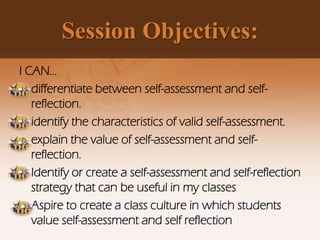
Session Objectives:
I CAN…
• differentiate between self-assessment and self-
reflection.
• identify the characteristics of valid self-assessment.
• explain the value of self-assessment and self-
reflection.
• Identify or create a self-assessment and self-reflection
strategy that can be useful in my classes
• Aspire to create a class culture in which students
value self-assessment and self reflection
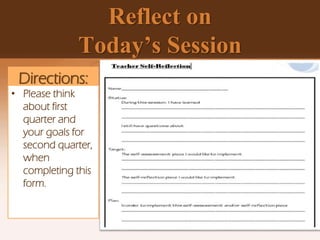
Reflect on
Today’s Session
Directions:
• Please think
about first
quarter and
your goals for
second quarter,
when
completing this
form.
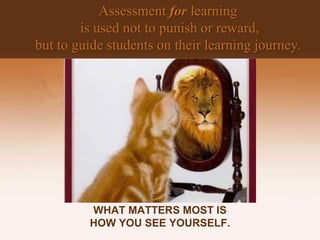
WHAT MATTERS MOST IS
HOW YOU SEE YOURSELF.
Assessment for learning
is used not to punish or reward,
but to guide students on their learning journey.
References
Chappuis, Jan (2009). Seven strategies of assessment for learning. Boston: Pearson
Education, Inc. 2009.’
Harlen, W., & M. James. (1997). Assessment and learning: Differences and relationships
between formative and summative assessment. Assessment in Education: Principles,
Policy, & Practice 4(3), 365-379.
Sadler, D. R. (1989). Formative assessment and the design of instructional systems.
Instructional Science, 18,119-144.
Shadle Park High School (2012-2013). Learning log: Sample learning log. Retrieved from
http://www.spokaneschools.org/Page/7603.
Stiggins, R (2007). Assessment for learning: An essential foundation of productive
instruction. In Douglas Reeves (ed.), Ahead of the curve (pp56-77). Bloomington, IN:
Solution Tree.
West Virginia Department of Education. Learning logs: Math journals. Retrieved from
http://wvde.state.wv.us/teach21/LearningResponseLogs.html
Williamson, Sean (2011). Student portfolio. Retrieved from

A Closer Look at Strategy 4 and 7

  • 1.
    A Closer Lookat One of the PLC Pieces: FORMATIVE ASSESSMENT STRATEGY 4 & 7
  • 2.
    Session Objectives: I WILL: differentiate between self-assessment and self-reflection. identify the characteristics of valid self-assessment and self-reflection. explain the value of self-assessment and self-reflection. create a (or modify an existing) self-assessment and self- reflection strategy to use in my classes. aspire to create a class culture in which students value self-assessment and self-reflection.
  • 3.
    Agenda: 1. The PLCCycle, Formative Assessment, & Strategies 4 & 7 2. Activity #1: Make a Prediction & Determine the Difference: Self-Assessment and Self-Reflection 3. Activity #2: Identify Characteristics of Valid Self-Assessment 4. Activity #3:Self-Assessing Level of Mastery of a Learning Target 5. Activity #4: What does the research say? 6. You Choose: Self-Assessment
  • 4.
    Agenda: 7. Your Draft:Self-Assessment 8. Strategy 7, Categories of Tracking Growth, Examples 9. You Choose: Self-Reflection 10. Your Draft: Self-Reflection 11. Exit Slip (Teacher Self-Reflection) & Conclusion
  • 5.
    The PLC Cycle& Formative Assessment
  • 6.
    The Seven Student-Centered Strategiesof Formative Assessment Strategy 1: Provide students with a clear and understandable vision of the learning target. Strategy 2: Use examples and models of strong and weak work. Strategy 3: Offer regular descriptive feedback. Teach students to self-assess and set goals. Strategy 5: Design lessons to focus on one learning target or aspect of quality at a time. Strategy 6: Teach students focused revision. Engage students in self-reflection, and let them keep track of and share their learning. Strategy 4: Strategy 7: Where Am I Going? Where Am I Now? How do I Close the Gap?
  • 7.
    Activity #1: Make aPrediction: Self-Assessment and Self-Reflection Directions: •. Find Activity #1 in your packet. •Write a definition for the terms: –Self-assessment –Self-reflection Packet p. 1
  • 8.
    Activity #1: Determining theDifference: Self-Assessment and Self-Reflection Directions: • Watch each video clip (2 in total). • Record the language and activities in the clip that justify it as an example of self- assessment or self- reflection.
  • 9.
    Clip #1: Self-Assessment WHATMAKES THIS CLIP AN EXAMPLE OF SELF-ASSESSMENT?
  • 10.
    Clip #2: Self-Reflection WHATMAKES THIS CLIP AN EXAMPLE OF SELF-REFLECTION?
  • 11.
    Concluding Activity #1: Determiningthe Difference: Self-Assessment and Self-Reflection WITH YOUR TABLE: 1) Discuss the characteristics of each clip with your table group. 2) Answer the following question: What distinguishes the example of self-assessment from the example of self-reflection?
  • 12.
    Self- Assessment vs.Self-Reflection Self-Assessment (Strategy 4) • Reviewing individual pieces of evidence to identify specific strengths and areas for further work • Where am I now? Self-Reflection (Strategy 7) • A more global process of looking back over a collection of evidence • How do I close the gap?
  • 13.
    How it Happens inthe Classroom SELF-ASSESSMENT SELF-REFLECTION • Class period • Game • Meet • Class unit, Mid-unit, quarter • Sports season • Series of games • Olympic run Methods: •Assigning a rating •Stomp and Clap •Fist to 5 •Assigning quality level with a rubric • or Methods: •Tracking, graphing, summarizing trends about progress •Using a collection of: -daily entry/exit slips -daily assignments -unit performances
  • 14.
    Who is helpedby Strategy 4 & 7? •All students – Targeted intervention for students not reaching learning targets – Differentiated tasks
  • 15.
    STRATEGY 4 Teach studentsto self-assess and set goals.
  • 16.
    STRATEGY 4: Teach studentsto self-assess and set goals. THE COMPONENTS OF VALID SELF-ASSESSMENT: Self-assessment:: Students make judgments about what they know, have learned, or have mastered. The judgment should be tied to a learning target. Justification: Students show evidence in their work as rationale for their judgments. Goal Setting: Students make a plan for continued learning. Goals should be specific and challenging.
  • 17.
    Gregory, Cameron, &Davies (2000) Options for Self-Assessment BEFORE LEARNING “When students are involved in self-assessment, they provide themselves with regular and immediate descriptive feedback to guide their learning. They become more actively involved in a curriculum that otherwise can seem unrelated to their lives and personal experiences.” SELF- ASSESSMENT: BEFORE LEARNING
  • 18.
    Options for Self-Assessment •During PowerPoint lecture or exit slip • During mid-unit quiz DURING LEARNING = full understanding  = need to “check” ? = confused or lost
  • 19.
    Options for Self-Assessment AFTERLEARNING Using the results of a formative quiz or assignment SELF- ASSESSMENT: AFTER LEARNING
  • 20.
    Activity #2: Identify Characteristicsof Valid Self-Assessment Directions: • As a table, select one subject area: – PE (pgs. 2-5 in packet) – History (pgs. 6-9 in packet) • Review Billy and Sally’s Self-Assessments • Compare and contrast Billy and Sally’s assessments • Determine which one is more valid than the other and why To Compare & Contrast: Does the student… assess in relation to the learning target? compare current status to the targets? justify judgment with evidence from work? set specific goals that guide next actions? Packet p. 2-5; 6-9
  • 21.
    Activity #2: Identify Characteristicsof Valid Self-Assessment To Compare & Contrast: Does the student: assess in relation to the learning target? compare current status to the targets? justify judgment with evidence from work? set specific goals that guide next actions? Why is this self-assessment? •student determines their own level of mastery as it relates to 1 learning target •student justifies what he/she needs to work on •student determines what he/she needs to do next to reach the learning target
  • 22.
    Activity #3: Self-Assessing Levelof Mastery of a Learning Target Packet p. 10 Directions: •Turn to page 10 of your packet • Review the 3-box rubric • 2 student responses have been provided, the first with a model of self-assessment. •Assess the second student response below as if it were your exit slip answer
  • 23.
    Implementation Challenges & Self-AssessmentTemplates Challenges We Face: • Culture • Inaccurate Self-Assessment • Logistical Trickiness
  • 24.
    Research Says… •Students willachieve at higher levels without additional instruction – Black & Wiliam (1998a): Feedback on oral reading rates. – White & Frederiksen (1998) Self-assessment on scientific inquiry skills.
  • 25.
    Activity #4- Table Discussion: Whatdoes the research say? Directions: •Read the eight research findings (pg. 11). •Put a check mark next to the two pieces of research that you find most thought-provoking. •In the space provided explain why those quotes catch your eye. When you are done… • Walk to the front of the room and a place a sticky note on the two pieces of research that you found thought-provoking. Packet p. 11
  • 26.
    You Choose: Self-Assessment By yourself: •Reviewthe templates in the self-assessment examples packet. •Consider the questions on pg. 12 of your Activity Packet. Determine: •Who in your classes would benefit from these strategies? •When (during a unit) would be a good time to use these strategies? •How would you use these strategies for your specific classes? •Select a template that you could use or adapt Packet p. 12
  • 27.
    Your Draft: Self- Assessment Directions: •Create a self- assessment for student use during your next instructional unit • Activity Packet pg. 13 Meaningful & valid self-assessment: – Assesses in relation to the learning target – Provides evidence – Sets specific goal Packet p. 13
  • 28.
    STRATEGY 7 Engage studentsin self-reflection, and let them keep track of and share their learning.
  • 29.
    STRATEGY 7: Engage studentsin self-reflection, and let them keep track of and share their learning Self-Reflection: Students: •connects students to their growth. •is embedded in the lesson design. •offers opportunities for students to share their progress. •is a gap-closing strategy because of its impact on student motivation and retention. •track progress •reflect on their learning processes and growth •share observations about achievement or about themselves as learners
  • 30.
    CATEGORIES EXPLANATION Recording Progress Tracking forms: •linkeach entry to a learning target • include a place for students to record and date their results on multiple trials Keeping Learning Journals •A collection of student thoughts about any aspect of learning can provide students and teachers with regular descriptive feedback. Collecting Samples of Work •A portfolio can be used for self-reflection, •especially if it documents growth, project completion, or achievement over a collection of learning targets. 3 Categories of Tracking Growth
  • 31.
    Tracking Growth mustbe Followed by Reflection • Students must look over their collection of tracked work and think meta-cognitively about their learning. Students should draw conclusions about:: What they have learned How they have learned it What worked and didn’t work What they would do differently
  • 32.
  • 33.
    Recording Progress withSelf-Reflection: LTHS Example
  • 34.
  • 35.
    What should accompany this graphto make it an example of self- reflection? Recording Progress: LTHS Example
  • 36.
    Differentiated Tasks Asks student to reflecton the task they chose and if it was appropriately challenging for their learning.
  • 37.
    Learning Journal: Example West VirginiaDepartment of Education. Retrieved from: http://wvde.state.wv.us/teach21/LearningResponseLogs.html
  • 38.
    Learning Journal: Example Shadle High School.Retrieved from : http://www.spokaneschools.org/Page/7603
  • 39.
    Portfolio with ReflectionStatement: Example Student Portfolio :Williamson, Sean. http://newtechhigh.org/Sample_Portfolios/sean/
  • 40.
    LTHS Example: Self-Reflection •Howdid you learn this? •What worked? Why? •What will you do to review this? •How will you learn this?
  • 41.
    You Choose: Self-Reflection By yourselfor with your table: •Review the templates in the self-reflection packet. •Consider the questions on pg. 14 of your Activity Packet. Determine: •How is a student tracking their progress? •How is the student being prompted to draw conclusions concerning their learning and growth over time? •How could you use this in your classroom? •Choose a template that would work for your students! Packet p. 14
  • 42.
    Your Draft: Self- Reflection Directions: •Design a self-reflection for use this semester. • Please make sure this reflection prompts students to look at a collection of work and draw conclusions. • Activity Packet pg. 15 SELF-REFLECTION INVOLVES: • Students must look over their collection of tracked work and think meta-cognitively about their learning. Students should draw conclusions about::  What they have learned  How they have learned it  What worked and didn’t work  What they would do differently Packet p. 15
  • 43.
    Session Objectives: I CAN… •differentiate between self-assessment and self- reflection. • identify the characteristics of valid self-assessment. • explain the value of self-assessment and self- reflection. • Identify or create a self-assessment and self-reflection strategy that can be useful in my classes • Aspire to create a class culture in which students value self-assessment and self reflection
  • 44.
    Reflect on Today’s Session Directions: •Please think about first quarter and your goals for second quarter, when completing this form.
  • 45.
    WHAT MATTERS MOSTIS HOW YOU SEE YOURSELF. Assessment for learning is used not to punish or reward, but to guide students on their learning journey.
  • 46.
    References Chappuis, Jan (2009).Seven strategies of assessment for learning. Boston: Pearson Education, Inc. 2009.’ Harlen, W., & M. James. (1997). Assessment and learning: Differences and relationships between formative and summative assessment. Assessment in Education: Principles, Policy, & Practice 4(3), 365-379. Sadler, D. R. (1989). Formative assessment and the design of instructional systems. Instructional Science, 18,119-144. Shadle Park High School (2012-2013). Learning log: Sample learning log. Retrieved from http://www.spokaneschools.org/Page/7603. Stiggins, R (2007). Assessment for learning: An essential foundation of productive instruction. In Douglas Reeves (ed.), Ahead of the curve (pp56-77). Bloomington, IN: Solution Tree. West Virginia Department of Education. Learning logs: Math journals. Retrieved from http://wvde.state.wv.us/teach21/LearningResponseLogs.html Williamson, Sean (2011). Student portfolio. Retrieved from