Peer Evaluation  … How to Join the USU Extension Witness Protection Program Dr Dallas L. Holmes Continuing Education ECEA Faculty Workshop,  Roosevelt, Utah April 15, 2005
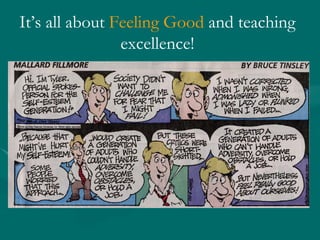
It’s all about  Feeling Good  and teaching excellence!
So Doc, What Have You Learned in Your 33 Years With Extension ?   Sage Words of Advice or the possibilities of surviving in a T&P frenzy!
Nothing increases your golf score like a witness! SCORE CARD
You must learn from the mistakes of others. You cannot possibly live long enough to make them all yourself. -  Sam Levenson
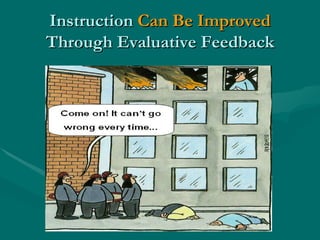
Instruction  Can Be Improved  Through Evaluative Feedback
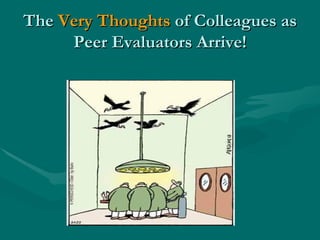
The  Very Thoughts  of Colleagues as Peer Evaluators Arrive!
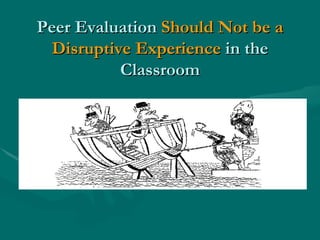
Peer Evaluation  Should Not be a Disruptive Experience  in the Classroom
Before you criticize someone, you should walk a mile in their shoes.  That way, when you criticize them, you are a mile away from them and you have their shoes . Peer Evaluator Rule #1
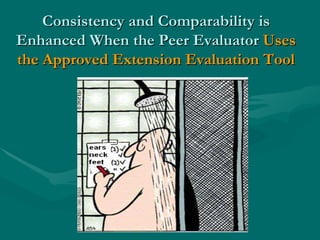
Consistency and Comparability is Enhanced When the Peer Evaluator  Uses the Approved Extension Evaluation Tool
USU Extension Peer Evaluation Form –  “The Plan” Part I - PEER EVALUATION FORM FOR CONTINUING EDUCATION CREDIT COURSES Instructor  Date of Visit Program Title Length of Time of Visit Peer Evaluator
USU Extension Peer Evaluation Form –  “The Plan” Part II – REVIEW OF INSTRUCTIONAL MATERIALS (some of the following may not be used). Marketing Materials Instructional or Course Outline Instructional Materials Evaluation Procedures Probable Impacts
USU Extension Peer Evaluation Form –  “The Plan” Part III -  COMMENDATIONS: Suggestions for Improvement: Signature of Evaluator Build Your T&P File with the Evaluation
Consider the importance of instructional feedback by looking at life through the windshield, not the  rear-view mirror.  - Byrd Baggett
You’ve got to be willing to give up good to get great  -  Kenny Rogers
Consider Your  Value in the Marketplace  of Students/Peers
Review Instructional Materials
Organization of Subject Was the format appropriate?  Were objectives shared with  learners?  Did the instructor get the  attention  of learners early?  If so, how?
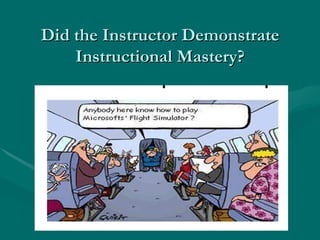
Did the Instructor Demonstrate Instructional Mastery?
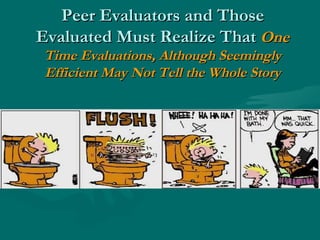
Peer Evaluators and Those Evaluated Must Realize That  One   Time Evaluations, Although Seemingly Efficient May Not Tell the Whole Story
When Appropriate,  Review the Marketing Materials  for the Course Being Evaluated
Review the Instructional Course Outline…  A Reality Check!
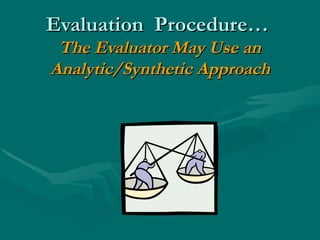
Evaluation  Procedure…  The Evaluator May Use an Analytic/Synthetic Approach
Did the Instructor…   Discuss points of view other than their own . Contrast implications of various theories.   Discuss recent developments in the field . Present origins of ideas and concepts . Give references for more interesting and  involved points . Present facts and concepts and related  fields . Emphasize conceptual understanding .
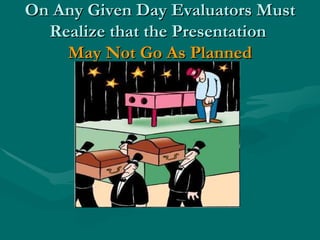
On Any Given Day Evaluators Must Realize that the Presentation  May Not Go As Planned
Did the instructor…    8.   Explain clearly . 9.   Seem well prepared .   10.   Give lectures that are easy to take notes in .   11.   Show care and precision in answering questions.   12.   Summarize major points . 13.   State objectives for each class session .   14.   Identify what they consider important .
Instructor-Group Interaction     15.   Encourage class discussion  16.   Invite students to share their knowledge and  experiences  17.   Clarify thinking by identifying reasons for questions  18.   Invite criticism of their own ideas  19. Know if the class is understanding them or not  20. Know when students are bored or confused  21.   Have interest and concern in the quality of their  teaching   22.   Have students apply concepts to  demonstrate understanding
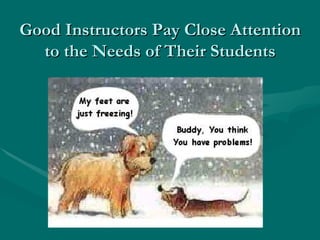
Good Instructors Pay Close Attention to the Needs of Their Students
Instructor-Individual Student Interaction   23. Have a genuine interest in students.  24. Are friendly toward students.  25.   Relate to students as individuals.  26. Recognize and greet students out of class.  27.   Are accessible to students out of class.  28.   Are valued for advice not directly related to the  course.  29.   Respect students as persons.

Dynamism/Enthusiasm   30.    Are dynamic and energetic persons. 31.  Have an interesting style of presentation. 32.  Seem to enjoy teaching. 33.   Are enthusiastic about their subject. 34.   Seem to have self-confidence.  35.   Vary the speed and tone of their voice.  Have a sense of humor. Milton Hildebrand, Robert C. Wilson, Evelyn R. Dienst (l971)  Evaluating University Teaching , Center for Research and Development in Higher Education, University of California, Berkeley.
So What is the  Probable Impact  of This Course Upon the Lives of the Students Enrolled?  The so what question  …
Was relevance demonstrated?  Did instructor link content with application? Did the instructor develop a conclusion?  Were stated objectives met?  Did instructor encourage student responsibility for further learning?
Comments and Instructor Dialogue
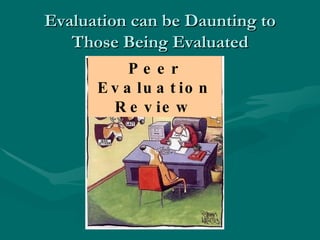
Evaluation can be Daunting to Those Being Evaluated Peer Evaluation Review
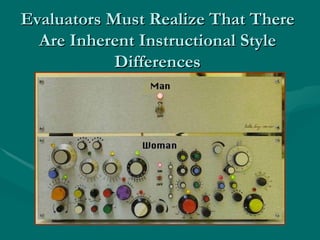
Evaluators Must Realize That There Are Inherent Instructional Style Differences
If It At First You Don’t Succeed, Redefine Success… Or At Least Consider Another Opinion
Faculty Response to the Evaluation…  How Do I Document this Evaluation Experience?
Documentation & Citation Standards T&P Binder Use committee members for this process. Obtain 2-3 Peer review teaching evaluations annually. Use the format suggested in the teaching format from the T&P manual when being evaluated by a reviewer. Include the Peer Evaluation Visit forms for each evaluation. typed (not handwritten) and signed by the evaluator. Make sure the review is held when you are teaching your clientele, not when you are teaching one another.  Place these in section F of the T&P binder A list of those who have conducted reviews should be included as part of this section. Prepare a list of peer evaluators.
Citation Standard Citation standard Holmes, D. L. (2001). Report of peer evaluation for Dr. (faculty) teaching  Integrated Life Science 1350,  an evening course taught at the Roosevelt Center. Bills, B. D. (2002). Report of peer evaluation for Dr. (faculty) teaching  Integrated Life Science 1350,  and evening course taught at the Roosevelt Center.
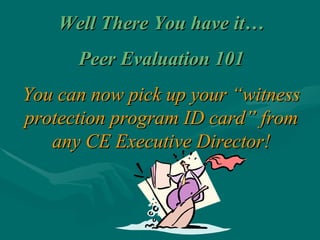
Well There You have it… Peer Evaluation 101 You can now pick up your “witness protection program ID card” from any CE Executive Director!

Peer Evaluation 0405

  • 1.
    Peer Evaluation … How to Join the USU Extension Witness Protection Program Dr Dallas L. Holmes Continuing Education ECEA Faculty Workshop, Roosevelt, Utah April 15, 2005
  • 2.
    It’s all about Feeling Good and teaching excellence!
  • 3.
    So Doc, WhatHave You Learned in Your 33 Years With Extension ? Sage Words of Advice or the possibilities of surviving in a T&P frenzy!
  • 4.
    Nothing increases yourgolf score like a witness! SCORE CARD
  • 5.
    You must learnfrom the mistakes of others. You cannot possibly live long enough to make them all yourself. - Sam Levenson
  • 6.
    Instruction CanBe Improved Through Evaluative Feedback
  • 7.
    The VeryThoughts of Colleagues as Peer Evaluators Arrive!
  • 8.
    Peer Evaluation Should Not be a Disruptive Experience in the Classroom
  • 9.
    Before you criticizesomeone, you should walk a mile in their shoes. That way, when you criticize them, you are a mile away from them and you have their shoes . Peer Evaluator Rule #1
  • 10.
    Consistency and Comparabilityis Enhanced When the Peer Evaluator Uses the Approved Extension Evaluation Tool
  • 11.
    USU Extension PeerEvaluation Form – “The Plan” Part I - PEER EVALUATION FORM FOR CONTINUING EDUCATION CREDIT COURSES Instructor Date of Visit Program Title Length of Time of Visit Peer Evaluator
  • 12.
    USU Extension PeerEvaluation Form – “The Plan” Part II – REVIEW OF INSTRUCTIONAL MATERIALS (some of the following may not be used). Marketing Materials Instructional or Course Outline Instructional Materials Evaluation Procedures Probable Impacts
  • 13.
    USU Extension PeerEvaluation Form – “The Plan” Part III - COMMENDATIONS: Suggestions for Improvement: Signature of Evaluator Build Your T&P File with the Evaluation
  • 14.
    Consider the importanceof instructional feedback by looking at life through the windshield, not the rear-view mirror. - Byrd Baggett
  • 15.
    You’ve got tobe willing to give up good to get great - Kenny Rogers
  • 16.
    Consider Your Value in the Marketplace of Students/Peers
  • 17.
  • 18.
    Organization of SubjectWas the format appropriate? Were objectives shared with learners? Did the instructor get the attention of learners early? If so, how?
  • 19.
    Did the InstructorDemonstrate Instructional Mastery?
  • 20.
    Peer Evaluators andThose Evaluated Must Realize That One Time Evaluations, Although Seemingly Efficient May Not Tell the Whole Story
  • 21.
    When Appropriate, Review the Marketing Materials for the Course Being Evaluated
  • 22.
    Review the InstructionalCourse Outline… A Reality Check!
  • 23.
    Evaluation Procedure… The Evaluator May Use an Analytic/Synthetic Approach
  • 24.
    Did the Instructor…  Discuss points of view other than their own . Contrast implications of various theories.   Discuss recent developments in the field . Present origins of ideas and concepts . Give references for more interesting and involved points . Present facts and concepts and related fields . Emphasize conceptual understanding .
  • 25.
    On Any GivenDay Evaluators Must Realize that the Presentation May Not Go As Planned
  • 26.
    Did the instructor…   8. Explain clearly . 9. Seem well prepared .   10. Give lectures that are easy to take notes in .   11. Show care and precision in answering questions.   12. Summarize major points . 13. State objectives for each class session .   14. Identify what they consider important .
  • 27.
    Instructor-Group Interaction   15. Encourage class discussion  16. Invite students to share their knowledge and experiences  17. Clarify thinking by identifying reasons for questions  18. Invite criticism of their own ideas  19. Know if the class is understanding them or not  20. Know when students are bored or confused  21. Have interest and concern in the quality of their teaching   22. Have students apply concepts to demonstrate understanding
  • 28.
    Good Instructors PayClose Attention to the Needs of Their Students
  • 29.
    Instructor-Individual Student Interaction 23. Have a genuine interest in students.  24. Are friendly toward students.  25. Relate to students as individuals.  26. Recognize and greet students out of class.  27. Are accessible to students out of class.  28. Are valued for advice not directly related to the course.  29. Respect students as persons.
  • 30.
    Dynamism/Enthusiasm 30. Are dynamic and energetic persons. 31. Have an interesting style of presentation. 32. Seem to enjoy teaching. 33. Are enthusiastic about their subject. 34. Seem to have self-confidence.  35. Vary the speed and tone of their voice.  Have a sense of humor. Milton Hildebrand, Robert C. Wilson, Evelyn R. Dienst (l971) Evaluating University Teaching , Center for Research and Development in Higher Education, University of California, Berkeley.
  • 31.
    So What isthe Probable Impact of This Course Upon the Lives of the Students Enrolled? The so what question …
  • 32.
    Was relevance demonstrated? Did instructor link content with application? Did the instructor develop a conclusion? Were stated objectives met? Did instructor encourage student responsibility for further learning?
  • 33.
  • 34.
    Evaluation can beDaunting to Those Being Evaluated Peer Evaluation Review
  • 35.
    Evaluators Must RealizeThat There Are Inherent Instructional Style Differences
  • 36.
    If It AtFirst You Don’t Succeed, Redefine Success… Or At Least Consider Another Opinion
  • 37.
    Faculty Response tothe Evaluation… How Do I Document this Evaluation Experience?
  • 38.
    Documentation & CitationStandards T&P Binder Use committee members for this process. Obtain 2-3 Peer review teaching evaluations annually. Use the format suggested in the teaching format from the T&P manual when being evaluated by a reviewer. Include the Peer Evaluation Visit forms for each evaluation. typed (not handwritten) and signed by the evaluator. Make sure the review is held when you are teaching your clientele, not when you are teaching one another. Place these in section F of the T&P binder A list of those who have conducted reviews should be included as part of this section. Prepare a list of peer evaluators.
  • 39.
    Citation Standard Citationstandard Holmes, D. L. (2001). Report of peer evaluation for Dr. (faculty) teaching Integrated Life Science 1350, an evening course taught at the Roosevelt Center. Bills, B. D. (2002). Report of peer evaluation for Dr. (faculty) teaching Integrated Life Science 1350, and evening course taught at the Roosevelt Center.
  • 40.
    Well There Youhave it… Peer Evaluation 101 You can now pick up your “witness protection program ID card” from any CE Executive Director!