ASSESSMENT AS
LEARNING
Ruth Ann Dapkus
ED 546
Summer 2016
Students as stakeholders...
• In charge of their own learning.
• Become independent, capable thinkers
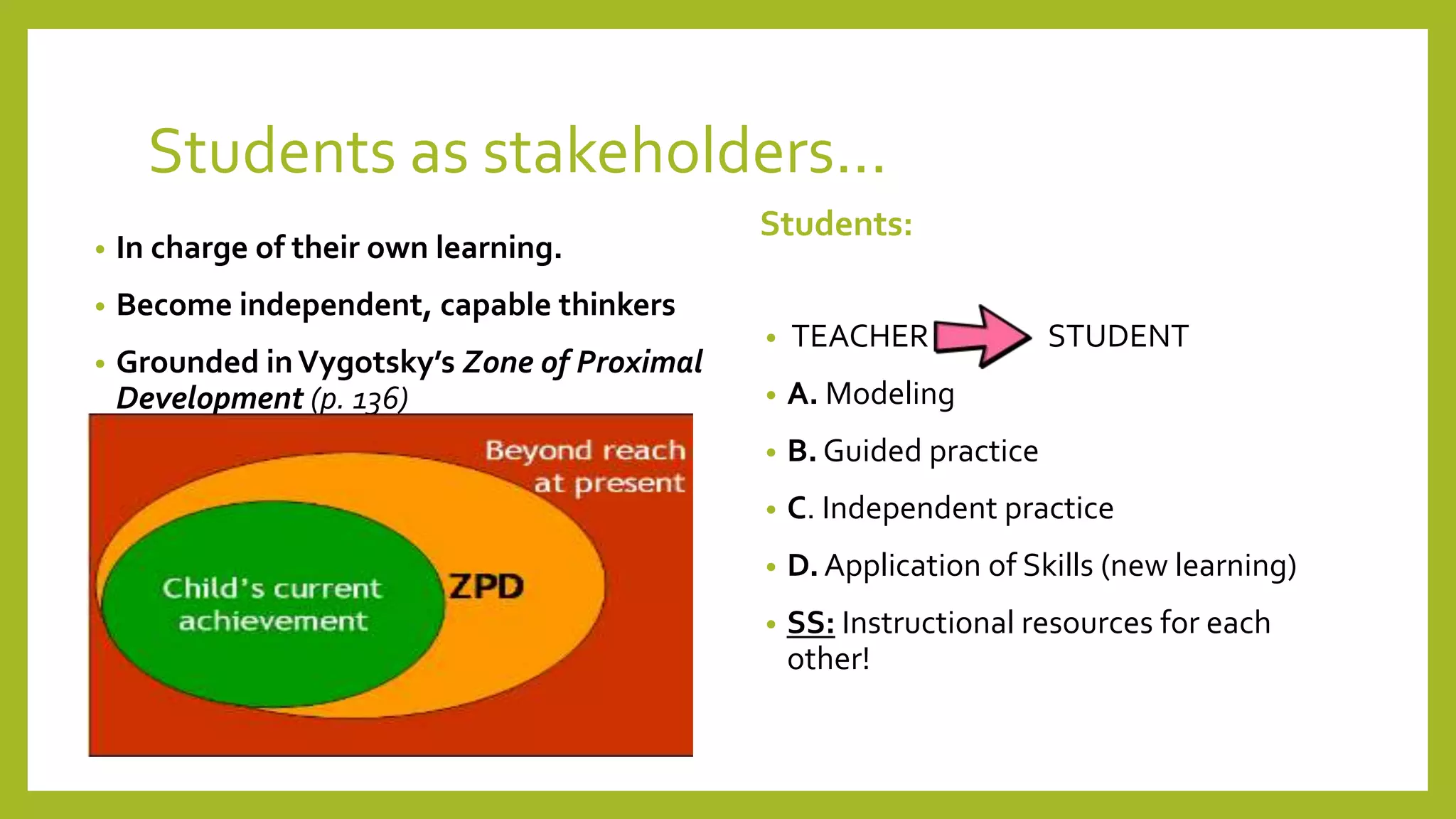
• Grounded inVygotsky’s Zone of Proximal
Development (p. 136)
• Retrieved from: http://ehlt.flinders.edu.au/education/DLiT/2006/Lstyles/Glossary.htm
Students:
• TEACHER STUDENT
• A. Modeling
• B. Guided practice
• C. Independent practice
• D. Application of Skills (new learning)
• SS: Instructional resources for each
other!
Can you think of ways of expanding their
engagement in instructional assessment?
Connecting Students & Classrooms...
• Amplify student presence through
publishing & Broadcasting
• Establish partners in Community and
beyond
• Opportunities for SERVICE
LEARNING (Connection)
• Curriculum design… authentic
problems
• Accept student ideas (assets)
• Mystery Skype
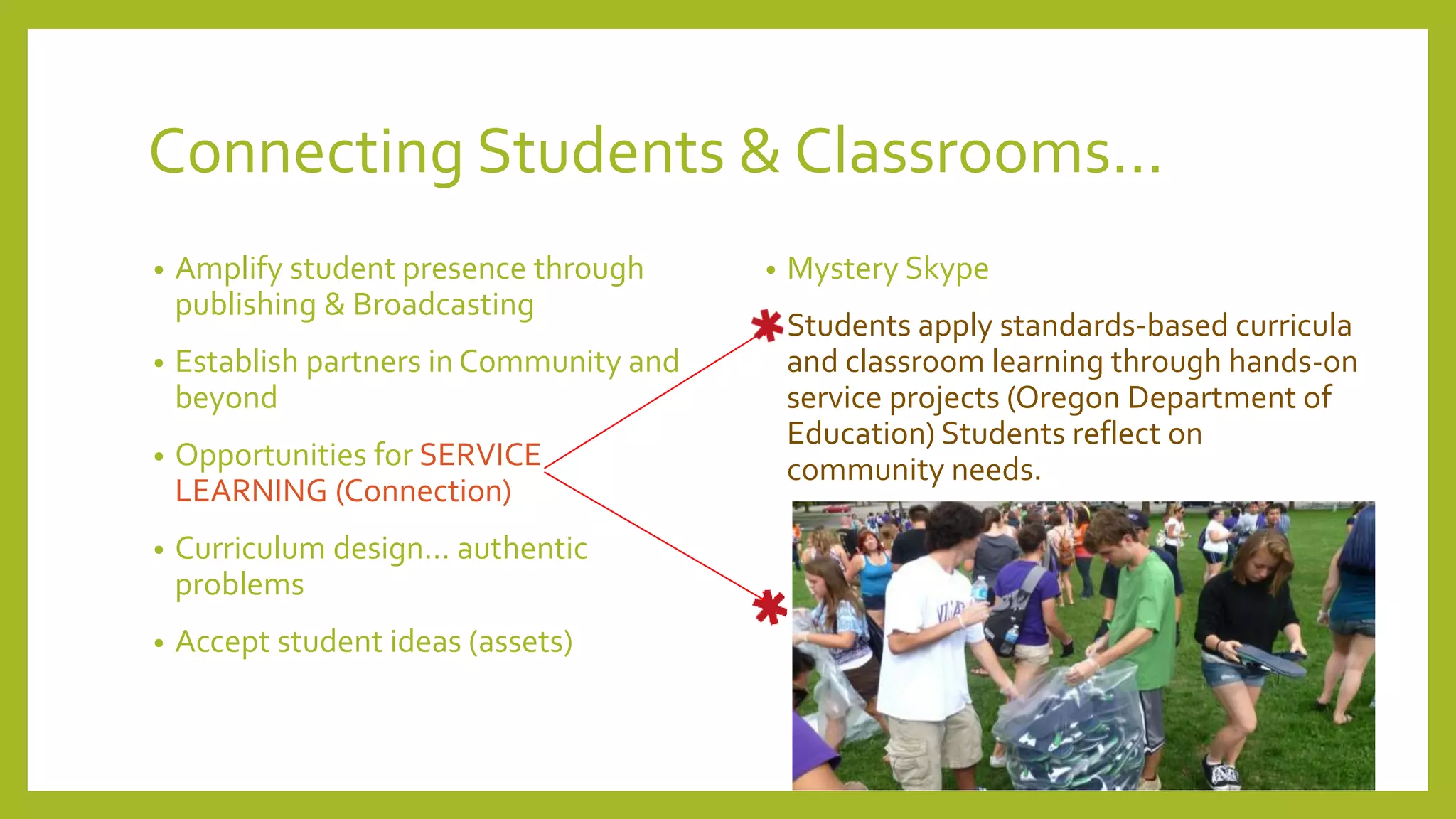
• Students apply standards-based curricula
and classroom learning through hands-on
service projects (Oregon Department of
Education) Students reflect on
community needs.
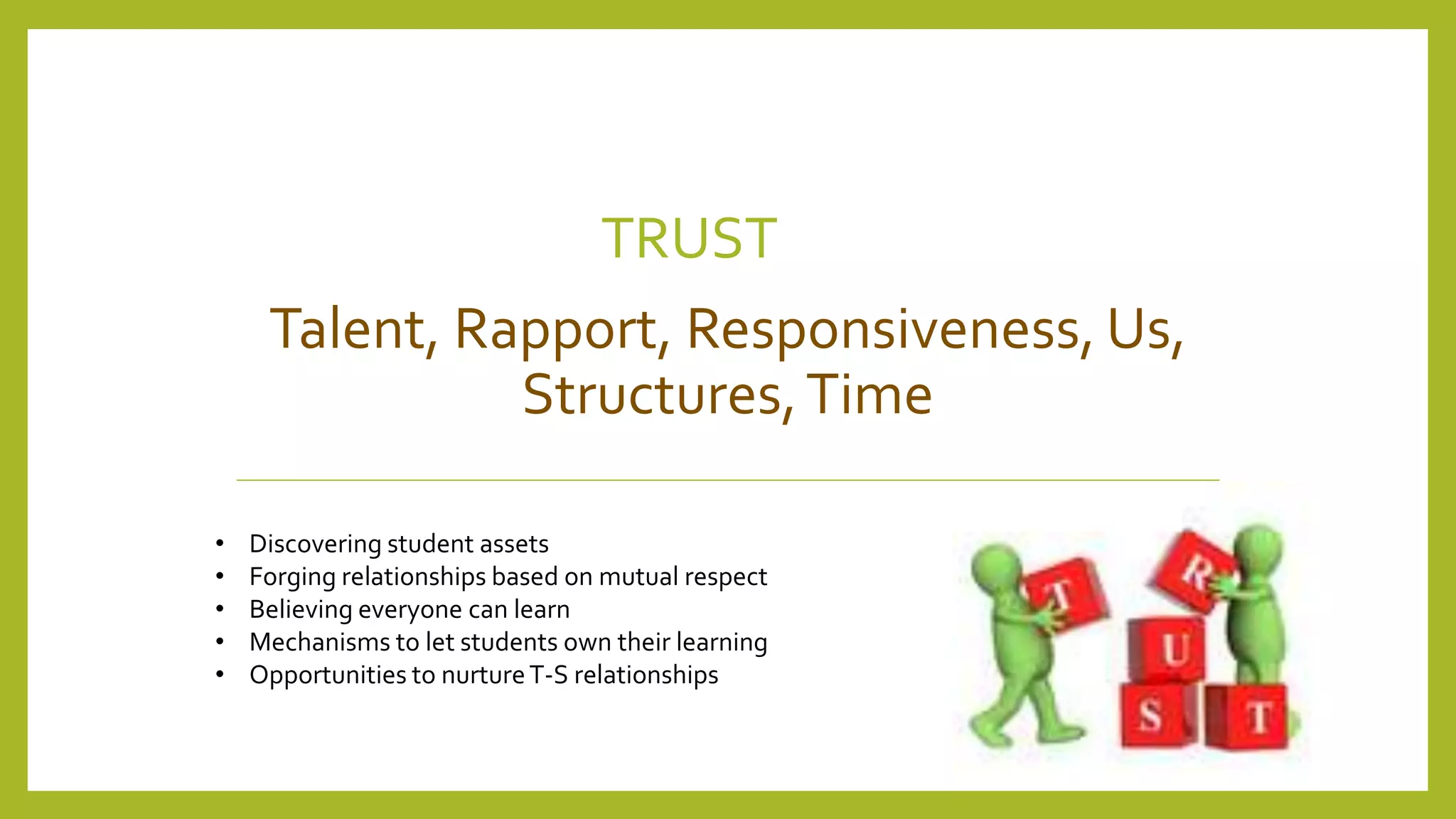
TRUST
Talent, Rapport, Responsiveness, Us,
Structures,Time
• Discovering student assets
• Forging relationships based on mutual respect
• Believing everyone can learn
• Mechanisms to let students own their learning
• Opportunities to nurtureT-S relationships
Assessment as Learning
• Inquiry habits
• Learner autonomy
• Advanced intrinsic motivation
• Honor intellectual & life experiences of student
• Include student in assessment planning (background knowledge)
•
Student planning
• Involve students
• EvaluatingAssessment as learning
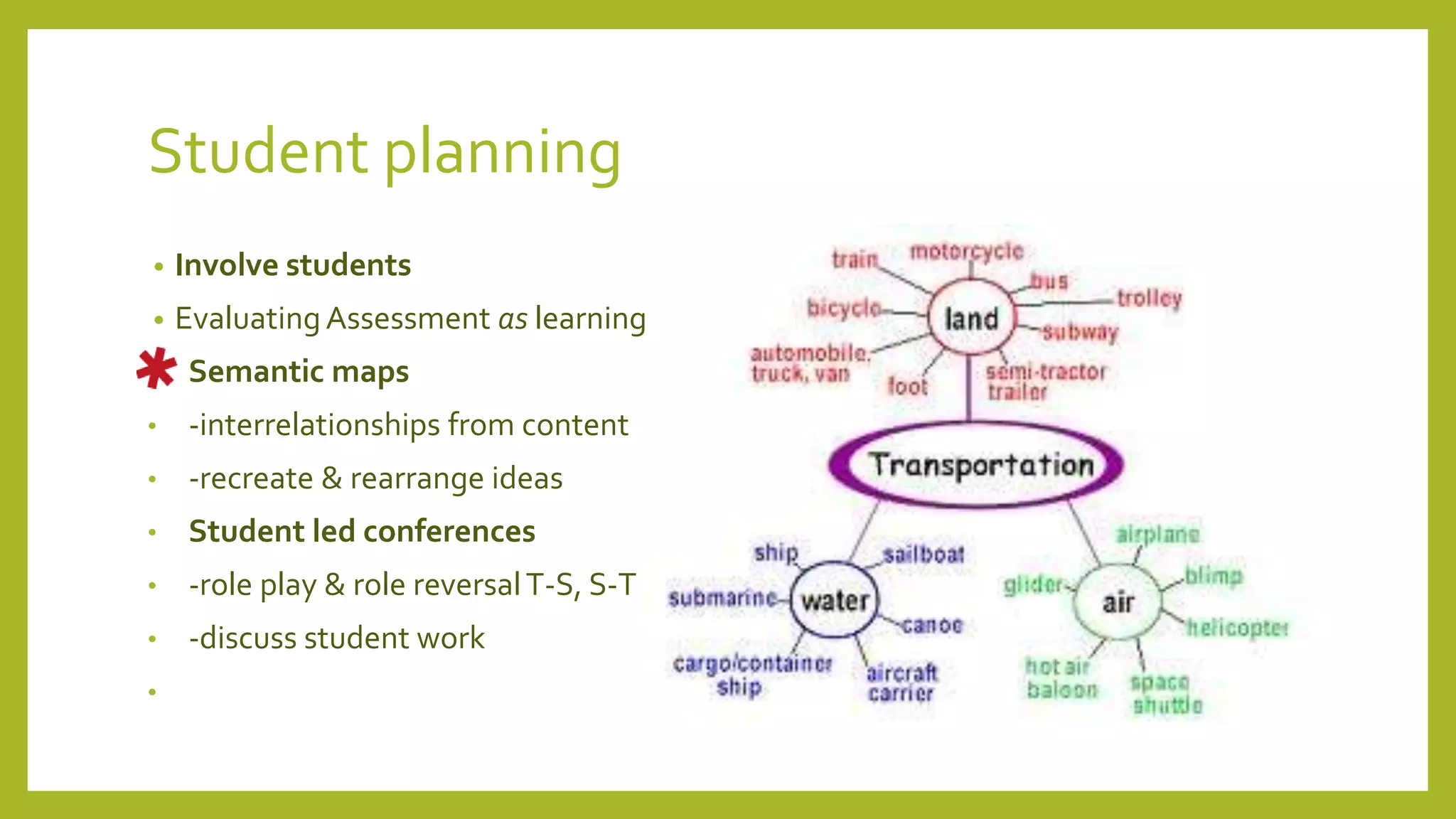
• Semantic maps
• -interrelationships from content
• -recreate & rearrange ideas
• Student led conferences
• -role play & role reversalT-S, S-T
• -discuss student work
•
Assessment as Learning (feedback)
Peers
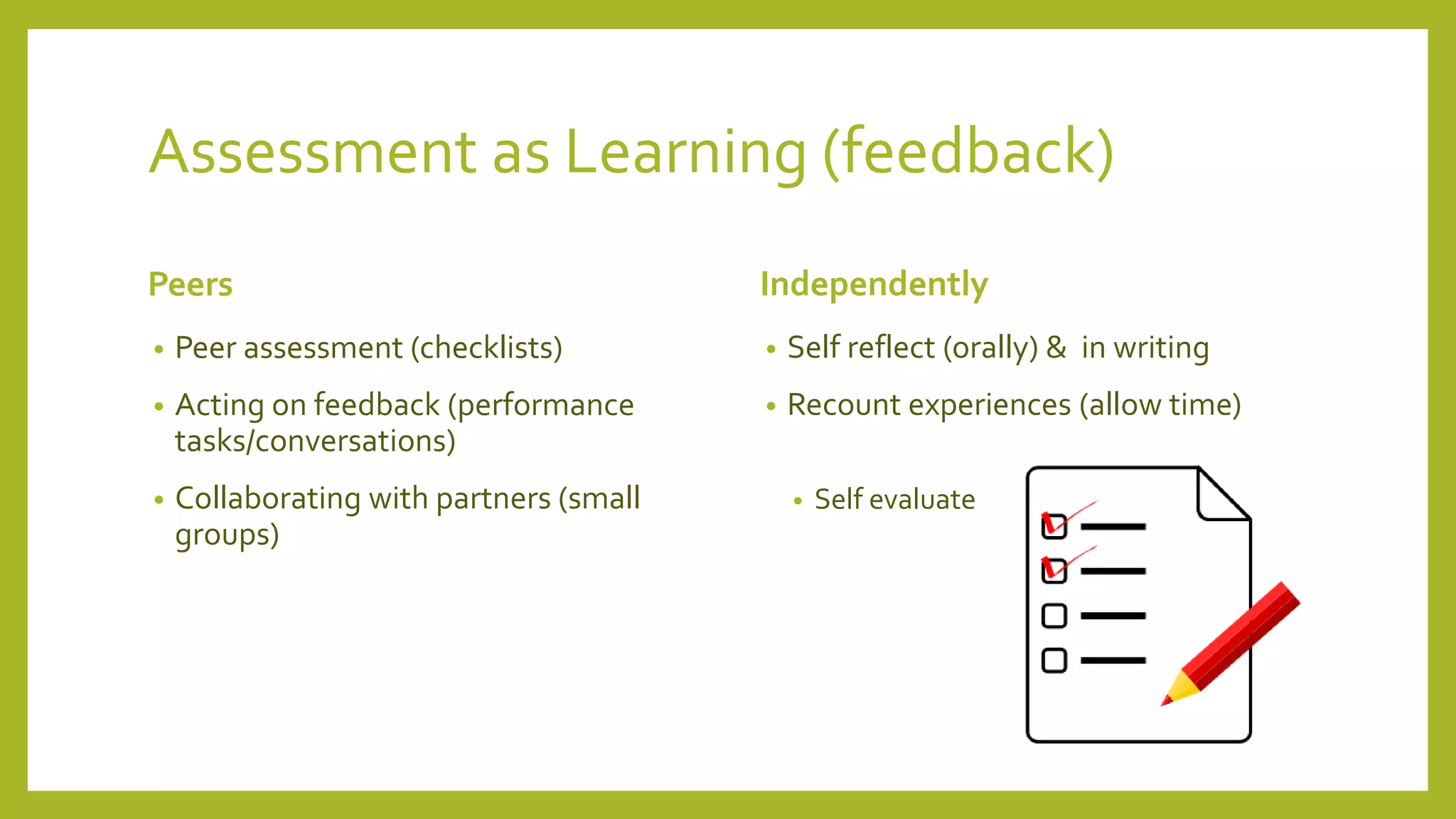
• Peer assessment (checklists)
• Acting on feedback (performance
tasks/conversations)
• Collaborating with partners (small
groups)
Independently
• Self reflect (orally) & in writing
• Recount experiences (allow time)
• Self evaluate
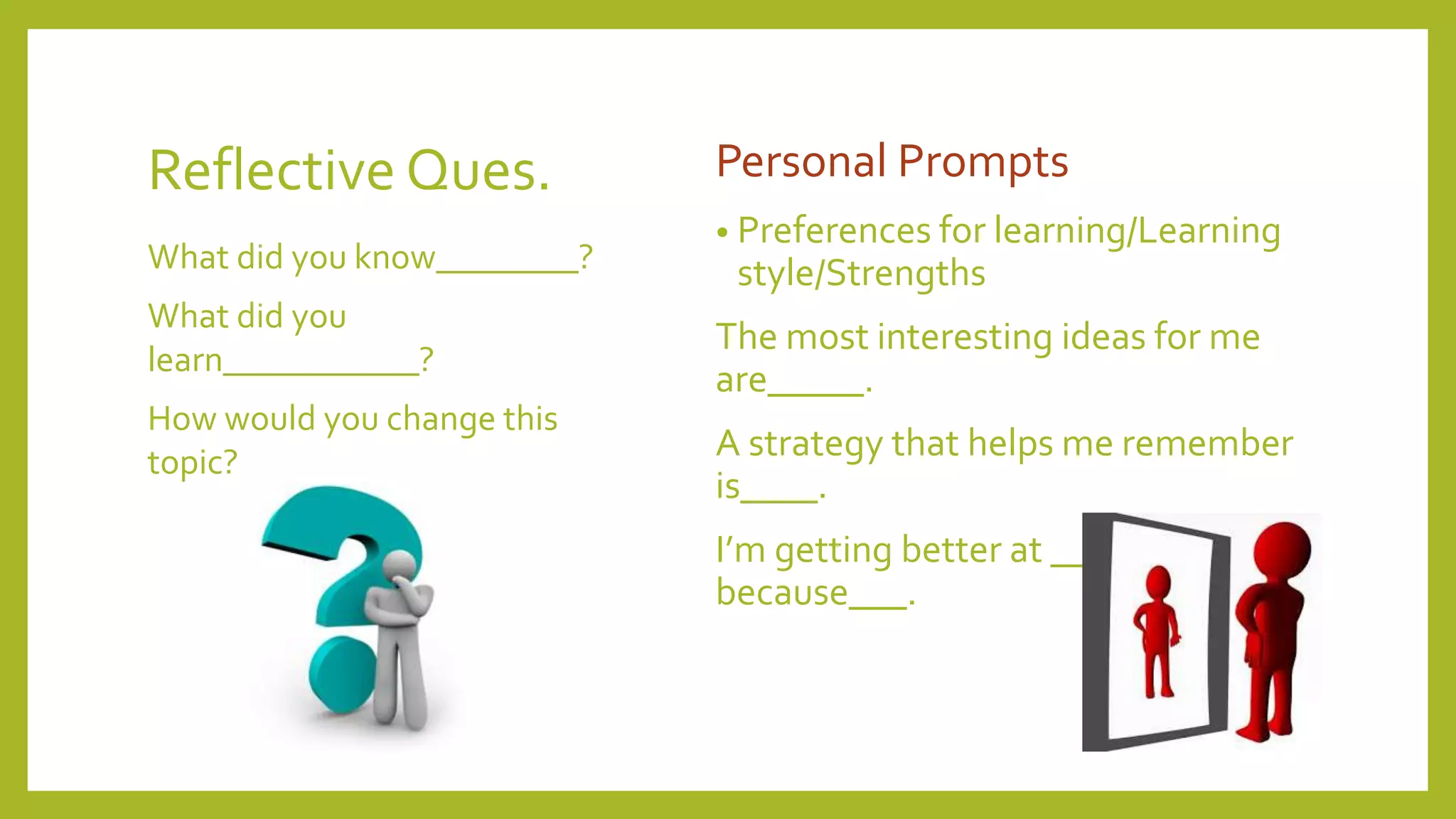
Reflective Ques. Personal Prompts
• Preferences for learning/Learning
style/Strengths
The most interesting ideas for me
are_____.
A strategy that helps me remember
is____.
I’m getting better at ____
because___.
What did you know________?
What did you
learn___________?
How would you change this
topic?
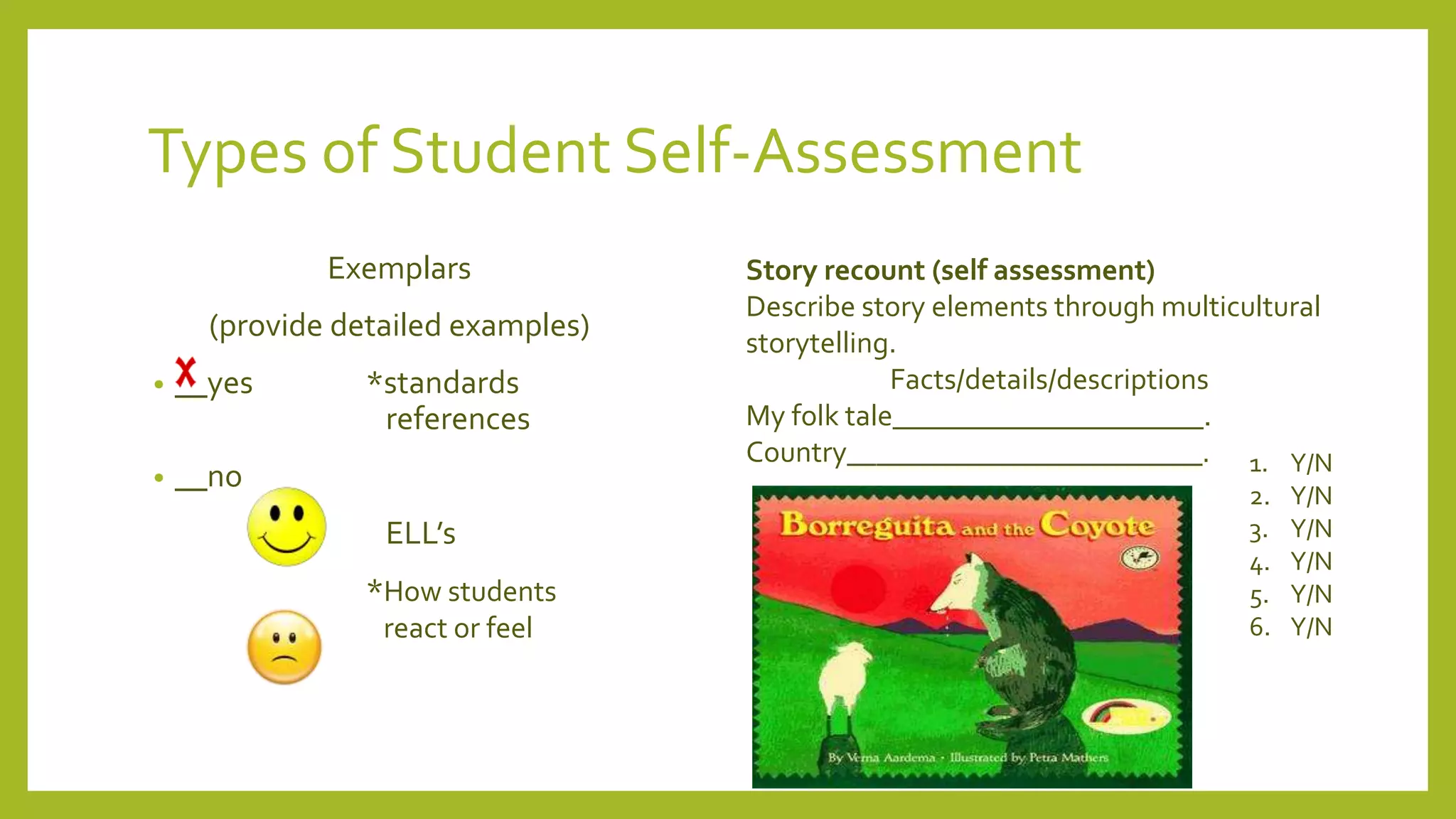
Types of Student Self-Assessment
Exemplars
(provide detailed examples)
• __yes *standards
references
• __no
ELL’s
*How students
react or feel
Story recount (self assessment)
Describe story elements through multicultural
storytelling.
Facts/details/descriptions
My folk tale_____________________.
Country________________________. 1. Y/N
2. Y/N
3. Y/N
4. Y/N
5. Y/N
6. Y/N
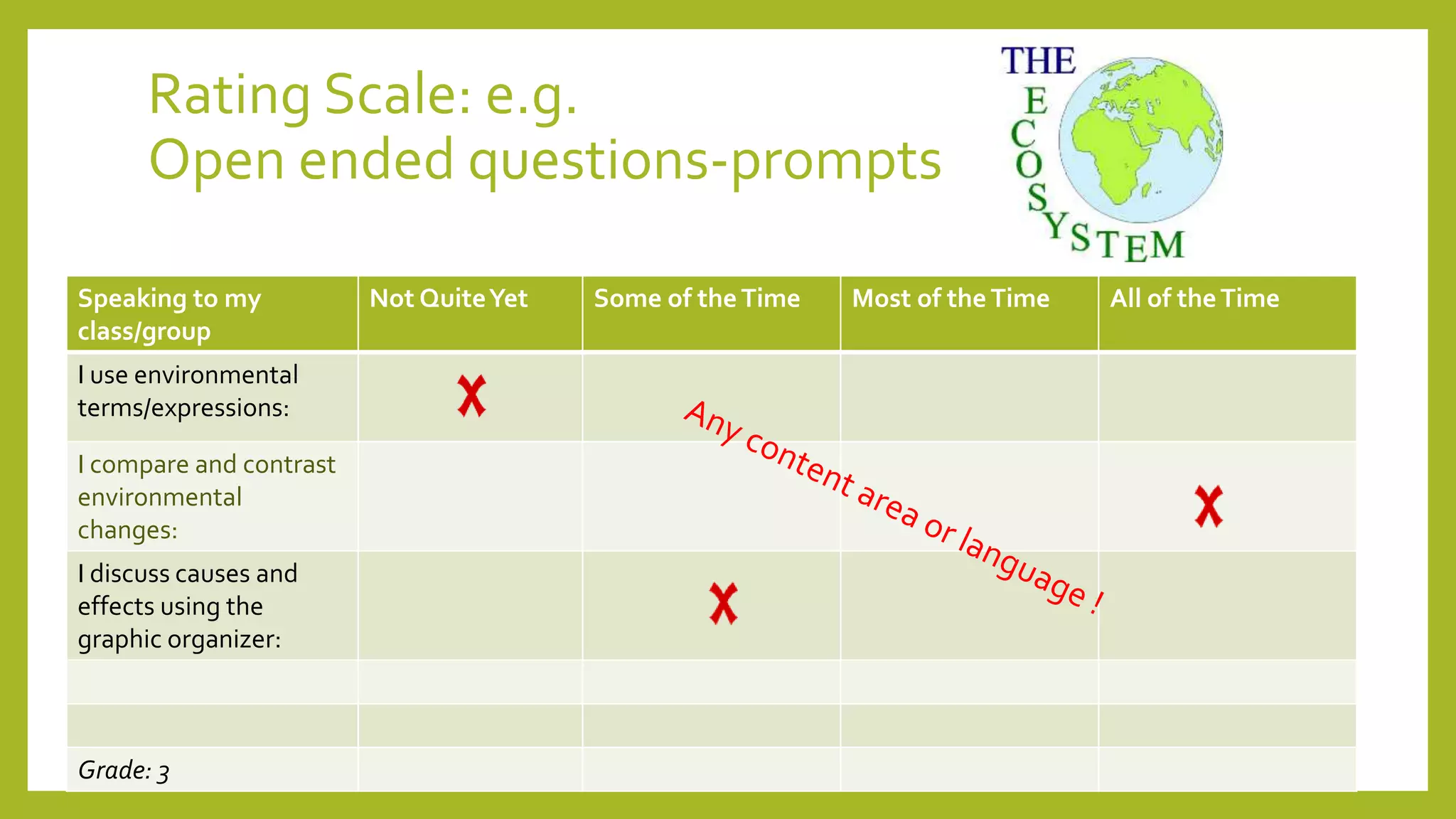
Rating Scale: e.g.
Open ended questions-prompts
Speaking to my
class/group
Not QuiteYet Some of theTime Most of theTime All of theTime
I use environmental
terms/expressions:
I compare and contrast
environmental
changes:
I discuss causes and
effects using the
graphic organizer:
Grade: 3
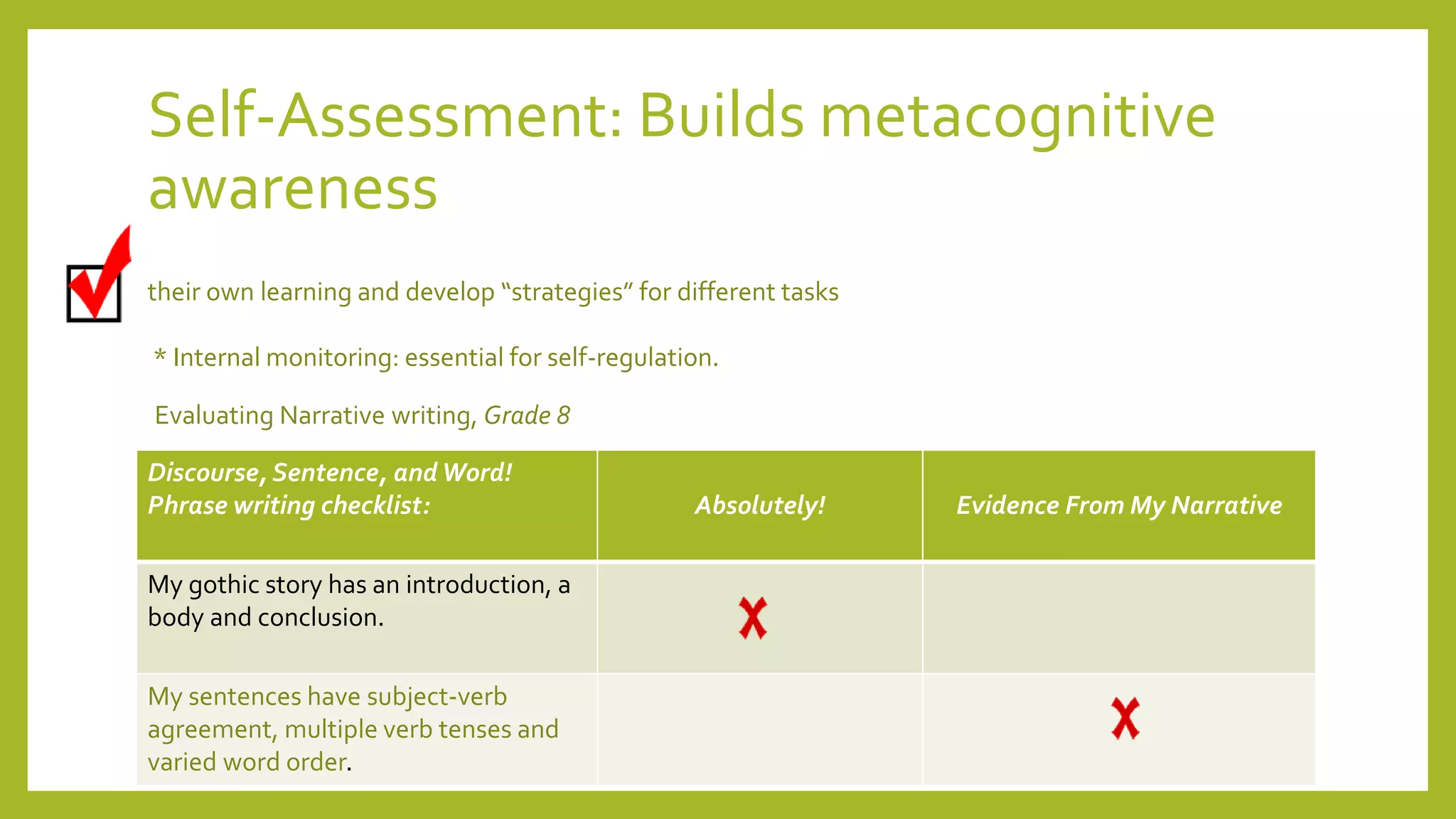
Self-Assessment: Builds metacognitive
awareness
their own learning and develop “strategies” for different tasks
* Internal monitoring: essential for self-regulation.
Evaluating Narrative writing, Grade 8
Discourse, Sentence, andWord!
Phrase writing checklist: Absolutely! Evidence From My Narrative
My gothic story has an introduction, a
body and conclusion.
My sentences have subject-verb
agreement, multiple verb tenses and
varied word order.
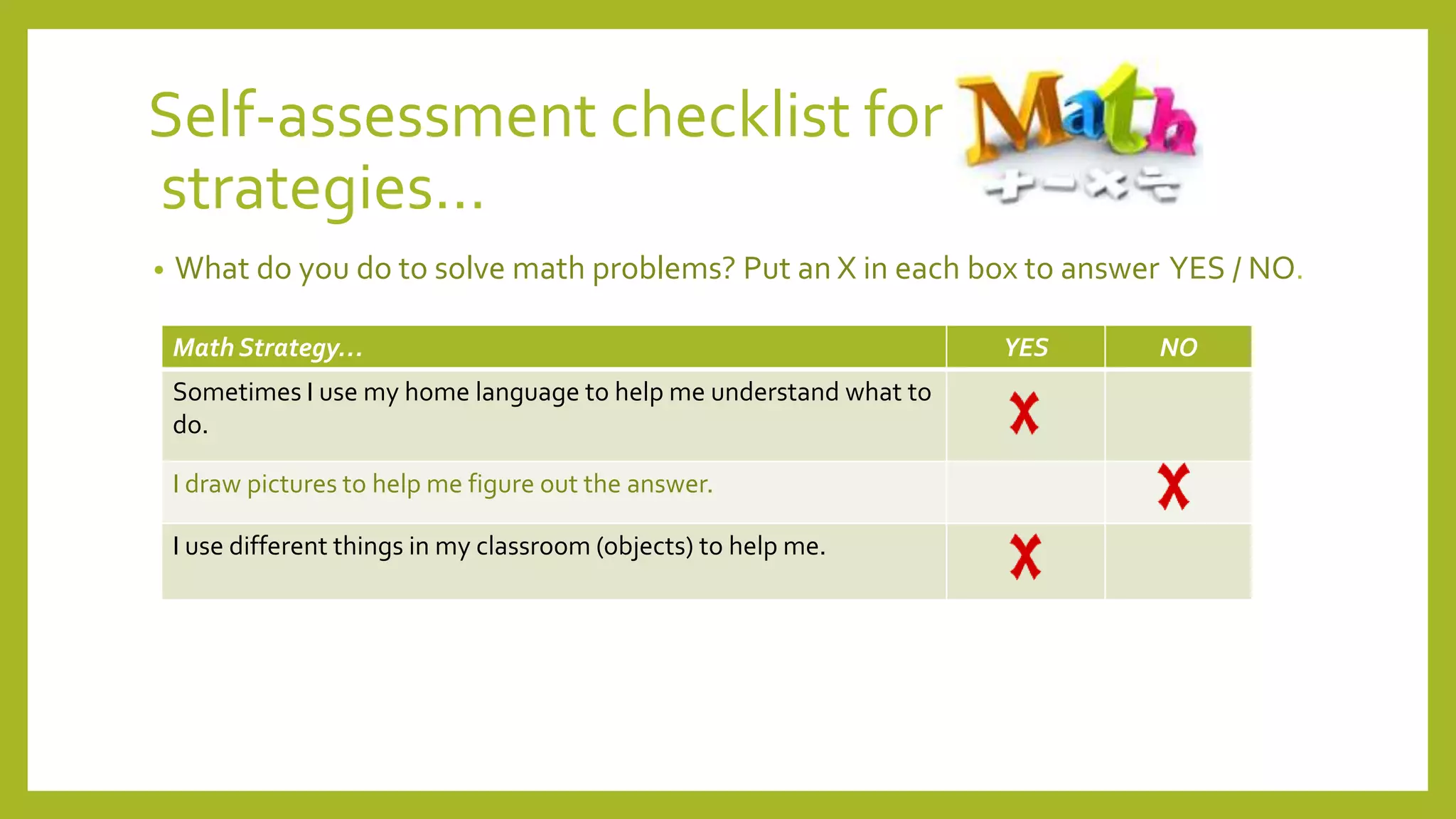
Self-assessment checklist for
strategies…
• What do you do to solve math problems? Put an X in each box to answer YES / NO.
Math Strategy… YES NO
Sometimes I use my home language to help me understand what to
do.
I draw pictures to help me figure out the answer.
I use different things in my classroom (objects) to help me.
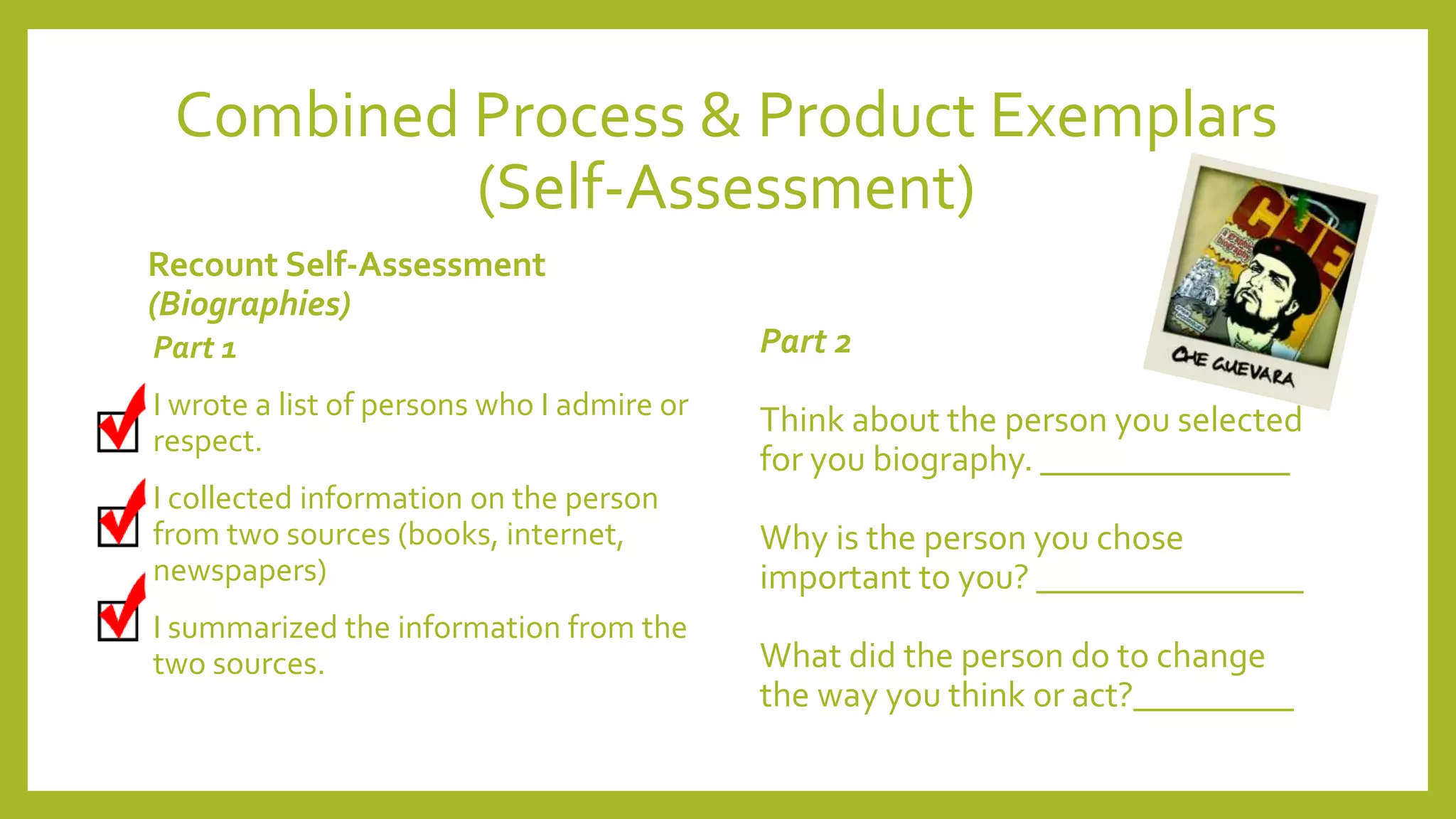
Combined Process & Product Exemplars
(Self-Assessment)
Recount Self-Assessment
(Biographies)
Part 1
I wrote a list of persons who I admire or
respect.
I collected information on the person
from two sources (books, internet,
newspapers)
I summarized the information from the
two sources.
Part 2
Think about the person you selected
for you biography. ______________
Why is the person you chose
important to you? _______________
What did the person do to change
the way you think or act?_________
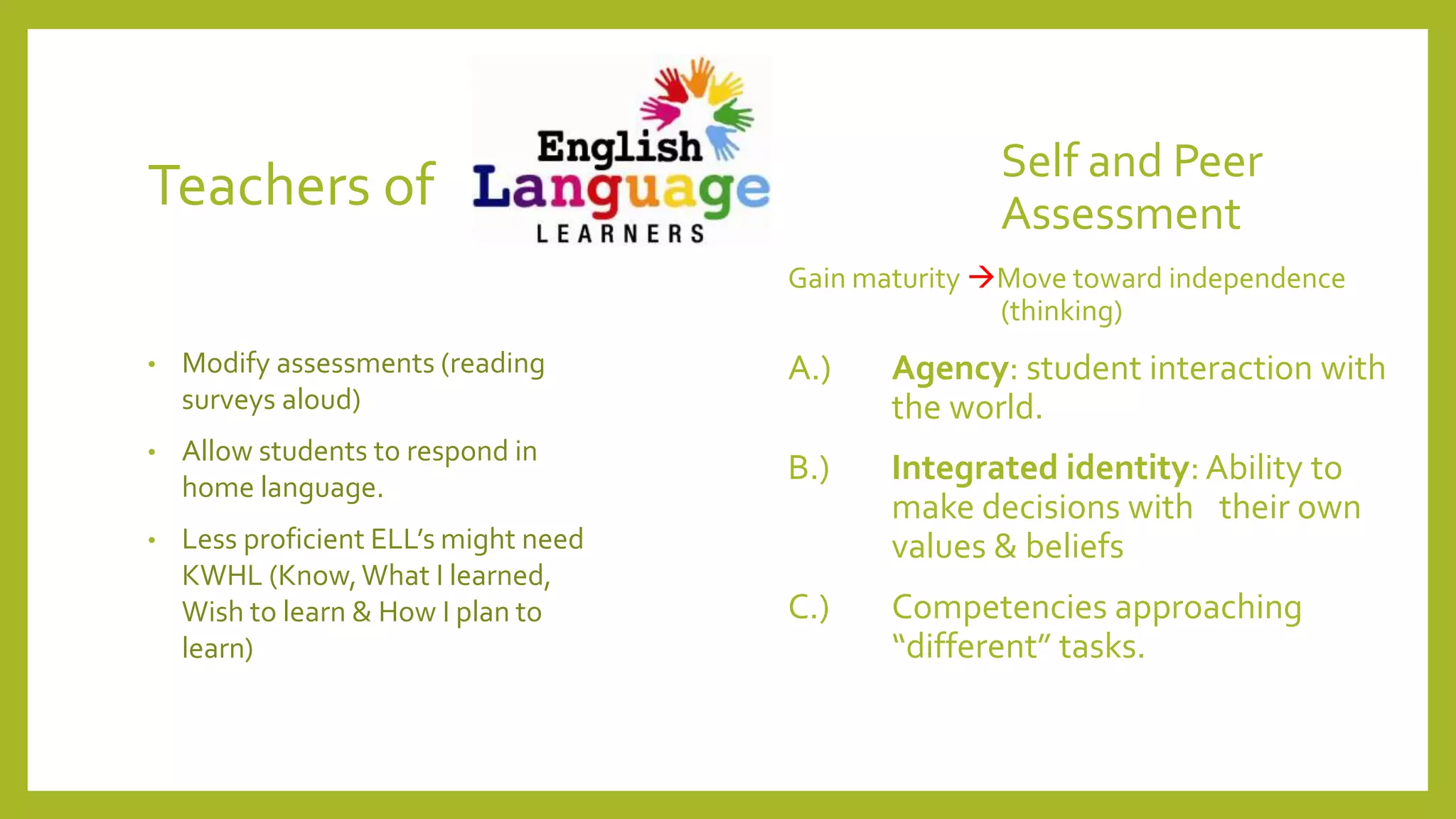
Teachers of Self and Peer
Assessment
Gain maturity Move toward independence
(thinking)
A.) Agency: student interaction with
the world.
B.) Integrated identity: Ability to
make decisions with their own
values & beliefs
C.) Competencies approaching
“different” tasks.
• Modify assessments (reading
surveys aloud)
• Allow students to respond in
home language.
• Less proficient ELL’s might need
KWHL (Know,What I learned,
Wish to learn & How I plan to
learn)
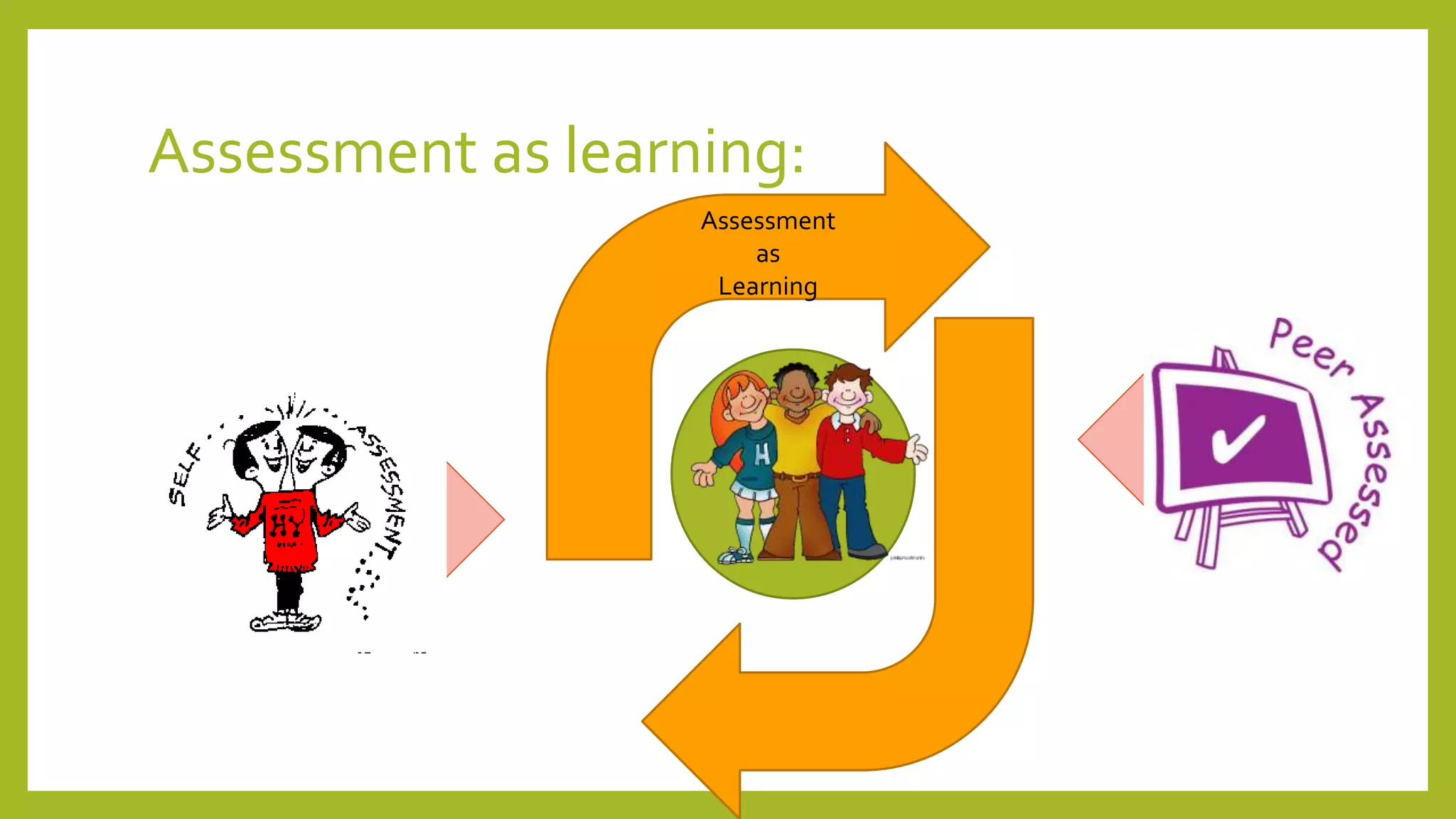
Assessment as learning:
Students
Assessment
as
Learning
SelfAssessment
Peer Assessment
HTTPS://WWW.TEACHINGCHANNEL.ORG/VIDEOS/PEER-TEACHING--2
Retrieved from:TheTeaching Channel
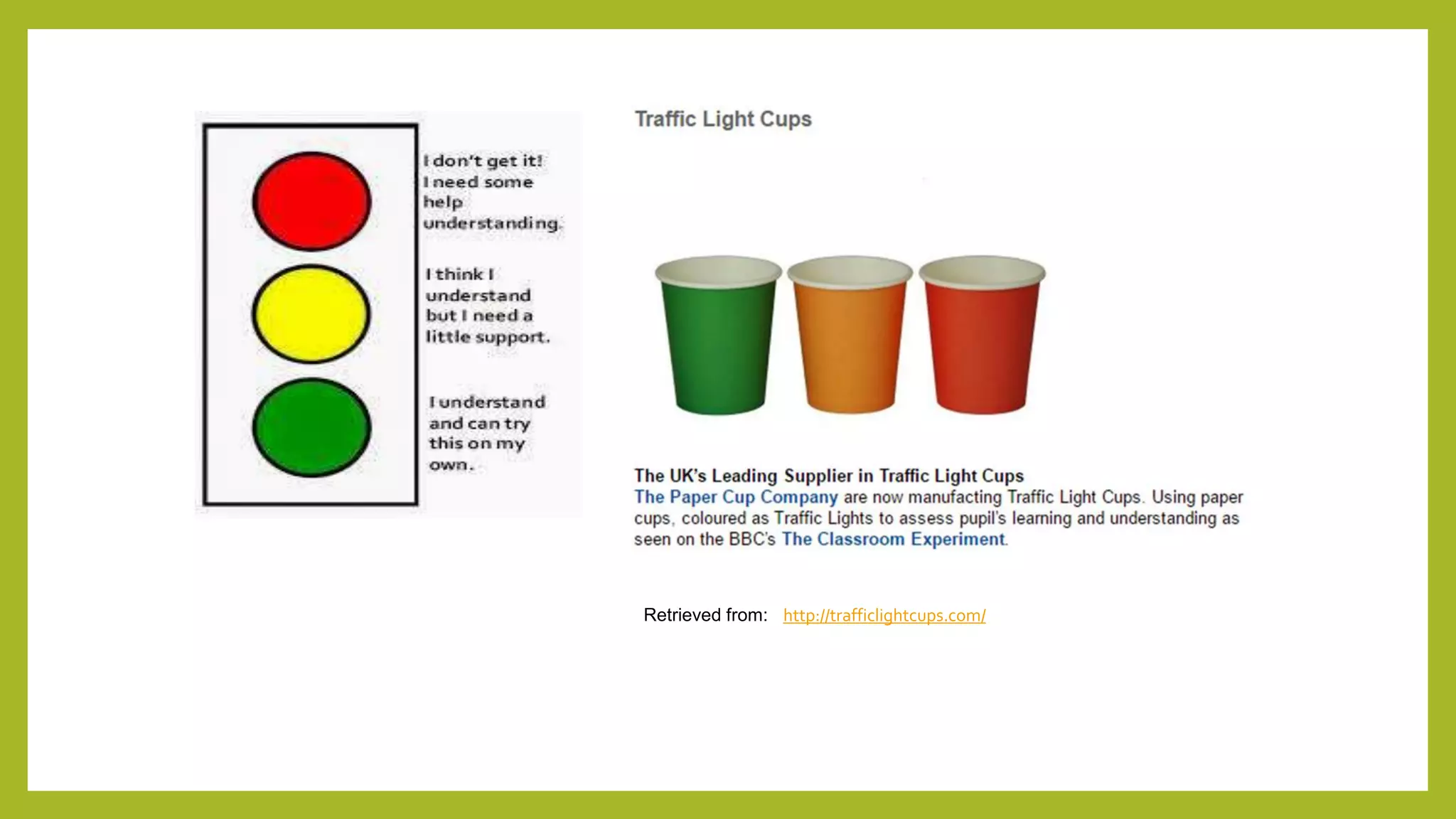
Retrieved from: http://trafficlightcups.com/
Chapter 5:
Discussion Questions
Assessment as Learning
1.) Based on the information in this chapter, how can you as an individual educator or as a member of a
professional learning team provide a rationale for having greater involvement of students in decision
making within classrooms?
2.) How might you introduce assessment as learning through a gradual release of responsibility?
3.) How can planning and enacting ways to engage students up front in their own learning be reinforced with
descriptive feedback?
4.) How do you see ELL’s, ELL’s with disabilities, or other students with disabilities participating in assessment
as learning?
5.) How can student voice in assessment as learning have more of a presence in your classroom?
6.) How can assessment as learning promote student equity?
REFERENCES
•
• Atherton. (2005). Glossary. Retrieved July 09, 2016, from
http://ehlt.flinders.edu.au/education/DLiT/2006/Lstyles/Glossary.htm
• Gottlieb, M. H. (2016). Assessing English language learners: Bridges to
educational equity: Connecting academic language proficiency to student
achievement. United States: SAGE Publications.
• Self-Assessment and Peer Support. (n.d.). Retrieved July 10, 2016, from
https://www.teachingchannel.org/videos/peer-teaching--2
• Traffic Light Cups - Home. (n.d.). Retrieved July 10, 2016, from
http://trafficlightcups.com/

Assessment as Learning ED546

  • 1.
    ASSESSMENT AS LEARNING Ruth AnnDapkus ED 546 Summer 2016
  • 2.
    Students as stakeholders... •In charge of their own learning. • Become independent, capable thinkers • Grounded inVygotsky’s Zone of Proximal Development (p. 136) • Retrieved from: http://ehlt.flinders.edu.au/education/DLiT/2006/Lstyles/Glossary.htm Students: • TEACHER STUDENT • A. Modeling • B. Guided practice • C. Independent practice • D. Application of Skills (new learning) • SS: Instructional resources for each other!
  • 3.
    Can you thinkof ways of expanding their engagement in instructional assessment?
  • 4.
    Connecting Students &Classrooms... • Amplify student presence through publishing & Broadcasting • Establish partners in Community and beyond • Opportunities for SERVICE LEARNING (Connection) • Curriculum design… authentic problems • Accept student ideas (assets) • Mystery Skype • Students apply standards-based curricula and classroom learning through hands-on service projects (Oregon Department of Education) Students reflect on community needs.
  • 5.
    TRUST Talent, Rapport, Responsiveness,Us, Structures,Time • Discovering student assets • Forging relationships based on mutual respect • Believing everyone can learn • Mechanisms to let students own their learning • Opportunities to nurtureT-S relationships
  • 6.
    Assessment as Learning •Inquiry habits • Learner autonomy • Advanced intrinsic motivation • Honor intellectual & life experiences of student • Include student in assessment planning (background knowledge) •
  • 7.
    Student planning • Involvestudents • EvaluatingAssessment as learning • Semantic maps • -interrelationships from content • -recreate & rearrange ideas • Student led conferences • -role play & role reversalT-S, S-T • -discuss student work •
  • 8.
    Assessment as Learning(feedback) Peers • Peer assessment (checklists) • Acting on feedback (performance tasks/conversations) • Collaborating with partners (small groups) Independently • Self reflect (orally) & in writing • Recount experiences (allow time) • Self evaluate
  • 9.
    Reflective Ques. PersonalPrompts • Preferences for learning/Learning style/Strengths The most interesting ideas for me are_____. A strategy that helps me remember is____. I’m getting better at ____ because___. What did you know________? What did you learn___________? How would you change this topic?
  • 10.
    Types of StudentSelf-Assessment Exemplars (provide detailed examples) • __yes *standards references • __no ELL’s *How students react or feel Story recount (self assessment) Describe story elements through multicultural storytelling. Facts/details/descriptions My folk tale_____________________. Country________________________. 1. Y/N 2. Y/N 3. Y/N 4. Y/N 5. Y/N 6. Y/N
  • 11.
    Rating Scale: e.g. Openended questions-prompts Speaking to my class/group Not QuiteYet Some of theTime Most of theTime All of theTime I use environmental terms/expressions: I compare and contrast environmental changes: I discuss causes and effects using the graphic organizer: Grade: 3
  • 12.
    Self-Assessment: Builds metacognitive awareness theirown learning and develop “strategies” for different tasks * Internal monitoring: essential for self-regulation. Evaluating Narrative writing, Grade 8 Discourse, Sentence, andWord! Phrase writing checklist: Absolutely! Evidence From My Narrative My gothic story has an introduction, a body and conclusion. My sentences have subject-verb agreement, multiple verb tenses and varied word order.
  • 13.
    Self-assessment checklist for strategies… •What do you do to solve math problems? Put an X in each box to answer YES / NO. Math Strategy… YES NO Sometimes I use my home language to help me understand what to do. I draw pictures to help me figure out the answer. I use different things in my classroom (objects) to help me.
  • 14.
    Combined Process &Product Exemplars (Self-Assessment) Recount Self-Assessment (Biographies) Part 1 I wrote a list of persons who I admire or respect. I collected information on the person from two sources (books, internet, newspapers) I summarized the information from the two sources. Part 2 Think about the person you selected for you biography. ______________ Why is the person you chose important to you? _______________ What did the person do to change the way you think or act?_________
  • 15.
    Teachers of Selfand Peer Assessment Gain maturity Move toward independence (thinking) A.) Agency: student interaction with the world. B.) Integrated identity: Ability to make decisions with their own values & beliefs C.) Competencies approaching “different” tasks. • Modify assessments (reading surveys aloud) • Allow students to respond in home language. • Less proficient ELL’s might need KWHL (Know,What I learned, Wish to learn & How I plan to learn)
  • 16.
  • 17.
  • 18.
  • 19.
    Chapter 5: Discussion Questions Assessmentas Learning 1.) Based on the information in this chapter, how can you as an individual educator or as a member of a professional learning team provide a rationale for having greater involvement of students in decision making within classrooms? 2.) How might you introduce assessment as learning through a gradual release of responsibility? 3.) How can planning and enacting ways to engage students up front in their own learning be reinforced with descriptive feedback? 4.) How do you see ELL’s, ELL’s with disabilities, or other students with disabilities participating in assessment as learning? 5.) How can student voice in assessment as learning have more of a presence in your classroom? 6.) How can assessment as learning promote student equity?
  • 20.
    REFERENCES • • Atherton. (2005).Glossary. Retrieved July 09, 2016, from http://ehlt.flinders.edu.au/education/DLiT/2006/Lstyles/Glossary.htm • Gottlieb, M. H. (2016). Assessing English language learners: Bridges to educational equity: Connecting academic language proficiency to student achievement. United States: SAGE Publications. • Self-Assessment and Peer Support. (n.d.). Retrieved July 10, 2016, from https://www.teachingchannel.org/videos/peer-teaching--2 • Traffic Light Cups - Home. (n.d.). Retrieved July 10, 2016, from http://trafficlightcups.com/

Editor's Notes

  • #3 ZPD: dissemination process. Gradual "bridge" or release of responsibility (a multi-phase process embeded in instruction) moves responsibility from teaching to learning.
  • #4 Involve students in the decision making process no matter their age, learning disability language proficiency, or achievement. Devise ways of expanding their engagement in instructional assessment. Ease them into becoming indep. Thinkers/doers. Guide students in setting personal goals & indiv. Plan
  • #5 With technology we are no longer limited to a single classroom: Mystery Skype : Skype in the Classroom
  • #6 Reflection lets teachers examine how working with students from linguistically and culturally diverse backgrounds is important....to connect with language, cultures, families. Teachers need to reflect. There are challenges. It’s necessary to overcome them. Many teachers will not be familiar with students’ languages and cultures at first.
  • #7 Including cultural identity in the process of planning assessment & personal connections = Provide a Spring board as well as lead to a deeper understanding
  • #8 (Pg. 142) Include students in planning of assessments. Semantic maps: students explain to each other the importance of ideas. One way to help students see the interconnectedness. Students can “recreate” or “rearrange” ideas.
  • #9 Promotes metacognitive, metalinguistic and sociocultural awareness. Motivates students to analyze quality of their work ELL’s do this as a whole group activity (entire class)
  • #11 1.) I can describe where the story takes place Y/N 2.) I can tell when the story takes place Y/N 3.) I can describe who the character are in the story. 4.) I can tell what the characters did Y/N
  • #12 Students may assume many roles to reflect on their learning such as scientists, mathematicians, historians or researchers.
  • #13 Metacognitive awareness=how one thinks
  • #14 Lists metacognitive strategies that students might engage in when attempting to solve math problems. Students are checking their own learning & developing a repertoire of strategies to apply to learning again…”different tasks” (Gottleib, 2016, p. 151).
  • #15 Product and process assessments can be combined. Students respond by checking & then reflect. For example, a step by step process to compose biographical info. Followed by open-ended “reflective” questions (Gottleib, 2016, p. 153).
  • #16 Pg. 154 Too often teachers dominate discussions in class and leave little rom for “speech” in class. Peer assessment give the opportunity for meaningful discussion & practice of academic language (tied to standards & activities/tasks within the unit.
  • #17 Assessment as learning revolves around “students”. Goal: student agency…when students gradually take responsibility for their own learning & become integrally attached to it through “self & peer” assessment. They become familiar with the role and content standards as well as lang. proficiency/development standards. E.g. lifelong learners..
  • #18 https://www.teachingchannel.org/videos/peer-teaching--2 Questions: Could you see the “traffic light” system implemented for quick self-assessment? What does peer support offer for efficient re-teaching? (For ELL’s?) What different and useful information could you learn from students self-assessment as compared to your own assessment of their work?
  • #19 to rate existing knowledge to show understanding to indicate responses to questions to ask a question to seek clarification to raise a point to rate achievement to create a formative dialogue.
  • #20 Pass out slips of paper with individual questions. Have students work in pairs with “elbow buddy” to answer the questions. Allow 5-7 minutes for this activity. Next: have students use their cups and share with the class what their consensus within their group was. 1. Student group will read the question and “listeners” e.g. the rest of the class will make use of their cups.