Peer and
  Self-Assessment
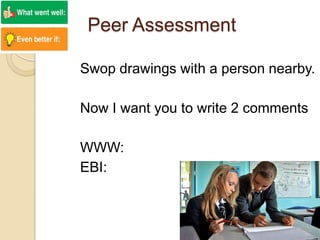
Task:

On a plain piece of paper, draw a picture of a
car.
Peer Assessment

Swop drawings with a person nearby.

Now I want you to write 2 comments

WWW:
EBI:
NTIW:
        Self Assessment
        Read the comments your peer has
        written and write you own comment at
        the bottom

        NTIW:
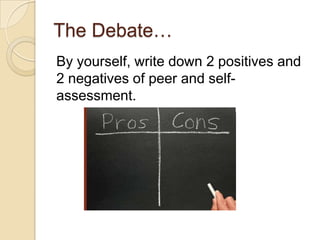
The Debate…
By yourself, write down 2 positives and
2 negatives of peer and self-
assessment.
Discuss…
Hodgen, J., & Wiliam, D. (2006). Mathematics inside
the black box: Assessment for learning in the
mathematics classroom. London: GL Assessment.

   This type of formative assessment
    ‘helps teachers to filter the rich data
    that arises in class discussion and
    activity so that professional
    judgements can be made about the
    next steps in learning. Feedback,
    peer and self assessment have an
    important role to play in this process
    and, if utilized properly, can result in
    large learning gains’.
Hodgen, J., & Wiliam, D. (2006). Mathematics inside
the black box: Assessment for learning in the
mathematics classroom. London: GL Assessment.
 Peer and self-assessment plays a vital
  role in students becoming familiar with
  the way that mathematical work is
  judged.
 The process promotes both active
  involvement and practiced in making
  judgement about quality of work –
  their own and fellow students.’
The Smith Report 2004
In 2004 the Smith report highlighted the
need for extended peer assessment:
Peer assessment should be ‘both
supportive and
developmental,...becoming more
common place in school.’
When to use it…
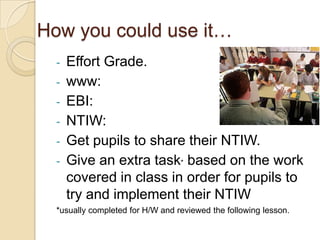
How you could use it…
  -   Effort Grade.
  -   www:
  -   EBI:
  -   NTIW:
  -   Get pupils to share their NTIW.
  -   Give an extra task* based on the work
      covered in class in order for pupils to
      try and implement their NTIW
  *usually completed for H/W and reviewed the following lesson.

Peer and Self Assessment in the Classroom

  • 1.
    Peer and Self-Assessment Task: On a plain piece of paper, draw a picture of a car.
  • 2.
    Peer Assessment Swop drawingswith a person nearby. Now I want you to write 2 comments WWW: EBI:
  • 3.
    NTIW: Self Assessment Read the comments your peer has written and write you own comment at the bottom NTIW:
  • 4.
    The Debate… By yourself,write down 2 positives and 2 negatives of peer and self- assessment.
  • 5.
  • 6.
    Hodgen, J., &Wiliam, D. (2006). Mathematics inside the black box: Assessment for learning in the mathematics classroom. London: GL Assessment.  This type of formative assessment ‘helps teachers to filter the rich data that arises in class discussion and activity so that professional judgements can be made about the next steps in learning. Feedback, peer and self assessment have an important role to play in this process and, if utilized properly, can result in large learning gains’.
  • 7.
    Hodgen, J., &Wiliam, D. (2006). Mathematics inside the black box: Assessment for learning in the mathematics classroom. London: GL Assessment.  Peer and self-assessment plays a vital role in students becoming familiar with the way that mathematical work is judged.  The process promotes both active involvement and practiced in making judgement about quality of work – their own and fellow students.’
  • 8.
    The Smith Report2004 In 2004 the Smith report highlighted the need for extended peer assessment: Peer assessment should be ‘both supportive and developmental,...becoming more common place in school.’
  • 9.
  • 10.
    How you coulduse it… - Effort Grade. - www: - EBI: - NTIW: - Get pupils to share their NTIW. - Give an extra task* based on the work covered in class in order for pupils to try and implement their NTIW *usually completed for H/W and reviewed the following lesson.