August 29, 2013
Tonight’s Agenda
 Introductions and attendance
 Course objectives
 Review of the syllabus
 Sentences, paragraphs, and essays
 Electronic writing tools
Course Objectives
1. Reading Critically
The students shall be able to evaluate assigned
readings with a view to their artistic merits,
content, logical progression, and thoroughness of
citations (if any). The students shall be able to find
the main idea of the assigned reading, recognize
and evaluate the supporting details and comment
on the effectiveness of the writer’s overall writing
technique.
Course Objectives
2. Essay Development
The students shall be able to compose units of
discourse and provide ideas and information
suitable to the audience and purpose.
Course Objectives
3. Conventions of Standard American English
The students shall be able to transmit ideas and
information in effective written language by
employing good diction, conventional sentence
structure, and standard written American English
grammar and usage.
Course Objectives
4. Research Skills
The students shall be able to locate and evaluate
primary and secondary sources in both print and
electronic formats and incorporate the relevant
information into a properly documented paper,
both internally and bibliographically.
Required Competencies
 Read with critical comprehension.
 Write clearly and coherently.
 Demonstrate and apply literacy across all the
disciplines.
 Information, technology, workplace, cultural,
quantitative, scientific, and environmental.
 Apply problem-solving skills or methods to make
informed decisions in a variety of contexts.
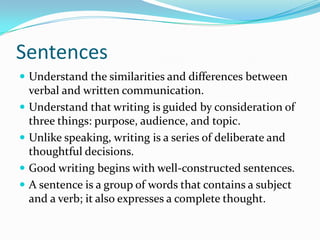
Sentences
 Understand the similarities and differences between
verbal and written communication.
 Understand that writing is guided by consideration of
three things: purpose, audience, and topic.
 Unlike speaking, writing is a series of deliberate and
thoughtful decisions.
 Good writing begins with well-constructed sentences.
 A sentence is a group of words that contains a subject
and a verb; it also expresses a complete thought.
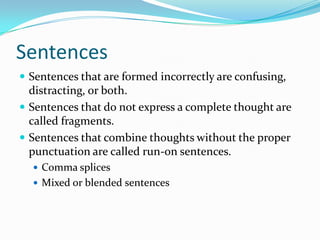
Sentences
 Sentences that are formed incorrectly are confusing,
distracting, or both.
 Sentences that do not express a complete thought are
called fragments.
 Sentences that combine thoughts without the proper
punctuation are called run-on sentences.
 Comma splices
 Mixed or blended sentences
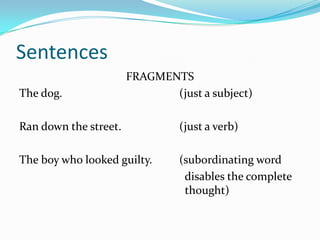
Sentences
FRAGMENTS
The dog. (just a subject)
Ran down the street. (just a verb)
The boy who looked guilty. (subordinating word
disables the complete
thought)
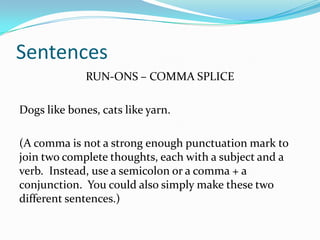
Sentences
RUN-ONS – COMMA SPLICE
Dogs like bones, cats like yarn.
(A comma is not a strong enough punctuation mark to
join two complete thoughts, each with a subject and a
verb. Instead, use a semicolon or a comma + a
conjunction. You could also simply make these two
different sentences.)
Sentences
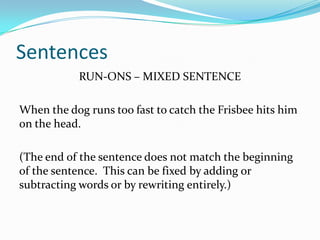
RUN-ONS – MIXED SENTENCE
When the dog runs too fast to catch the Frisbee hits him
on the head.
(The end of the sentence does not match the beginning
of the sentence. This can be fixed by adding or
subtracting words or by rewriting entirely.)
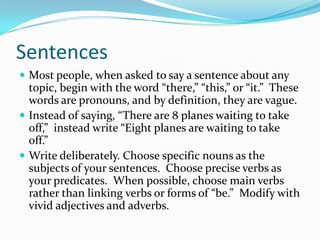
Sentences
 Most people, when asked to say a sentence about any
topic, begin with the word “there,” “this,” or “it.” These
words are pronouns, and by definition, they are vague.
 Instead of saying, “There are 8 planes waiting to take
off,” instead write “Eight planes are waiting to take
off.”
 Write deliberately. Choose specific nouns as the
subjects of your sentences. Choose precise verbs as
your predicates. When possible, choose main verbs
rather than linking verbs or forms of “be.” Modify with
vivid adjectives and adverbs.
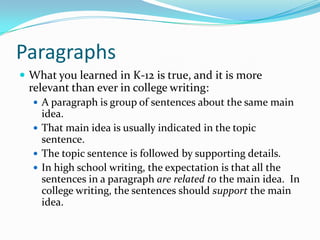
Paragraphs
 What you learned in K-12 is true, and it is more
relevant than ever in college writing:
 A paragraph is group of sentences about the same main
idea.
 That main idea is usually indicated in the topic
sentence.
 The topic sentence is followed by supporting details.
 In high school writing, the expectation is that all the
sentences in a paragraph are related to the main idea. In
college writing, the sentences should support the main
idea.
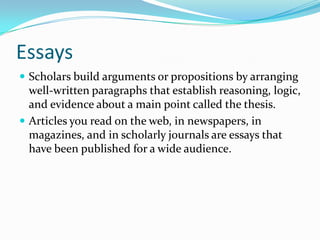
Essays
 Scholars build arguments or propositions by arranging
well-written paragraphs that establish reasoning, logic,
and evidence about a main point called the thesis.
 Articles you read on the web, in newspapers, in
magazines, and in scholarly journals are essays that
have been published for a wide audience.
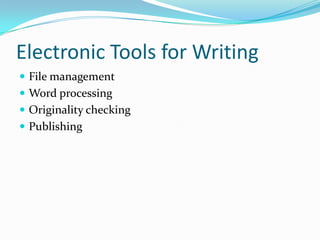
Electronic Tools for Writing
 File management
 Word processing
 Originality checking
 Publishing
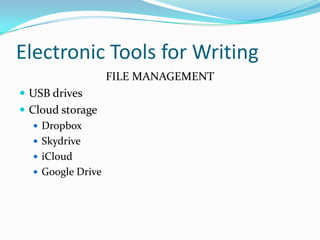
Electronic Tools for Writing
FILE MANAGEMENT
 USB drives
 Cloud storage
 Dropbox
 Skydrive
 iCloud
 Google Drive
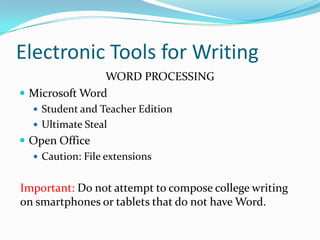
Electronic Tools for Writing
WORD PROCESSING
 Microsoft Word
 Student and Teacher Edition
 Ultimate Steal
 Open Office
 Caution: File extensions
Important: Do not attempt to compose college writing
on smartphones or tablets that do not have Word.
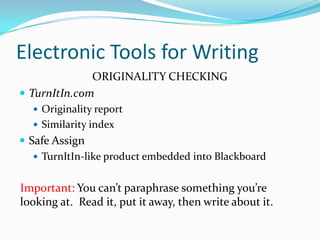
Electronic Tools for Writing
ORIGINALITY CHECKING
 TurnItIn.com
 Originality report
 Similarity index
 Safe Assign
 TurnItIn-like product embedded into Blackboard
Important: You can’t paraphrase something you’re
looking at. Read it, put it away, then write about it.
Electronic Tools for Writing
PUBLISHING
 Desktop publishing
 MS Publisher
 Blogging
 Blogger, WordPress, others….
 Template-driven web sites
 Weebly
In this class, we’ll be using Edublogs.
Homework
1. Create an account at TurnItIn.com and join the class.
2. Create an account and Edublogs and email me your
username so I can add you as an author.
3. Take or find a picture of you. Incorporate it into a
blog post that explains why it is meaningful.

Broward College ENC 1101 13F Dr. Record 8-29-13

  • 1.
  • 2.
    Tonight’s Agenda  Introductionsand attendance  Course objectives  Review of the syllabus  Sentences, paragraphs, and essays  Electronic writing tools
  • 4.
    Course Objectives 1. ReadingCritically The students shall be able to evaluate assigned readings with a view to their artistic merits, content, logical progression, and thoroughness of citations (if any). The students shall be able to find the main idea of the assigned reading, recognize and evaluate the supporting details and comment on the effectiveness of the writer’s overall writing technique.
  • 5.
    Course Objectives 2. EssayDevelopment The students shall be able to compose units of discourse and provide ideas and information suitable to the audience and purpose.
  • 6.
    Course Objectives 3. Conventionsof Standard American English The students shall be able to transmit ideas and information in effective written language by employing good diction, conventional sentence structure, and standard written American English grammar and usage.
  • 7.
    Course Objectives 4. ResearchSkills The students shall be able to locate and evaluate primary and secondary sources in both print and electronic formats and incorporate the relevant information into a properly documented paper, both internally and bibliographically.
  • 8.
    Required Competencies  Readwith critical comprehension.  Write clearly and coherently.  Demonstrate and apply literacy across all the disciplines.  Information, technology, workplace, cultural, quantitative, scientific, and environmental.  Apply problem-solving skills or methods to make informed decisions in a variety of contexts.
  • 9.
    Sentences  Understand thesimilarities and differences between verbal and written communication.  Understand that writing is guided by consideration of three things: purpose, audience, and topic.  Unlike speaking, writing is a series of deliberate and thoughtful decisions.  Good writing begins with well-constructed sentences.  A sentence is a group of words that contains a subject and a verb; it also expresses a complete thought.
  • 10.
    Sentences  Sentences thatare formed incorrectly are confusing, distracting, or both.  Sentences that do not express a complete thought are called fragments.  Sentences that combine thoughts without the proper punctuation are called run-on sentences.  Comma splices  Mixed or blended sentences
  • 11.
    Sentences FRAGMENTS The dog. (justa subject) Ran down the street. (just a verb) The boy who looked guilty. (subordinating word disables the complete thought)
  • 12.
    Sentences RUN-ONS – COMMASPLICE Dogs like bones, cats like yarn. (A comma is not a strong enough punctuation mark to join two complete thoughts, each with a subject and a verb. Instead, use a semicolon or a comma + a conjunction. You could also simply make these two different sentences.)
  • 13.
    Sentences RUN-ONS – MIXEDSENTENCE When the dog runs too fast to catch the Frisbee hits him on the head. (The end of the sentence does not match the beginning of the sentence. This can be fixed by adding or subtracting words or by rewriting entirely.)
  • 14.
    Sentences  Most people,when asked to say a sentence about any topic, begin with the word “there,” “this,” or “it.” These words are pronouns, and by definition, they are vague.  Instead of saying, “There are 8 planes waiting to take off,” instead write “Eight planes are waiting to take off.”  Write deliberately. Choose specific nouns as the subjects of your sentences. Choose precise verbs as your predicates. When possible, choose main verbs rather than linking verbs or forms of “be.” Modify with vivid adjectives and adverbs.
  • 15.
    Paragraphs  What youlearned in K-12 is true, and it is more relevant than ever in college writing:  A paragraph is group of sentences about the same main idea.  That main idea is usually indicated in the topic sentence.  The topic sentence is followed by supporting details.  In high school writing, the expectation is that all the sentences in a paragraph are related to the main idea. In college writing, the sentences should support the main idea.
  • 16.
    Essays  Scholars buildarguments or propositions by arranging well-written paragraphs that establish reasoning, logic, and evidence about a main point called the thesis.  Articles you read on the web, in newspapers, in magazines, and in scholarly journals are essays that have been published for a wide audience.
  • 17.
    Electronic Tools forWriting  File management  Word processing  Originality checking  Publishing
  • 18.
    Electronic Tools forWriting FILE MANAGEMENT  USB drives  Cloud storage  Dropbox  Skydrive  iCloud  Google Drive
  • 19.
    Electronic Tools forWriting WORD PROCESSING  Microsoft Word  Student and Teacher Edition  Ultimate Steal  Open Office  Caution: File extensions Important: Do not attempt to compose college writing on smartphones or tablets that do not have Word.
  • 20.
    Electronic Tools forWriting ORIGINALITY CHECKING  TurnItIn.com  Originality report  Similarity index  Safe Assign  TurnItIn-like product embedded into Blackboard Important: You can’t paraphrase something you’re looking at. Read it, put it away, then write about it.
  • 21.
    Electronic Tools forWriting PUBLISHING  Desktop publishing  MS Publisher  Blogging  Blogger, WordPress, others….  Template-driven web sites  Weebly In this class, we’ll be using Edublogs.
  • 22.
    Homework 1. Create anaccount at TurnItIn.com and join the class. 2. Create an account and Edublogs and email me your username so I can add you as an author. 3. Take or find a picture of you. Incorporate it into a blog post that explains why it is meaningful.