By the endof the session, students will be able to:
• Understand the scope of Productive Written Language
Skills
• Define and identify sentences, paragraphs, and essays
• Recognize the components of effective writing
• Collaborate in discussing writing concepts
Learning Objectives
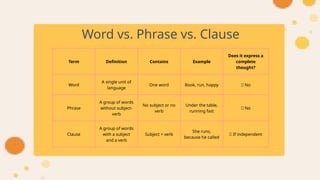
Term Definition ContainsExample
Does it express a
complete
thought?
Word
A single unit of
language
One word Book, run, happy ❌ No
Phrase
A group of words
without subject-
verb
No subject or no
verb
Under the table,
running fast
❌ No
Clause
A group of words
with a subject
and a verb
Subject + verb
She runs,
because he called
✅ If independent
Word vs. Phrase vs. Clause
5.
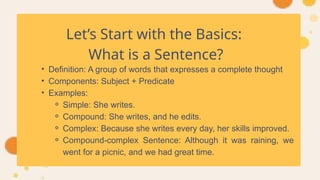
Let’s Start withthe Basics:
What is a Sentence?
• Definition: A group of words that expresses a complete thought
• Components: Subject + Predicate
• Examples:
⚬ Simple: She writes.
⚬ Compound: She writes, and he edits.
⚬ Complex: Because she writes every day, her skills improved.
⚬ Compound-complex Sentence: Although it was raining, we
went for a picnic, and we had great time.
6.
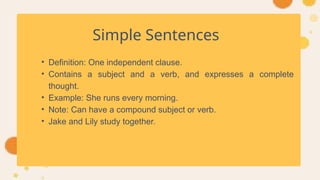
Simple Sentences
• Definition:One independent clause.
• Contains a subject and a verb, and expresses a complete
thought.
• Example: She runs every morning.
• Note: Can have a compound subject or verb.
• Jake and Lily study together.
7.
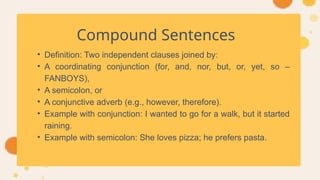
Compound Sentences
• Definition:Two independent clauses joined by:
• A coordinating conjunction (for, and, nor, but, or, yet, so –
FANBOYS),
• A semicolon, or
• A conjunctive adverb (e.g., however, therefore).
• Example with conjunction: I wanted to go for a walk, but it started
raining.
• Example with semicolon: She loves pizza; he prefers pasta.
8.
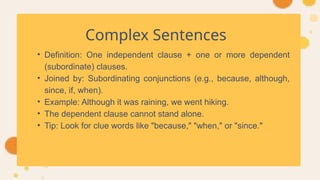
Complex Sentences
• Definition:One independent clause + one or more dependent
(subordinate) clauses.
• Joined by: Subordinating conjunctions (e.g., because, although,
since, if, when).
• Example: Although it was raining, we went hiking.
• The dependent clause cannot stand alone.
• Tip: Look for clue words like "because," "when," or "since."
9.
Why Use DifferentSentence Types?
• To add variety and interest to your writing.
• To express different kinds of ideas clearly.
• To improve readability and style.
10.
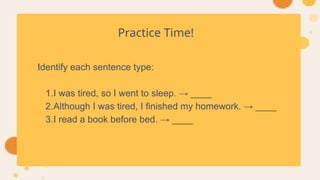
Practice Time!
Identify eachsentence type:
1.I was tired, so I went to sleep. → ____
2.Although I was tired, I finished my homework. → ____
3.I read a book before bed. → ____
11.
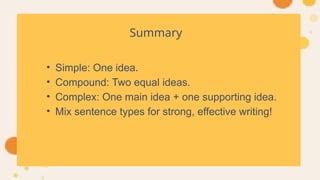
Summary
• Simple: Oneidea.
• Compound: Two equal ideas.
• Complex: One main idea + one supporting idea.
• Mix sentence types for strong, effective writing!
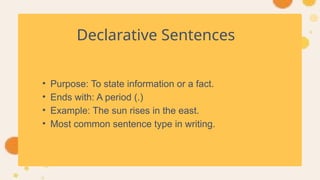
Declarative Sentences
• Purpose:To state information or a fact.
• Ends with: A period (.)
• Example: The sun rises in the east.
• Most common sentence type in writing.
14.
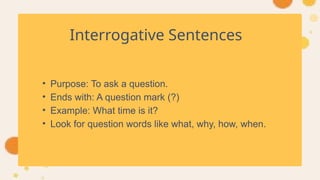
Interrogative Sentences
• Purpose:To ask a question.
• Ends with: A question mark (?)
• Example: What time is it?
• Look for question words like what, why, how, when.
15.
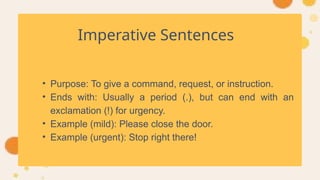
Imperative Sentences
• Purpose:To give a command, request, or instruction.
• Ends with: Usually a period (.), but can end with an
exclamation (!) for urgency.
• Example (mild): Please close the door.
• Example (urgent): Stop right there!
16.
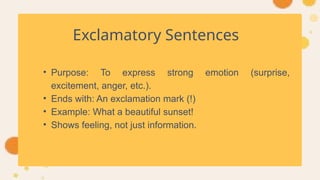
Exclamatory Sentences
• Purpose:To express strong emotion (surprise,
excitement, anger, etc.).
• Ends with: An exclamation mark (!)
• Example: What a beautiful sunset!
• Shows feeling, not just information.
17.
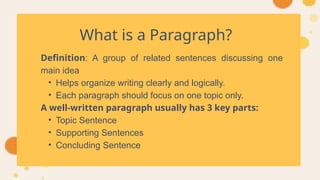
What is aParagraph?
Definition: A group of related sentences discussing one
main idea
• Helps organize writing clearly and logically.
• Each paragraph should focus on one topic only.
A well-written paragraph usually has 3 key parts:
• Topic Sentence
• Supporting Sentences
• Concluding Sentence
18.
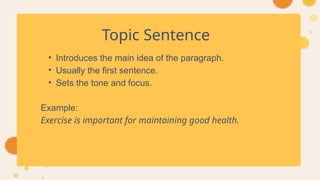
Topic Sentence
• Introducesthe main idea of the paragraph.
• Usually the first sentence.
• Sets the tone and focus.
Example:
Exercise is important for maintaining good health.
19.
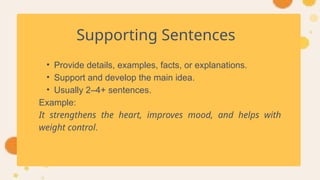
Supporting Sentences
• Providedetails, examples, facts, or explanations.
• Support and develop the main idea.
• Usually 2–4+ sentences.
Example:
It strengthens the heart, improves mood, and helps with
weight control.
20.
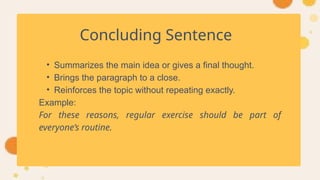
Concluding Sentence
• Summarizesthe main idea or gives a final thought.
• Brings the paragraph to a close.
• Reinforces the topic without repeating exactly.
Example:
For these reasons, regular exercise should be part of
everyone’s routine.
21.
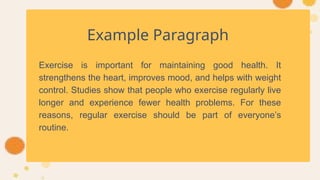
Example Paragraph
Exercise isimportant for maintaining good health. It
strengthens the heart, improves mood, and helps with weight
control. Studies show that people who exercise regularly live
longer and experience fewer health problems. For these
reasons, regular exercise should be part of everyone’s
routine.
22.
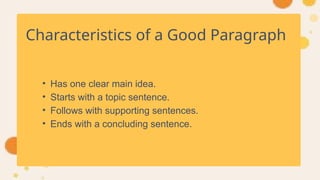
Characteristics of aGood Paragraph
• Has one clear main idea.
• Starts with a topic sentence.
• Follows with supporting sentences.
• Ends with a concluding sentence.
23.
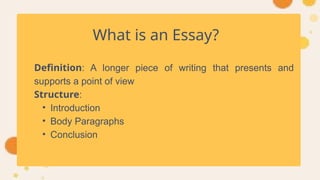
What is anEssay?
Definition: A longer piece of writing that presents and
supports a point of view
Structure:
• Introduction
• Body Paragraphs
• Conclusion
24.
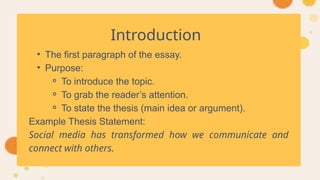
Introduction
• The firstparagraph of the essay.
• Purpose:
⚬ To introduce the topic.
⚬ To grab the reader’s attention.
⚬ To state the thesis (main idea or argument).
Example Thesis Statement:
Social media has transformed how we communicate and
connect with others.
25.
Body Paragraphs
• Usually3 or more paragraphs.
• Each paragraph supports the thesis with: evidence,
examples, explanations
• Each one has:
-A topic sentence
-Supporting details
• Tip: Focus on one idea per paragraph.
26.
Conclusion
• The finalparagraph of the essay.
Purpose:
• To summarize main points.
• To restate the thesis in a new way.
• To leave the reader with a final thought.
Avoid introducing new ideas here.
27.
Final Tips forWriting an Essay
• Plan before writing (use outlines).
• Stay focused on the main idea.
• Use transitions to connect paragraphs.
• Revise and proofread for clarity and grammar.
28.
Types of Essays
•Narrative
• Descriptive
• Expository
• Persuasive
• Argumentative
• Compare and contrast
• Cause and effect
29.
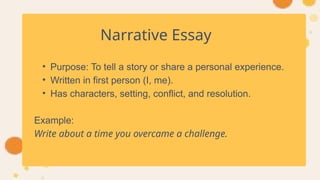
Narrative Essay
• Purpose:To tell a story or share a personal experience.
• Written in first person (I, me).
• Has characters, setting, conflict, and resolution.
Example:
Write about a time you overcame a challenge.
30.
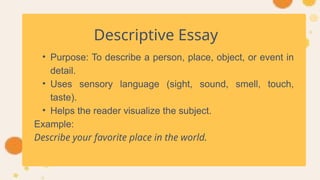
Descriptive Essay
• Purpose:To describe a person, place, object, or event in
detail.
• Uses sensory language (sight, sound, smell, touch,
taste).
• Helps the reader visualize the subject.
Example:
Describe your favorite place in the world.
31.
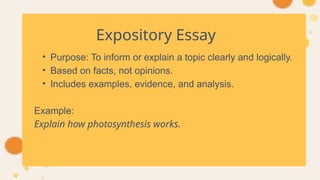
Expository Essay
• Purpose:To inform or explain a topic clearly and logically.
• Based on facts, not opinions.
• Includes examples, evidence, and analysis.
Example:
Explain how photosynthesis works.
32.
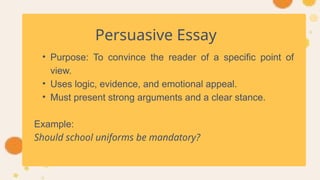
Persuasive Essay
• Purpose:To convince the reader of a specific point of
view.
• Uses logic, evidence, and emotional appeal.
• Must present strong arguments and a clear stance.
Example:
Should school uniforms be mandatory?
33.
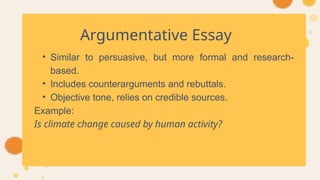
Argumentative Essay
• Similarto persuasive, but more formal and research-
based.
• Includes counterarguments and rebuttals.
• Objective tone, relies on credible sources.
Example:
Is climate change caused by human activity?
34.
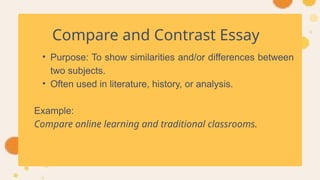
Compare and ContrastEssay
• Purpose: To show similarities and/or differences between
two subjects.
• Often used in literature, history, or analysis.
Example:
Compare online learning and traditional classrooms.
35.
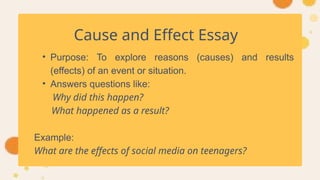
Cause and EffectEssay
• Purpose: To explore reasons (causes) and results
(effects) of an event or situation.
• Answers questions like:
Why did this happen?
What happened as a result?
Example:
What are the effects of social media on teenagers?
36.
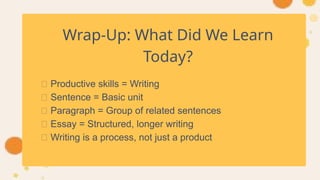
Wrap-Up: What DidWe Learn
Today?
✅ Productive skills = Writing
✅ Sentence = Basic unit
✅ Paragraph = Group of related sentences
✅ Essay = Structured, longer writing
✅ Writing is a process, not just a product
37.
Mini Task
Write:
1.A shortparagraph “Why writing is important in my life.”
(5–7 sentences)
2.Write a 5-paragraph essay (Introduction, 3 Body
Paragraphs, Conclusion).
38.
Essay Prompt (ChooseOne):
• Persuasive: Should students have homework every day? Give
reasons to support your opinion.
• Narrative: Describe a time when you faced a challenge and how
you overcame it.
• Expository: Explain the benefits of learning a new language.
• Descriptive: Describe your ideal vacation spot in detail.