Dr. Peter Ufland, Adjunct Professor, Community College of the District of ColumbiaTamara Reavis, Instructional Systems Specialist, Office of the state Superintendent of educationBridging the Gap:Preparing High School Students for College Writing
Writing Skills EssentialsGrammarEditingOrganizationArgumentationStyleResearch
Grammar/PunctuationStudents should be able to identify and correctly use all parts of speech.Students should know all verb tenses and when to apply themStudents should know how to maintain verb tense consistency and use proper subject-verb agreementStudents should know the proper uses of commas, colons, semi-colons, apostrophes, and quotation marksStudents should know what words require capitalizationStudents should know the difference between clauses and phrasesStudents should know what run-on sentences and sentence fragments
EditingStudents should understand the importance of writing drafts and editing workStudents should know basic editing skills/strategies in order to identify grammatical and structural errors in both their own and others writingStudents should be able to evaluate the soundness/logic of organization and strength of argumentationStudents should be able to assess the appropriateness of a given style of writing depending on the assignmentStudents should be willing to accept and use feedback from others
 OrganizationStudents should know how to plan a paper through a variety of prewriting strategies: brainstorming; outlining; etc.Students should know how to present ideas in a logical orderStudents should know how to link sentences/ideas together in order to form a coherent and cohesive paragraphStudents should be able to place paragraphs in an order that is logical and supports their purpose
ArgumentationStudents should know the difference between their topic and their thesisStudents should know how to support their thesis through the use of appropriate and compelling evidence, examples, logic; etc.Students should know how to use refutation of counterarguments as a means of strengthening their own theses
StyleStudents should be able to understand the need for different styles of writing depending on both the objective and the audience of their workStudents should be able to employ the different writing styles mentioned aboveStudents should be able to write in a variety of styles and at the same time develop and maintain their own unique voice in writing*
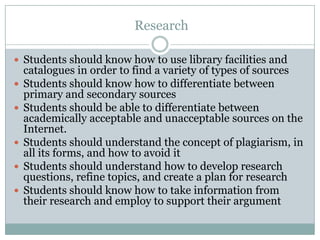
 ResearchStudents should know how to use library facilities and catalogues in order to find a variety of types of sourcesStudents should know how to differentiate between primary and secondary sourcesStudents should be able to differentiate between academically acceptable and unacceptable sources on the Internet.Students should understand the concept of plagiarism, in all its forms, and how to avoid itStudents should understand how to develop research questions, refine topics, and create a plan for researchStudents should know how to take information from their research and employ to support their argument
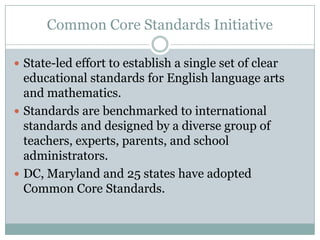
Common Core Standards InitiativeState-led effort to establish a single set of clear educational standards for English language arts and mathematics. Standards are benchmarked to international standards and designed by a diverse group of teachers, experts, parents, and school administrators.DC, Maryland and 25 states have adopted Common Core Standards.
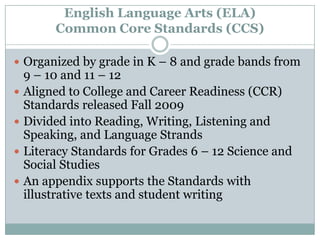
English Language Arts (ELA) Common Core Standards (CCS)Organized by grade in K – 8 and grade bands from 9 – 10 and 11 – 12Aligned to College and Career Readiness (CCR) Standards released Fall 2009Divided into Reading, Writing, Listening and Speaking, and Language StrandsLiteracy Standards for Grades 6 – 12 Science and Social StudiesAn appendix supports the Standards with illustrative texts and student writing
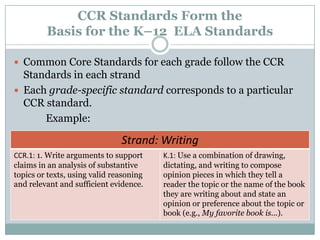
CCR Standards Form theBasis for the K–12  ELA StandardsCommon Core Standards for each grade follow the CCR Standards in each strand Each grade-specific standard corresponds to a particular CCR standard. 		Example:
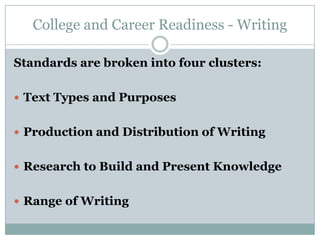
College and Career Readiness - WritingStandards are broken into four clusters:Text Types and PurposesProduction and Distribution of WritingResearch to Build and Present KnowledgeRange of Writing
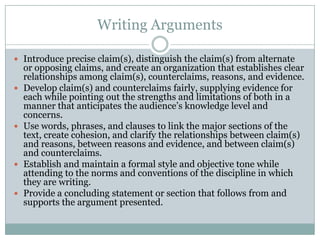
Writing ArgumentsIntroduce precise claim(s), distinguish the claim(s) from alternate or opposing claims, and create an organization that establishes clear relationships among claim(s), counterclaims, reasons, and evidence.Develop claim(s) and counterclaims fairly, supplying evidence for each while pointing out the strengths and limitations of both in a manner that anticipates the audience’s knowledge level and concerns.Use words, phrases, and clauses to link the major sections of the text, create cohesion, and clarify the relationships between claim(s) and reasons, between reasons and evidence, and between claim(s) and counterclaims.Establish and maintain a formal style and objective tone while attending to the norms and conventions of the discipline in which they are writing.Provide a concluding statement or section that follows from and supports the argument presented.
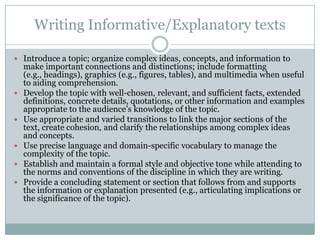
Writing Informative/Explanatory textsIntroduce a topic; organize complex ideas, concepts, and information to make important connections and distinctions; include formatting (e.g., headings), graphics (e.g., figures, tables), and multimedia when useful to aiding comprehension.Develop the topic with well-chosen, relevant, and sufficient facts, extended definitions, concrete details, quotations, or other information and examples appropriate to the audience’s knowledge of the topic.Use appropriate and varied transitions to link the major sections of the text, create cohesion, and clarify the relationships among complex ideas and concepts.Use precise language and domain-specific vocabulary to manage the complexity of the topic.Establish and maintain a formal style and objective tone while attending to the norms and conventions of the discipline in which they are writing.Provide a concluding statement or section that follows from and supports the information or explanation presented (e.g., articulating implications or the significance of the topic).
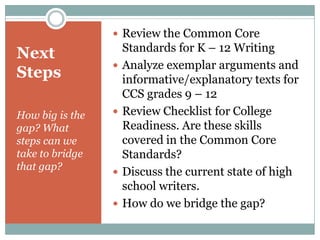
Next StepsHow big is the gap? What steps can we take to bridge that gap?Review the Common Core Standards for K – 12 WritingAnalyze exemplar arguments and informative/explanatory texts for CCS grades 9 – 12 Review Checklist for College Readiness. Are these skills covered in the Common Core Standards?Discuss the current state of high school writers.How do we bridge the gap?
Go to www.corestandards.org

Day 1_Session I_Standards and Alignment

  • 1.
    Dr. Peter Ufland,Adjunct Professor, Community College of the District of ColumbiaTamara Reavis, Instructional Systems Specialist, Office of the state Superintendent of educationBridging the Gap:Preparing High School Students for College Writing
  • 2.
  • 3.
    Grammar/PunctuationStudents should beable to identify and correctly use all parts of speech.Students should know all verb tenses and when to apply themStudents should know how to maintain verb tense consistency and use proper subject-verb agreementStudents should know the proper uses of commas, colons, semi-colons, apostrophes, and quotation marksStudents should know what words require capitalizationStudents should know the difference between clauses and phrasesStudents should know what run-on sentences and sentence fragments
  • 4.
    EditingStudents should understandthe importance of writing drafts and editing workStudents should know basic editing skills/strategies in order to identify grammatical and structural errors in both their own and others writingStudents should be able to evaluate the soundness/logic of organization and strength of argumentationStudents should be able to assess the appropriateness of a given style of writing depending on the assignmentStudents should be willing to accept and use feedback from others
  • 5.
    OrganizationStudents shouldknow how to plan a paper through a variety of prewriting strategies: brainstorming; outlining; etc.Students should know how to present ideas in a logical orderStudents should know how to link sentences/ideas together in order to form a coherent and cohesive paragraphStudents should be able to place paragraphs in an order that is logical and supports their purpose
  • 6.
    ArgumentationStudents should knowthe difference between their topic and their thesisStudents should know how to support their thesis through the use of appropriate and compelling evidence, examples, logic; etc.Students should know how to use refutation of counterarguments as a means of strengthening their own theses
  • 7.
    StyleStudents should beable to understand the need for different styles of writing depending on both the objective and the audience of their workStudents should be able to employ the different writing styles mentioned aboveStudents should be able to write in a variety of styles and at the same time develop and maintain their own unique voice in writing*
  • 8.
    ResearchStudents shouldknow how to use library facilities and catalogues in order to find a variety of types of sourcesStudents should know how to differentiate between primary and secondary sourcesStudents should be able to differentiate between academically acceptable and unacceptable sources on the Internet.Students should understand the concept of plagiarism, in all its forms, and how to avoid itStudents should understand how to develop research questions, refine topics, and create a plan for researchStudents should know how to take information from their research and employ to support their argument
  • 9.
    Common Core StandardsInitiativeState-led effort to establish a single set of clear educational standards for English language arts and mathematics. Standards are benchmarked to international standards and designed by a diverse group of teachers, experts, parents, and school administrators.DC, Maryland and 25 states have adopted Common Core Standards.
  • 10.
    English Language Arts(ELA) Common Core Standards (CCS)Organized by grade in K – 8 and grade bands from 9 – 10 and 11 – 12Aligned to College and Career Readiness (CCR) Standards released Fall 2009Divided into Reading, Writing, Listening and Speaking, and Language StrandsLiteracy Standards for Grades 6 – 12 Science and Social StudiesAn appendix supports the Standards with illustrative texts and student writing
  • 11.
    CCR Standards FormtheBasis for the K–12 ELA StandardsCommon Core Standards for each grade follow the CCR Standards in each strand Each grade-specific standard corresponds to a particular CCR standard. Example:
  • 12.
    College and CareerReadiness - WritingStandards are broken into four clusters:Text Types and PurposesProduction and Distribution of WritingResearch to Build and Present KnowledgeRange of Writing
  • 13.
    Writing ArgumentsIntroduce preciseclaim(s), distinguish the claim(s) from alternate or opposing claims, and create an organization that establishes clear relationships among claim(s), counterclaims, reasons, and evidence.Develop claim(s) and counterclaims fairly, supplying evidence for each while pointing out the strengths and limitations of both in a manner that anticipates the audience’s knowledge level and concerns.Use words, phrases, and clauses to link the major sections of the text, create cohesion, and clarify the relationships between claim(s) and reasons, between reasons and evidence, and between claim(s) and counterclaims.Establish and maintain a formal style and objective tone while attending to the norms and conventions of the discipline in which they are writing.Provide a concluding statement or section that follows from and supports the argument presented.
  • 14.
    Writing Informative/Explanatory textsIntroducea topic; organize complex ideas, concepts, and information to make important connections and distinctions; include formatting (e.g., headings), graphics (e.g., figures, tables), and multimedia when useful to aiding comprehension.Develop the topic with well-chosen, relevant, and sufficient facts, extended definitions, concrete details, quotations, or other information and examples appropriate to the audience’s knowledge of the topic.Use appropriate and varied transitions to link the major sections of the text, create cohesion, and clarify the relationships among complex ideas and concepts.Use precise language and domain-specific vocabulary to manage the complexity of the topic.Establish and maintain a formal style and objective tone while attending to the norms and conventions of the discipline in which they are writing.Provide a concluding statement or section that follows from and supports the information or explanation presented (e.g., articulating implications or the significance of the topic).
  • 15.
    Next StepsHow bigis the gap? What steps can we take to bridge that gap?Review the Common Core Standards for K – 12 WritingAnalyze exemplar arguments and informative/explanatory texts for CCS grades 9 – 12 Review Checklist for College Readiness. Are these skills covered in the Common Core Standards?Discuss the current state of high school writers.How do we bridge the gap?
  • 16.
  • 17.
  • 18.
    Under news goto the tab Common Core standards
  • 19.
  • 20.
    Tamara Reavis tamara.reavis@dc.gov
  • 21.