Agenda Share your Race & Ethnic Variations chart Changing Gender Roles- Questions Premarital Relationships
Chapter 7: Premarital and Non-Marital Relationships
What are premarital relationships?
Socio-Cultural Context of Non-Marital Relationships Non-marital and premarital relationships have become increasingly ambiguous. Process is filled with uncertainty and risk. Norms regarding mate selection are changing. More emphasis on the  expressive self ; less emphasis on institutional regulation.
What is love?
Love Love is a  socially constructed  concept because it takes on different meanings, importance, and behaviors according to the social context in which it is used. Love that supports marriage and family has emotional, cognitive, relational, and behavioral aspects.
Aspects of Love Emotional Cognitive  Relational  Behavioral
Individualistic  Explanations of Partner Selection Instinctive and biological theories  are rooted in evolutionary instinct, genetic similarity, and unconscious needs and drives. E.g. mating and ovulation Parental image theories  assume that individuals select mates similar to their opposite-sex parent. E.g. psychoanalitical theory Complementary needs theories  assume that people choose others who meet their psychological needs.
Socio-cultural  Explanations of Partner Selection Value Theory—Interpersonal attraction results from having similar values. Role Theory—People who share similar role definitions and expectations are more likely to partner. Exchange Theory—Persons will partner when benefits outweigh costs for each. Sequential Theories—view movement toward marriage or cohabitation as a series of changing criteria, stages, or patterned regularities.
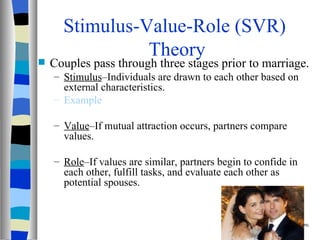
Stimulus-Value-Role (SVR)  Theory Couples pass through three stages prior to marriage. Stimulus –Individuals are drawn to each other based on external characteristics. Example Value –If mutual attraction occurs, partners compare values. Role –If values are similar, partners begin to confide in each other, fulfill tasks, and evaluate each other as potential spouses.
From Single to Married The process is youth-centered and competitive. It occurs in a series of stages with differing commitment levels. The rules, goals, and strategies of the “game” are different for males and females. Communication often takes the form of nonverbal cues, signs, gestures and other symbolic movements. Example
How would you describe dating?
How would you describe hooking-up?
Hooking Up and Dating Traditional  dating  is becoming more infrequent. Hooking up , physical contact or intercourse without commitment, is becoming more common. Hanging out  in a group where individuals do not make their interests in each other explicit is also becoming the norm.
Hooking Up and Dating Internet chat rooms or personals ads Dating scripts still tend to be fairly traditional, with men exerting greater control Waller’s  Principle of Least Interest  suggests that the partner who is less interested in continuing the relationship controls the relationship. HJNTIY
Interactional Patterns of Hooking up Receive support from same-sex friends Some research suggests it is more common among men Does not have an impact on psychological well-being. Impacts sexual behaviors
Engagement Engagement  is the final transition in the process from single to married. It is a ritual that: Implies dating exclusiveness; Reinforces the importance of the couple relationship; and Involves a financial and symbolic commitment.
Non-Marital Cohabitation Non-marital cohabitation  has become an important step in the courtship process. In 2006, there were  4.7 million unmarried heterosexual couple  households in the U.S. More than half of first unions  in the 1990’s were cohabiting, rather than marriage.
Methodological Concerns Self-selection bias  may influence findings on cohabitation. The meanings of cohabitation are less clear than the meanings of marriage.
Interactional Patterns of Cohabitation Compared to married persons, cohabitors: Have more liberal gender roles; Are more likely to keep finances separate; Less likely to own homes; More likely to experience relationship violence; Have a lower desire to marry; and  Are less likely to ever marry. Does not serve as a successful trial for marriage Lower-quality marriages and are more likely to divorce (may be due to self-selection bias).
Chapter 8:  Sexuality and Non-Marital Relationships
Regulation of Sexual Relationships Sexual relationships are regulated by: Institutions such as family, religion, and education; Social norms, statuses and roles, and social sanctions; and Differing expectations, rights, and privileges by gender, age, marital status, and sexual orientation
Biological versus Sociological Approaches Biological  approaches emphasize anatomical, hormonal, and chemical factors relevant to sexual drives, needs and responses. Sociological  explanations focus on socialization and social context.
Social Dimensions of Sexuality Social Network Theory  focuses on the sexual dyad within a larger network of social relationships. Home, School, or Neighborhood Choice Theory  explains sexual decision making in terms of available resources, behavioral goals, and potential rewards versus costs. Sexual Scripting Theory  explains how people construct sexual ideas through social interaction.
Sexual Orientation Sexual Orientation  is an enduring emotional, romantic, sexual, or affectional attraction to another person. Heterosexuals  are attracted to the opposite sex. Homosexuals  are attracted to the same sex. Bisexuals  are attracted to both sexes.
Origins of Sexual Orientation Sexual orientation results from a complex interplay of biological, cognitive, and environmental factors. Both appear early in life. Individuals have little choice in their sexual orientation.
Heteronormativity Heteronormativity  social process whereby the rules or scripts for acceptable social behavior are constructed by labeling unacceptable behaviors and attaching negative images and sanctions to those labels. Defines ‘normal’ sexuality as heterosexual Assumes that non-heterosexual sexuality is ‘deviant’ Assumes that everyone is heterosexual What are the implications of heteronormativity?
Non-Marital  Sexual Behavior Antecedents  of sexual behavior are factors that precede a given sexual activity. Biological antecedents  include age and sexual maturation. Psychological antecedents  include cognitive and emotional development. Social antecedents  include family and peers, religion, and cultural norms.
Family Antecedents of  Sexual Behavior Families are central in: Forming sexual attitudes and behaviors Teaching standards of sexual conduct Providing role models Promoting a healthy environment Neither parental attitudes nor parent-child communication affect the sexual and contraceptive behavior of teens .  Both lenient and strict parental disciplinary styles result in greater child sexual permissiveness.
Non-Family Influences on Sexual Behavior Reference group theory  posits that we form and re-form our self concepts and experiences based on reactions we receive from others in our social network. When children reach adolescence, peer sexual behaviors and attitudes gain in importance. Using alcohol or drugs greatly increases the risk of early sexual activity.
Formal Sex Education The decision to engage in sexual behavior is not influenced by sex education classes. Formal sex education seems to have some effect on knowledge about, and effective use of, contraceptives. Abstinence only vs Comprehensive
Premarital Sexual  Intercourse Involves at least one partner who is single and has not been previously married. First sexual intercourse in the U.S.: Most often occurs within a ‘hooking up’ or dating context; Is usually an unplanned event; Seldom includes the use of contraceptives; and Is often not pleasurable, especially for women.
Changes in Premarital Sexual Activity Premarital sexual activity has increased since 1971, but at a much slower rate since 1980. Changes are more pronounced for females: Greater permissiveness Fewer male/female differences Double standard remains in place
High Risk Sexual Behavior
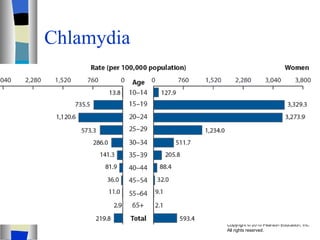
Chlamydia
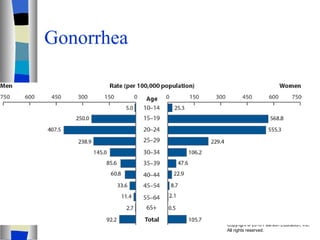
Gonorrhea
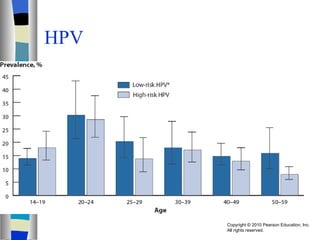
HPV
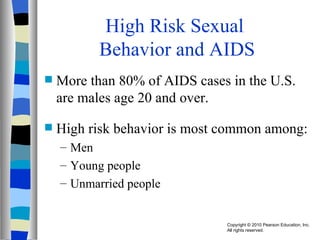
High Risk Sexual  Behavior and AIDS More than 80% of AIDS cases in the U.S. are males age 20 and over. High risk behavior is most common among: Men Young people Unmarried people
Influence of AIDS  on American Sexuality Increased selectivity of sexual partners Greater condom usage NOT abstention from sexual activity

Ppt non marital relationship

  • 1.
    Agenda Share yourRace & Ethnic Variations chart Changing Gender Roles- Questions Premarital Relationships
  • 2.
    Chapter 7: Premaritaland Non-Marital Relationships
  • 3.
    What are premaritalrelationships?
  • 4.
    Socio-Cultural Context ofNon-Marital Relationships Non-marital and premarital relationships have become increasingly ambiguous. Process is filled with uncertainty and risk. Norms regarding mate selection are changing. More emphasis on the expressive self ; less emphasis on institutional regulation.
  • 5.
  • 6.
    Love Love isa socially constructed concept because it takes on different meanings, importance, and behaviors according to the social context in which it is used. Love that supports marriage and family has emotional, cognitive, relational, and behavioral aspects.
  • 7.
    Aspects of LoveEmotional Cognitive Relational Behavioral
  • 8.
    Individualistic Explanationsof Partner Selection Instinctive and biological theories are rooted in evolutionary instinct, genetic similarity, and unconscious needs and drives. E.g. mating and ovulation Parental image theories assume that individuals select mates similar to their opposite-sex parent. E.g. psychoanalitical theory Complementary needs theories assume that people choose others who meet their psychological needs.
  • 9.
    Socio-cultural Explanationsof Partner Selection Value Theory—Interpersonal attraction results from having similar values. Role Theory—People who share similar role definitions and expectations are more likely to partner. Exchange Theory—Persons will partner when benefits outweigh costs for each. Sequential Theories—view movement toward marriage or cohabitation as a series of changing criteria, stages, or patterned regularities.
  • 10.
    Stimulus-Value-Role (SVR) Theory Couples pass through three stages prior to marriage. Stimulus –Individuals are drawn to each other based on external characteristics. Example Value –If mutual attraction occurs, partners compare values. Role –If values are similar, partners begin to confide in each other, fulfill tasks, and evaluate each other as potential spouses.
  • 11.
    From Single toMarried The process is youth-centered and competitive. It occurs in a series of stages with differing commitment levels. The rules, goals, and strategies of the “game” are different for males and females. Communication often takes the form of nonverbal cues, signs, gestures and other symbolic movements. Example
  • 12.
    How would youdescribe dating?
  • 13.
    How would youdescribe hooking-up?
  • 14.
    Hooking Up andDating Traditional dating is becoming more infrequent. Hooking up , physical contact or intercourse without commitment, is becoming more common. Hanging out in a group where individuals do not make their interests in each other explicit is also becoming the norm.
  • 15.
    Hooking Up andDating Internet chat rooms or personals ads Dating scripts still tend to be fairly traditional, with men exerting greater control Waller’s Principle of Least Interest suggests that the partner who is less interested in continuing the relationship controls the relationship. HJNTIY
  • 16.
    Interactional Patterns ofHooking up Receive support from same-sex friends Some research suggests it is more common among men Does not have an impact on psychological well-being. Impacts sexual behaviors
  • 17.
    Engagement Engagement is the final transition in the process from single to married. It is a ritual that: Implies dating exclusiveness; Reinforces the importance of the couple relationship; and Involves a financial and symbolic commitment.
  • 18.
    Non-Marital Cohabitation Non-maritalcohabitation has become an important step in the courtship process. In 2006, there were 4.7 million unmarried heterosexual couple households in the U.S. More than half of first unions in the 1990’s were cohabiting, rather than marriage.
  • 19.
    Methodological Concerns Self-selectionbias may influence findings on cohabitation. The meanings of cohabitation are less clear than the meanings of marriage.
  • 20.
    Interactional Patterns ofCohabitation Compared to married persons, cohabitors: Have more liberal gender roles; Are more likely to keep finances separate; Less likely to own homes; More likely to experience relationship violence; Have a lower desire to marry; and Are less likely to ever marry. Does not serve as a successful trial for marriage Lower-quality marriages and are more likely to divorce (may be due to self-selection bias).
  • 21.
    Chapter 8: Sexuality and Non-Marital Relationships
  • 22.
    Regulation of SexualRelationships Sexual relationships are regulated by: Institutions such as family, religion, and education; Social norms, statuses and roles, and social sanctions; and Differing expectations, rights, and privileges by gender, age, marital status, and sexual orientation
  • 23.
    Biological versus SociologicalApproaches Biological approaches emphasize anatomical, hormonal, and chemical factors relevant to sexual drives, needs and responses. Sociological explanations focus on socialization and social context.
  • 24.
    Social Dimensions ofSexuality Social Network Theory focuses on the sexual dyad within a larger network of social relationships. Home, School, or Neighborhood Choice Theory explains sexual decision making in terms of available resources, behavioral goals, and potential rewards versus costs. Sexual Scripting Theory explains how people construct sexual ideas through social interaction.
  • 25.
    Sexual Orientation SexualOrientation is an enduring emotional, romantic, sexual, or affectional attraction to another person. Heterosexuals are attracted to the opposite sex. Homosexuals are attracted to the same sex. Bisexuals are attracted to both sexes.
  • 26.
    Origins of SexualOrientation Sexual orientation results from a complex interplay of biological, cognitive, and environmental factors. Both appear early in life. Individuals have little choice in their sexual orientation.
  • 27.
    Heteronormativity Heteronormativity social process whereby the rules or scripts for acceptable social behavior are constructed by labeling unacceptable behaviors and attaching negative images and sanctions to those labels. Defines ‘normal’ sexuality as heterosexual Assumes that non-heterosexual sexuality is ‘deviant’ Assumes that everyone is heterosexual What are the implications of heteronormativity?
  • 28.
    Non-Marital SexualBehavior Antecedents of sexual behavior are factors that precede a given sexual activity. Biological antecedents include age and sexual maturation. Psychological antecedents include cognitive and emotional development. Social antecedents include family and peers, religion, and cultural norms.
  • 29.
    Family Antecedents of Sexual Behavior Families are central in: Forming sexual attitudes and behaviors Teaching standards of sexual conduct Providing role models Promoting a healthy environment Neither parental attitudes nor parent-child communication affect the sexual and contraceptive behavior of teens . Both lenient and strict parental disciplinary styles result in greater child sexual permissiveness.
  • 30.
    Non-Family Influences onSexual Behavior Reference group theory posits that we form and re-form our self concepts and experiences based on reactions we receive from others in our social network. When children reach adolescence, peer sexual behaviors and attitudes gain in importance. Using alcohol or drugs greatly increases the risk of early sexual activity.
  • 31.
    Formal Sex EducationThe decision to engage in sexual behavior is not influenced by sex education classes. Formal sex education seems to have some effect on knowledge about, and effective use of, contraceptives. Abstinence only vs Comprehensive
  • 32.
    Premarital Sexual Intercourse Involves at least one partner who is single and has not been previously married. First sexual intercourse in the U.S.: Most often occurs within a ‘hooking up’ or dating context; Is usually an unplanned event; Seldom includes the use of contraceptives; and Is often not pleasurable, especially for women.
  • 33.
    Changes in PremaritalSexual Activity Premarital sexual activity has increased since 1971, but at a much slower rate since 1980. Changes are more pronounced for females: Greater permissiveness Fewer male/female differences Double standard remains in place
  • 34.
  • 35.
  • 36.
  • 37.
  • 38.
    High Risk Sexual Behavior and AIDS More than 80% of AIDS cases in the U.S. are males age 20 and over. High risk behavior is most common among: Men Young people Unmarried people
  • 39.
    Influence of AIDS on American Sexuality Increased selectivity of sexual partners Greater condom usage NOT abstention from sexual activity