MICROBE-HUMAN
INTERACTIONS, INFECTION AND
DISEASE
Melvin Failagao
BSED-Bio. Sci
PROGRESS OF AN INFECTION
TYPES OF PATHOGENS
TRUE PATHOGENS
are capable of causing infection and disease in healthy persons with
normal immune defenses.
OPPORTUNISTIC PATHOGENS
can cause disease when the host's defenses are compromised or
when they become established in a part of the body that is not
natural to them.
Stages in Infection/Disease
a. Incubation period, the period from contact with
infectious agent until appearance of first symptoms.
b. Prodromium, a short period of initial, vague
symptoms.
c. Period of invasion, a variable period during which
microbe multiplies in high numbers and causes severest
symptoms.
d. Convalescent period, a period of recovery, with
decline of symptoms
Type of Infections/Diseases
a. Localized infection, microbe remains in isolated site.
b. Systemic infection, microbe is spread through the
tissues by circulation.
c. Focal infection, microbe spreads from local site to
entire body (systemic).
d. Mixed infection, several microbes cause one type of
infection simultaneously.
e. Primary infection, the initial infection in a series.
Type of Infections/Diseases
f. Secondary infection, a second infection that
complicates a primary infection.
g. Septicemia and bacteremia refer to microbes in the
blood.
h. Acute infection appears suddenly, has a short course,
and is relatively severe.
i. Chronic infection persists over a long period of time.
j. Sub-acute infection has a pattern between acute and
chronic.
Levels and Classes of Microbes
Class 1: not known to cause disease.
Class 2: moderate risk agents.
Class 3: readily transmitted and virulent
agents.
Class 4: highest risk, deadly pathogens.
Virulence factors are the properties of
microbes to invade a host and produce
toxins (toxigenicity).
Virulence or the degree of disease can
be due to single or multiple factors.
Pathogenicity is the ability to cause
disease in host.
Virulence Factors
a. Exoenzymes digest epithelial tissues, disrupt tissues,
and permit invasion.
b. Toxigenicity is a microbe’s capacity to produce toxins
at site of multiplication which affect cellular targets
(1) Toxinoses are diseases caused by toxins that damage
structure or function of host cells.
(2) Toxemia refers to toxins absorbed into the blood.
(3) Intoxication means ingestion of toxins.
Virulence Factors
(4) An exotoxin is a protein secreted by living bacteria
with powerful effects on a specific organ. Examples are
hemolysins and tetanus and diphtheria toxins.
(5) Endotoxin is the lipopolysaccharide portion of a
gram-negative cell wall released when a bacterial cell
dies; causes generalized symptoms such as fever
c. Antiphagocytic factors include leukocidins (white
blood cell poisons) and capsules.
Portal of Entry: Gateway to Infection
Exogenous
originating from source outside the body
(environment, human, or animal).
Endogenous
already existing on or in the body.
Storch
common infections of fetus and neonate.
Signs and Symptoms: Manifestations of disease,
indicators of pathologic effects on target organs
a. Sign is objective, measurable evidence noted by an observer.
Examples include septicemia, change in number of white blood
cells; skin lesions; inflammation; necrosis, lysis or death of tissue.
b. Symptom is a subjective effect of disease as sensed by
patient. Examples are pain, fatigue, and nausea.
c. Syndrome is a disease that manifests as a predictable
complex of symptoms; infections that do not show symptoms
are called asymptomatic, subclinical, or in apparent.
Size of Inoculum
Infection dose
minimum number for infection to occur.
Microorganisms with smaller infectious
dose have greater virulence. Lack of
infectious dose will generally not result in
infection. Once in excess of ID, disease
can be extremely rapid
Mechanisms of Invasion and
Establishment of the Pathogen
Adhesion
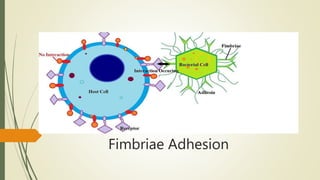
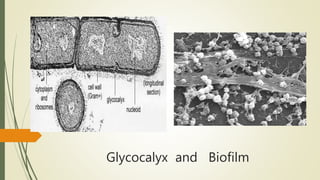
process by which microbes gain more stable
foothold at the portal of entry.
a.Fimbriae
b.Glycocalyx
c.Adhesins (ligands)
d.Biofilm
Fimbriae Adhesion
Glycocalyx and Biofilm
EPIDEMIOLOGY: THE STUDY OF
DISEASE IN POPULATIONS
Notifiable- agencies required by law to collect data
Communicable- host to host transmission.
Contagious- extremely efficient host to host transmission.
Non-Communicable- no host to host transmission.
Correlation- one factor assumed to be related to another.
Cause and Effect- one factor is proven to caused
a measurable change in another.
EPIDEMIOLOGY
science that determines the factors influencing
causation, frequency, and distribution of disease in a
community
Epidemiologist
involved in surveillance of reportable diseases in
populations and consider measures to protect the
public health.
involved in surveillance of reportable diseases in
populations and consider measures to protect the
public health.
Frequency of Disease
Endemic, a disease constantly present in a certain
geographic area.
Sporadic, a disease that occurs occasionally with
no predictable pattern.
Epidemic, sudden outbreak of disease in which
numbers increase beyond expected trends.
Pandemic, worldwide epidemic.
Origin of Pathogens
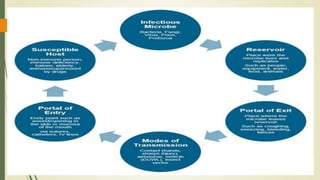
The reservoir is a place where the pathogen
ultimately originates (its habitat).
Source of infection refers to the immediate origin
of an infectious agent.
Carrier is an individual that inconspicuously
shelters a pathogen and spreads it to others.
CLASSIFICATION OF CARRIERS
Asymptomatic carrier is infected without symptoms.
Incubation carriers carry early in disease.
Convalescent carriers carry in last phases of recovery.
Chronic carriers carry for long periods after recovery.
Passive carriers are uninfected but convey infectious
agents from infected persons to uninfected ones by
hand and instrument contact.
Vectors/Zoonoses
vector is an animal that transmits pathogens.
 biological vector is an alternate animal host (mosquito,
flea) that assists in completion of life cycle of microbe.
mechanical vector is an animal that does not host microbial
life cycle, but is a short-term transmitter (housefly).
zoonosis is an infection for which animals are the natural
reservoir and host that can be transmitted to humans.
Acquisition of Infection
1. Communicable infectious disease occurs when pathogen
is transmitted from host to host directly or indirectly;
contagious diseases are readily transmissible through direct
contact.
2. Non-communicable diseases are not spread from host to
host; acquired from one’s own flora (pneumonia) or from a
non-living environmental reservoir (tetanus).
3. Direct Transmission Infectious agent is spread through
direct contact of portal of exit with portal of entry (STDs,
herpes simplex)
Acquisition of Infection
4. Indirect Transmission
a.material (vehicle) contaminated with pathogens serves as
intermediate source of infections.
b.fomite is an inanimate object contaminated with pathogens
(public facilities, personal items).
c. Food serves as a vehicle.
d.Droplet nuclei are airborne dried particles containing
infectious agents, formed by sneezing and coughing.
Acquisition of Infection
Nosocomial infections are infectious diseases that
originate in the hospital or clinical setting.
a. They commonly occur among surgical and
chronically ill patients.
b. Hospitals monitor various asepsis procedures to
help reduce the number of infections.
c. Isolation of patients and other universal precautions
are necessary controls.
Koch's Postulates
defines a series of criteria that must be
followed to determine the etiologic
(causative) agent of disease.
1. Microorganisms are isolated from a
dead animal.
2. Microorganisms are grown in pure
culture. The microorganisms are
identified.
Koch's Postulates
3. The microorganisms are injected into a healthy
animal.
4. The disease is reproduced in the second animal;
microorganisms are isolated from this animal.
5. Pathogenic microorganisms are grown in pure
culture. Identical microorganism identified.
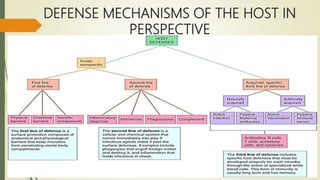
DEFENSE MECHANISMS OF THE HOST IN
PERSPECTIVE
DEFENSE MECHANISMS OF THE
HOST IN PERSPECTIVE
The First Line of Defense
Nonspecific Chemical Defenses
Sebaceous secretions and specialized glands-
antimicrobial
Lysozyme in tears
Lactic acid and electrolyte concentrations of
sweat
Skin’s acidic pH and fatty acid content
DEFENSE MECHANISMS OF THE
HOST IN PERSPECTIVE
The First Line of Defense
Nonspecific Chemical Defenses
HCl in the stomach
Digestive juices and bile in the intestine
Semen- antimicrobial chemical
Acidic pH in the vagina
TYPES OF NON-SPECIFIC MECHANISMS
First Line of Defenses
 MECHANICAL AND PHYSICAL BARRIERS
CHEMICAL BARRIERS
COMPLEX BIOLOGICAL MECHANISMS
AND REPONSES
evaluation

Microbe-Human Interactions: Infection and Disease

  • 1.
  • 2.
    PROGRESS OF ANINFECTION TYPES OF PATHOGENS TRUE PATHOGENS are capable of causing infection and disease in healthy persons with normal immune defenses. OPPORTUNISTIC PATHOGENS can cause disease when the host's defenses are compromised or when they become established in a part of the body that is not natural to them.
  • 3.
    Stages in Infection/Disease a.Incubation period, the period from contact with infectious agent until appearance of first symptoms. b. Prodromium, a short period of initial, vague symptoms. c. Period of invasion, a variable period during which microbe multiplies in high numbers and causes severest symptoms. d. Convalescent period, a period of recovery, with decline of symptoms
  • 4.
    Type of Infections/Diseases a.Localized infection, microbe remains in isolated site. b. Systemic infection, microbe is spread through the tissues by circulation. c. Focal infection, microbe spreads from local site to entire body (systemic). d. Mixed infection, several microbes cause one type of infection simultaneously. e. Primary infection, the initial infection in a series.
  • 5.
    Type of Infections/Diseases f.Secondary infection, a second infection that complicates a primary infection. g. Septicemia and bacteremia refer to microbes in the blood. h. Acute infection appears suddenly, has a short course, and is relatively severe. i. Chronic infection persists over a long period of time. j. Sub-acute infection has a pattern between acute and chronic.
  • 6.
    Levels and Classesof Microbes Class 1: not known to cause disease. Class 2: moderate risk agents. Class 3: readily transmitted and virulent agents. Class 4: highest risk, deadly pathogens.
  • 7.
    Virulence factors arethe properties of microbes to invade a host and produce toxins (toxigenicity). Virulence or the degree of disease can be due to single or multiple factors. Pathogenicity is the ability to cause disease in host.
  • 8.
    Virulence Factors a. Exoenzymesdigest epithelial tissues, disrupt tissues, and permit invasion. b. Toxigenicity is a microbe’s capacity to produce toxins at site of multiplication which affect cellular targets (1) Toxinoses are diseases caused by toxins that damage structure or function of host cells. (2) Toxemia refers to toxins absorbed into the blood. (3) Intoxication means ingestion of toxins.
  • 9.
    Virulence Factors (4) Anexotoxin is a protein secreted by living bacteria with powerful effects on a specific organ. Examples are hemolysins and tetanus and diphtheria toxins. (5) Endotoxin is the lipopolysaccharide portion of a gram-negative cell wall released when a bacterial cell dies; causes generalized symptoms such as fever c. Antiphagocytic factors include leukocidins (white blood cell poisons) and capsules.
  • 10.
    Portal of Entry:Gateway to Infection Exogenous originating from source outside the body (environment, human, or animal). Endogenous already existing on or in the body. Storch common infections of fetus and neonate.
  • 11.
    Signs and Symptoms:Manifestations of disease, indicators of pathologic effects on target organs a. Sign is objective, measurable evidence noted by an observer. Examples include septicemia, change in number of white blood cells; skin lesions; inflammation; necrosis, lysis or death of tissue. b. Symptom is a subjective effect of disease as sensed by patient. Examples are pain, fatigue, and nausea. c. Syndrome is a disease that manifests as a predictable complex of symptoms; infections that do not show symptoms are called asymptomatic, subclinical, or in apparent.
  • 12.
    Size of Inoculum Infectiondose minimum number for infection to occur. Microorganisms with smaller infectious dose have greater virulence. Lack of infectious dose will generally not result in infection. Once in excess of ID, disease can be extremely rapid
  • 13.
    Mechanisms of Invasionand Establishment of the Pathogen Adhesion process by which microbes gain more stable foothold at the portal of entry. a.Fimbriae b.Glycocalyx c.Adhesins (ligands) d.Biofilm
  • 14.
  • 15.
  • 16.
    EPIDEMIOLOGY: THE STUDYOF DISEASE IN POPULATIONS Notifiable- agencies required by law to collect data Communicable- host to host transmission. Contagious- extremely efficient host to host transmission. Non-Communicable- no host to host transmission. Correlation- one factor assumed to be related to another. Cause and Effect- one factor is proven to caused a measurable change in another.
  • 17.
    EPIDEMIOLOGY science that determinesthe factors influencing causation, frequency, and distribution of disease in a community Epidemiologist involved in surveillance of reportable diseases in populations and consider measures to protect the public health. involved in surveillance of reportable diseases in populations and consider measures to protect the public health.
  • 18.
    Frequency of Disease Endemic,a disease constantly present in a certain geographic area. Sporadic, a disease that occurs occasionally with no predictable pattern. Epidemic, sudden outbreak of disease in which numbers increase beyond expected trends. Pandemic, worldwide epidemic.
  • 19.
    Origin of Pathogens Thereservoir is a place where the pathogen ultimately originates (its habitat). Source of infection refers to the immediate origin of an infectious agent. Carrier is an individual that inconspicuously shelters a pathogen and spreads it to others.
  • 20.
    CLASSIFICATION OF CARRIERS Asymptomaticcarrier is infected without symptoms. Incubation carriers carry early in disease. Convalescent carriers carry in last phases of recovery. Chronic carriers carry for long periods after recovery. Passive carriers are uninfected but convey infectious agents from infected persons to uninfected ones by hand and instrument contact.
  • 21.
    Vectors/Zoonoses vector is ananimal that transmits pathogens.  biological vector is an alternate animal host (mosquito, flea) that assists in completion of life cycle of microbe. mechanical vector is an animal that does not host microbial life cycle, but is a short-term transmitter (housefly). zoonosis is an infection for which animals are the natural reservoir and host that can be transmitted to humans.
  • 22.
    Acquisition of Infection 1.Communicable infectious disease occurs when pathogen is transmitted from host to host directly or indirectly; contagious diseases are readily transmissible through direct contact. 2. Non-communicable diseases are not spread from host to host; acquired from one’s own flora (pneumonia) or from a non-living environmental reservoir (tetanus). 3. Direct Transmission Infectious agent is spread through direct contact of portal of exit with portal of entry (STDs, herpes simplex)
  • 23.
    Acquisition of Infection 4.Indirect Transmission a.material (vehicle) contaminated with pathogens serves as intermediate source of infections. b.fomite is an inanimate object contaminated with pathogens (public facilities, personal items). c. Food serves as a vehicle. d.Droplet nuclei are airborne dried particles containing infectious agents, formed by sneezing and coughing.
  • 24.
    Acquisition of Infection Nosocomialinfections are infectious diseases that originate in the hospital or clinical setting. a. They commonly occur among surgical and chronically ill patients. b. Hospitals monitor various asepsis procedures to help reduce the number of infections. c. Isolation of patients and other universal precautions are necessary controls.
  • 26.
    Koch's Postulates defines aseries of criteria that must be followed to determine the etiologic (causative) agent of disease. 1. Microorganisms are isolated from a dead animal. 2. Microorganisms are grown in pure culture. The microorganisms are identified.
  • 27.
    Koch's Postulates 3. Themicroorganisms are injected into a healthy animal. 4. The disease is reproduced in the second animal; microorganisms are isolated from this animal. 5. Pathogenic microorganisms are grown in pure culture. Identical microorganism identified.
  • 28.
    DEFENSE MECHANISMS OFTHE HOST IN PERSPECTIVE
  • 29.
    DEFENSE MECHANISMS OFTHE HOST IN PERSPECTIVE The First Line of Defense Nonspecific Chemical Defenses Sebaceous secretions and specialized glands- antimicrobial Lysozyme in tears Lactic acid and electrolyte concentrations of sweat Skin’s acidic pH and fatty acid content
  • 30.
    DEFENSE MECHANISMS OFTHE HOST IN PERSPECTIVE The First Line of Defense Nonspecific Chemical Defenses HCl in the stomach Digestive juices and bile in the intestine Semen- antimicrobial chemical Acidic pH in the vagina
  • 31.
    TYPES OF NON-SPECIFICMECHANISMS First Line of Defenses  MECHANICAL AND PHYSICAL BARRIERS CHEMICAL BARRIERS COMPLEX BIOLOGICAL MECHANISMS AND REPONSES
  • 32.