Post Partum
Hemorrhage
Presenter: Se To Ka Wai & Ng Pei Song
Supervisor: Dr Afif
Definition
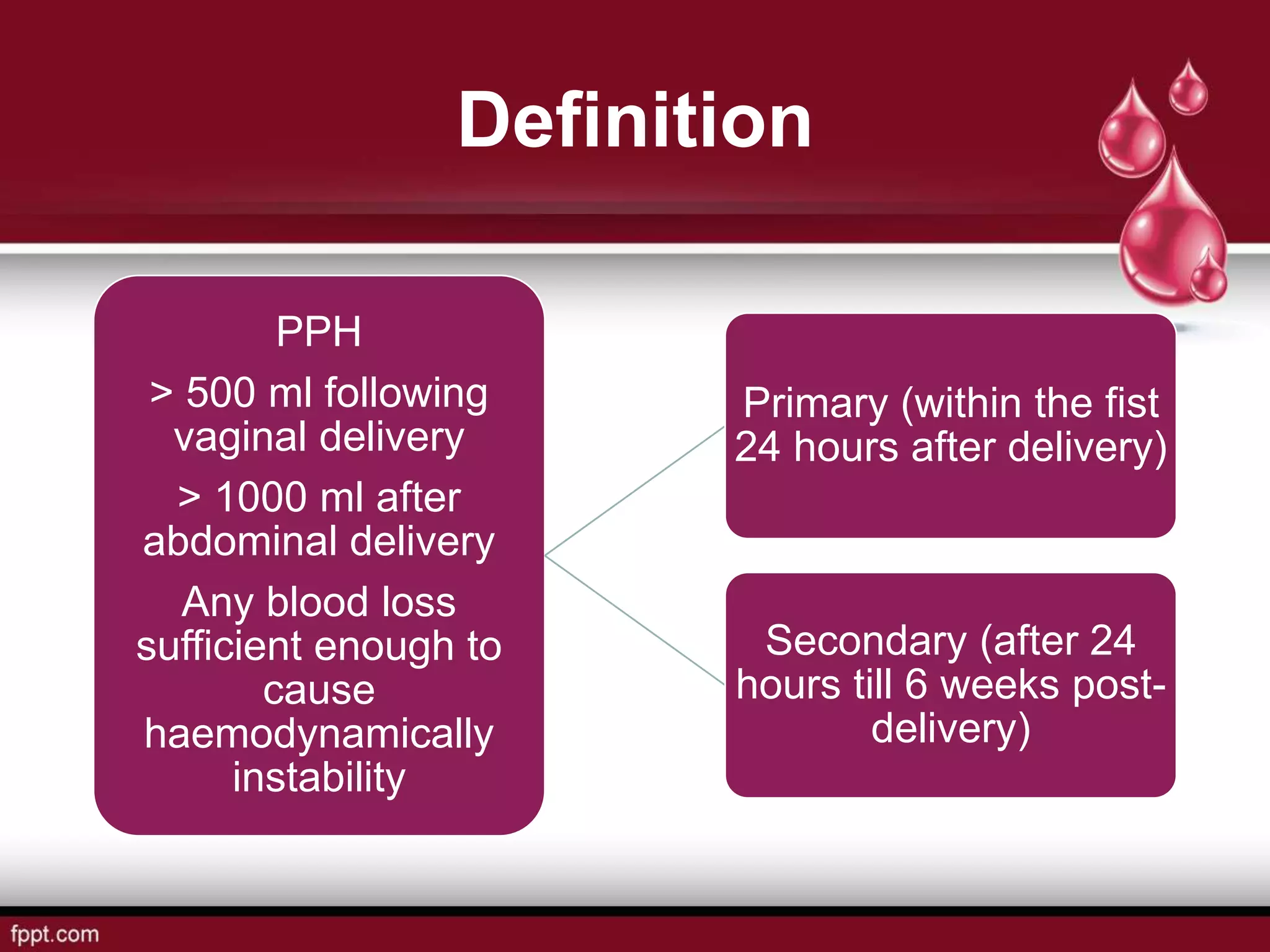
PPH
> 500 ml following
vaginal delivery
> 1000 ml after
abdominal delivery
Any blood loss
sufficient enough to
cause
haemodynamically
instability
Primary (within the fist
24 hours after delivery)
Secondary (after 24
hours till 6 weeks post-
delivery)
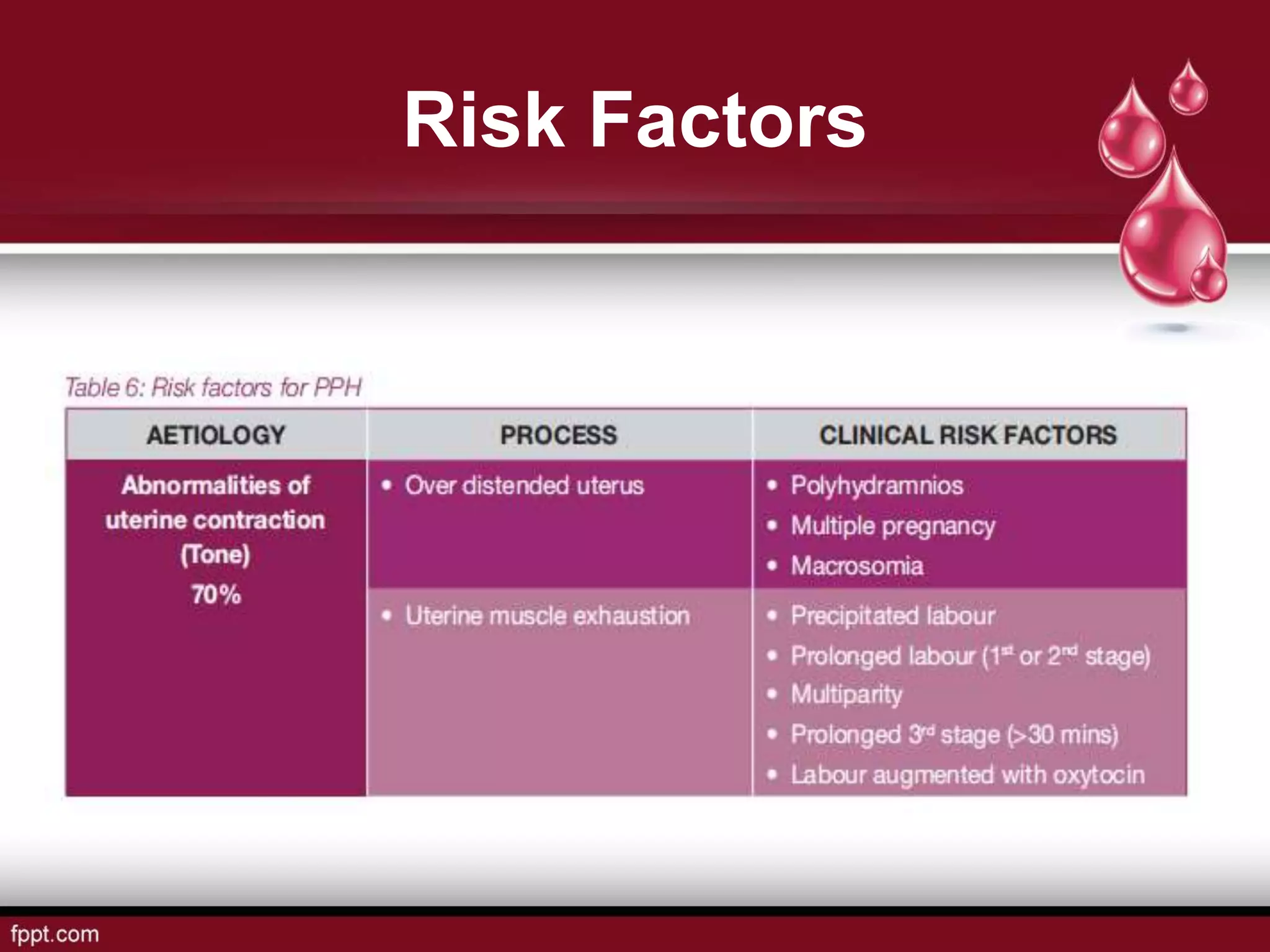
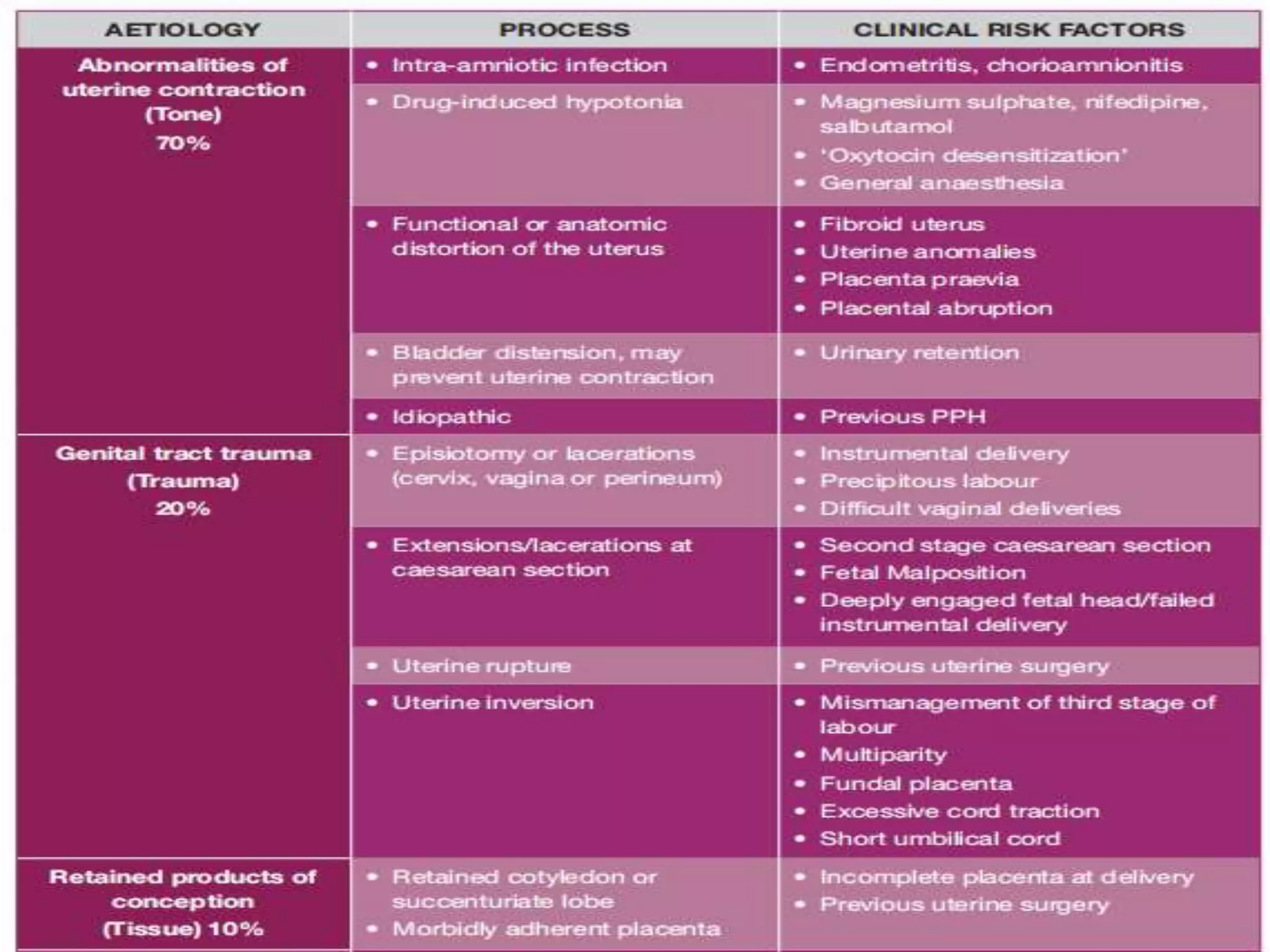
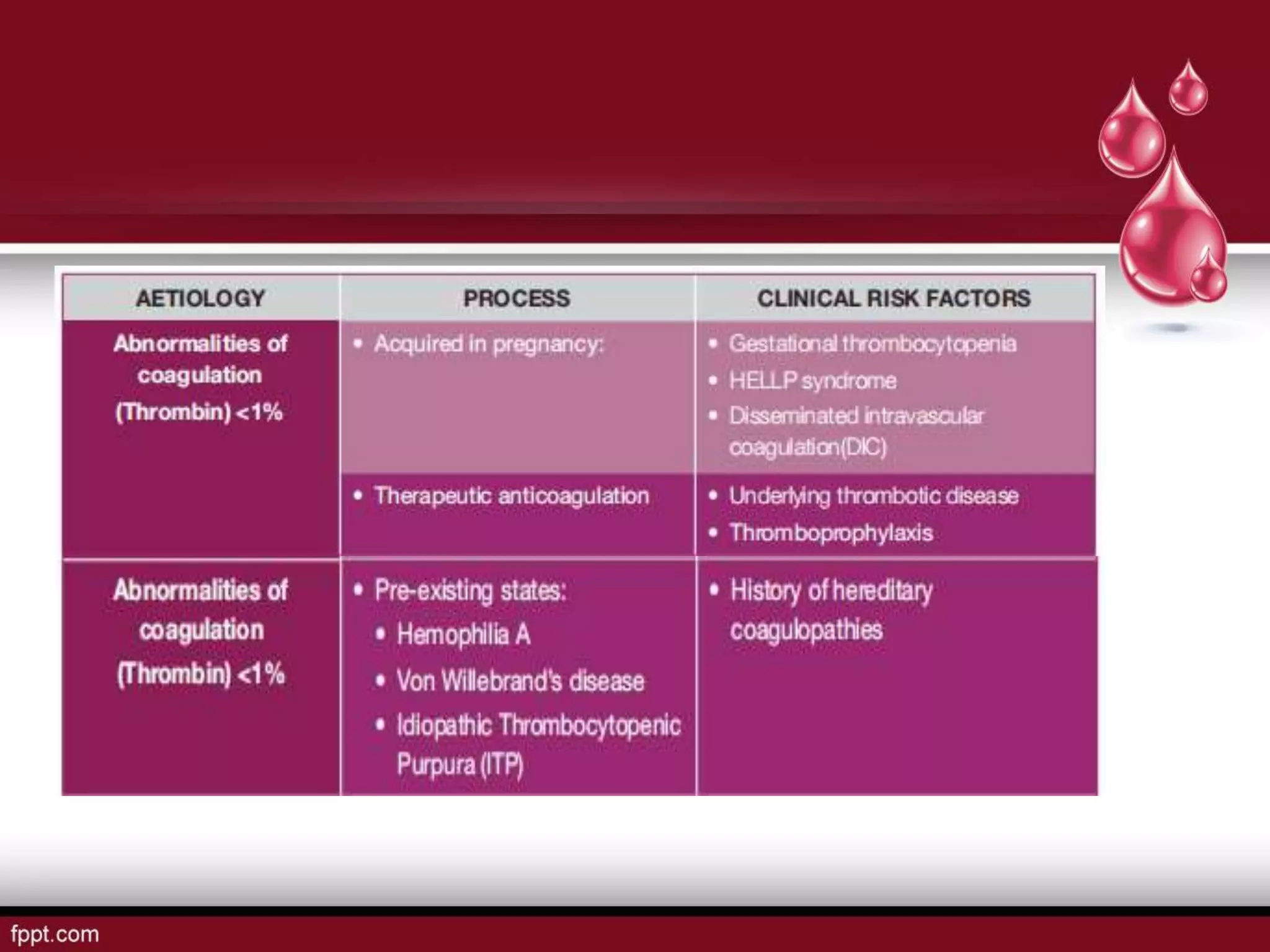
Risk Factors
Risk Reduction Measures
(Antenatal)
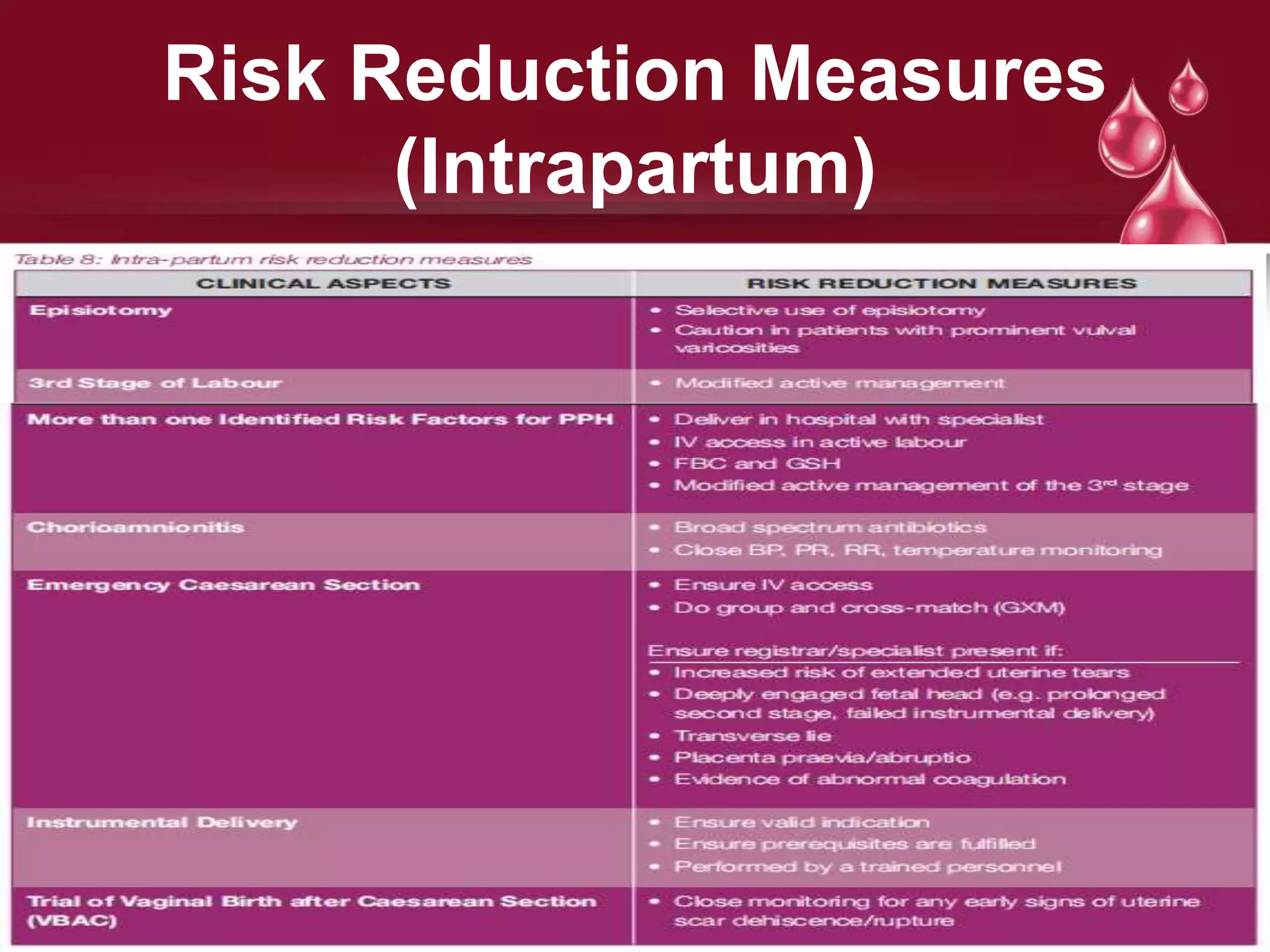
Risk Reduction Measures
(Intrapartum)
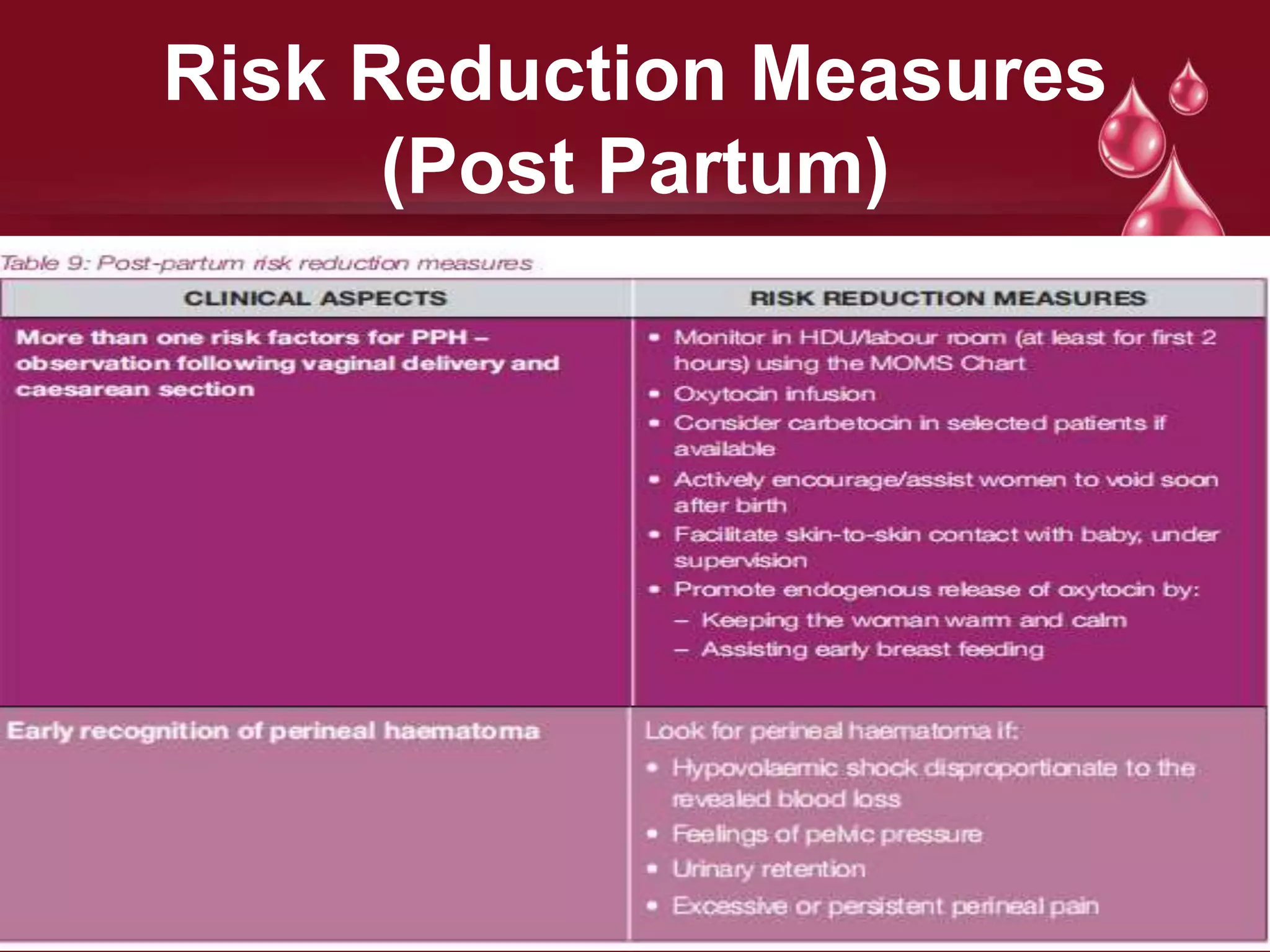
Risk Reduction Measures
(Post Partum)
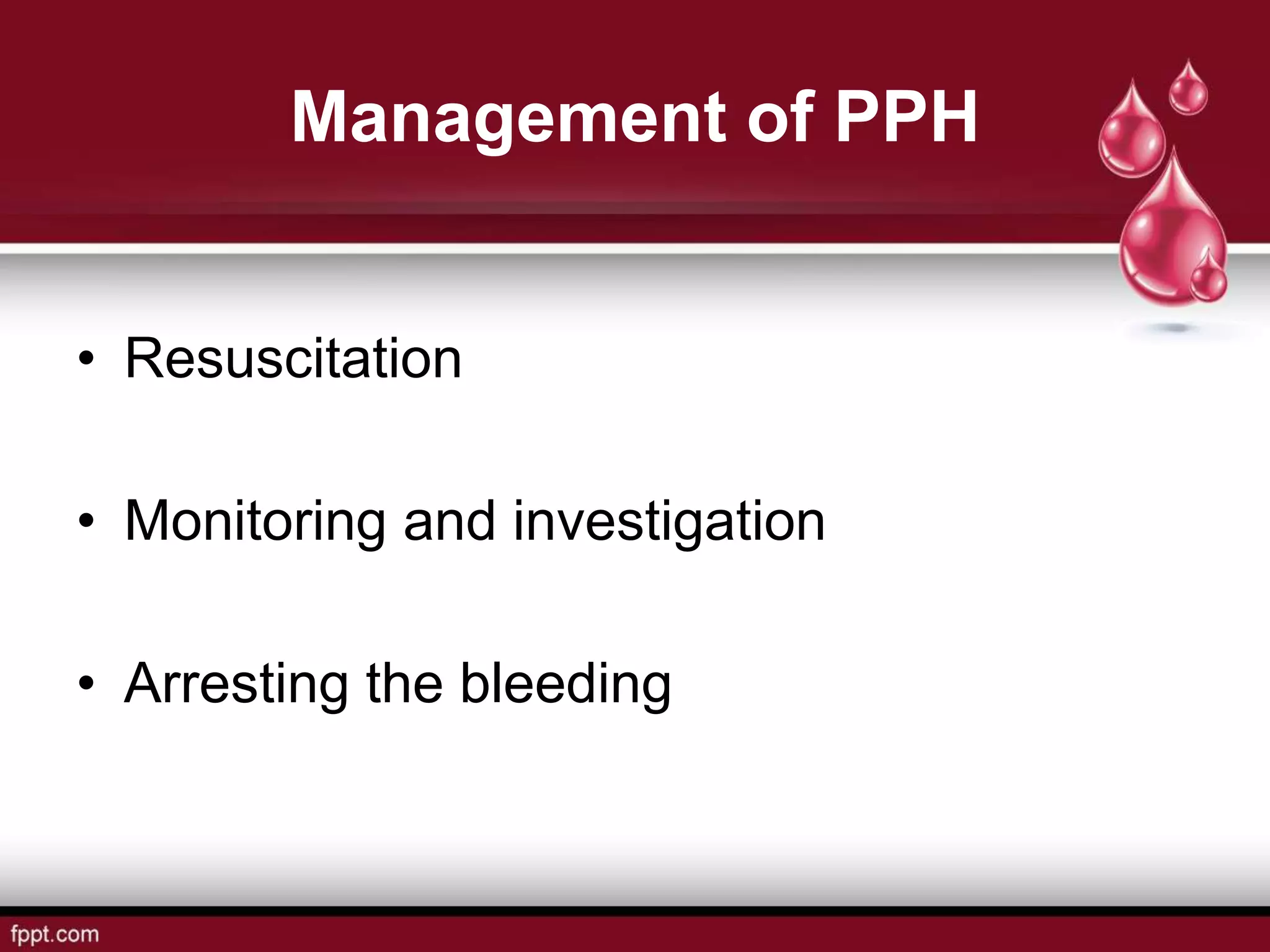
Management of PPH
• Resuscitation
• Monitoring and investigation
• Arresting the bleeding
Resuscitation
• High flow facial O2 at 15L/min
• Protect airway if level of consciousness impaired
• 2 large bore branula
• IV fluid, blood & blood products, drugs
• CBD with strict I/O chart
Drugs
• Uterotonic drugs
• IV tranexamic acid
• Vasopressors or inotropic drugs
Monitoring and investigations
• Monitoring
– Vital signs (BP, PR, RR, Temp, PS, SpO2)
– Fluid balance
• Investigations
– FBC, BUSE, Coag profile, ABG, GXM
Arresting the bleeding
• Uterine massage
• Ensure placenta and membrane complete
• Uterotonic drugs
• Find causes and treat the underlying
causes
Uterine atony
• First line drugs
– IV Oxytocin 40IU
– IM Syntometrine
– IM Carboprost 250mcg over 15minutes
– Rectal misoprostol 800-1000mcg
– Rectal Gemeprost 1mg
• Other measures
– Bimanual compression and/or aortic compression
– Bakri balloon
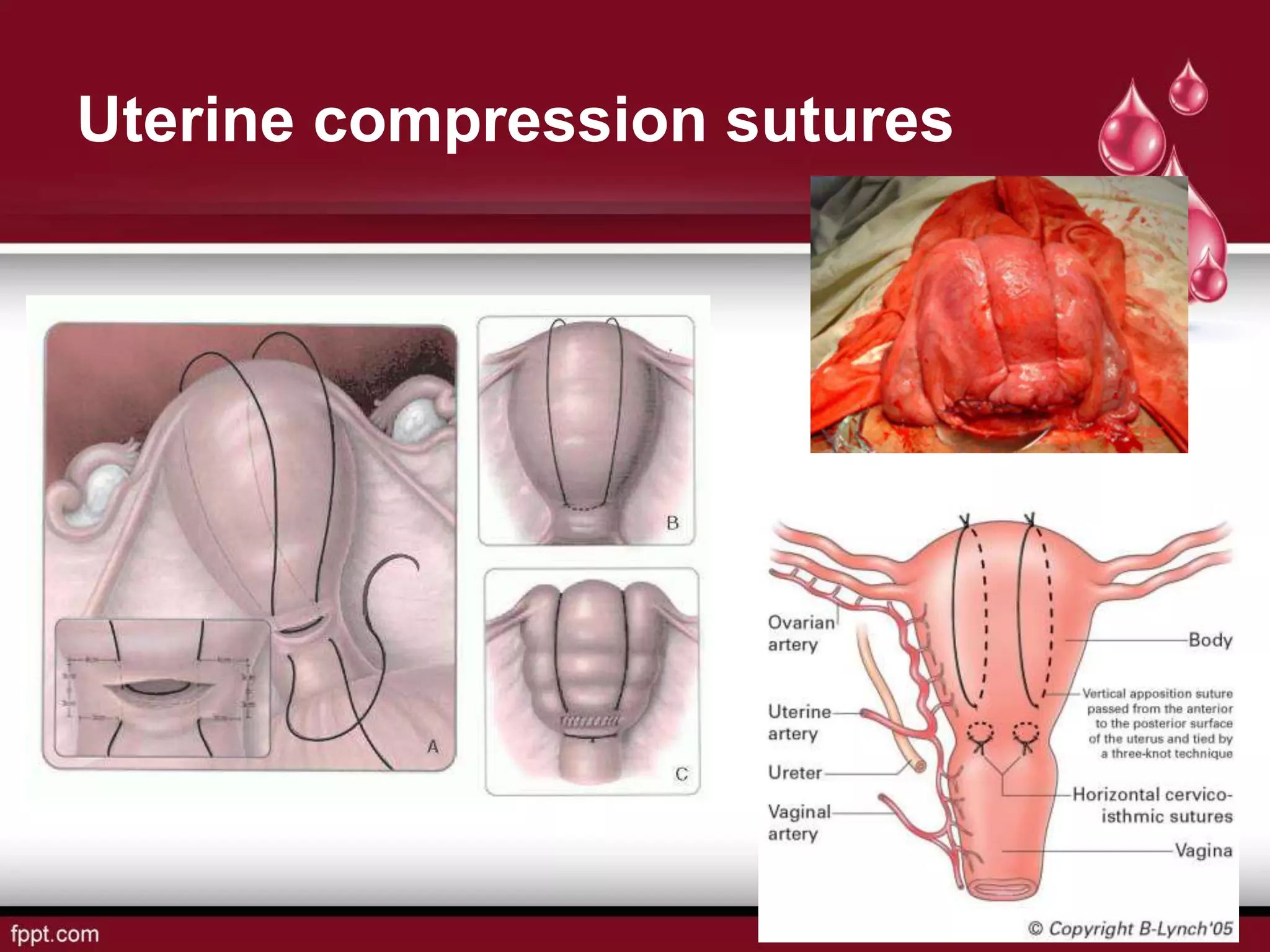
– Laparotomy – uterine compression suture, pelvic devascularisation,
hysterectomy
Bimanual compression
Bakri balloon
Uterine compression sutures
Retained placenta
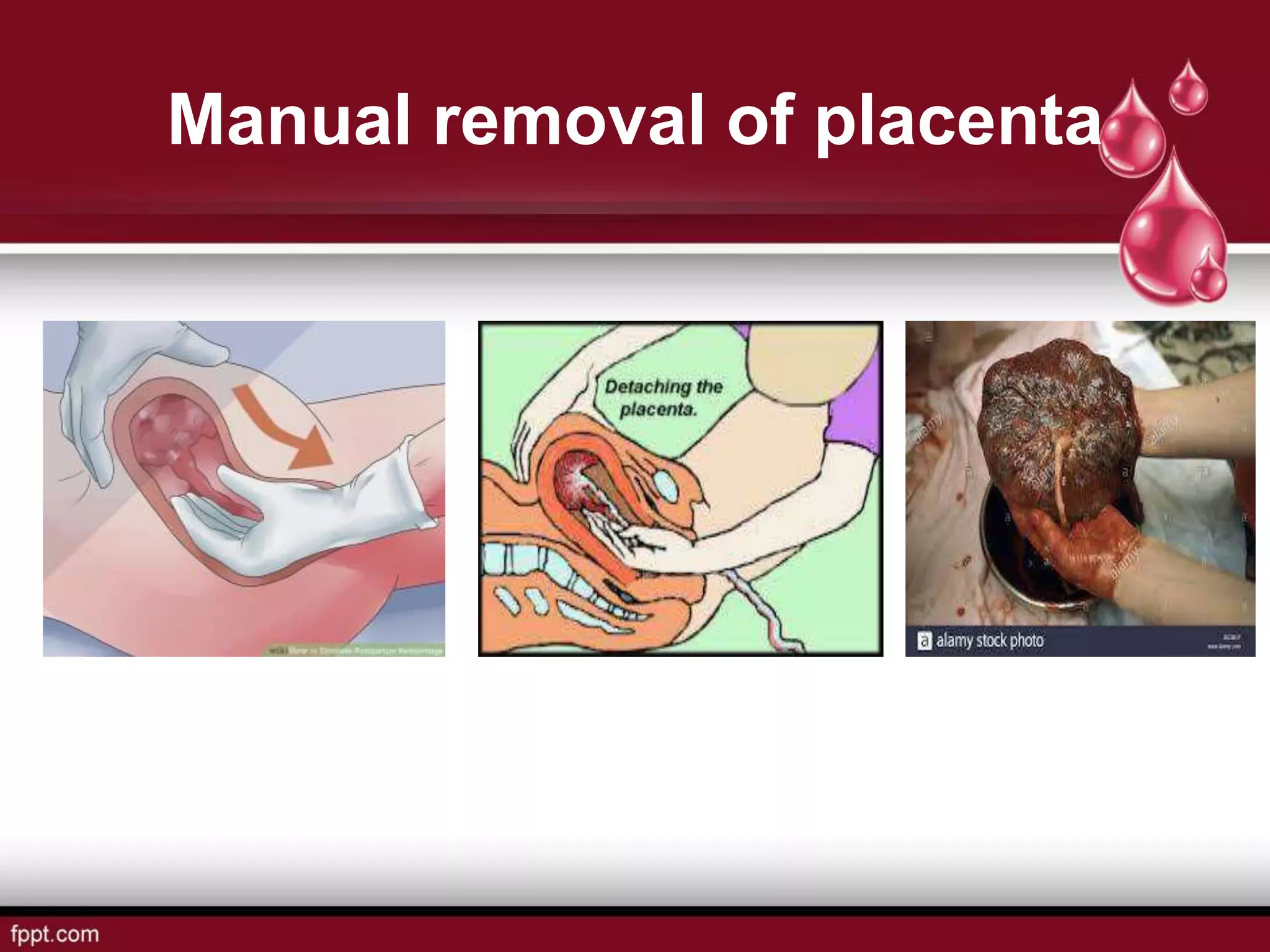
• Manual removal of placenta
• Monitor vitals & blood loss every
15minutes while awaiting OT call
Manual removal of placenta
Genital tract trauma
• Repair of any tear or lacerations
• Ideally done in OT with good lighting and
prophylactic antibiotics
• Examine for hematoma
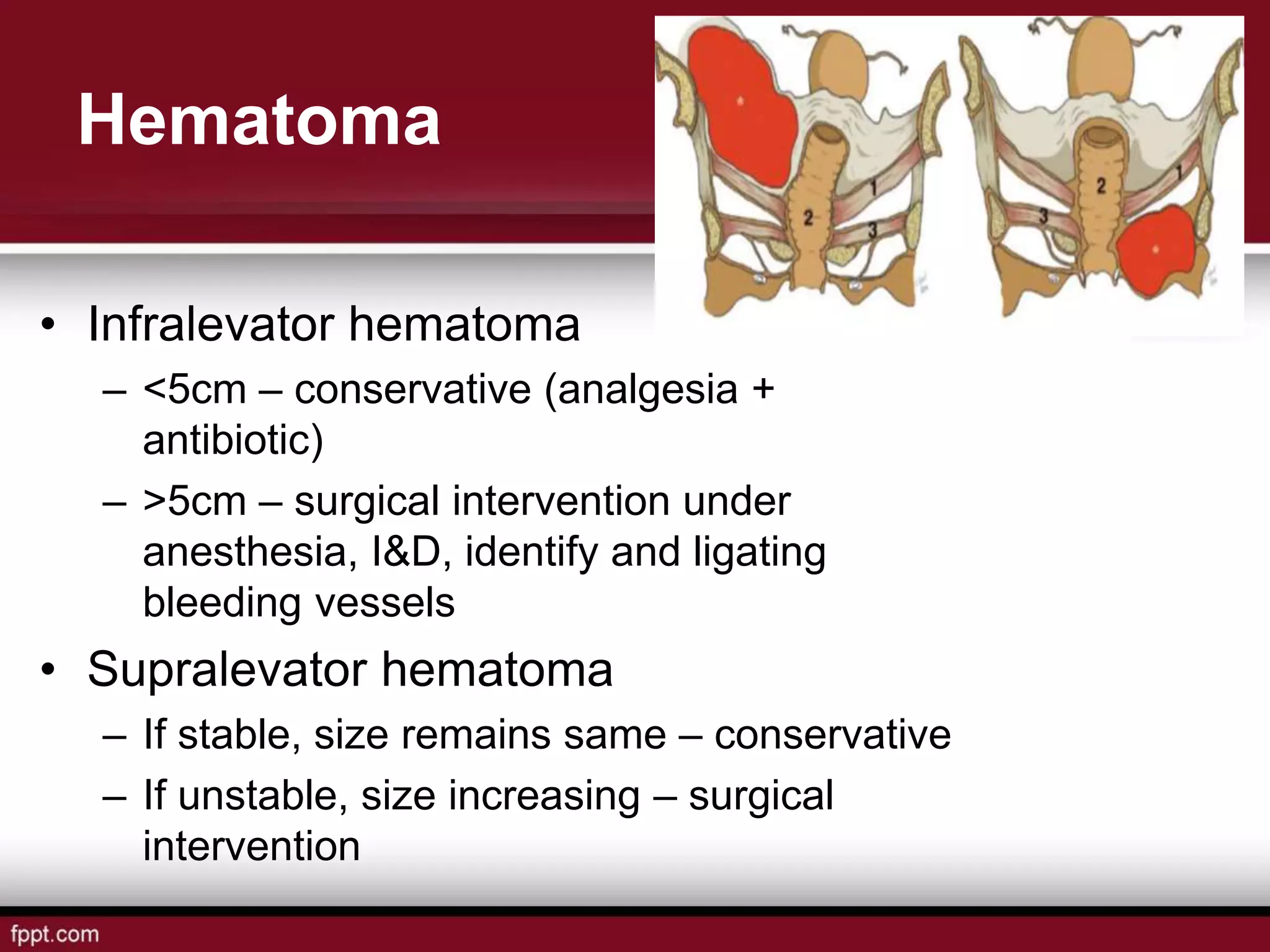
Hematoma
• Infralevator hematoma
– <5cm – conservative (analgesia +
antibiotic)
– >5cm – surgical intervention under
anesthesia, I&D, identify and ligating
bleeding vessels
• Supralevator hematoma
– If stable, size remains same – conservative
– If unstable, size increasing – surgical
intervention
Uterine inversion
• Manual replacement
• Hydrostatic replacement
– O’Sullivan’s technique
• Surgical replacement
– Huntington’s procedure
– Haultain’s procedure
Uterine rupture
• Resuscitation
• Laparotomy and repair
• Hysterectomy if beyond repair, unable to
secure hemostasis
THANK YOU

CME PPH.ppt