MarlonT. Mondoy RN
Emergency Department
MHARS Medical Center
Personal Protective Equipment
Objective
2
 Choose appropriate Personal Protective Equipment (PPE)
equipment and use without contamination.
March 23, 2025
Introduction
PPE
3
Prior to entering the patient isolation rooms/areas,
ensure that all visitors and health-care workers
rigorously use personal protective equipment (PPE)
and perform hand hygiene.
-WHO 2014
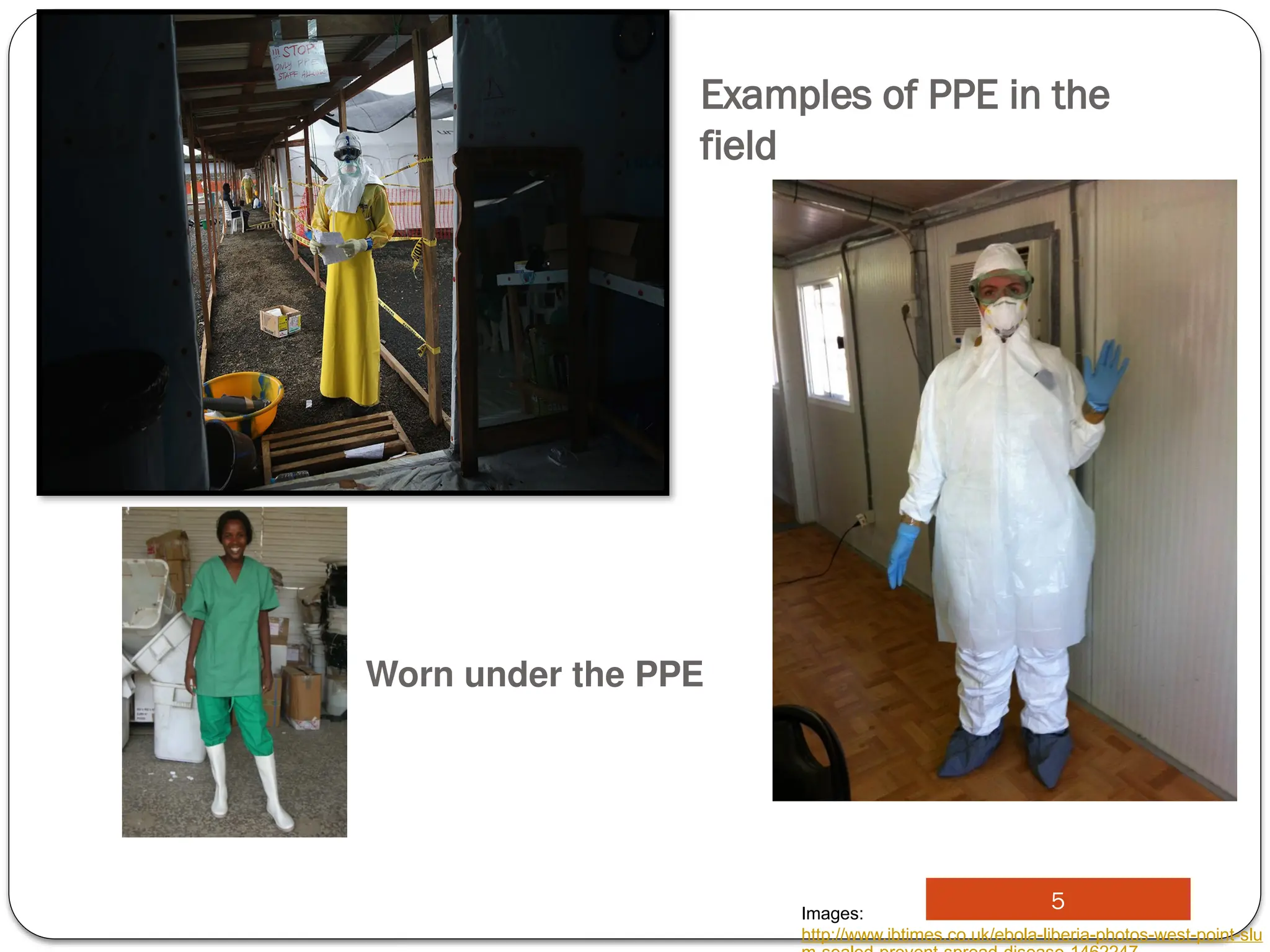
Examples of PPE in the
field
March 23, 2025
5
Images:
http://www.ibtimes.co.uk/ebola-liberia-photos-west-point-slu
Worn under the PPE
New PPE Guidance
6
 PPE recommendations remain different between organizations (MSF,
CDC,WHO)
 Currently adapting and discussing this issue
These hospitals followed three principles.
 Principle #1: Rigorous and repeated training
 Principle #2: No skin exposure when PPE is worn
 Principle #3:Trained monitor
 The enhanced guidance is centered on the 3 principles
* Emory University Hospital, Nebraska Medical Center and National Institutes of Health (NIH) Clinical Center
CDC 2014 http://www.cdc.gov/media/releases/2014/fs1020-ebola-personal-protective-equipment.html
Principle #1: Rigorous and repeated training
7
 Focusing only on PPE gives a false sense of security of safe
care and worker safety.
 Training is critical to ensure infection control.
 Ensure all HCWs practice numerous times
 Make sure HCWs understand how to appropriately use the
equipment
 Especially the step by step donning and doffing of PPE
CDC 2014 http://www.cdc.gov/media/releases/2014/fs1020-ebola-personal-protective-equipment.html
Principle #2:
No skin exposure when PPE is worn
8
 Two specific, recommended PPE options with equivalent protection if
worn, donned and doffed correctly:
 Gown/body suit
 N-95/PAPR
 Designated areas for putting on and taking off PPE
 Ensure that space and lay-out allows for clear separation between low-risk and high-
risk areas
 Step-by-step PPE removal instructions including:
 Disinfecting visibly contaminated PPE using an 1:10 bleach disinfectant wipe
prior to taking off equipment
 Disinfection of gloved hands using either an 1:10 bleach disinfectant wipe or
alcohol-based hand sanitizer between steps of taking off PPE
CDC 2014 http://www.cdc.gov/media/releases/2014/fs1020-ebola-personal-protective-equipment.html
Principle #2:
No skin exposure when PPE is worn
9
PPE recommended for healthcare workers caring for patients
with COVID 19 includes:
 Double gloves
 Boot covers
 Gown or coverall:
 Single use fluid resistant or impermeable.
 Gown extends to at least mid-calf.
 Respirators, including either N95 respirators or powered air
purifying respirator(PAPR)
 Single-use, full-face shield
 Hoods to ensure complete coverage of the head and neck
 Apron that is waterproof and covers the torso to the level of
the mid-calf CDC 2014; Images Johns
Hopkins Health System
Principle #3: Trained monitor
10
 CDC is recommending a trained monitor
 Actively observe and supervise each worker taking PPE on and
off
 To ensure each worker follows the step by step processes,
especially to disinfect visibly contaminated PPE
 Can spot any missteps in real-time and immediately address
CDC 2014 http://www.cdc.gov/media/releases/2014/fs1020-ebola-personal-protective-equipment.html
11
 Nurse.com, 10/31/14
 “The idea of a trained observer highlights some practices we
should be doing every day,”“There are many more things that
could be on the horizon when it comes to infection, and the
CDC’s new guidelines are a reminder that we have the
ability to watch out for each other. Small decisions
like pointing out an error or reminding someone
about something can mean the difference in infection
and prevention.”
Linda Greene, MPS, RN, CIC, an infection prevention manager at Highland Hospital in
Rochester, N.Y., and a member of the regulatory review panel for theAssociation for
Professionals in Infection Control and Epidemiology.
Use of a Trained Observer
12
 The sequence and actions involved in each donning and doffing step are critical to
avoiding exposure, a trained observer:
 will read aloud to the healthcare worker each step in the procedure checklist and visually
confirm and document that the step has been completed correctly.
 The trained observer is a dedicated individual with the sole responsibility of
ensuring adherence to the entire donning and doffing process.
 The trained observer will be knowledgeable about all PPE recommended in the
facility’s protocol and the correct donning and doffing procedures, including disposal
of used PPE, and will be qualified to provide guidance and technique
recommendations to the healthcare worker.
 The trained observer will monitor and document successful donning and doffing
procedures, providing immediate corrective instruction if the healthcare worker is not
following the recommended steps.
 The trained observer should know the exposure management plan in the event of an
unintentional break in procedure.
Recommended PPE for Trained Observer during
Observations of PPE Doffing
13
 The trained observer should not enter the room of a patient with COVID, but will be in the
PPE removal area to observe and assist with removal of specific components of PPE.
 The observer should not participate in any COVID patient care activities while conducting
observations.
 The following PPE are recommended for trained observers:
 Single-use (disposable) fluid-resistant or impermeable gown that extends to at least
mid-calf or coverall without integrated hood.
 Single-use (disposable) full face shield.
 Single-use (disposable) nitrile examination gloves with extended cuffs.Two pairs of
gloves should be worn. At a minimum, outer gloves should have extended cuffs.
 Single-use (disposable) fluid-resistant or impermeable shoe covers. Shoe covers
should allow for ease of movement and not present a slip hazard to the worker.
 Trained observers should don and doff selected PPE according to standard procedures.
 If the trained observer assists with PPE doffing, then the trained observer should disinfect
outer-gloved hands with an *EPA-registered disinfectant wipe orABHR immediately after
contact with healthcare worker’s PPE.
More than PPE is needed
14
 PPE is Only One Aspect of Infection Control
 It is critical to focus on other prevention activities to halt the
spread of Ebola in healthcare settings, including:
 Prompt screening and triage of potential patients
 Designated site managers to ensure proper implementation
of precautions
 Limiting personnel in the isolation room
 Effective environmental cleaning
CDC 2014 http://www.cdc.gov/media/releases/2014/fs1020-ebola-personal-protective-equipment.html
March 23, 2025
Ppe Components
15
Under the PPE
16
For wearing in low-risk area
 Scrub suit (washable or disposable)
 Covered toes, fluid and puncture
resistant boots
Launder scrubs and clean boots at health
facility
Gloves
 Intended to prevent skin contact with
hazardous substances, e.g. body fluids
 Do not reuse disposable gloves
 Double gloves are recommended
 Gloves with long cuffs offer more protection
 Use correct size
 Remove a soiled gloves as soon as possible
and apply hand hygiene to avoid transfer of
microorganisms to other patients or
environments.
Slide adapted from World Health Organization
Boot Covers
 Protects the boot from gross contamination
 Fluid resistant or impermeable
 Remove carefully by stepping on the back of
the boot cover and only touch the inside of the
covers once removed
Slide adapted from World Health Organization
Gown or Body Suit
 Protects skin
 Prevents soiling of clothing
 Fluid resistant or impermeable
 Remove a soiled garment as promptly as
possible and apply hand hygiene to avoid
transfer of microorganisms to other patients or
environments.
Slide adapted from World Health Organization
Apron
Apron protects front of
gown/body suit from gross
contamination with infectious
body fluids resulting safer
removal
Essential if:
 The gown is not impermeable
 Strenuous activity with risk of
disrupting the gown
 Large amount of blood and
body fluids expected
Slide adapted from World Health Organization
Mask
 Protects the mucosa of nose and
mouth from droplets, spills and
splashes
 Wear medical masks tightly to the
face
 Discard immediately after use
 If wet or dirty with secretions, it
must be changed promptly
Medical mask
N-95 mask
Aerosol Generating Procedures
March 23, 2025
23
 Wear a respirator any procedures that
stimulate coughing or promote
generation of aerosols
 Different models available
 Aerosols
 Tiny particles < 5 m
 Float on air currents for long
distances
Source: World Health Organization 2014
Aerosol Generating Procedures
March 23, 2025
24
 Aerosol generating procedures include:
 Aerosolized or nebulized medication administration
 Diagnostic sputum induction
 Bronchoscopy
 Airway suctioning
 Intubation
 Positive pressure ventilation via facemask
 For COVID patient, avoid as much as possible due to potential
for virus to become aerosolized
Source: World Health Organization 2014
Fit test ≠ seal check
 Fit test evaluates the existence of leaks at the
moment it is performed for the model being
tested
 The conditions during the test may not be the same
as "real life"
 In the real life the type of respirator may differ
from the one fit tested
 Seal check
 helps check if the respirator is well adjusted to the
face
 should be done before EACH USE
 Users should be trained on how to use the
respirator
Slide used with permission from World Health Organization
Particulate Respirator Seal Check
 Cup the respirator in your hand with the
nosepiece at your fingertips allowing the
headbands to hang freely below your hand
 Position the respirator under your chin with the
nosepiece up
Slide used with permission from World Health Organization
Pull the top strap over your head resting it high at
the back of your head. Pull the bottom strap over
your head and position it around the neck below
the ears
Place fingertips of both hands at the top of the metal
nosepiece. Mold the nosepiece (USINGTWO
FINGERS OF EACH HAND) to the shape of your
nose. Pinching the nosepiece using one hand may
result in less effective respirator performance
Slide used with permission from World Health Organization
Particulate Respirator Seal Check
Cover the front of the respirator with both
hands, being careful not to disturb the position
of respirator
Positive seal check
 Exhale sharply.A positive pressure inside
the respirator = no leakage. If leakage,
adjust position and/or tension straps.
 Retest the seal and repeat the steps until
respirator is sealed properly
Negative seal check
 Inhale deeply. If no leakage, negative pressure
will make respirator cling to your face
 Leakage will result in loss of negative
pressure in the respirator due to air entering
through gaps in the seal
Slide used with permission from World Health Organization
DO THIS
EACH TIME
YOU PUT ON
MASK
Eye protection
Face shield
Goggles
Visor
March 23, 2025
Ppe use
30
Designating Areas for PPE Donning and Doffing
March 23, 2025
31
 Facilities should ensure that space and layout allow for clear separation
between clean and potentially contaminated areas.
 It is critical that physical barriers (e.g., plastic enclosures) be used where
necessary, along with visible signage, to separate distinct areas and ensure a
one-way flow of care moving from clean areas (e.g., area where PPE is donned
and unused equipment is stored) to the patient room and to the PPE removal
area (area where PPE is removed and discarded).
 Post signage to highlight key aspects of PPE donning and doffing, including:
 Designating clean areas vs. potentially contaminated areas
 Reminding healthcare workers to wait for a trained observer before removing PPE
 Reinforcing need for slow and deliberate removal of PPE to prevent self-
contamination
 Reminding healthcare workers to perform disinfection of gloved hands in between
steps of the doffing procedure, as indicated below.
Designate the following areas with appropriate signage:
32
 PPE Storage and DonningArea
 This is an area outside the Ebola patient room (e.g., a nearby
vacant patient room, a marked area in the hallway outside the
patient room) where clean PPE is stored and where healthcare
workers can don PPE before entering the patient’s room.
 Do not store potentially contaminated equipment, used PPE, or
waste removed from the patient’s room in this area.
 Waste must not pass through this area, if it does it must be
properly contained.
33
Preparation and Planning
 Prepare designated area
to put on PPE(in low-
risk)
 Guarantee hand hygiene
facility
 Guarantee
recommended PPE
 Adequate supplies
 Adequate space to put
on
PPE Removal Area
34
 This is an area in proximity to the patient’s room (e.g., anteroom or adjacent
vacant patient room that is separate from the clean area) where healthcare
workers leaving the patient’s room can doff and discard their PPE.
 Some steps of the PPE removal process may be performed in a clearly
designated area of the patient’s room near the door, provided these steps can be
seen and supervised by a trained observer (e.g., through a window such that the
healthcare worker doffing PPE can still hear the instructions of the trained
observer).
 Do not use this clearly designated area within the patient room for any other
purpose.
 Stock gloves in a clean section of the PPE removal area accessible to the
healthcare worker while doffing.
PPE Removal Area
35
 In the PPE removal area, provide supplies for disinfection of PPE and for
performing hand hygiene and space to remove PPE, including a place for sitting
that can be easily cleaned and disinfected, where the healthcare workers can
remove boot covers.
 Provide leak-proof infectious waste containers for discarding used PPE.
 Perform frequent environmental cleaning and disinfection of the PPE removal
area, including upon completion of doffing procedure by healthcare workers.
PPE Removal Area
36
 If a facility must use the hallway outside the patient room as the PPE
removal area:
 construct physical barriers to close the hallway to through traffic and thereby create an
anteroom
 should make sure that this hallway space complies with fire-codes.
 Restrict access to this hallway to essential personnel who are properly trained on
recommended infection prevention practices for the care of Ebola patients.
 Facilities should consider making showers available for use by healthcare
workers after doffing of PPE.
PPE Use
 Avoid reuse of disposable PPE items
 Reprocessed disposable PPE may not provide the same protective
efficacy and safety as new PPE
 Reuse may increase the risk of infection in HCWs
Slide used with permission from WHO
PPE Use if Supplies are Limited
 If resources are limited and disposable PPE items are not available
 properly disinfect reusable items after each use
 Avoid wastage:
 Critically evaluate situations in which PPE is indicated
 Batch clinical care during each entry to the patient's room
 Work from suspect to confirmed cases
 Work from clean to dirty procedures
 Prioritize for scenarios that have been consistently associated with increased risk of
pathogen transmission
 Use of unnecessary PPE should be avoided
 Training is not unnecessary use
Slide used with permission from World Health Organization
39
March 23, 2025
40
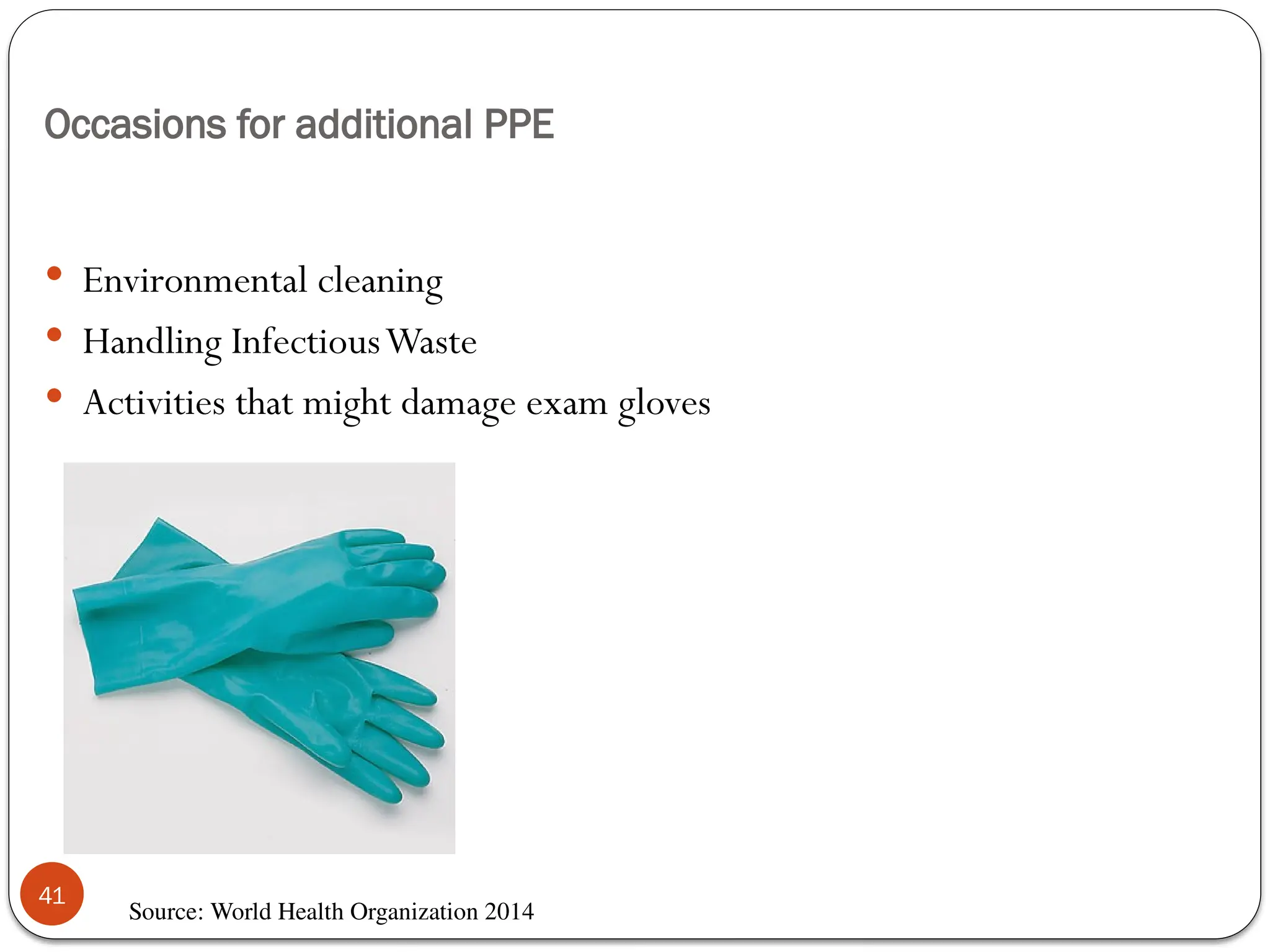
Occasions for additional PPE
41
 Environmental cleaning
 Handling InfectiousWaste
 Activities that might damage exam gloves
Source: World Health Organization 2014
Important Points about wearing PPE for Ebola
Before entering the isolation room/area:
 Collect all equipment needed (time out)
 Go to bathroom
 Perform hand hygiene
 Put on PPE
 in the order that ensures adequate placement of PPE items
 prevents self-contamination and self-inoculation while using and
taking off PPE
Slide used with permission from World Health Organization
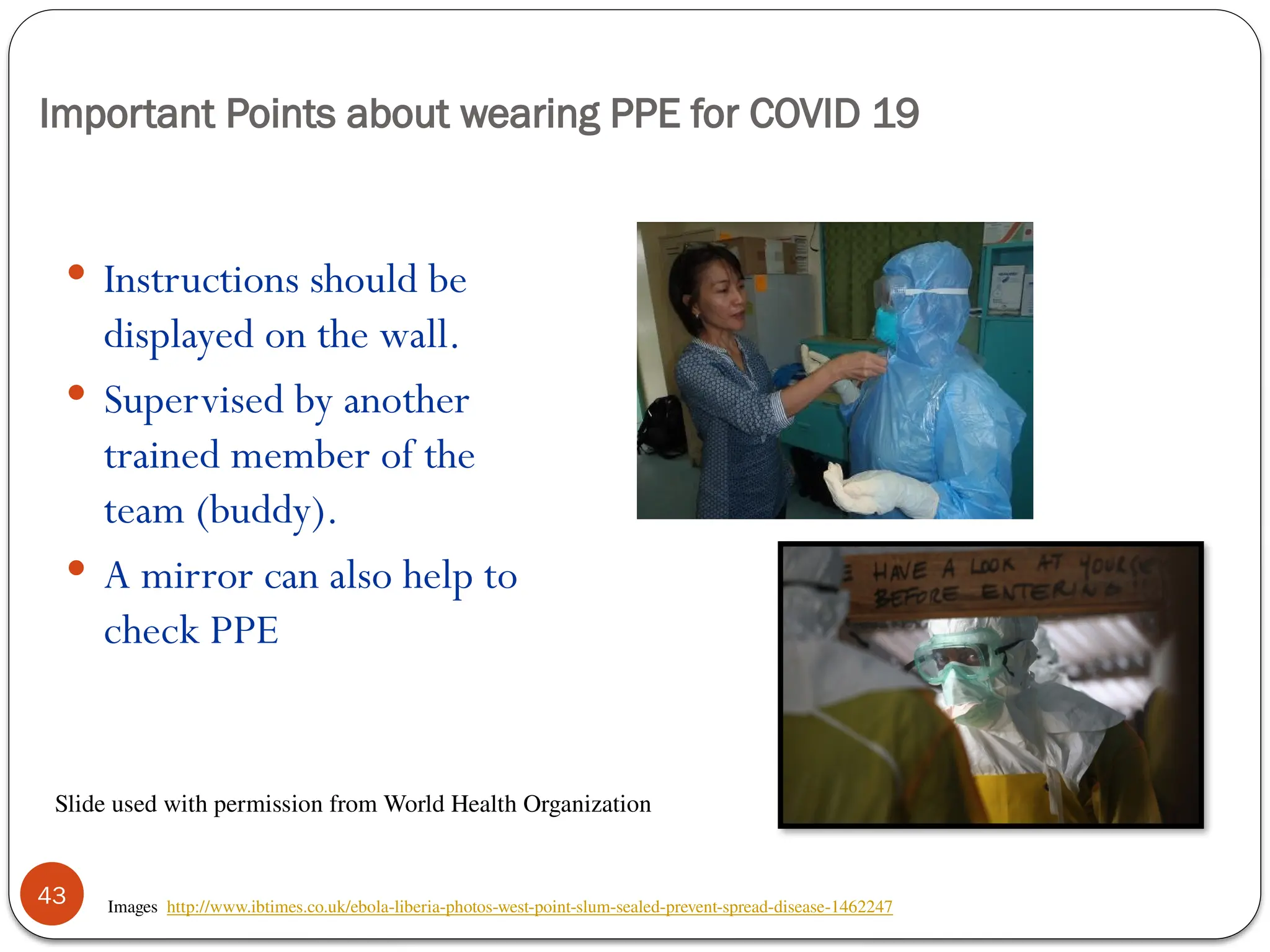
Important Points about wearing PPE for COVID 19
43
 Instructions should be
displayed on the wall.
 Supervised by another
trained member of the
team (buddy).
 A mirror can also help to
check PPE
Images: http://www.ibtimes.co.uk/ebola-liberia-photos-west-point-slum-sealed-prevent-spread-disease-1462247
Slide used with permission from World Health Organization
March 23, 2025
Re-processing ppe
Cleaning PPE
March 23, 2025
45
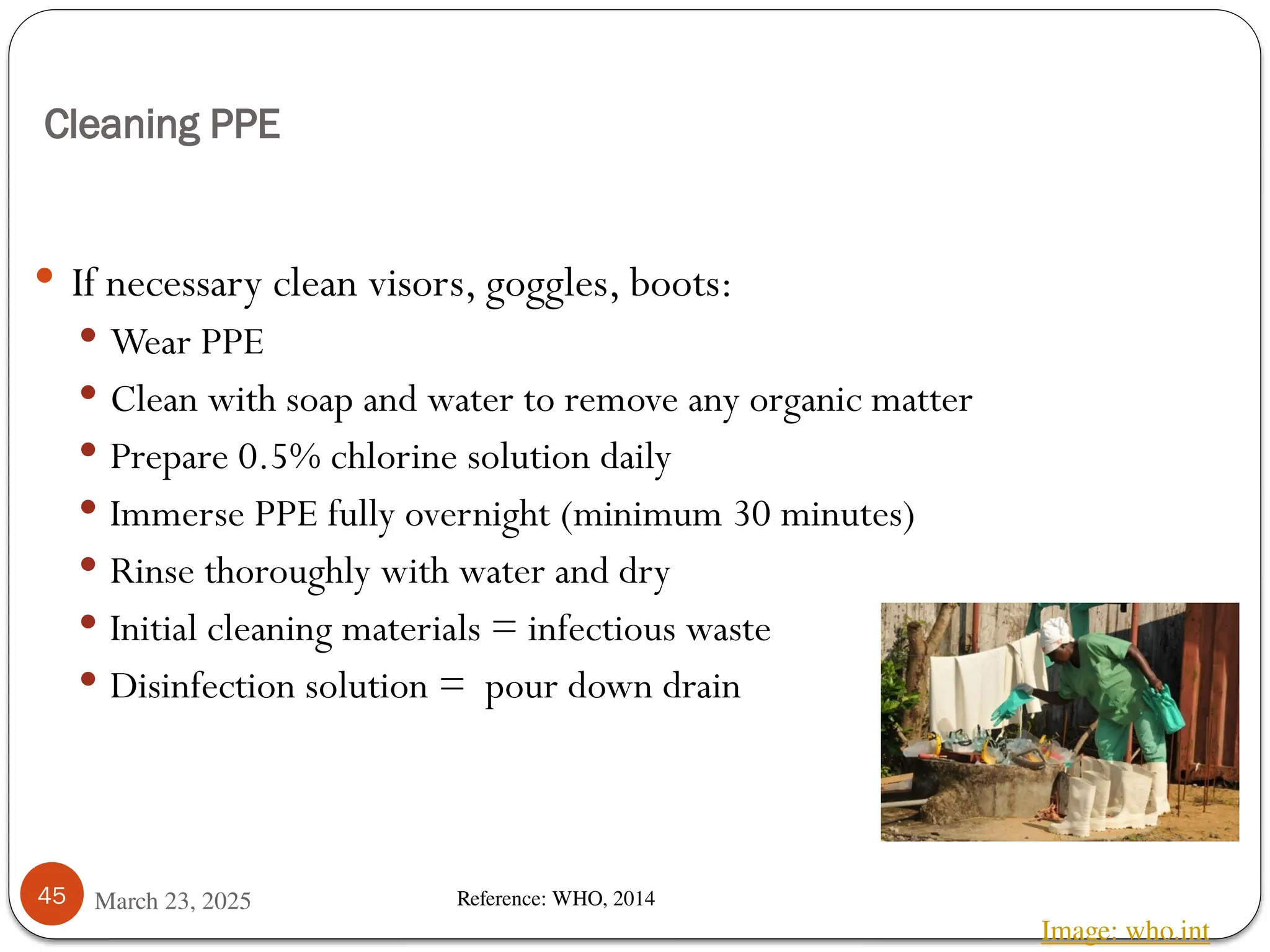
 If necessary clean visors, goggles, boots:
 Wear PPE
 Clean with soap and water to remove any organic matter
 Prepare 0.5% chlorine solution daily
 Immerse PPE fully overnight (minimum 30 minutes)
 Rinse thoroughly with water and dry
 Initial cleaning materials = infectious waste
 Disinfection solution = pour down drain
Image: who.int
Reference: WHO, 2014
How much PPE do I need?
46
Things to consider:
 Duration of each entry (in PPE)
 Estimated number of entries per shift
 Number of people caring for patient per shift
 Number of days for each patient
Additional considerations:
 Lab and medical procedures per person
 Time for re-processing of reusable PPE
ADD EXTRA 10% AS BUFFER UNEXPTECTED
March 23, 2025
Heat - related illness
Heat Related Illness
 Heat illness is a serious risk while wearing PPE in tropical
conditions
 It is preventable
 Heat storage is the major cause
 Hydration is important but will not affect heat storage
 Team protocols are required for:
 Prevention
 Heat illness monitoring
 Heat illness treatment
Slide used with permission from World Health Organization
Heat storage
 YOU MUST PACEYOURSELF AND NOT OVER-EXERT
 If you do not your core temp will rise rapidly and reach critical levels in under
one hour.
 Plan you day
 Limit time in PPE (45-1hr minutes)
 Make sure you are hydrated
 Symptoms are a continuum of mild to moderate to severe and
even life threatening
Heat Related Illness Spectrum
System Heat Cramps Heat exhaustion Heat stroke
Temperature >380
C >40.50
C
or 104.90
F
Skin Temperature Normal Normal or cool and
clammy
Hot and dry (50%
cases)
Sweat Rate Increased Increased or
decreased
Decreased
Urine Output Normal Oliguria Anuria
GI Thirst Nausea +/- vomiting Nausea and vomiting
CVS Tachycardia Hypotension +/- Circulatory
Collapse
CNS Nil Uncoordinated,
Irritable or confused
Delirium/seizure/
coma
Other Thirst Renal Failure
Liver Failure
DIC
Resources
March 23, 2025
51
WHO 2014 Interim Infection Prevention and Control Guidance for Care of Patients with
Suspected or Confirmed Filovirus Haemorrhagic Fever in Health-Care Settings,with Focus on
Ebola
http://apps.who.int/iris/bitstream/10665/130596/1/WHO_HIS_SDS_2014.4
_eng.pdf?ua=1&ua=1
CDC 2014Guidance on Personal Protective EquipmentTo Be Used by Healthcare
Workers During Management of Patients with EbolaVirus Disease in U.S.
Hospitals, Including Procedures for Putting On (Donning) and Removing
(Doffing) http://www.cdc.gov/vhf/ebola/hcp/procedures-for-ppe.html

PPE Guidance, Principles, Components and Its Uses

  • 1.
    MarlonT. Mondoy RN EmergencyDepartment MHARS Medical Center Personal Protective Equipment
  • 2.
    Objective 2  Choose appropriatePersonal Protective Equipment (PPE) equipment and use without contamination.
  • 3.
  • 4.
    Prior to enteringthe patient isolation rooms/areas, ensure that all visitors and health-care workers rigorously use personal protective equipment (PPE) and perform hand hygiene. -WHO 2014
  • 5.
    Examples of PPEin the field March 23, 2025 5 Images: http://www.ibtimes.co.uk/ebola-liberia-photos-west-point-slu Worn under the PPE
  • 6.
    New PPE Guidance 6 PPE recommendations remain different between organizations (MSF, CDC,WHO)  Currently adapting and discussing this issue These hospitals followed three principles.  Principle #1: Rigorous and repeated training  Principle #2: No skin exposure when PPE is worn  Principle #3:Trained monitor  The enhanced guidance is centered on the 3 principles * Emory University Hospital, Nebraska Medical Center and National Institutes of Health (NIH) Clinical Center CDC 2014 http://www.cdc.gov/media/releases/2014/fs1020-ebola-personal-protective-equipment.html
  • 7.
    Principle #1: Rigorousand repeated training 7  Focusing only on PPE gives a false sense of security of safe care and worker safety.  Training is critical to ensure infection control.  Ensure all HCWs practice numerous times  Make sure HCWs understand how to appropriately use the equipment  Especially the step by step donning and doffing of PPE CDC 2014 http://www.cdc.gov/media/releases/2014/fs1020-ebola-personal-protective-equipment.html
  • 8.
    Principle #2: No skinexposure when PPE is worn 8  Two specific, recommended PPE options with equivalent protection if worn, donned and doffed correctly:  Gown/body suit  N-95/PAPR  Designated areas for putting on and taking off PPE  Ensure that space and lay-out allows for clear separation between low-risk and high- risk areas  Step-by-step PPE removal instructions including:  Disinfecting visibly contaminated PPE using an 1:10 bleach disinfectant wipe prior to taking off equipment  Disinfection of gloved hands using either an 1:10 bleach disinfectant wipe or alcohol-based hand sanitizer between steps of taking off PPE CDC 2014 http://www.cdc.gov/media/releases/2014/fs1020-ebola-personal-protective-equipment.html
  • 9.
    Principle #2: No skinexposure when PPE is worn 9 PPE recommended for healthcare workers caring for patients with COVID 19 includes:  Double gloves  Boot covers  Gown or coverall:  Single use fluid resistant or impermeable.  Gown extends to at least mid-calf.  Respirators, including either N95 respirators or powered air purifying respirator(PAPR)  Single-use, full-face shield  Hoods to ensure complete coverage of the head and neck  Apron that is waterproof and covers the torso to the level of the mid-calf CDC 2014; Images Johns Hopkins Health System
  • 10.
    Principle #3: Trainedmonitor 10  CDC is recommending a trained monitor  Actively observe and supervise each worker taking PPE on and off  To ensure each worker follows the step by step processes, especially to disinfect visibly contaminated PPE  Can spot any missteps in real-time and immediately address CDC 2014 http://www.cdc.gov/media/releases/2014/fs1020-ebola-personal-protective-equipment.html
  • 11.
    11  Nurse.com, 10/31/14 “The idea of a trained observer highlights some practices we should be doing every day,”“There are many more things that could be on the horizon when it comes to infection, and the CDC’s new guidelines are a reminder that we have the ability to watch out for each other. Small decisions like pointing out an error or reminding someone about something can mean the difference in infection and prevention.” Linda Greene, MPS, RN, CIC, an infection prevention manager at Highland Hospital in Rochester, N.Y., and a member of the regulatory review panel for theAssociation for Professionals in Infection Control and Epidemiology.
  • 12.
    Use of aTrained Observer 12  The sequence and actions involved in each donning and doffing step are critical to avoiding exposure, a trained observer:  will read aloud to the healthcare worker each step in the procedure checklist and visually confirm and document that the step has been completed correctly.  The trained observer is a dedicated individual with the sole responsibility of ensuring adherence to the entire donning and doffing process.  The trained observer will be knowledgeable about all PPE recommended in the facility’s protocol and the correct donning and doffing procedures, including disposal of used PPE, and will be qualified to provide guidance and technique recommendations to the healthcare worker.  The trained observer will monitor and document successful donning and doffing procedures, providing immediate corrective instruction if the healthcare worker is not following the recommended steps.  The trained observer should know the exposure management plan in the event of an unintentional break in procedure.
  • 13.
    Recommended PPE forTrained Observer during Observations of PPE Doffing 13  The trained observer should not enter the room of a patient with COVID, but will be in the PPE removal area to observe and assist with removal of specific components of PPE.  The observer should not participate in any COVID patient care activities while conducting observations.  The following PPE are recommended for trained observers:  Single-use (disposable) fluid-resistant or impermeable gown that extends to at least mid-calf or coverall without integrated hood.  Single-use (disposable) full face shield.  Single-use (disposable) nitrile examination gloves with extended cuffs.Two pairs of gloves should be worn. At a minimum, outer gloves should have extended cuffs.  Single-use (disposable) fluid-resistant or impermeable shoe covers. Shoe covers should allow for ease of movement and not present a slip hazard to the worker.  Trained observers should don and doff selected PPE according to standard procedures.  If the trained observer assists with PPE doffing, then the trained observer should disinfect outer-gloved hands with an *EPA-registered disinfectant wipe orABHR immediately after contact with healthcare worker’s PPE.
  • 14.
    More than PPEis needed 14  PPE is Only One Aspect of Infection Control  It is critical to focus on other prevention activities to halt the spread of Ebola in healthcare settings, including:  Prompt screening and triage of potential patients  Designated site managers to ensure proper implementation of precautions  Limiting personnel in the isolation room  Effective environmental cleaning CDC 2014 http://www.cdc.gov/media/releases/2014/fs1020-ebola-personal-protective-equipment.html
  • 15.
    March 23, 2025 PpeComponents 15
  • 16.
    Under the PPE 16 Forwearing in low-risk area  Scrub suit (washable or disposable)  Covered toes, fluid and puncture resistant boots Launder scrubs and clean boots at health facility
  • 17.
    Gloves  Intended toprevent skin contact with hazardous substances, e.g. body fluids  Do not reuse disposable gloves  Double gloves are recommended  Gloves with long cuffs offer more protection  Use correct size  Remove a soiled gloves as soon as possible and apply hand hygiene to avoid transfer of microorganisms to other patients or environments. Slide adapted from World Health Organization
  • 18.
    Boot Covers  Protectsthe boot from gross contamination  Fluid resistant or impermeable  Remove carefully by stepping on the back of the boot cover and only touch the inside of the covers once removed Slide adapted from World Health Organization
  • 19.
    Gown or BodySuit  Protects skin  Prevents soiling of clothing  Fluid resistant or impermeable  Remove a soiled garment as promptly as possible and apply hand hygiene to avoid transfer of microorganisms to other patients or environments. Slide adapted from World Health Organization
  • 20.
    Apron Apron protects frontof gown/body suit from gross contamination with infectious body fluids resulting safer removal Essential if:  The gown is not impermeable  Strenuous activity with risk of disrupting the gown  Large amount of blood and body fluids expected Slide adapted from World Health Organization
  • 21.
    Mask  Protects themucosa of nose and mouth from droplets, spills and splashes  Wear medical masks tightly to the face  Discard immediately after use  If wet or dirty with secretions, it must be changed promptly Medical mask N-95 mask
  • 22.
    Aerosol Generating Procedures March23, 2025 23  Wear a respirator any procedures that stimulate coughing or promote generation of aerosols  Different models available  Aerosols  Tiny particles < 5 m  Float on air currents for long distances Source: World Health Organization 2014
  • 23.
    Aerosol Generating Procedures March23, 2025 24  Aerosol generating procedures include:  Aerosolized or nebulized medication administration  Diagnostic sputum induction  Bronchoscopy  Airway suctioning  Intubation  Positive pressure ventilation via facemask  For COVID patient, avoid as much as possible due to potential for virus to become aerosolized Source: World Health Organization 2014
  • 24.
    Fit test ≠seal check  Fit test evaluates the existence of leaks at the moment it is performed for the model being tested  The conditions during the test may not be the same as "real life"  In the real life the type of respirator may differ from the one fit tested  Seal check  helps check if the respirator is well adjusted to the face  should be done before EACH USE  Users should be trained on how to use the respirator Slide used with permission from World Health Organization
  • 25.
    Particulate Respirator SealCheck  Cup the respirator in your hand with the nosepiece at your fingertips allowing the headbands to hang freely below your hand  Position the respirator under your chin with the nosepiece up Slide used with permission from World Health Organization
  • 26.
    Pull the topstrap over your head resting it high at the back of your head. Pull the bottom strap over your head and position it around the neck below the ears Place fingertips of both hands at the top of the metal nosepiece. Mold the nosepiece (USINGTWO FINGERS OF EACH HAND) to the shape of your nose. Pinching the nosepiece using one hand may result in less effective respirator performance Slide used with permission from World Health Organization Particulate Respirator Seal Check
  • 27.
    Particulate Respirator SealCheck Cover the front of the respirator with both hands, being careful not to disturb the position of respirator Positive seal check  Exhale sharply.A positive pressure inside the respirator = no leakage. If leakage, adjust position and/or tension straps.  Retest the seal and repeat the steps until respirator is sealed properly Negative seal check  Inhale deeply. If no leakage, negative pressure will make respirator cling to your face  Leakage will result in loss of negative pressure in the respirator due to air entering through gaps in the seal Slide used with permission from World Health Organization DO THIS EACH TIME YOU PUT ON MASK
  • 28.
  • 29.
  • 30.
    Designating Areas forPPE Donning and Doffing March 23, 2025 31  Facilities should ensure that space and layout allow for clear separation between clean and potentially contaminated areas.  It is critical that physical barriers (e.g., plastic enclosures) be used where necessary, along with visible signage, to separate distinct areas and ensure a one-way flow of care moving from clean areas (e.g., area where PPE is donned and unused equipment is stored) to the patient room and to the PPE removal area (area where PPE is removed and discarded).  Post signage to highlight key aspects of PPE donning and doffing, including:  Designating clean areas vs. potentially contaminated areas  Reminding healthcare workers to wait for a trained observer before removing PPE  Reinforcing need for slow and deliberate removal of PPE to prevent self- contamination  Reminding healthcare workers to perform disinfection of gloved hands in between steps of the doffing procedure, as indicated below.
  • 31.
    Designate the followingareas with appropriate signage: 32  PPE Storage and DonningArea  This is an area outside the Ebola patient room (e.g., a nearby vacant patient room, a marked area in the hallway outside the patient room) where clean PPE is stored and where healthcare workers can don PPE before entering the patient’s room.  Do not store potentially contaminated equipment, used PPE, or waste removed from the patient’s room in this area.  Waste must not pass through this area, if it does it must be properly contained.
  • 32.
    33 Preparation and Planning Prepare designated area to put on PPE(in low- risk)  Guarantee hand hygiene facility  Guarantee recommended PPE  Adequate supplies  Adequate space to put on
  • 33.
    PPE Removal Area 34 This is an area in proximity to the patient’s room (e.g., anteroom or adjacent vacant patient room that is separate from the clean area) where healthcare workers leaving the patient’s room can doff and discard their PPE.  Some steps of the PPE removal process may be performed in a clearly designated area of the patient’s room near the door, provided these steps can be seen and supervised by a trained observer (e.g., through a window such that the healthcare worker doffing PPE can still hear the instructions of the trained observer).  Do not use this clearly designated area within the patient room for any other purpose.  Stock gloves in a clean section of the PPE removal area accessible to the healthcare worker while doffing.
  • 34.
    PPE Removal Area 35 In the PPE removal area, provide supplies for disinfection of PPE and for performing hand hygiene and space to remove PPE, including a place for sitting that can be easily cleaned and disinfected, where the healthcare workers can remove boot covers.  Provide leak-proof infectious waste containers for discarding used PPE.  Perform frequent environmental cleaning and disinfection of the PPE removal area, including upon completion of doffing procedure by healthcare workers.
  • 35.
    PPE Removal Area 36 If a facility must use the hallway outside the patient room as the PPE removal area:  construct physical barriers to close the hallway to through traffic and thereby create an anteroom  should make sure that this hallway space complies with fire-codes.  Restrict access to this hallway to essential personnel who are properly trained on recommended infection prevention practices for the care of Ebola patients.  Facilities should consider making showers available for use by healthcare workers after doffing of PPE.
  • 36.
    PPE Use  Avoidreuse of disposable PPE items  Reprocessed disposable PPE may not provide the same protective efficacy and safety as new PPE  Reuse may increase the risk of infection in HCWs Slide used with permission from WHO
  • 37.
    PPE Use ifSupplies are Limited  If resources are limited and disposable PPE items are not available  properly disinfect reusable items after each use  Avoid wastage:  Critically evaluate situations in which PPE is indicated  Batch clinical care during each entry to the patient's room  Work from suspect to confirmed cases  Work from clean to dirty procedures  Prioritize for scenarios that have been consistently associated with increased risk of pathogen transmission  Use of unnecessary PPE should be avoided  Training is not unnecessary use Slide used with permission from World Health Organization
  • 38.
  • 39.
  • 40.
    Occasions for additionalPPE 41  Environmental cleaning  Handling InfectiousWaste  Activities that might damage exam gloves Source: World Health Organization 2014
  • 41.
    Important Points aboutwearing PPE for Ebola Before entering the isolation room/area:  Collect all equipment needed (time out)  Go to bathroom  Perform hand hygiene  Put on PPE  in the order that ensures adequate placement of PPE items  prevents self-contamination and self-inoculation while using and taking off PPE Slide used with permission from World Health Organization
  • 42.
    Important Points aboutwearing PPE for COVID 19 43  Instructions should be displayed on the wall.  Supervised by another trained member of the team (buddy).  A mirror can also help to check PPE Images: http://www.ibtimes.co.uk/ebola-liberia-photos-west-point-slum-sealed-prevent-spread-disease-1462247 Slide used with permission from World Health Organization
  • 43.
  • 44.
    Cleaning PPE March 23,2025 45  If necessary clean visors, goggles, boots:  Wear PPE  Clean with soap and water to remove any organic matter  Prepare 0.5% chlorine solution daily  Immerse PPE fully overnight (minimum 30 minutes)  Rinse thoroughly with water and dry  Initial cleaning materials = infectious waste  Disinfection solution = pour down drain Image: who.int Reference: WHO, 2014
  • 45.
    How much PPEdo I need? 46 Things to consider:  Duration of each entry (in PPE)  Estimated number of entries per shift  Number of people caring for patient per shift  Number of days for each patient Additional considerations:  Lab and medical procedures per person  Time for re-processing of reusable PPE ADD EXTRA 10% AS BUFFER UNEXPTECTED
  • 46.
    March 23, 2025 Heat- related illness
  • 47.
    Heat Related Illness Heat illness is a serious risk while wearing PPE in tropical conditions  It is preventable  Heat storage is the major cause  Hydration is important but will not affect heat storage  Team protocols are required for:  Prevention  Heat illness monitoring  Heat illness treatment Slide used with permission from World Health Organization
  • 48.
    Heat storage  YOUMUST PACEYOURSELF AND NOT OVER-EXERT  If you do not your core temp will rise rapidly and reach critical levels in under one hour.  Plan you day  Limit time in PPE (45-1hr minutes)  Make sure you are hydrated  Symptoms are a continuum of mild to moderate to severe and even life threatening
  • 49.
    Heat Related IllnessSpectrum System Heat Cramps Heat exhaustion Heat stroke Temperature >380 C >40.50 C or 104.90 F Skin Temperature Normal Normal or cool and clammy Hot and dry (50% cases) Sweat Rate Increased Increased or decreased Decreased Urine Output Normal Oliguria Anuria GI Thirst Nausea +/- vomiting Nausea and vomiting CVS Tachycardia Hypotension +/- Circulatory Collapse CNS Nil Uncoordinated, Irritable or confused Delirium/seizure/ coma Other Thirst Renal Failure Liver Failure DIC
  • 50.
    Resources March 23, 2025 51 WHO2014 Interim Infection Prevention and Control Guidance for Care of Patients with Suspected or Confirmed Filovirus Haemorrhagic Fever in Health-Care Settings,with Focus on Ebola http://apps.who.int/iris/bitstream/10665/130596/1/WHO_HIS_SDS_2014.4 _eng.pdf?ua=1&ua=1 CDC 2014Guidance on Personal Protective EquipmentTo Be Used by Healthcare Workers During Management of Patients with EbolaVirus Disease in U.S. Hospitals, Including Procedures for Putting On (Donning) and Removing (Doffing) http://www.cdc.gov/vhf/ebola/hcp/procedures-for-ppe.html

Editor's Notes

  • #25  Particulate respirator wearers should be trained how to use the device (e.g. putting on of respirator, avoidance of self-contamination during use and upon removal, and ways to achieve the best seal). The application of fit testing to improve HCWs' ability to comply with adequate use of respirators has been evaluated and has not been shown to be an effective means to improve compliance. Ref:Hannum D, Cycan K, Jones L, et al. The effect of respirator training on the ability of healthcare workers to pass a qualitative fit test. Infect Control Hosp Epidemiology 1996;17(10):636-40.