Purposive
Communication
General Education Course
GROUP: PRELIM REPORTERS
INSTRUCTOR: NORMAN T. CAHATI
Essence of
Communication
Communication is vital to all of life. Notice how ants make a trail leading
to its source of food.
COMMUNICATION
PROCESSES, PRINCIPLES,
AND ETHICS
CHAPTER:1
At the end of this chapter, the student are expected to
■ Discuss the essence of communication to individuals;
■ Define communication as a process;
■ Determine the elements of communication and its important;
■ Identify the functions of verbal and non-verbal communication in
various and multi cultural context; and
■ Cite examples of communication between and among individuals.
Objectives:
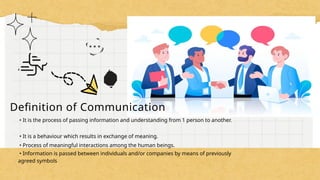
Definition of Communication
• It is the process of passing information and understanding from 1 person to another.
• It is a behaviour which results in exchange of meaning.
• Process of meaningful interactions among the human beings.
• Information is passed between individuals and/or companies by means of previously
agreed symbols
Elements of
Communication
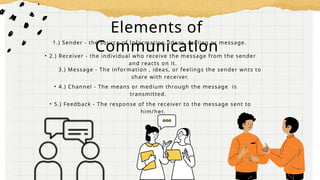
1.) Sender - the source of Information, ideas, feeling or message.
• 2.) Receiver - the individual who receive the message from the sender
and reacts on it.
• 4.) Channel - The means or medium through the message is
transmitted.
3.) Message - The information , ideas, or feelings the sender wnts to
share with receiver.
• 5.) Feedback - The response of the receiver to the message sent to
him/her.
Models of
Communication
As we have identified the essential
elements of communication, let us look
into the different models of
communications as processed by
various scholars and thinkers.
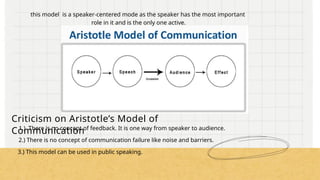
this model is a speaker-centered mode as the speaker has the most important
role in it and is the only one active.
Criticism on Aristotle’s Model of
Communication
1.) There is no concept of feedback. It is one way from speaker to audience.
2.) There is no concept of communication failure like noise and barriers.
3.) This model can be used in public speaking.
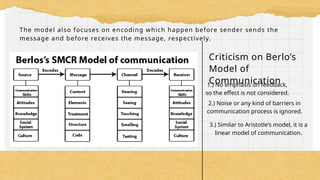
The model also focuses on encoding which happen before sender sends the
message and before receives the message, respectively.
Criticism on Berlo’s
Model of
Communication
1.) No emphasis on feedback,
so the effect is not considered.
2.) Noise or any kind of barriers in
communication process is ignored.
3.) Similar to Aristotle’s model, it is a
linear model of communication.
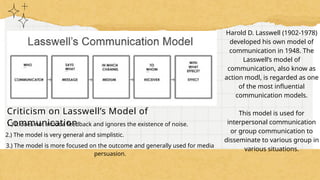
Harold D. Lasswell (1902-1978)
developed his own model of
communication in 1948. The
Lasswell’s model of
communication, also know as
action modl, is regarded as one
of the most influential
communication models.
This model is used for
interpersonal communication
or group communication to
disseminate to various group in
various situations.
Criticism on Lasswell’s Model of
Communication
1.) It does not include feedback and ignores the existence of noise.
2.) The model is very general and simplistic.
3.) The model is more focused on the outcome and generally used for media
persuasion.
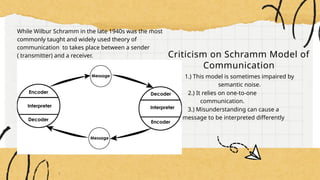
While Wilbur Schramm in the late 1940s was the most
commonly taught and widely used theory of
communication to takes place between a sender
( transmitter) and a receiver.
1.) This model is sometimes impaired by
semantic noise.
2.) It relies on one-to-one
communication.
3.) Misunderstanding can cause a
message to be interpreted differently
Criticism on Schramm Model of
Communication
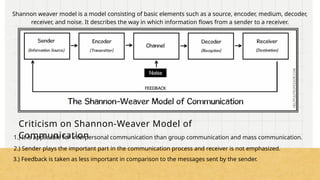
Shannon weaver model is a model consisting of basic elements such as a source, encoder, medium, decoder,
receiver, and noise. It describes the way in which information flows from a sender to a receiver.
1.) It is applicable for interpersonal communication than group communication and mass communication.
3.) Feedback is taken as less important in comparison to the messages sent by the sender.
2.) Sender plays the important part in the communication process and receiver is not emphasized.
Criticism on Shannon-Weaver Model of
Communication
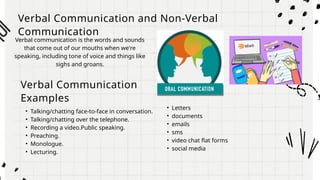
Verbal Communication and Non-Verbal
Communication
Verbal communication is the words and sounds
that come out of our mouths when we're
speaking, including tone of voice and things like
sighs and groans.
• Talking/chatting face-to-face in conversation.
• Talking/chatting over the telephone.
• Recording a video.Public speaking.
• Preaching.
• Monologue.
• Lecturing.
Verbal Communication
Examples
• Letters
• documents
• emails
• sms
• video chat flat forms
• social media
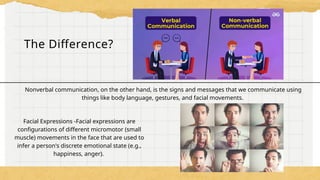
Nonverbal communication, on the other hand, is the signs and messages that we communicate using
things like body language, gestures, and facial movements.
Facial Expressions -Facial expressions are
configurations of different micromotor (small
muscle) movements in the face that are used to
infer a person's discrete emotional state (e.g.,
happiness, anger).
The Difference?
Gestures - Hand signs or sort back up
for communication
Body language - Body language is a range of nonverbal
signals that you can use to communicate your feelings
and intentions.
Functions of Non-
verbaCommunication
Non-verbal communication is used to regulate verbal communication.
Non-verbal communication is used to publicate verbal communication.
Non-verbal communication is used to compliment verbal communication.
Forms of Non-verbal
Communication
1.) Kinesics - include body movements gestures and facial expressions and can be
intentional or unconscious.
2.) Chronemics - pertains on how people use, perceive and structure their time.
3.) Proxemics - refers to the interpersonal space to regulate intimacy.
4.) Paralinguistic - includes factors such as tone of the voice, loudness,, inflection, and
pitch.
5.) Haptics - is communicating through touch. Touch can be used to communicate
effection, familarity, sympathy and other emotions.
6.) Oculesics - is communication using the eyes like gazing,eye movement,etc.
COMMUNICATION
AND
GLOBALIZATION
Objectives:
CHAPTER:2
At the end of this chapter, the student are expected to;
■ Explain how cultural and global issues effect communication;
■ Appreciate the impact of communication on society and the world; and
■ Discuss the impact of globalization on how people communicate and
vice-versa.
From simple smoke signals and sending messenger
pigeons to high-tech video-
conferencing,communication has extensively change.
Globalization: its impact on Global
Communication
The process of globalization has widely increased the availability of information for
people across the world.
Availability of Information
Business
Conduct
Globalization has influenced global communication by implementing new techniques for
business conduct among workers at international corporations.
Social
Awareness
The availability of information is one of the major effects of the process of Globalization
The availability of information, which is a direct effect of the development of global communication
systems, has led to increased social awareness of people across the world.
The Dilemma
Despite its quick spread and continuous, global communication has
not reached the majority of people on all continents.
The Effects of Globalization on global
COmmunication By Anam Ahmed
Globalization impacts communication by influencing the media
landscape towards a uniform global culture . It also leads to the rapid
exchange of cultural values and lifestyles between different countries,
resulting in the emergence of new cultural forms while traditional ones
may diminish .
Increased Business
Opportunities
Many companies today hire employees that are located in other countries.
Fewer Cultural Barriers
Many people perceive culture to be the root of communication challenges.
Creation of a Global Village
A “ global village”, as presented by McLuhan, is a situation where modern technologies would
connect all people worldwide. This interconnectedness implies that people worldwide can
connect and share information and experiences even when they are not physically close.
The Flight from Conversation
“The Flight from Conversation” is an article by Sherry Turkle and it is about how
this generation of people are losing their ability to communicate via face to
face and how we are always communicating on social media websites. The
author backs up her argument of how we sacrificed our face to face
conversation to only only communication.
The Impact of Cultural on Communication
Culture can affect how people communicate in different ways. For example, it
may affect communication styles in aspects such as phrases, words, gestures,
and languages used. Culture can also affect how people deliver information
and their attitudes towards conflict.
By Sherry Turkle
Implication for Intercultural
Communication
The notion of “culture” currently used by intercultural communication scholars
emerges out of a specific set of historical circumstances, in particular, the 1940s
and Edward T. Hall's work at the Foreign Service Institute. This article reviews
intercultural communication research as it is published by communication
journals, and examines how culture is conceptualized in intercultural
communication research. Alternate ways in which “culture” might be
conceptualized are then discussed and the consequences that this might have for
intercultural communication scholarship are explored.
Members:
Jaydah Mae
Abucejo
Kian V. Cassion Syrra B. Daguplo
Justine Mark Agbo Kier Cedrick Albarico Julius Ancheta
Justinjade T. Baguio
Gerald Bernadas
Riza Mae Bernadas
Jaime Jr. C Bitangcor Jeeboy Bitco
Gibson
Cubian
Thank you
very much!
for
listening

PRELIM Purposive Communication Presentation.pptx

  • 1.
    Purposive Communication General Education Course GROUP:PRELIM REPORTERS INSTRUCTOR: NORMAN T. CAHATI
  • 2.
    Essence of Communication Communication isvital to all of life. Notice how ants make a trail leading to its source of food. COMMUNICATION PROCESSES, PRINCIPLES, AND ETHICS CHAPTER:1 At the end of this chapter, the student are expected to ■ Discuss the essence of communication to individuals; ■ Define communication as a process; ■ Determine the elements of communication and its important; ■ Identify the functions of verbal and non-verbal communication in various and multi cultural context; and ■ Cite examples of communication between and among individuals. Objectives:
  • 3.
    Definition of Communication •It is the process of passing information and understanding from 1 person to another. • It is a behaviour which results in exchange of meaning. • Process of meaningful interactions among the human beings. • Information is passed between individuals and/or companies by means of previously agreed symbols
  • 4.
    Elements of Communication 1.) Sender- the source of Information, ideas, feeling or message. • 2.) Receiver - the individual who receive the message from the sender and reacts on it. • 4.) Channel - The means or medium through the message is transmitted. 3.) Message - The information , ideas, or feelings the sender wnts to share with receiver. • 5.) Feedback - The response of the receiver to the message sent to him/her.
  • 5.
    Models of Communication As wehave identified the essential elements of communication, let us look into the different models of communications as processed by various scholars and thinkers.
  • 6.
    this model isa speaker-centered mode as the speaker has the most important role in it and is the only one active. Criticism on Aristotle’s Model of Communication 1.) There is no concept of feedback. It is one way from speaker to audience. 2.) There is no concept of communication failure like noise and barriers. 3.) This model can be used in public speaking.
  • 7.
    The model alsofocuses on encoding which happen before sender sends the message and before receives the message, respectively. Criticism on Berlo’s Model of Communication 1.) No emphasis on feedback, so the effect is not considered. 2.) Noise or any kind of barriers in communication process is ignored. 3.) Similar to Aristotle’s model, it is a linear model of communication.
  • 8.
    Harold D. Lasswell(1902-1978) developed his own model of communication in 1948. The Lasswell’s model of communication, also know as action modl, is regarded as one of the most influential communication models. This model is used for interpersonal communication or group communication to disseminate to various group in various situations. Criticism on Lasswell’s Model of Communication 1.) It does not include feedback and ignores the existence of noise. 2.) The model is very general and simplistic. 3.) The model is more focused on the outcome and generally used for media persuasion.
  • 9.
    While Wilbur Schrammin the late 1940s was the most commonly taught and widely used theory of communication to takes place between a sender ( transmitter) and a receiver. 1.) This model is sometimes impaired by semantic noise. 2.) It relies on one-to-one communication. 3.) Misunderstanding can cause a message to be interpreted differently Criticism on Schramm Model of Communication
  • 10.
    Shannon weaver modelis a model consisting of basic elements such as a source, encoder, medium, decoder, receiver, and noise. It describes the way in which information flows from a sender to a receiver. 1.) It is applicable for interpersonal communication than group communication and mass communication. 3.) Feedback is taken as less important in comparison to the messages sent by the sender. 2.) Sender plays the important part in the communication process and receiver is not emphasized. Criticism on Shannon-Weaver Model of Communication
  • 11.
    Verbal Communication andNon-Verbal Communication Verbal communication is the words and sounds that come out of our mouths when we're speaking, including tone of voice and things like sighs and groans. • Talking/chatting face-to-face in conversation. • Talking/chatting over the telephone. • Recording a video.Public speaking. • Preaching. • Monologue. • Lecturing. Verbal Communication Examples • Letters • documents • emails • sms • video chat flat forms • social media
  • 12.
    Nonverbal communication, onthe other hand, is the signs and messages that we communicate using things like body language, gestures, and facial movements. Facial Expressions -Facial expressions are configurations of different micromotor (small muscle) movements in the face that are used to infer a person's discrete emotional state (e.g., happiness, anger). The Difference?
  • 13.
    Gestures - Handsigns or sort back up for communication Body language - Body language is a range of nonverbal signals that you can use to communicate your feelings and intentions.
  • 15.
    Functions of Non- verbaCommunication Non-verbalcommunication is used to regulate verbal communication. Non-verbal communication is used to publicate verbal communication. Non-verbal communication is used to compliment verbal communication.
  • 16.
    Forms of Non-verbal Communication 1.)Kinesics - include body movements gestures and facial expressions and can be intentional or unconscious. 2.) Chronemics - pertains on how people use, perceive and structure their time. 3.) Proxemics - refers to the interpersonal space to regulate intimacy. 4.) Paralinguistic - includes factors such as tone of the voice, loudness,, inflection, and pitch. 5.) Haptics - is communicating through touch. Touch can be used to communicate effection, familarity, sympathy and other emotions. 6.) Oculesics - is communication using the eyes like gazing,eye movement,etc.
  • 17.
    COMMUNICATION AND GLOBALIZATION Objectives: CHAPTER:2 At the endof this chapter, the student are expected to; ■ Explain how cultural and global issues effect communication; ■ Appreciate the impact of communication on society and the world; and ■ Discuss the impact of globalization on how people communicate and vice-versa. From simple smoke signals and sending messenger pigeons to high-tech video- conferencing,communication has extensively change.
  • 18.
    Globalization: its impacton Global Communication The process of globalization has widely increased the availability of information for people across the world. Availability of Information Business Conduct Globalization has influenced global communication by implementing new techniques for business conduct among workers at international corporations. Social Awareness The availability of information is one of the major effects of the process of Globalization The availability of information, which is a direct effect of the development of global communication systems, has led to increased social awareness of people across the world.
  • 19.
    The Dilemma Despite itsquick spread and continuous, global communication has not reached the majority of people on all continents. The Effects of Globalization on global COmmunication By Anam Ahmed Globalization impacts communication by influencing the media landscape towards a uniform global culture . It also leads to the rapid exchange of cultural values and lifestyles between different countries, resulting in the emergence of new cultural forms while traditional ones may diminish .
  • 20.
    Increased Business Opportunities Many companiestoday hire employees that are located in other countries. Fewer Cultural Barriers Many people perceive culture to be the root of communication challenges. Creation of a Global Village A “ global village”, as presented by McLuhan, is a situation where modern technologies would connect all people worldwide. This interconnectedness implies that people worldwide can connect and share information and experiences even when they are not physically close.
  • 21.
    The Flight fromConversation “The Flight from Conversation” is an article by Sherry Turkle and it is about how this generation of people are losing their ability to communicate via face to face and how we are always communicating on social media websites. The author backs up her argument of how we sacrificed our face to face conversation to only only communication. The Impact of Cultural on Communication Culture can affect how people communicate in different ways. For example, it may affect communication styles in aspects such as phrases, words, gestures, and languages used. Culture can also affect how people deliver information and their attitudes towards conflict. By Sherry Turkle
  • 22.
    Implication for Intercultural Communication Thenotion of “culture” currently used by intercultural communication scholars emerges out of a specific set of historical circumstances, in particular, the 1940s and Edward T. Hall's work at the Foreign Service Institute. This article reviews intercultural communication research as it is published by communication journals, and examines how culture is conceptualized in intercultural communication research. Alternate ways in which “culture” might be conceptualized are then discussed and the consequences that this might have for intercultural communication scholarship are explored.
  • 23.
    Members: Jaydah Mae Abucejo Kian V.Cassion Syrra B. Daguplo
  • 24.
    Justine Mark AgboKier Cedrick Albarico Julius Ancheta
  • 25.
    Justinjade T. Baguio GeraldBernadas Riza Mae Bernadas
  • 26.
    Jaime Jr. CBitangcor Jeeboy Bitco Gibson Cubian
  • 27.