Powerful Tips to
Boost
Communication
What is Communication?
Communication is sending or receiving ideas, thoughts or feelings from one
person to one or more persons in such a way that, the person receiving it
understands it in the same way the sender wants him/her to understand.
SENDER MESSAGE CHANNEL RECEIVER
Context
FEEDBACK
The Communication Process
The person
initiating the
communication, or
broadcasting the
message.
The specific set of
words, gestures and
images that the sender
uses to convey what he
or she wants to say.
The channel
through which
the message
moves.
Receivers (or the
audience for the
message) - from whom
the receiver often
expects a response.
The response from the receiver
to the sender.
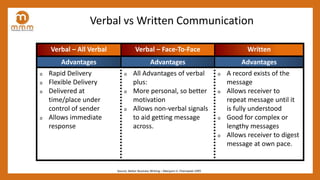
Verbal vs Written Communication
Verbal – All Verbal Verbal – Face-To-Face Written
Advantages Advantages Advantages
o Rapid Delivery
o Flexible Delivery
o Delivered at
time/place under
control of sender
o Allows immediate
response
o All Advantages of verbal
plus:
o More personal, so better
motivation
o Allows non-verbal signals
to aid getting message
across.
o A record exists of the
message
o Allows receiver to
repeat message until it
is fully understood
o Good for complex or
lengthy messages
o Allows receiver to digest
message at own pace.
Source: Better Business Writing – Maryann V. Piotrowski 1995
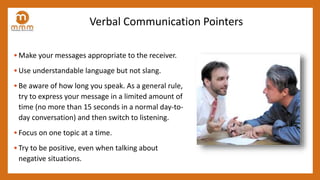
Verbal Communication Pointers
• Make your messages appropriate to the receiver.
• Use understandable language but not slang.
• Be aware of how long you speak. As a general rule,
try to express your message in a limited amount of
time (no more than 15 seconds in a normal day-to-
day conversation) and then switch to listening.
• Focus on one topic at a time.
• Try to be positive, even when talking about
negative situations.
Rules for Communication
2. A.B.C: 3. K.I.S.S 4. Deliver information
in 3 stages:
Accuracy Keep Introduction
Brevity It Main body of content
Clarity Short Summary
Simple
1. Ensure it fits the purpose
Ways to Encourage Communication
• Effective ways to elicit information:
• Asking Effective Questions
• Intently Listening
Work performed by the Academy for Educational Development under sponsorship of the United States Agency for International
Development (USAID) Contract Number: LAG -I-00-98-00011-00, Task Order Number: 804
Words
7%
Tone of
Voice
38%
Body
Language
55%
Positive Non-Verbal Communications
• Smiling – there is nothing like a smile and pleasant face to greet a customer,
especially if he/she has a complaint.
• Eye contact – always look into your customer’s eyes. Directly address
customers.
• How you look – personal grooming has a big impact on your customers. Let
customers know you take seriously your position.
• Shaking hands – when shaking hands with a customer a firm and professional
handshake is expected.
"Communication is really all anyone ever gets
paid for ultimately...and if you cannot
effectively communicate...you will PAY...not
get paid."
- Doug Firebaugh
MMM TRAINING SOLUTIONS
Landline: +91-44-42317735
Cell: +91 9025523000
Cell: +91 9677040908
Email: admin@mmmts.org
Website: www.mmmts.com
Contact Information

Powerful Tips to Boost Communication

  • 1.
  • 2.
    What is Communication? Communicationis sending or receiving ideas, thoughts or feelings from one person to one or more persons in such a way that, the person receiving it understands it in the same way the sender wants him/her to understand.
  • 3.
    SENDER MESSAGE CHANNELRECEIVER Context FEEDBACK The Communication Process The person initiating the communication, or broadcasting the message. The specific set of words, gestures and images that the sender uses to convey what he or she wants to say. The channel through which the message moves. Receivers (or the audience for the message) - from whom the receiver often expects a response. The response from the receiver to the sender.
  • 4.
    Verbal vs WrittenCommunication Verbal – All Verbal Verbal – Face-To-Face Written Advantages Advantages Advantages o Rapid Delivery o Flexible Delivery o Delivered at time/place under control of sender o Allows immediate response o All Advantages of verbal plus: o More personal, so better motivation o Allows non-verbal signals to aid getting message across. o A record exists of the message o Allows receiver to repeat message until it is fully understood o Good for complex or lengthy messages o Allows receiver to digest message at own pace. Source: Better Business Writing – Maryann V. Piotrowski 1995
  • 6.
    Verbal Communication Pointers •Make your messages appropriate to the receiver. • Use understandable language but not slang. • Be aware of how long you speak. As a general rule, try to express your message in a limited amount of time (no more than 15 seconds in a normal day-to- day conversation) and then switch to listening. • Focus on one topic at a time. • Try to be positive, even when talking about negative situations.
  • 7.
    Rules for Communication 2.A.B.C: 3. K.I.S.S 4. Deliver information in 3 stages: Accuracy Keep Introduction Brevity It Main body of content Clarity Short Summary Simple 1. Ensure it fits the purpose
  • 8.
    Ways to EncourageCommunication • Effective ways to elicit information: • Asking Effective Questions • Intently Listening
  • 10.
    Work performed bythe Academy for Educational Development under sponsorship of the United States Agency for International Development (USAID) Contract Number: LAG -I-00-98-00011-00, Task Order Number: 804 Words 7% Tone of Voice 38% Body Language 55%
  • 11.
    Positive Non-Verbal Communications •Smiling – there is nothing like a smile and pleasant face to greet a customer, especially if he/she has a complaint. • Eye contact – always look into your customer’s eyes. Directly address customers. • How you look – personal grooming has a big impact on your customers. Let customers know you take seriously your position. • Shaking hands – when shaking hands with a customer a firm and professional handshake is expected.
  • 12.
    "Communication is reallyall anyone ever gets paid for ultimately...and if you cannot effectively communicate...you will PAY...not get paid." - Doug Firebaugh
  • 13.
    MMM TRAINING SOLUTIONS Landline:+91-44-42317735 Cell: +91 9025523000 Cell: +91 9677040908 Email: admin@mmmts.org Website: www.mmmts.com Contact Information