SKCOMMUNICATIONS
ILLS
SAIYAM AGRAWAL
FMS GKV
MBA 1ST year
INTRODUCTION
Communication is the process of exchanging information between two or
more parties. In this process, one party transmits message by using a
medium and the other party receives the message. In the communication
process, information flows from sender to receiver.
In order to make communication effective, the sender should know the
reaction of the receiver. When the receiver sends back his response to the
sender in connection with the message received, it is called two-way
communication. Through two-way communication, parties can exchange
their views, attitudes, feelings, new, messages information, data etc. Many
authors defined communication in various ways. Some of their definitions
are quoted below:
DEFINITION
According to Emery and others, “Communication is the art of transmitting information,
ideas and attitudes from one person to another.”
According to Theo Haiman defined, “Communication means the process of passing
information and understanding from one person to another.”
According to Elliot Jaquer, “Communication is the sum totals of directly and indirectly,
consciously an unconsciously transmitted feelings, attitudes and wishes.”
In the opinion of Weihrich and Koontz, “Communication is the transfer of information from
a sender to a receiver, with the information being understood by the receiver.”
Newstrom and Davis stated, “Communication is the transfer of information from one
person to another person. It is a way of reaching others by transmitting ideas, facts,
thoughts, feelings and values.”
In the words of Trewatha, “Communication is the process of transferring and receiving
information through the use of common symbols so that understanding takes place.”
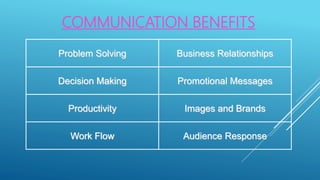
COMMUNICATION BENEFITS
Problem Solving
Decision Making
Productivity
Work Flow
Business Relationships
Promotional Messages
Images and Brands
Audience Response
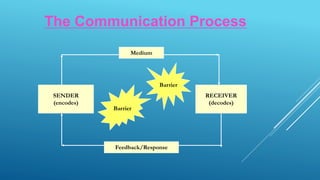
The Communication Process
SENDER
(encodes)
RECEIVER
(decodes)
Barrier
Barrier
Medium
Feedback/Response
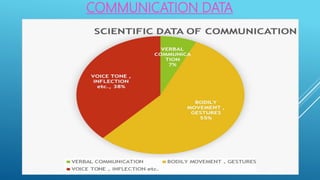
COMMUNICATION DATA
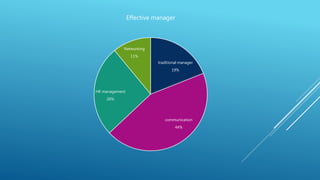
traditional manager
19%
communication
44%
HR management
26%
Networking
11%
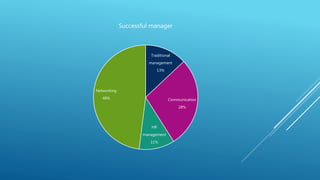
Effective manager
Traditional
management
13%
Communication
28%
HR
management
11%
Networking
48%
Successful manager
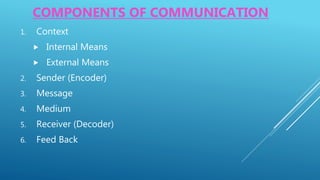
COMPONENTS OF COMMUNICATION
1. Context
 Internal Means
 External Means
2. Sender (Encoder)
3. Message
4. Medium
5. Receiver (Decoder)
6. Feed Back
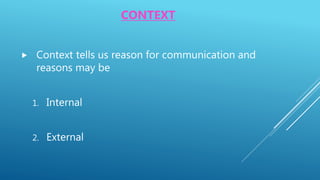
CONTEXT
 Context tells us reason for communication and
reasons may be
1. Internal
2. External
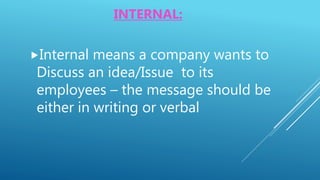
INTERNAL:
Internal means a company wants to
Discuss an idea/Issue to its
employees – the message should be
either in writing or verbal
EXTERNAL:
In eternal context –some query from stakeholders
or from outside the organization-
You may response to query
Email
Fax
Telephone
Letter
Verbal etc.
SENDER (ENCODER)
When you sending the message, you are the
“Encoder” .
Here the word you mean writer/Speaker decides
whether the message should be in written or oral.
He/She may choose Words, Symbols, Pictures or
Graphics that express the objective in the real sense.
MESSAGE
 Message is basically the basic idea that you want to communicate.
 The message may be
 Verbal, means (Written or Spoken)
 Non-Verbal, means( Symbols, Pictures or unspoken).
 This is very much important component of communication “ Your
message should be or MUST be clear and easy to understand”
 The most important element in message is your receiver . You must be
well aware about your receiver.
 While preparing a message you should keep in mind how your receiver
will interpret the message.
MESSAGE (CONT.)
You (Sender) should also keep in mind your relationship with
the receiver while preparing message.
some times wrong message may create a loss to your
organization , to yourself.
or it can create a bad impression for you/your company.
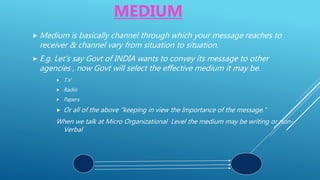
MEDIUM
 Medium is basically channel through which your message reaches to
receiver & channel vary from situation to situation.
 E.g. Let’s say Govt of INDIA wants to convey its message to other
agencies , now Govt will select the effective medium it may be.
 T.V
 Radio
 Papers
 Or all of the above “keeping in view the Importance of the message.”
When we talk at Micro Organizational Level the medium may be writing or non-
Verbal
RECEIVER (DECODER)
To whom the message is being sent.
In simple words we can say that receiver is your
reader (in case of press , letters etc.) or Listener (In
case of TV, radio, Speaker Etc.)
Receiver is also known as decoder.
FEEDBACK
Feedback is basically the response/reaction of Receiver
after receiving the message.
 Sender always need feedback to check weather the
message effectively reached or not…? Or in other
words….
Sender need feedback to examine the success or failure
of the message.
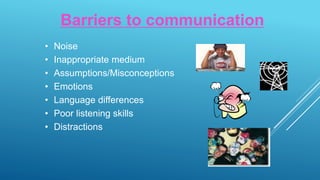
Barriers to communication
• Noise
• Inappropriate medium
• Assumptions/Misconceptions
• Emotions
• Language differences
• Poor listening skills
• Distractions
Always think ahead about what you are going to say.
Use simple words and phrases that are understood by every body.
Increase your knowledge on all subjects you are required to speak.
Speak clearly and audibly.
Check twice with the listener whether you have been understood accurately or not
In case of an interruption, always do a little recap of what has been already said.
Always pay undivided attention to the speaker while listening.
While listening, always make notes of important points.
Always ask for clarification if you have failed to grasp other’s point of view.
Repeat what the speaker has said to check whether you have understood accurately.
ESSENTIALS OF COMMUNICATION
Dos
ESSENTIALS OF COMMUNICATION
DON’Ts
Do not instantly react and mutter something in anger.
Do not use technical terms & terminologies not understood by majority of
people.
Do not speak too fast or too slow.
Do not speak in inaudible surroundings, as you won’t be heard.
Do not assume that every body understands you.
While listening do not glance here and there as it might distract the
speaker.
Do not interrupt the speaker.
Do not jump to the conclusion that you have understood every thing.
How to Improve Existing Level of
COMMUNICATION?
IMPROVE LANGUAGE.
IMPROVE PRONUNCIATIOON.
WORK ON VOICE MODULATION.
WORK ON BODY LANGUAGE.
READ MORE
LISTEN MORE
AVOID READING OR WATCHING OR LISTENING UNWANTED LITERATURE, GOSSIP, MEDIA PRESENTATION ETC.
INTERACT WITH QUALITATIVE PEOPLE.
IMPROVE ON YOU TOPIC OF DISCUSSION,
PRACTICE MEDITATION & GOOD THOUGHTS.
THINK AND SPEAK.
DO NOT SPEAK TOO FAST.
USE SIMPLE VOCABULARY.
DO NOT SPEAK ONLY TO IMPRESS SOMEONE.
LOOK PRESENTABLE AND CONFIDENT.
Improving Body Language -
Tips
• Keep appropriate distance
• Touch only when appropriate
• Take care of your appearance
• Be aware - people may give false cues
• Maintain eye contact
• Smile genuinely
…in the new global and diverse
workplace requires
excellent communication skills!
Success for YOU…
ANY
QUESTION

communication skills

  • 1.
  • 2.
    INTRODUCTION Communication is theprocess of exchanging information between two or more parties. In this process, one party transmits message by using a medium and the other party receives the message. In the communication process, information flows from sender to receiver. In order to make communication effective, the sender should know the reaction of the receiver. When the receiver sends back his response to the sender in connection with the message received, it is called two-way communication. Through two-way communication, parties can exchange their views, attitudes, feelings, new, messages information, data etc. Many authors defined communication in various ways. Some of their definitions are quoted below:

  • 3.
    DEFINITION According to Emeryand others, “Communication is the art of transmitting information, ideas and attitudes from one person to another.” According to Theo Haiman defined, “Communication means the process of passing information and understanding from one person to another.” According to Elliot Jaquer, “Communication is the sum totals of directly and indirectly, consciously an unconsciously transmitted feelings, attitudes and wishes.” In the opinion of Weihrich and Koontz, “Communication is the transfer of information from a sender to a receiver, with the information being understood by the receiver.” Newstrom and Davis stated, “Communication is the transfer of information from one person to another person. It is a way of reaching others by transmitting ideas, facts, thoughts, feelings and values.” In the words of Trewatha, “Communication is the process of transferring and receiving information through the use of common symbols so that understanding takes place.”
  • 4.
    COMMUNICATION BENEFITS Problem Solving DecisionMaking Productivity Work Flow Business Relationships Promotional Messages Images and Brands Audience Response
  • 5.
  • 6.
  • 7.
  • 8.
  • 9.
    COMPONENTS OF COMMUNICATION 1.Context  Internal Means  External Means 2. Sender (Encoder) 3. Message 4. Medium 5. Receiver (Decoder) 6. Feed Back
  • 10.
    CONTEXT  Context tellsus reason for communication and reasons may be 1. Internal 2. External
  • 11.
    INTERNAL: Internal means acompany wants to Discuss an idea/Issue to its employees – the message should be either in writing or verbal
  • 12.
    EXTERNAL: In eternal context–some query from stakeholders or from outside the organization- You may response to query Email Fax Telephone Letter Verbal etc.
  • 13.
    SENDER (ENCODER) When yousending the message, you are the “Encoder” . Here the word you mean writer/Speaker decides whether the message should be in written or oral. He/She may choose Words, Symbols, Pictures or Graphics that express the objective in the real sense.
  • 14.
    MESSAGE  Message isbasically the basic idea that you want to communicate.  The message may be  Verbal, means (Written or Spoken)  Non-Verbal, means( Symbols, Pictures or unspoken).  This is very much important component of communication “ Your message should be or MUST be clear and easy to understand”  The most important element in message is your receiver . You must be well aware about your receiver.  While preparing a message you should keep in mind how your receiver will interpret the message.
  • 15.
    MESSAGE (CONT.) You (Sender)should also keep in mind your relationship with the receiver while preparing message. some times wrong message may create a loss to your organization , to yourself. or it can create a bad impression for you/your company.
  • 16.
    MEDIUM  Medium isbasically channel through which your message reaches to receiver & channel vary from situation to situation.  E.g. Let’s say Govt of INDIA wants to convey its message to other agencies , now Govt will select the effective medium it may be.  T.V  Radio  Papers  Or all of the above “keeping in view the Importance of the message.” When we talk at Micro Organizational Level the medium may be writing or non- Verbal
  • 17.
    RECEIVER (DECODER) To whomthe message is being sent. In simple words we can say that receiver is your reader (in case of press , letters etc.) or Listener (In case of TV, radio, Speaker Etc.) Receiver is also known as decoder.
  • 18.
    FEEDBACK Feedback is basicallythe response/reaction of Receiver after receiving the message.  Sender always need feedback to check weather the message effectively reached or not…? Or in other words…. Sender need feedback to examine the success or failure of the message.
  • 19.
    Barriers to communication •Noise • Inappropriate medium • Assumptions/Misconceptions • Emotions • Language differences • Poor listening skills • Distractions
  • 20.
    Always think aheadabout what you are going to say. Use simple words and phrases that are understood by every body. Increase your knowledge on all subjects you are required to speak. Speak clearly and audibly. Check twice with the listener whether you have been understood accurately or not In case of an interruption, always do a little recap of what has been already said. Always pay undivided attention to the speaker while listening. While listening, always make notes of important points. Always ask for clarification if you have failed to grasp other’s point of view. Repeat what the speaker has said to check whether you have understood accurately. ESSENTIALS OF COMMUNICATION Dos
  • 21.
    ESSENTIALS OF COMMUNICATION DON’Ts Donot instantly react and mutter something in anger. Do not use technical terms & terminologies not understood by majority of people. Do not speak too fast or too slow. Do not speak in inaudible surroundings, as you won’t be heard. Do not assume that every body understands you. While listening do not glance here and there as it might distract the speaker. Do not interrupt the speaker. Do not jump to the conclusion that you have understood every thing.
  • 22.
    How to ImproveExisting Level of COMMUNICATION? IMPROVE LANGUAGE. IMPROVE PRONUNCIATIOON. WORK ON VOICE MODULATION. WORK ON BODY LANGUAGE. READ MORE LISTEN MORE AVOID READING OR WATCHING OR LISTENING UNWANTED LITERATURE, GOSSIP, MEDIA PRESENTATION ETC. INTERACT WITH QUALITATIVE PEOPLE. IMPROVE ON YOU TOPIC OF DISCUSSION, PRACTICE MEDITATION & GOOD THOUGHTS. THINK AND SPEAK. DO NOT SPEAK TOO FAST. USE SIMPLE VOCABULARY. DO NOT SPEAK ONLY TO IMPRESS SOMEONE. LOOK PRESENTABLE AND CONFIDENT.
  • 23.
    Improving Body Language- Tips • Keep appropriate distance • Touch only when appropriate • Take care of your appearance • Be aware - people may give false cues • Maintain eye contact • Smile genuinely
  • 24.
    …in the newglobal and diverse workplace requires excellent communication skills! Success for YOU…
  • 25.