
July 8, 2015Copyright © 2010, Anand Joshi
July 8, 2015Copyright © 2010, Anand Joshi July 8, 2015Copyright © 2010, Anand Joshi July 8, 2015Copyright © 2010, Anand Joshi
July 8, 2015Copyright © 2010, Anand Joshi July 8, 2015Copyright © 2010, Anand Joshi
 Introduction to the communication
 The Process
 Business Communication
 Barriers and overcoming those
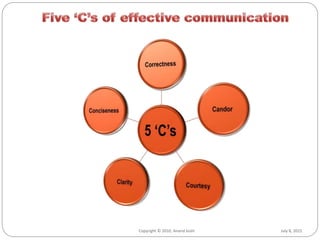
 Five “C”s of Effective communication
 Exercise
 Assertive Communication
July 8, 2015Copyright © 2010, Anand Joshi
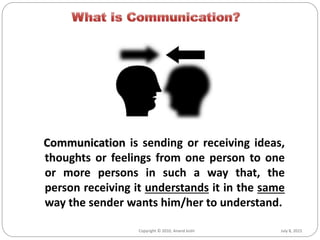
Communication is sending or receiving ideas,
thoughts or feelings from one person to one
or more persons in such a way that, the
person receiving it understands it in the same
way the sender wants him/her to understand.
July 8, 2015Copyright © 2010, Anand Joshi July 8, 2015Copyright © 2010, Anand Joshi
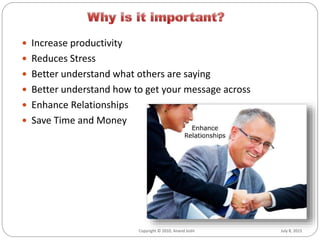
 Increase productivity
 Reduces Stress
 Better understand what others are saying
 Better understand how to get your message across
 Enhance Relationships
 Save Time and Money
July 8, 2015Copyright © 2010, Anand Joshi July 8, 2015Copyright © 2010, Anand Joshi
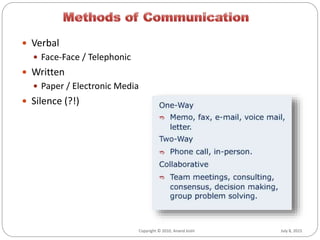
 Verbal
 Face-Face / Telephonic
 Written
 Paper / Electronic Media
 Silence (?!)
July 8, 2015Copyright © 2010, Anand Joshi July 8, 2015Copyright © 2010, Anand Joshi
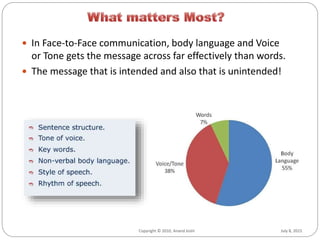
 In Face-to-Face communication, body language and Voice
or Tone gets the message across far effectively than words.
 The message that is intended and also that is unintended!
July 8, 2015Copyright © 2010, Anand Joshi
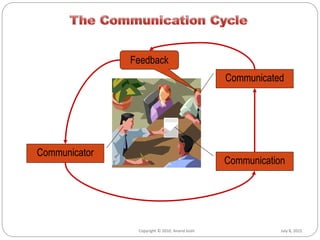
Communicator
Communication
Communicated
Feedback
July 8, 2015Copyright © 2010, Anand Joshi July 8, 2015Copyright © 2010, Anand Joshi
1. Business communication is a specialized branch of general communication
2. Business Communication should always be Clear & Concise
3. The purpose is to give information to the point so that there is no waste of time of
those people whom it is targeted.
4. Business communication is
broadly classified as:
1. Internal Communication
2. External Communication
July 8, 2015Copyright © 2010, Anand Joshi
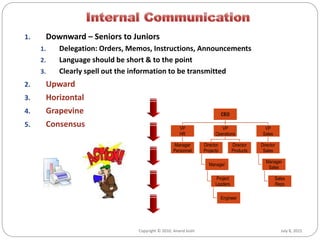
1. Downward – Seniors to Juniors
1. Delegation: Orders, Memos, Instructions, Announcements
2. Language should be short & to the point
3. Clearly spell out the information to be transmitted
2. Upward
3. Horizontal
4. Grapevine
5. Consensus
CEO
VP
HR
Manager
Personnel
VP
Operations
Director
Projects
Manager
Project
Leaders
Engineer
Director
Products
VP
Sales
Director
Sales
Manager
Sales
Sales
Reps
July 8, 2015Copyright © 2010, Anand Joshi
1. Downward
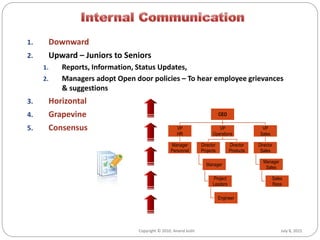
2. Upward – Juniors to Seniors
1. Reports, Information, Status Updates,
2. Managers adopt Open door policies – To hear employee grievances
& suggestions
3. Horizontal
4. Grapevine
5. Consensus
CEO
VP
HR
Manager
Personnel
VP
Operations
Director
Projects
Manager
Project
Leaders
Engineer
Director
Products
VP
Sales
Director
Sales
Manager
Sales
Sales
Reps
July 8, 2015Copyright © 2010, Anand Joshi
1. Downward
2. Upward
3. Horizontal – Peer to Peer – Work at same level
1. More natural informal – Less need driven
2. For Networking
3. Passing on information
4. Sharing ideas
4. Grapevine
5. Consensus
July 8, 2015Copyright © 2010, Anand Joshi
1. Downward
2. Upward
3. Horizontal
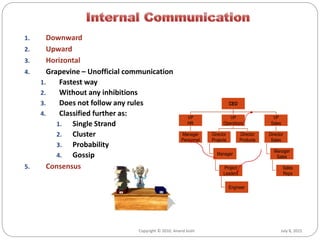
4. Grapevine – Unofficial communication
1. Fastest way
2. Without any inhibitions
3. Does not follow any rules
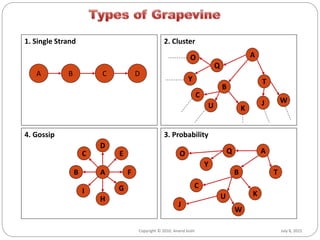
4. Classified further as:
1. Single Strand
2. Cluster
3. Probability
4. Gossip
5. Consensus
CEO
VP
HR
Manager
Personnel
VP
Operations
Director
Projects
Manager
Project
Leaders
Engineer
Director
Products
VP
Sales
Director
Sales
Manager
Sales
Sales
Reps
July 8, 2015Copyright © 2010, Anand Joshi
1. Single Strand
A B C D
2. Cluster
O
Q
A
Y T
J W
U
C
K
B
4. Gossip
B A
D
E
3. Probability
O Q A
Y
T
J
W
U
C
K
B
C
F
G
H
I
July 8, 2015Copyright © 2010, Anand Joshi
1. Downward
2. Upward
3. Horizontal
4. Grapevine
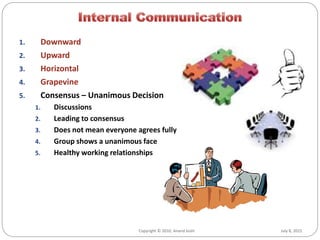
5. Consensus – Unanimous Decision
1. Discussions
2. Leading to consensus
3. Does not mean everyone agrees fully
4. Group shows a unanimous face
5. Healthy working relationships
July 8, 2015Copyright © 2010, Anand Joshi
1. Inward –
1. Communication received from the people outside the organization such as
clients, banks, insurance companies, suppliers etc.
2. This can be Verbal or Written
3. Examples: Complaints, Sales Orders, Agreement of purchase of goods /
Services
4. This communication should be acknowledged, studies & recorded
2. Outward
July 8, 2015Copyright © 2010, Anand Joshi
1. Inward
2. Outward –
1. Communication sent to the people outside the organization such as
clients, banks, insurance companies, suppliers etc.
2. This can be Verbal or Written
3. Examples: Instructions to the banks, Advertisements, Press
handouts, Purchase Orders to suppliers, Periodicals etc.
4. This communication should be handled carefully since it moulds the
public image of the organization.
July 8, 2015Copyright © 2010, Anand Joshi
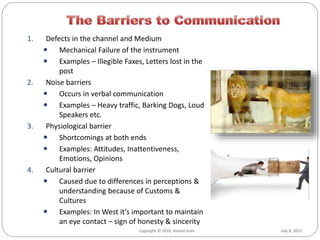
1. Defects in the channel and Medium
 Mechanical Failure of the instrument
 Examples – Illegible Faxes, Letters lost in the
post
2. Noise barriers
 Occurs in verbal communication
 Examples – Heavy traffic, Barking Dogs, Loud
Speakers etc.
3. Physiological barrier
 Shortcomings at both ends
 Examples: Attitudes, Inattentiveness,
Emotions, Opinions
4. Cultural barrier
 Caused due to differences in perceptions &
understanding because of Customs &
Cultures
 Examples: In West it’s important to maintain
an eye contact – sign of honesty & sincerity
July 8, 2015Copyright © 2010, Anand Joshi
5. ‘Status’ blocks
 Affects only communicated
 Works at Communication, Perception & Acceptance
 Example: “Know it all” attitude
6. Semantic barrier
 Interpretation errors at both ends
 Example: Different meanings of the same word
7. Lack of Exposure
 To the subject discussed
8. Built-in resistance
 Inertia
 Not willing to change or accept new ideas
July 8, 2015Copyright © 2010, Anand Joshi
1. This is the most important principle of the communication.
2. This is important to create a rapport with the communicated.
3. Courtesy helps to develop a mutual beneficial relationship between the two
parties.
4. Modern terminology: Instead of using old concepts, use short and simple
sentences. Such as “ I have been having pleasure of informing you …” , one
can use “ I am pleased to let you know …”
5. Sincerity: convey communication with integrity and sincerity. Apologize for
any mistakes or omissions, express favor which has been received.
6. Gender bias: Avoid gender bias while communicating. This may cause
negative impact for ex: instead of chairman use chairperson.
7. Positive and Negative facts:
 Positive one should be highlighted and negative should not be emphasized.
 Use as many positive terms as possible without overdoing it
 Try to substitute the words (customer care dept instead of customer complaints
dept.)
July 8, 2015Copyright © 2010, Anand Joshi
1. It is one the important features in business communication which
contains two forms:
 Clarity of thoughts
 Clarity of expressions
2. Clarity of thoughts: for effective communication thoughts, purpose
should be clear to communicate precisely. Articulation is important!
3. Clarity of expressions: It is essential so that communication process can
flow smoothly. Audience should be familiar with the language they are
using for communication.
e. g. The use of jargons, words which are often confusing, the use of
foreign words, words with the multiple meanings etc should strictly
be avoided.
July 8, 2015Copyright © 2010, Anand Joshi
1. Any business communication should be as short and simple as much possible.
2. Longish communication often feels irritating in business.
3. Communication should be relevant, should not be repetitive and should not
contain long expressions.
4. Structure: It should contain Subject, an Opening , a body, an indication of the
expected feedback and closing
Subject: Should always specify what is this communication about
Opening: This is to inform you …
In response to your advertisement …
With reference to your letter dated …
Body: Should contain all the information related with that subject.
Feedback: Response expected from the communicated
The action or information transmitted from the communicated.
Closing: Logical and relevant closing should be made - Summary
Looking forward to meet you
Grateful if you reply us soon.
July 8, 2015Copyright © 2010, Anand Joshi July 8, 2015Copyright © 2010, Anand Joshi
1. All the facts: All the relevant facts are included
2. Purpose of the communication has been mentioned
3. Indication of the expected feedback
4. Figures, tables, graphs are checked properly before
communication
5. All typographical errors are corrected
There are 5 Ws for accurate communication
Why?
When?
Who?
What?
Where?
“How?” is the most important part!
July 8, 2015Copyright © 2010, Anand Joshi July 8, 2015Copyright © 2010, Anand Joshi
Communication should be truthful
July 8, 2015Copyright © 2010, Anand Joshi July 8, 2015Copyright © 2010, Anand Joshi
Active Listening Techniques
1. Attending: using non-verbal indicators such as leaning forward, nodding your head, sitting in an
open, receptive posture
2. Paraphrasing: repeating in your own words what the other person has said; the restatement
should not judge in any way
3. Speaking from the self: using "I" statements, rather than speaking for others (we all think) or
speaking in the passive tense. Do not make assumptions about others, their opinions, and
feelings.
4. Clarifying: asking for further clarification or an example to illustrate often helps find clarity in
the meaning.
5. Asking: probing questions; identify and explore options and alternatives e.g., use probes -
short, open questions to dig deeper into issues. May be nonverbal such as a look that asks
"Then what/ How?” Silence can be used to encourage the speaker to continue.
6. Encouraging: asking person to “tell me more about” or give them a supportive comment like
“good idea” or “I like that approach”.
7. Reflecting: playing back the communication as you hear and feel it, e.g., “you seem to feel
very strongly about that”
8. Summarizing: giving back a review or summary of what you heard. This helps make sure the
communication is accurate and that the main ideas expressed reached you, the listener.
July 8, 2015Copyright © 2010, Anand Joshi July 8, 2015Copyright © 2010, Anand Joshi
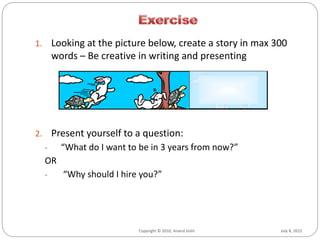
1. Looking at the picture below, create a story in max 300
words – Be creative in writing and presenting
2. Present yourself to a question:
- “What do I want to be in 3 years from now?”
OR
- “Why should I hire you?”
July 8, 2015Copyright © 2010, Anand Joshi July 8, 2015Copyright © 2010, Anand Joshi July 8, 2015Copyright © 2010, Anand Joshi
July 8, 2015Copyright © 2010, Anand Joshi July 8, 2015Copyright © 2010, Anand Joshi
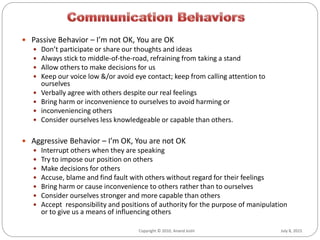
 Passive Behavior – I’m not OK, You are OK
 Don’t participate or share our thoughts and ideas
 Always stick to middle-of-the-road, refraining from taking a stand
 Allow others to make decisions for us
 Keep our voice low &/or avoid eye contact; keep from calling attention to
ourselves
 Verbally agree with others despite our real feelings
 Bring harm or inconvenience to ourselves to avoid harming or
 inconveniencing others
 Consider ourselves less knowledgeable or capable than others.
 Aggressive Behavior – I’m OK, You are not OK
 Interrupt others when they are speaking
 Try to impose our position on others
 Make decisions for others
 Accuse, blame and find fault with others without regard for their feelings
 Bring harm or cause inconvenience to others rather than to ourselves
 Consider ourselves stronger and more capable than others
 Accept responsibility and positions of authority for the purpose of manipulation
or to give us a means of influencing others
July 8, 2015Copyright © 2010, Anand Joshi July 8, 2015Copyright © 2010, Anand Joshi
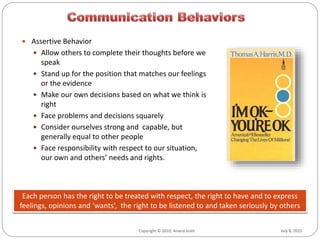
 Assertive Behavior
 Allow others to complete their thoughts before we
speak
 Stand up for the position that matches our feelings
or the evidence
 Make our own decisions based on what we think is
right
 Face problems and decisions squarely
 Consider ourselves strong and capable, but
generally equal to other people
 Face responsibility with respect to our situation,
our own and others’ needs and rights.
Each person has the right to be treated with respect, the right to have and to express
feelings, opinions and ‘wants’, the right to be listened to and taken seriously by others
July 8, 2015Copyright © 2010, Anand Joshi July 8, 2015Copyright © 2010, Anand Joshi
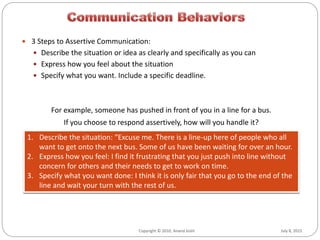
 3 Steps to Assertive Communication:
 Describe the situation or idea as clearly and specifically as you can
 Express how you feel about the situation
 Specify what you want. Include a specific deadline.
For example, someone has pushed in front of you in a line for a bus.
If you choose to respond assertively, how will you handle it?
1. Describe the situation: “Excuse me. There is a line-up here of people who all
want to get onto the next bus. Some of us have been waiting for over an hour.
2. Express how you feel: I find it frustrating that you just push into line without
concern for others and their needs to get to work on time.
3. Specify what you want done: I think it is only fair that you go to the end of the
line and wait your turn with the rest of us.

Interpersonal & Communication skills

  • 1.
    July 8, 2015Copyright© 2010, Anand Joshi
  • 2.
    July 8, 2015Copyright© 2010, Anand Joshi July 8, 2015Copyright © 2010, Anand Joshi July 8, 2015Copyright © 2010, Anand Joshi
  • 3.
    July 8, 2015Copyright© 2010, Anand Joshi July 8, 2015Copyright © 2010, Anand Joshi  Introduction to the communication  The Process  Business Communication  Barriers and overcoming those  Five “C”s of Effective communication  Exercise  Assertive Communication
  • 4.
    July 8, 2015Copyright© 2010, Anand Joshi Communication is sending or receiving ideas, thoughts or feelings from one person to one or more persons in such a way that, the person receiving it understands it in the same way the sender wants him/her to understand.
  • 5.
    July 8, 2015Copyright© 2010, Anand Joshi July 8, 2015Copyright © 2010, Anand Joshi  Increase productivity  Reduces Stress  Better understand what others are saying  Better understand how to get your message across  Enhance Relationships  Save Time and Money
  • 6.
    July 8, 2015Copyright© 2010, Anand Joshi July 8, 2015Copyright © 2010, Anand Joshi  Verbal  Face-Face / Telephonic  Written  Paper / Electronic Media  Silence (?!)
  • 7.
    July 8, 2015Copyright© 2010, Anand Joshi July 8, 2015Copyright © 2010, Anand Joshi  In Face-to-Face communication, body language and Voice or Tone gets the message across far effectively than words.  The message that is intended and also that is unintended!
  • 8.
    July 8, 2015Copyright© 2010, Anand Joshi Communicator Communication Communicated Feedback
  • 9.
    July 8, 2015Copyright© 2010, Anand Joshi July 8, 2015Copyright © 2010, Anand Joshi 1. Business communication is a specialized branch of general communication 2. Business Communication should always be Clear & Concise 3. The purpose is to give information to the point so that there is no waste of time of those people whom it is targeted. 4. Business communication is broadly classified as: 1. Internal Communication 2. External Communication
  • 10.
    July 8, 2015Copyright© 2010, Anand Joshi 1. Downward – Seniors to Juniors 1. Delegation: Orders, Memos, Instructions, Announcements 2. Language should be short & to the point 3. Clearly spell out the information to be transmitted 2. Upward 3. Horizontal 4. Grapevine 5. Consensus CEO VP HR Manager Personnel VP Operations Director Projects Manager Project Leaders Engineer Director Products VP Sales Director Sales Manager Sales Sales Reps
  • 11.
    July 8, 2015Copyright© 2010, Anand Joshi 1. Downward 2. Upward – Juniors to Seniors 1. Reports, Information, Status Updates, 2. Managers adopt Open door policies – To hear employee grievances & suggestions 3. Horizontal 4. Grapevine 5. Consensus CEO VP HR Manager Personnel VP Operations Director Projects Manager Project Leaders Engineer Director Products VP Sales Director Sales Manager Sales Sales Reps
  • 12.
    July 8, 2015Copyright© 2010, Anand Joshi 1. Downward 2. Upward 3. Horizontal – Peer to Peer – Work at same level 1. More natural informal – Less need driven 2. For Networking 3. Passing on information 4. Sharing ideas 4. Grapevine 5. Consensus
  • 13.
    July 8, 2015Copyright© 2010, Anand Joshi 1. Downward 2. Upward 3. Horizontal 4. Grapevine – Unofficial communication 1. Fastest way 2. Without any inhibitions 3. Does not follow any rules 4. Classified further as: 1. Single Strand 2. Cluster 3. Probability 4. Gossip 5. Consensus CEO VP HR Manager Personnel VP Operations Director Projects Manager Project Leaders Engineer Director Products VP Sales Director Sales Manager Sales Sales Reps
  • 14.
    July 8, 2015Copyright© 2010, Anand Joshi 1. Single Strand A B C D 2. Cluster O Q A Y T J W U C K B 4. Gossip B A D E 3. Probability O Q A Y T J W U C K B C F G H I
  • 15.
    July 8, 2015Copyright© 2010, Anand Joshi 1. Downward 2. Upward 3. Horizontal 4. Grapevine 5. Consensus – Unanimous Decision 1. Discussions 2. Leading to consensus 3. Does not mean everyone agrees fully 4. Group shows a unanimous face 5. Healthy working relationships
  • 16.
    July 8, 2015Copyright© 2010, Anand Joshi 1. Inward – 1. Communication received from the people outside the organization such as clients, banks, insurance companies, suppliers etc. 2. This can be Verbal or Written 3. Examples: Complaints, Sales Orders, Agreement of purchase of goods / Services 4. This communication should be acknowledged, studies & recorded 2. Outward
  • 17.
    July 8, 2015Copyright© 2010, Anand Joshi 1. Inward 2. Outward – 1. Communication sent to the people outside the organization such as clients, banks, insurance companies, suppliers etc. 2. This can be Verbal or Written 3. Examples: Instructions to the banks, Advertisements, Press handouts, Purchase Orders to suppliers, Periodicals etc. 4. This communication should be handled carefully since it moulds the public image of the organization.
  • 18.
    July 8, 2015Copyright© 2010, Anand Joshi 1. Defects in the channel and Medium  Mechanical Failure of the instrument  Examples – Illegible Faxes, Letters lost in the post 2. Noise barriers  Occurs in verbal communication  Examples – Heavy traffic, Barking Dogs, Loud Speakers etc. 3. Physiological barrier  Shortcomings at both ends  Examples: Attitudes, Inattentiveness, Emotions, Opinions 4. Cultural barrier  Caused due to differences in perceptions & understanding because of Customs & Cultures  Examples: In West it’s important to maintain an eye contact – sign of honesty & sincerity
  • 19.
    July 8, 2015Copyright© 2010, Anand Joshi 5. ‘Status’ blocks  Affects only communicated  Works at Communication, Perception & Acceptance  Example: “Know it all” attitude 6. Semantic barrier  Interpretation errors at both ends  Example: Different meanings of the same word 7. Lack of Exposure  To the subject discussed 8. Built-in resistance  Inertia  Not willing to change or accept new ideas
  • 20.
    July 8, 2015Copyright© 2010, Anand Joshi
  • 21.
    July 8, 2015Copyright© 2010, Anand Joshi 1. This is the most important principle of the communication. 2. This is important to create a rapport with the communicated. 3. Courtesy helps to develop a mutual beneficial relationship between the two parties. 4. Modern terminology: Instead of using old concepts, use short and simple sentences. Such as “ I have been having pleasure of informing you …” , one can use “ I am pleased to let you know …” 5. Sincerity: convey communication with integrity and sincerity. Apologize for any mistakes or omissions, express favor which has been received. 6. Gender bias: Avoid gender bias while communicating. This may cause negative impact for ex: instead of chairman use chairperson. 7. Positive and Negative facts:  Positive one should be highlighted and negative should not be emphasized.  Use as many positive terms as possible without overdoing it  Try to substitute the words (customer care dept instead of customer complaints dept.)
  • 22.
    July 8, 2015Copyright© 2010, Anand Joshi 1. It is one the important features in business communication which contains two forms:  Clarity of thoughts  Clarity of expressions 2. Clarity of thoughts: for effective communication thoughts, purpose should be clear to communicate precisely. Articulation is important! 3. Clarity of expressions: It is essential so that communication process can flow smoothly. Audience should be familiar with the language they are using for communication. e. g. The use of jargons, words which are often confusing, the use of foreign words, words with the multiple meanings etc should strictly be avoided.
  • 23.
    July 8, 2015Copyright© 2010, Anand Joshi 1. Any business communication should be as short and simple as much possible. 2. Longish communication often feels irritating in business. 3. Communication should be relevant, should not be repetitive and should not contain long expressions. 4. Structure: It should contain Subject, an Opening , a body, an indication of the expected feedback and closing Subject: Should always specify what is this communication about Opening: This is to inform you … In response to your advertisement … With reference to your letter dated … Body: Should contain all the information related with that subject. Feedback: Response expected from the communicated The action or information transmitted from the communicated. Closing: Logical and relevant closing should be made - Summary Looking forward to meet you Grateful if you reply us soon.
  • 24.
    July 8, 2015Copyright© 2010, Anand Joshi July 8, 2015Copyright © 2010, Anand Joshi 1. All the facts: All the relevant facts are included 2. Purpose of the communication has been mentioned 3. Indication of the expected feedback 4. Figures, tables, graphs are checked properly before communication 5. All typographical errors are corrected There are 5 Ws for accurate communication Why? When? Who? What? Where? “How?” is the most important part!
  • 25.
    July 8, 2015Copyright© 2010, Anand Joshi July 8, 2015Copyright © 2010, Anand Joshi Communication should be truthful
  • 26.
    July 8, 2015Copyright© 2010, Anand Joshi July 8, 2015Copyright © 2010, Anand Joshi Active Listening Techniques 1. Attending: using non-verbal indicators such as leaning forward, nodding your head, sitting in an open, receptive posture 2. Paraphrasing: repeating in your own words what the other person has said; the restatement should not judge in any way 3. Speaking from the self: using "I" statements, rather than speaking for others (we all think) or speaking in the passive tense. Do not make assumptions about others, their opinions, and feelings. 4. Clarifying: asking for further clarification or an example to illustrate often helps find clarity in the meaning. 5. Asking: probing questions; identify and explore options and alternatives e.g., use probes - short, open questions to dig deeper into issues. May be nonverbal such as a look that asks "Then what/ How?” Silence can be used to encourage the speaker to continue. 6. Encouraging: asking person to “tell me more about” or give them a supportive comment like “good idea” or “I like that approach”. 7. Reflecting: playing back the communication as you hear and feel it, e.g., “you seem to feel very strongly about that” 8. Summarizing: giving back a review or summary of what you heard. This helps make sure the communication is accurate and that the main ideas expressed reached you, the listener.
  • 27.
    July 8, 2015Copyright© 2010, Anand Joshi July 8, 2015Copyright © 2010, Anand Joshi 1. Looking at the picture below, create a story in max 300 words – Be creative in writing and presenting 2. Present yourself to a question: - “What do I want to be in 3 years from now?” OR - “Why should I hire you?”
  • 28.
    July 8, 2015Copyright© 2010, Anand Joshi July 8, 2015Copyright © 2010, Anand Joshi July 8, 2015Copyright © 2010, Anand Joshi
  • 29.
    July 8, 2015Copyright© 2010, Anand Joshi July 8, 2015Copyright © 2010, Anand Joshi  Passive Behavior – I’m not OK, You are OK  Don’t participate or share our thoughts and ideas  Always stick to middle-of-the-road, refraining from taking a stand  Allow others to make decisions for us  Keep our voice low &/or avoid eye contact; keep from calling attention to ourselves  Verbally agree with others despite our real feelings  Bring harm or inconvenience to ourselves to avoid harming or  inconveniencing others  Consider ourselves less knowledgeable or capable than others.  Aggressive Behavior – I’m OK, You are not OK  Interrupt others when they are speaking  Try to impose our position on others  Make decisions for others  Accuse, blame and find fault with others without regard for their feelings  Bring harm or cause inconvenience to others rather than to ourselves  Consider ourselves stronger and more capable than others  Accept responsibility and positions of authority for the purpose of manipulation or to give us a means of influencing others
  • 30.
    July 8, 2015Copyright© 2010, Anand Joshi July 8, 2015Copyright © 2010, Anand Joshi  Assertive Behavior  Allow others to complete their thoughts before we speak  Stand up for the position that matches our feelings or the evidence  Make our own decisions based on what we think is right  Face problems and decisions squarely  Consider ourselves strong and capable, but generally equal to other people  Face responsibility with respect to our situation, our own and others’ needs and rights. Each person has the right to be treated with respect, the right to have and to express feelings, opinions and ‘wants’, the right to be listened to and taken seriously by others
  • 31.
    July 8, 2015Copyright© 2010, Anand Joshi July 8, 2015Copyright © 2010, Anand Joshi  3 Steps to Assertive Communication:  Describe the situation or idea as clearly and specifically as you can  Express how you feel about the situation  Specify what you want. Include a specific deadline. For example, someone has pushed in front of you in a line for a bus. If you choose to respond assertively, how will you handle it? 1. Describe the situation: “Excuse me. There is a line-up here of people who all want to get onto the next bus. Some of us have been waiting for over an hour. 2. Express how you feel: I find it frustrating that you just push into line without concern for others and their needs to get to work on time. 3. Specify what you want done: I think it is only fair that you go to the end of the line and wait your turn with the rest of us.