
Promoting   Deep  Learning & Thinking   the   development  of   a   Powerful   Learning   Process ...a  glimpse  of one  school’s  Journey Online Bridges ICT Cluster Jan 2010
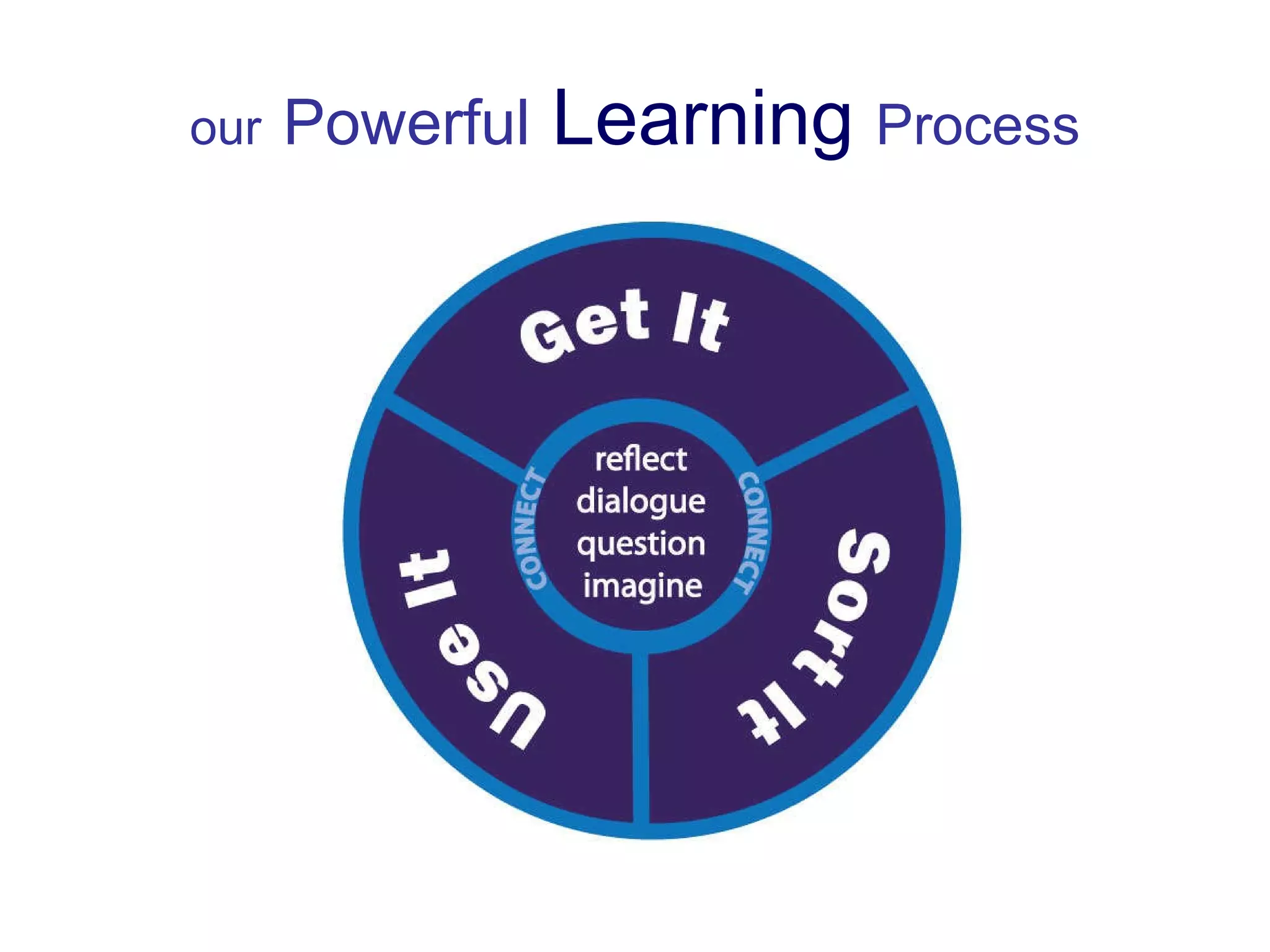
our   Powerful   Learning   Process
Agenda  - Learning  Intentions To learn … where the RBS Powerful Learning Process fits in the big picture why/how the Powerful Learning Process evolved. how thinking is embedded as part of the Powerful Learning Process and can be activated at different levels How are learners (teachers and students) supported in the development of PL?
Thinking Big Picture
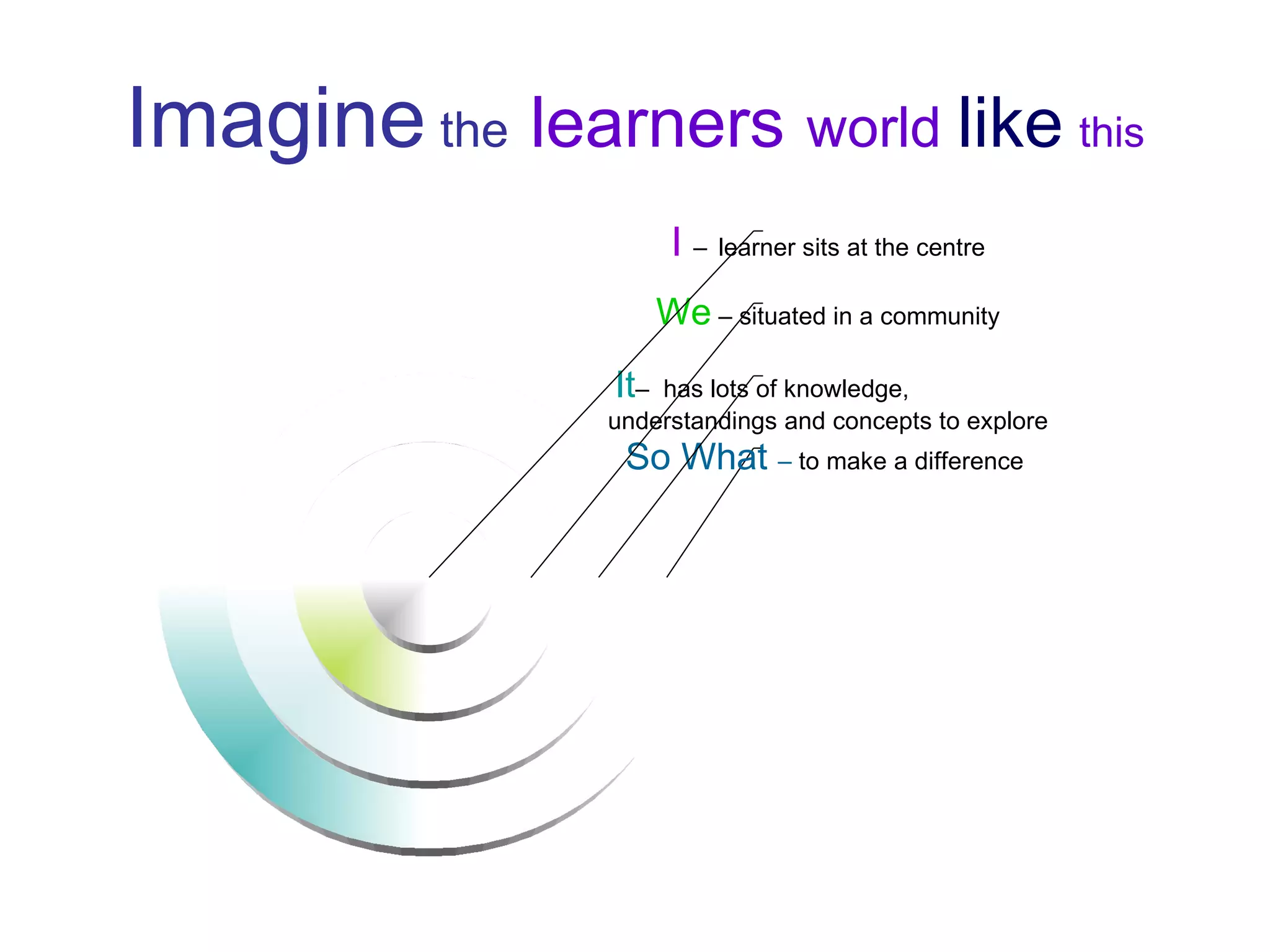
Imagine  the   learners   world  like   this So What  –  to make a difference  It –  has lots of knowledge,  understandings and concepts to explore We  – situated in a community I  –   learner sits at the centre
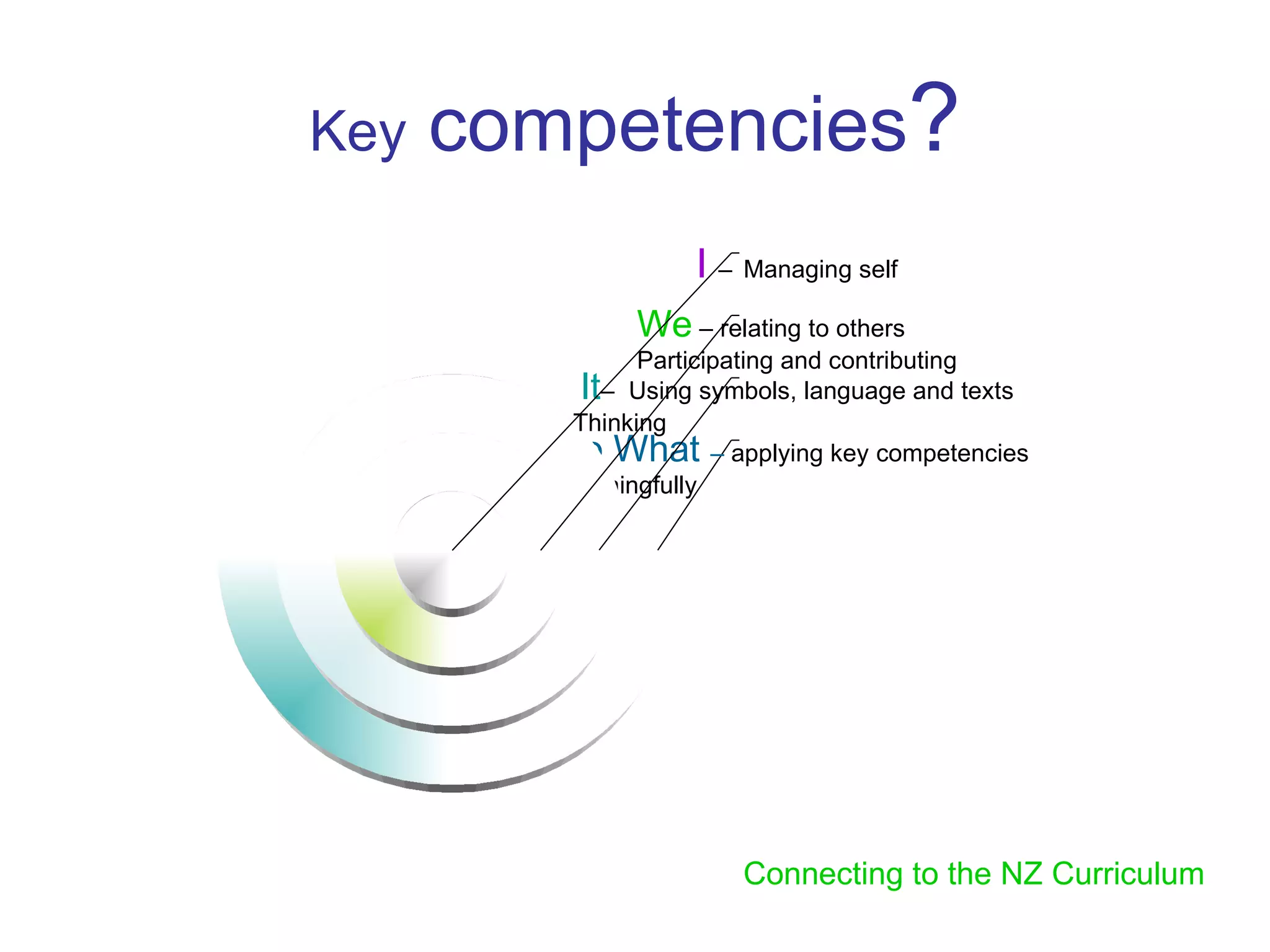
Key   competencies ? Connecting to the NZ Curriculum So What  –  applying key competencies  meaningfully  It –  Using symbols, language and texts  Thinking We  – relating to others Participating and contributing I  –   Managing self
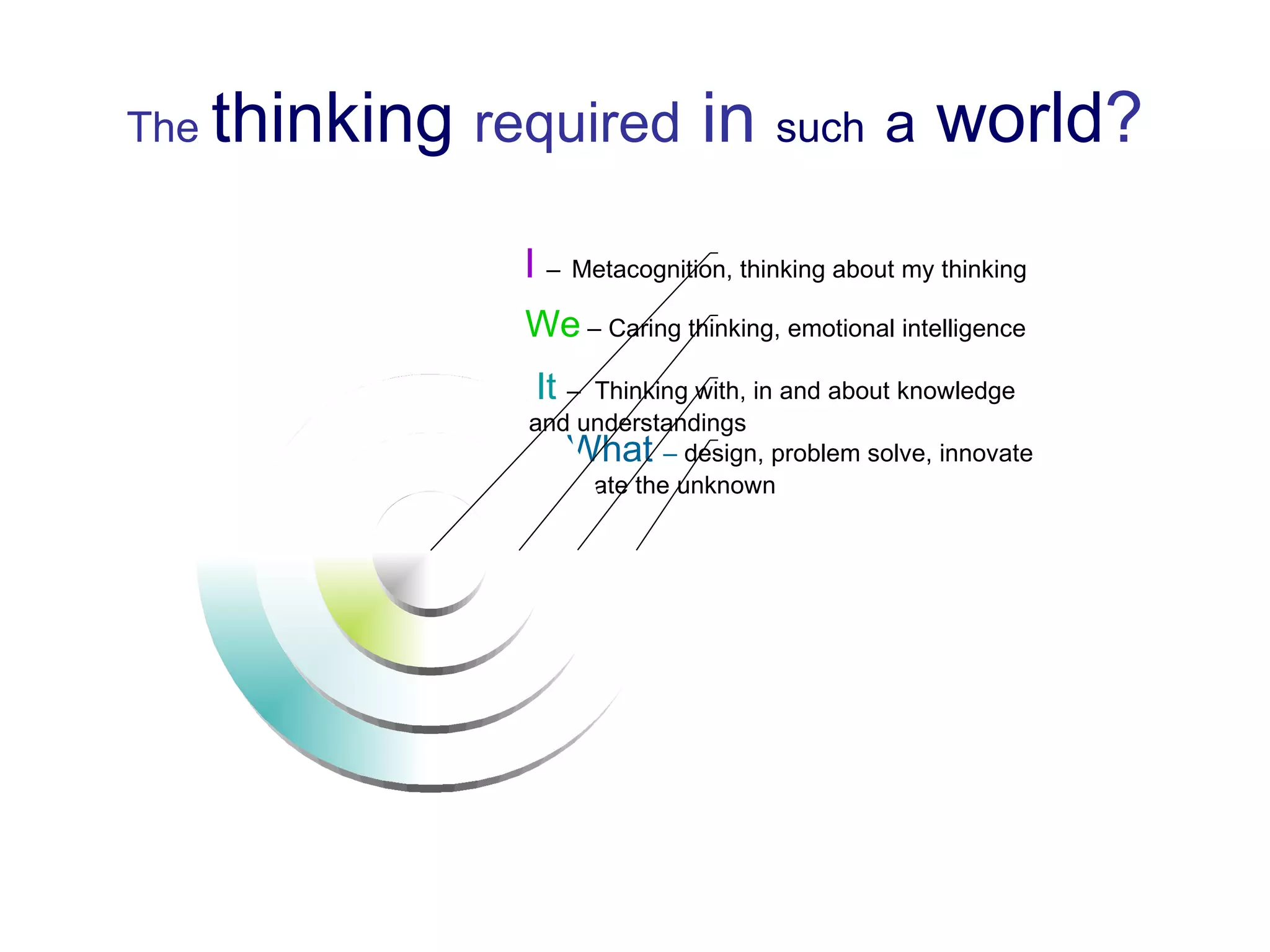
The  thinking  required  in   such   a  world ? So What  –  design, problem solve, innovate  and create the unknown  It  –  Thinking with, in and about knowledge  and understandings We  – Caring thinking, emotional intelligence I  –   Metacognition, thinking about my thinking
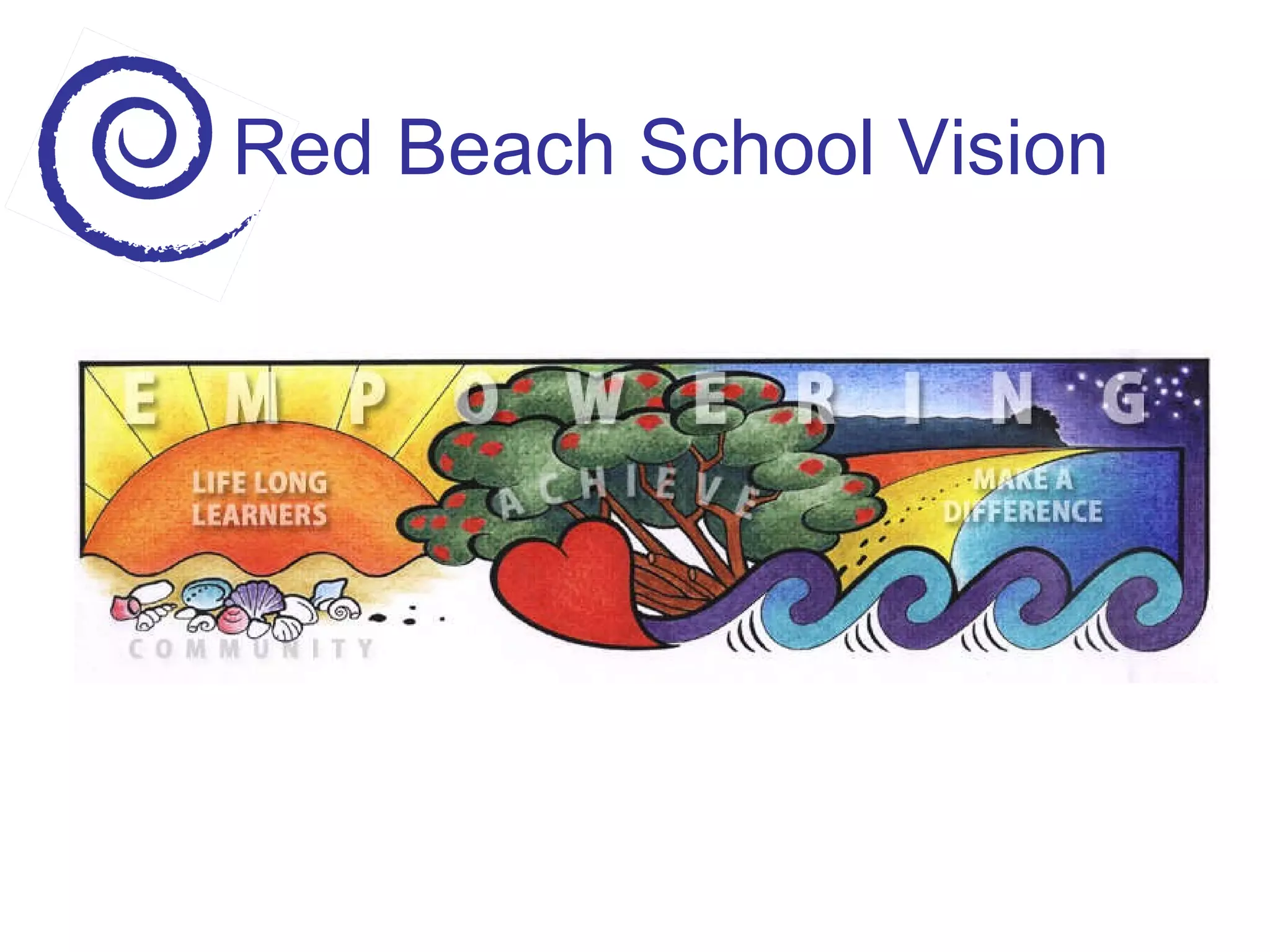
Red Beach School Vision
Change   Fundamental –  Creating   a  vision Ensuring  the  vision   lives
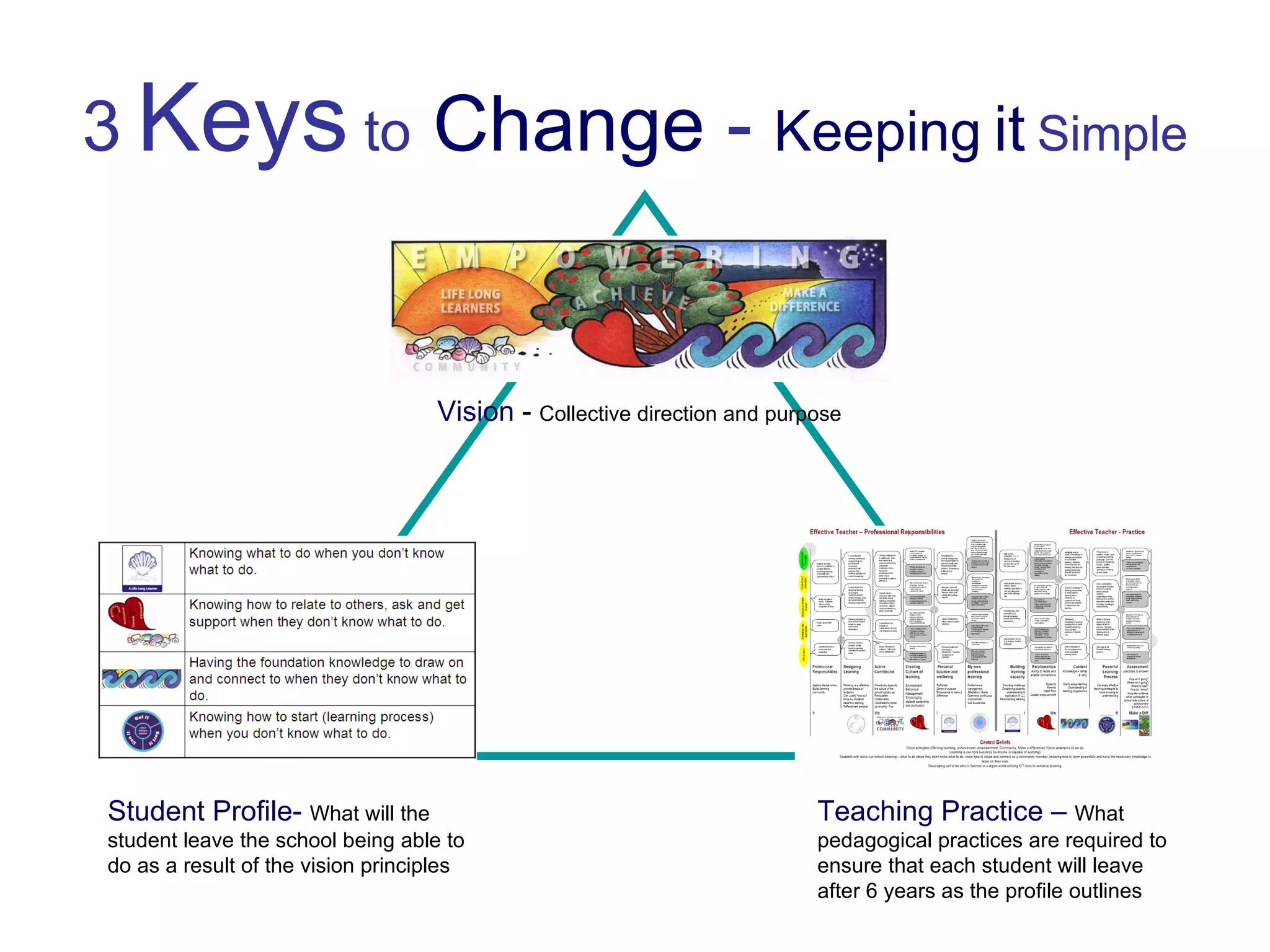
3   Keys  to   Change  -   Keeping   it   Simple Vision  -  Collective direction and purpose Student Profile-   What will the student leave the school being able to do as a result of the vision principles Teaching Practice –  What pedagogical practices are required to ensure that each student will leave after 6 years as the profile outlines
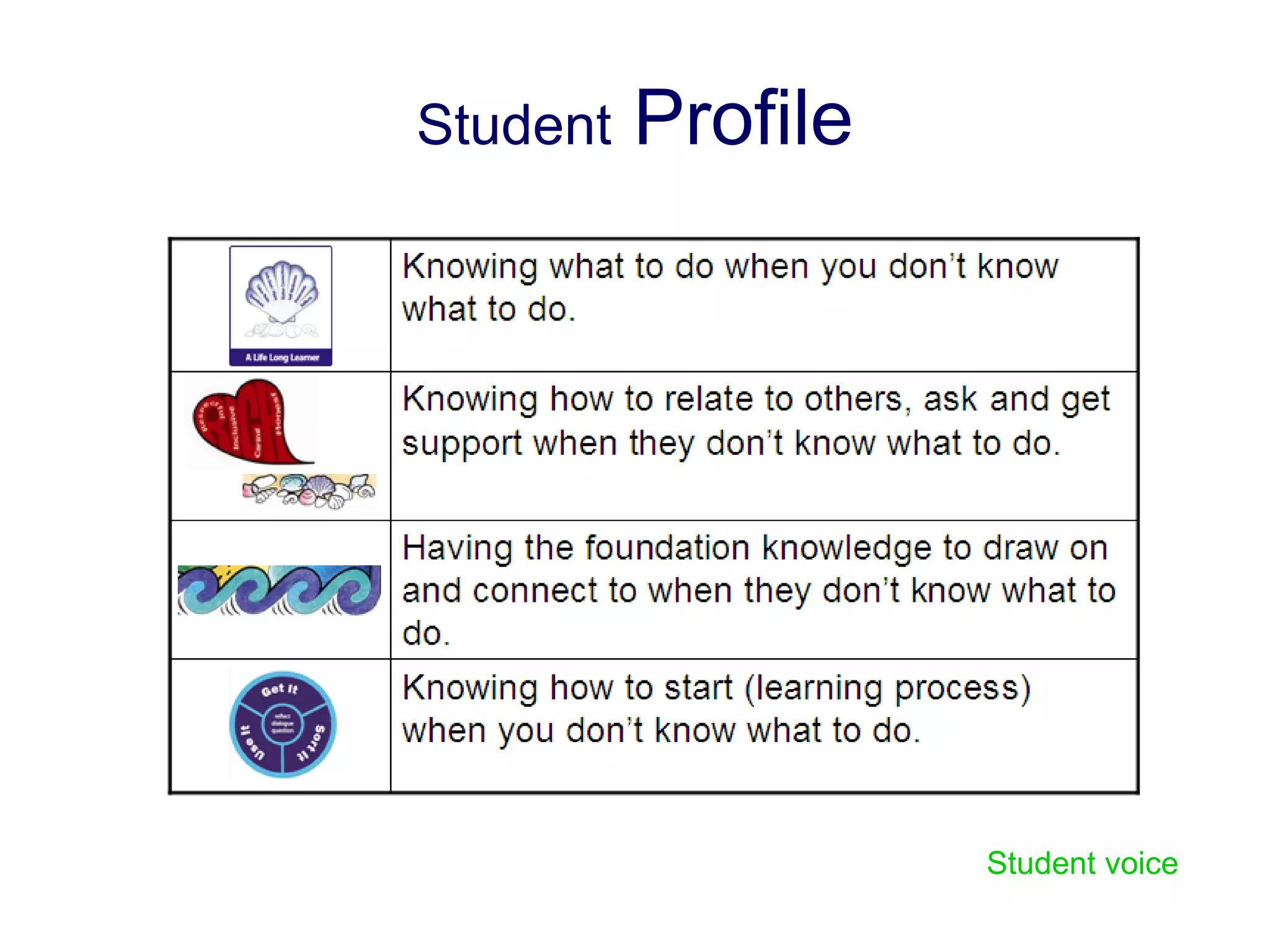
Student  Profile Student voice
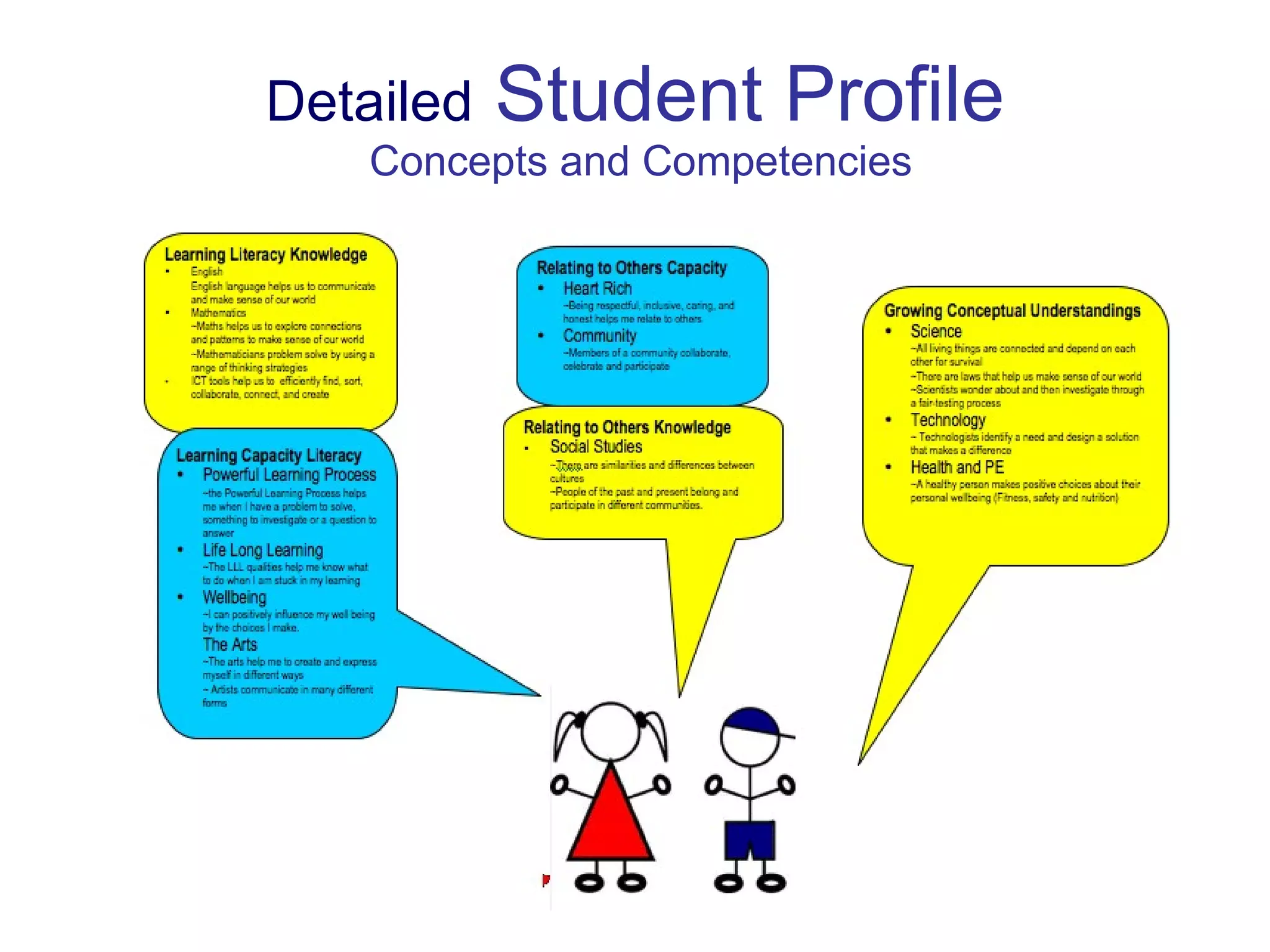
Detailed  Student Profile  Concepts and Competencies
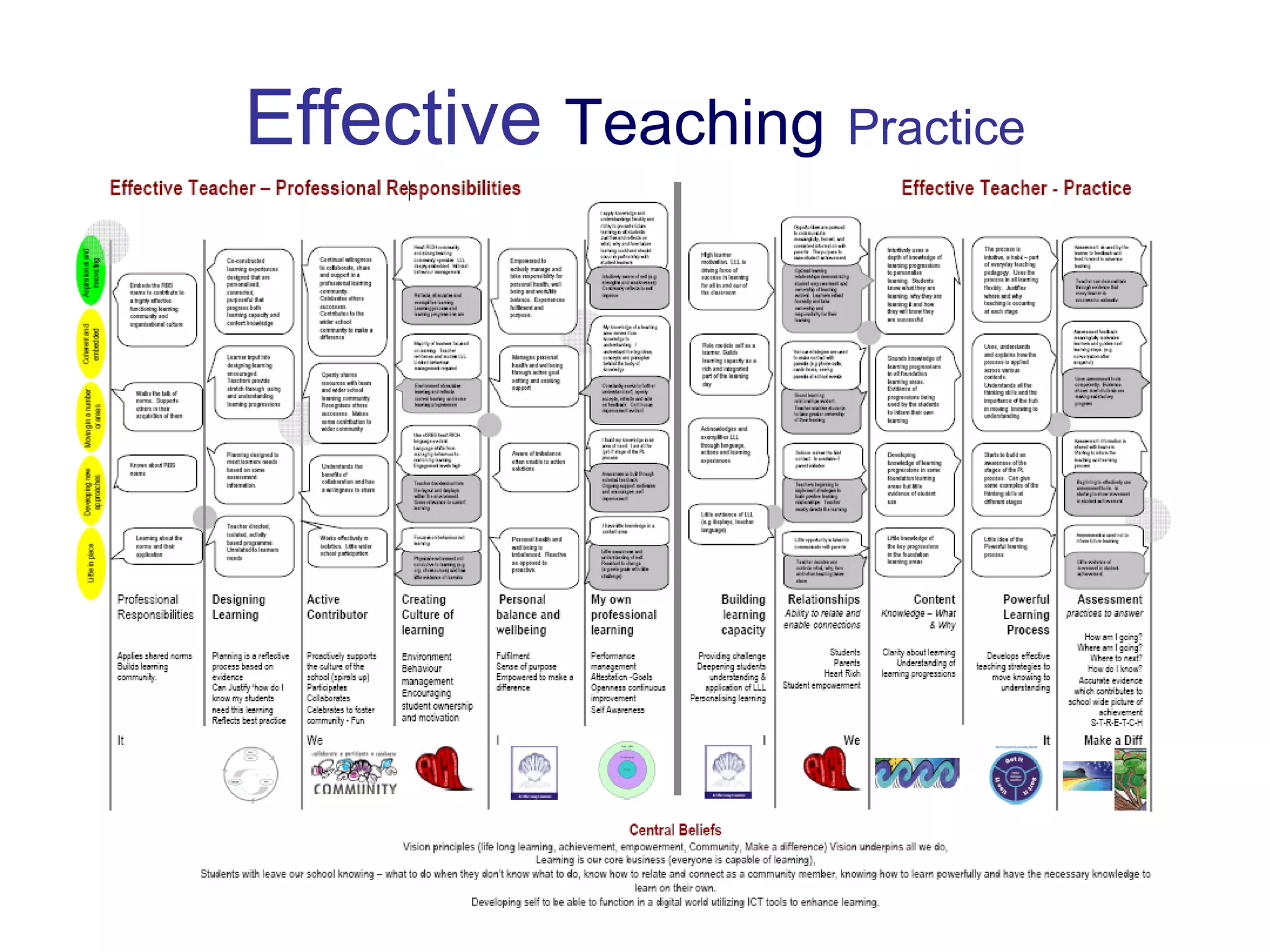
Effective  Teaching   Practice
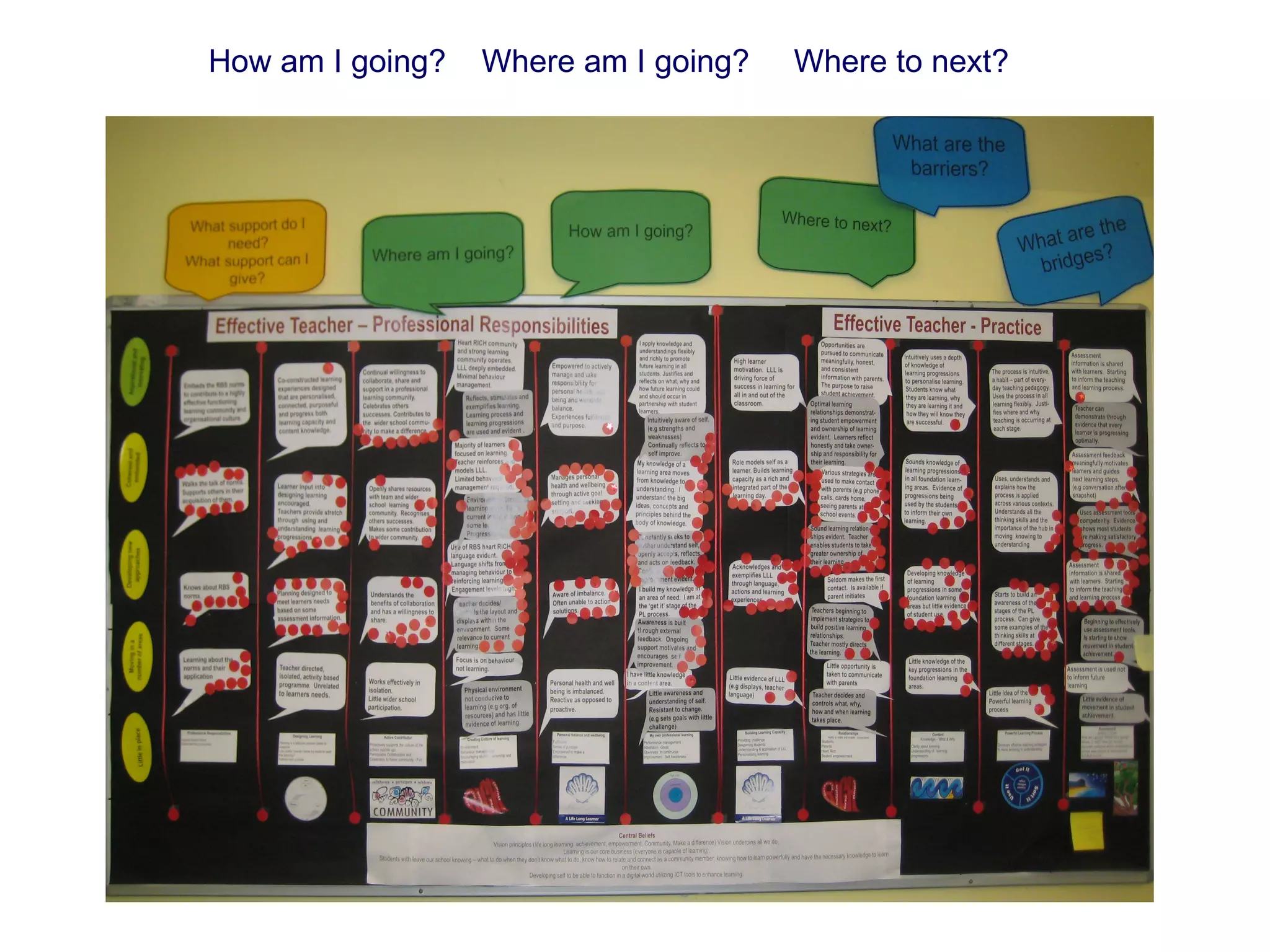
How am I going?  Where am I going?  Where to next?
Align  Practice  with   Belief
Powerful Learning where in the big picture does it fit?
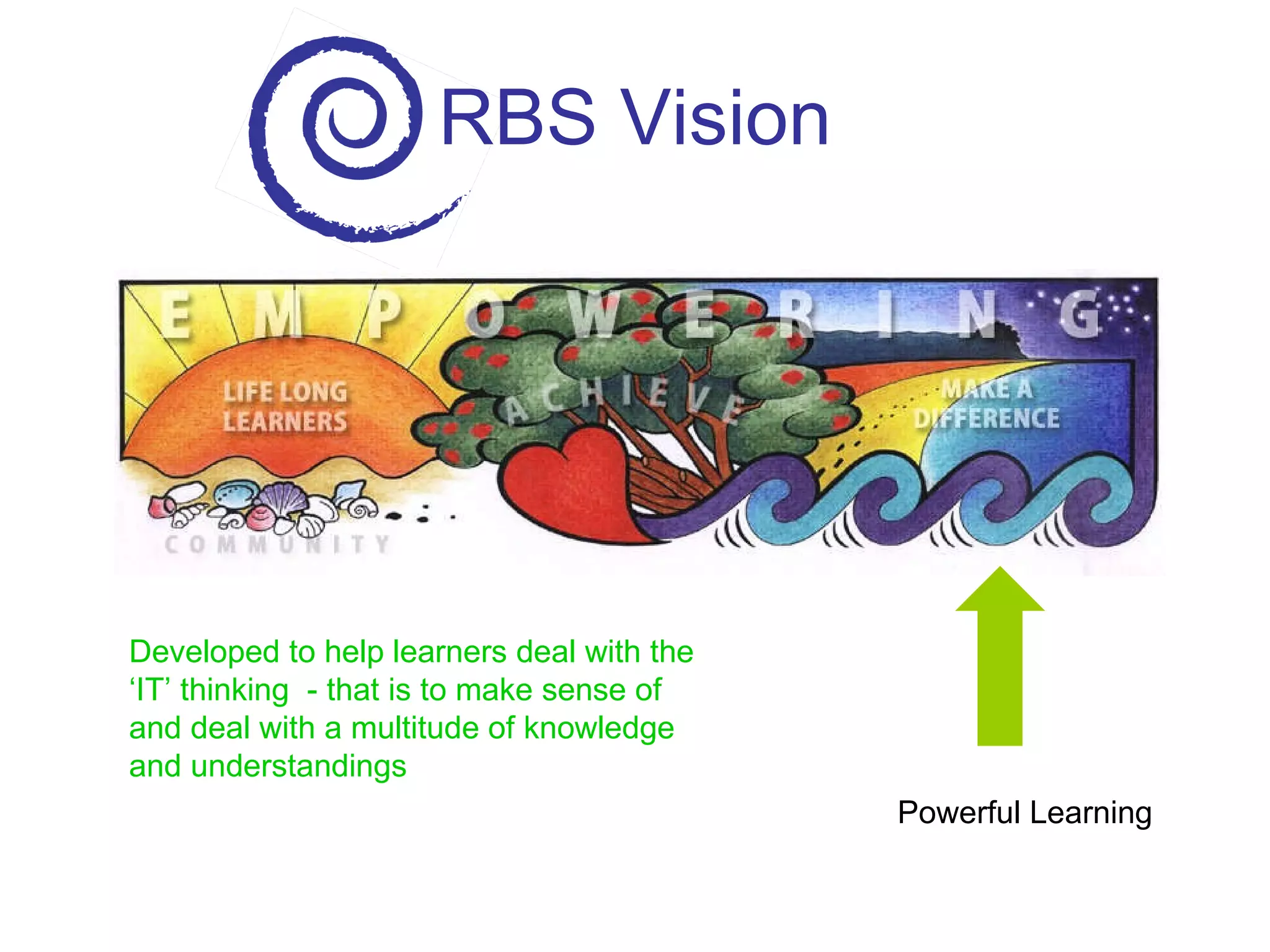
RBS Vision Powerful Learning Developed to help learners deal with the ‘IT’ thinking  - that is to make sense of and deal with a multitude of knowledge and understandings
Learning  Intentions I am learning … where the Powerful Learning Process fits in the big picture why /how the Powerful Learning Process evolved. how thinking is embedded as part of the Powerful Learning Process and can be activated at different levels How are learners (teachers and students) supported in the development of PL?
 
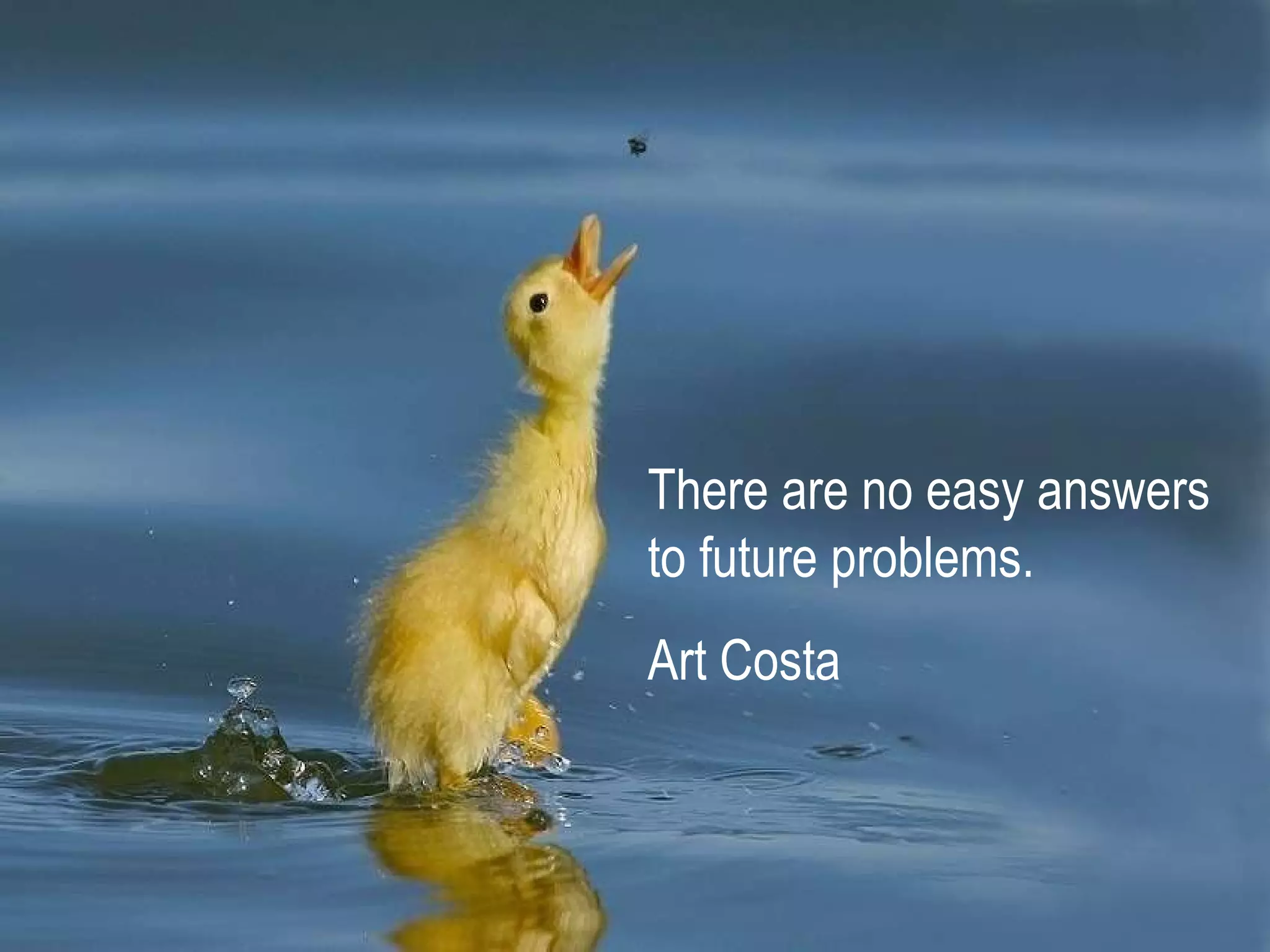
There are no easy answers to future problems. Art Costa
One of the core functions of 21st century education is learning to learn in preparation for a lifetime of change. David Miliband, 2003
We need to produce people who know how to act when they are faced with situations for which they were not specifically prepared. Seymour Papert, 1998
Learning  Intentions I am learning … where the Powerful Learning Process fits in the big picture why/ how  the Powerful Learning Process evolved. how thinking is embedded as part of the Powerful Learning Process and can be activated at different levels How are learners (teachers and students) supported in the development of PL?
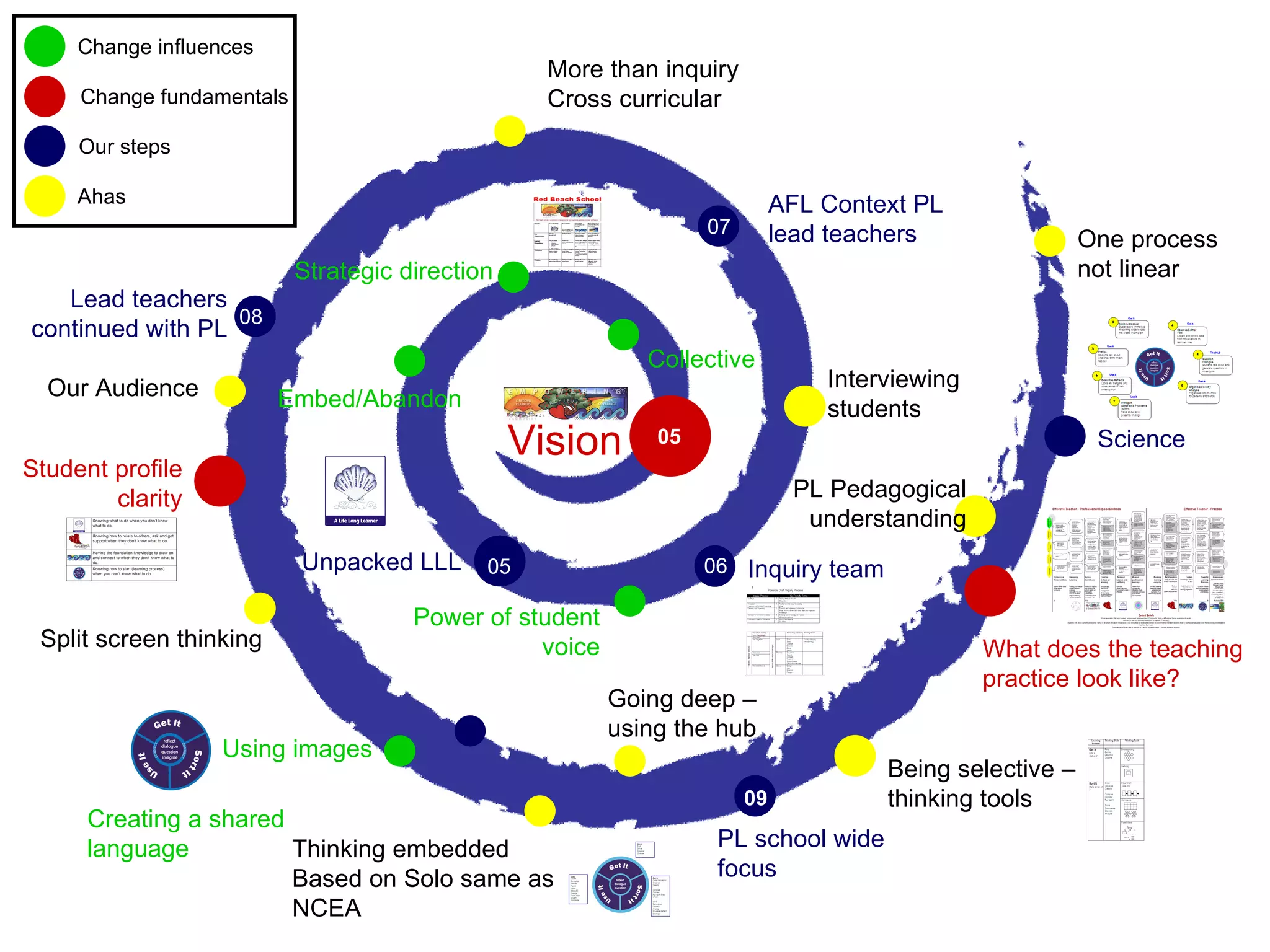
Unpacked LLL Embed/Abandon Vision What does the teaching practice look like? 05 05 Interviewing students Strategic direction Student profile clarity Using images Collective AFL Context PL lead teachers  07 Power of student voice Inquiry team 06 08 Lead teachers continued with PL Science Split screen thinking One process not linear Being selective – thinking tools Thinking embedded Based on Solo same as NCEA More than inquiry Cross curricular Creating a shared language 09 PL school wide focus Going deep – using the hub Our Audience PL Pedagogical understanding Change influences Change fundamentals Our steps Ahas
The test of successful education is not the amount of knowledge that pupils take away from school, but their appetite to think, know and their capacity to learn. Sir Richard Livingstone, 1941
Pedagogy should at its best be about what teachers do that not only helps students to learn but actively strengthens their capacity to think and learn David Hargreaves, 2004
To   survive , thrive and  learn   successfully in the  predicted  future  one  needs  to be   able  to  think!
Take a minute to share with the people sitting next to you what tools, strategies, techniques you use in the classroom to promote thinking.
Let’s  Share
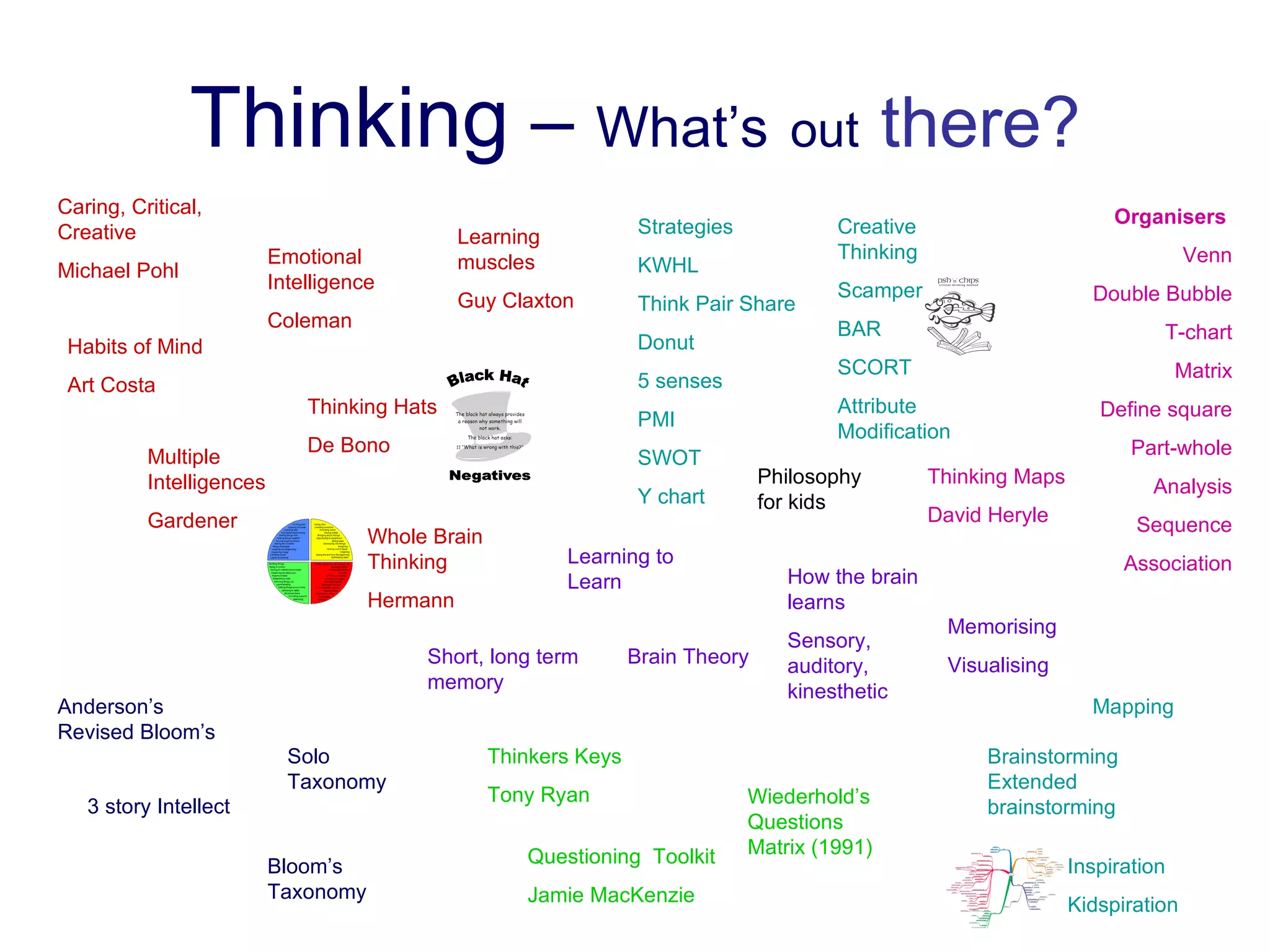
Thinking   –  What’s   out   there? Caring, Critical, Creative Michael Pohl Emotional Intelligence Coleman Habits of Mind Art Costa Learning muscles  Guy Claxton Thinking Maps  David Heryle Organisers  Venn Double Bubble T-chart Matrix Define square Part-whole Analysis Sequence Association Thinking Hats  De Bono Multiple Intelligences  Gardener Whole Brain Thinking Hermann  Learning to Learn Thinkers Keys  Tony Ryan Questioning  Toolkit Jamie MacKenzie Creative Thinking  Scamper BAR SCORT Attribute Modification Bloom’s Taxonomy 3 story Intellect Solo  Taxonomy Anderson’s Revised Bloom’s Wiederhold’s Questions Matrix (1991) Inspiration Kidspiration Strategies  KWHL Think Pair Share Donut 5 senses PMI SWOT Y chart Brainstorming Extended brainstorming Short, long term memory Brain Theory How the brain learns Sensory, auditory, kinesthetic Mapping Memorising Visualising Philosophy for kids
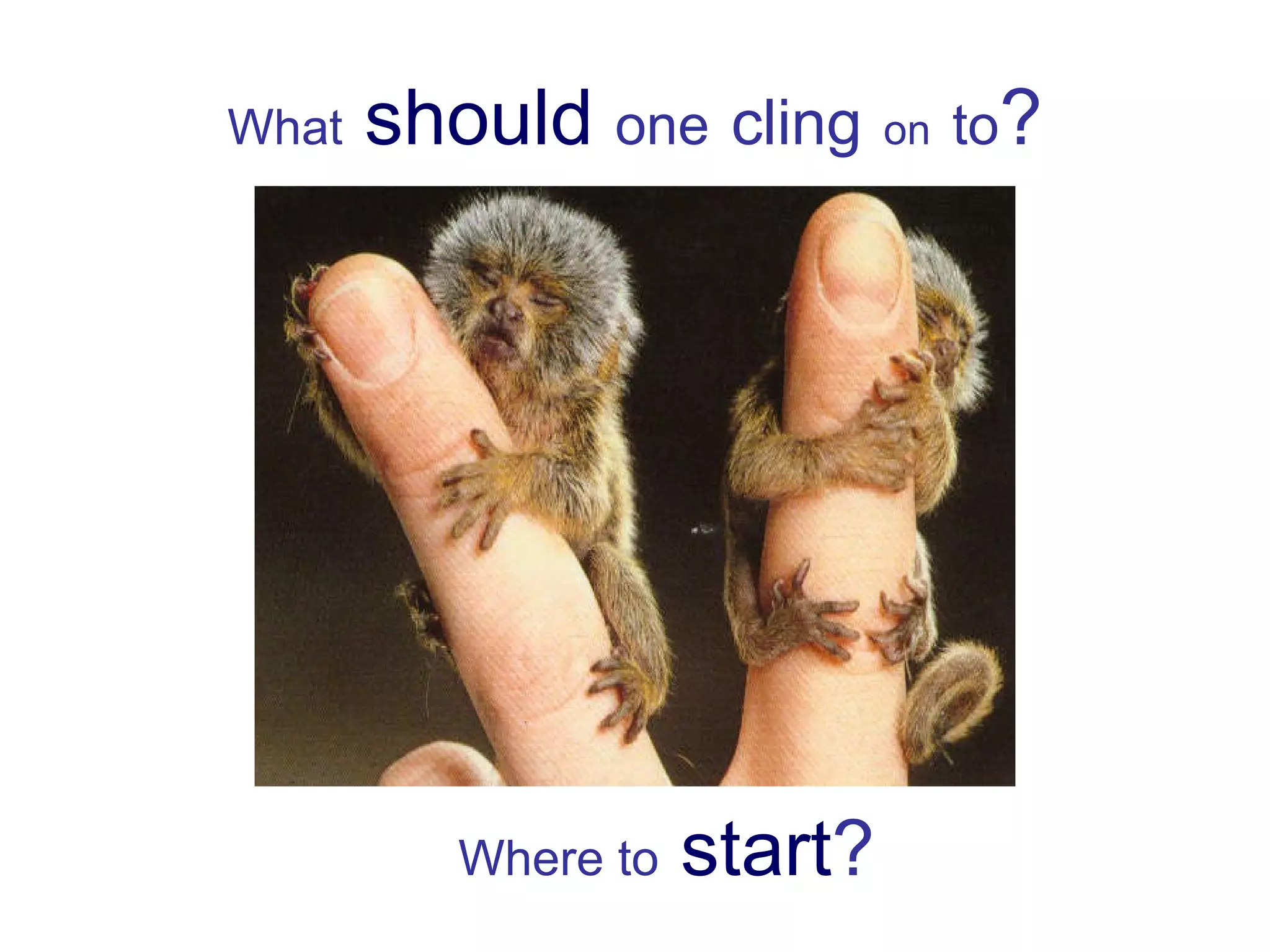
What   should   one   cling   on   to ? Where to   start ?
Learning  Intentions I am learning … where the Powerful Learning Process fits in the big picture why/how the Powerful Learning Process evolved. how thinking is embedded as part of the Powerful Learning Process and can be activated at different levels How are learners (teachers and students) supported in the development of PL?
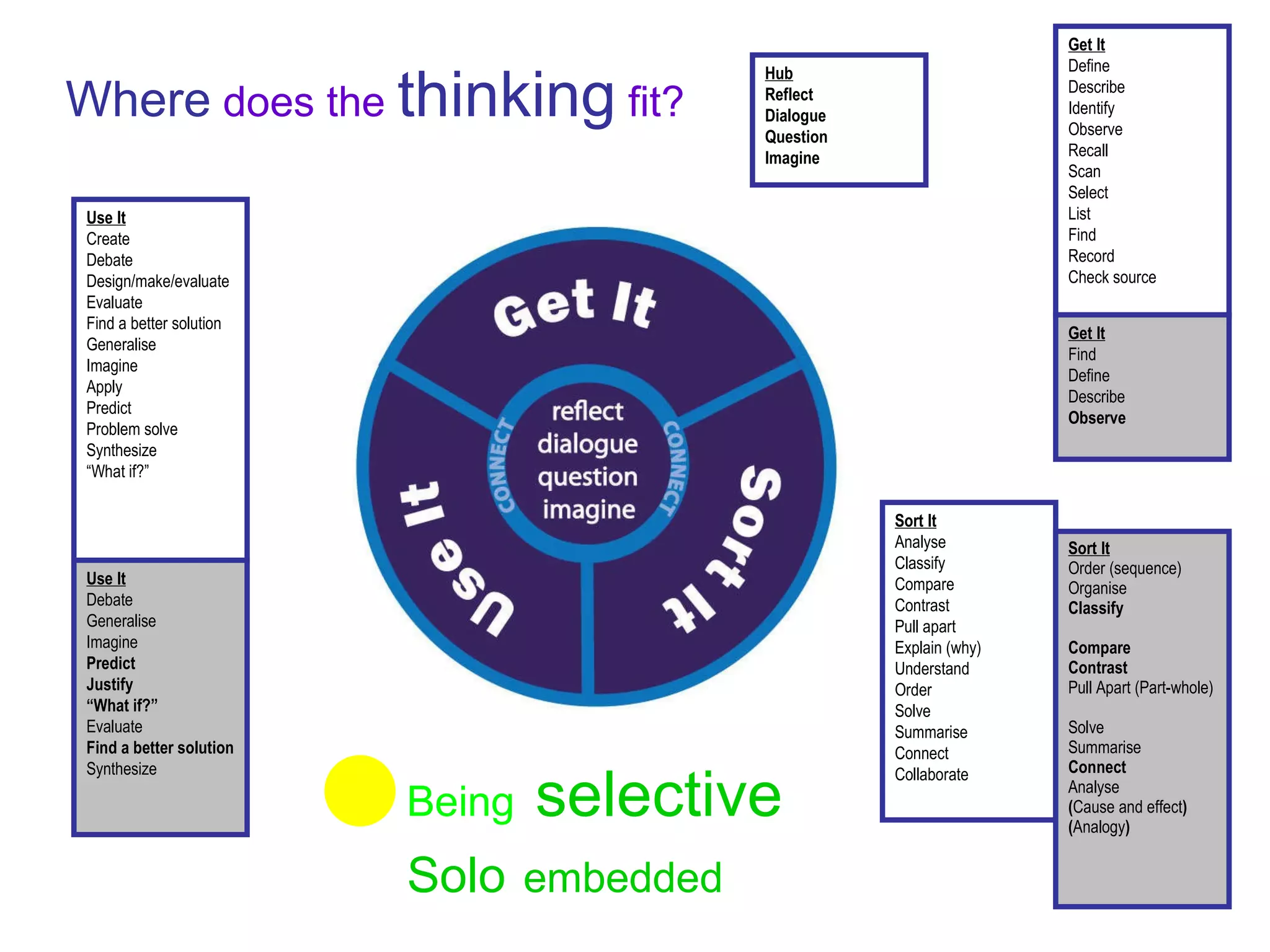
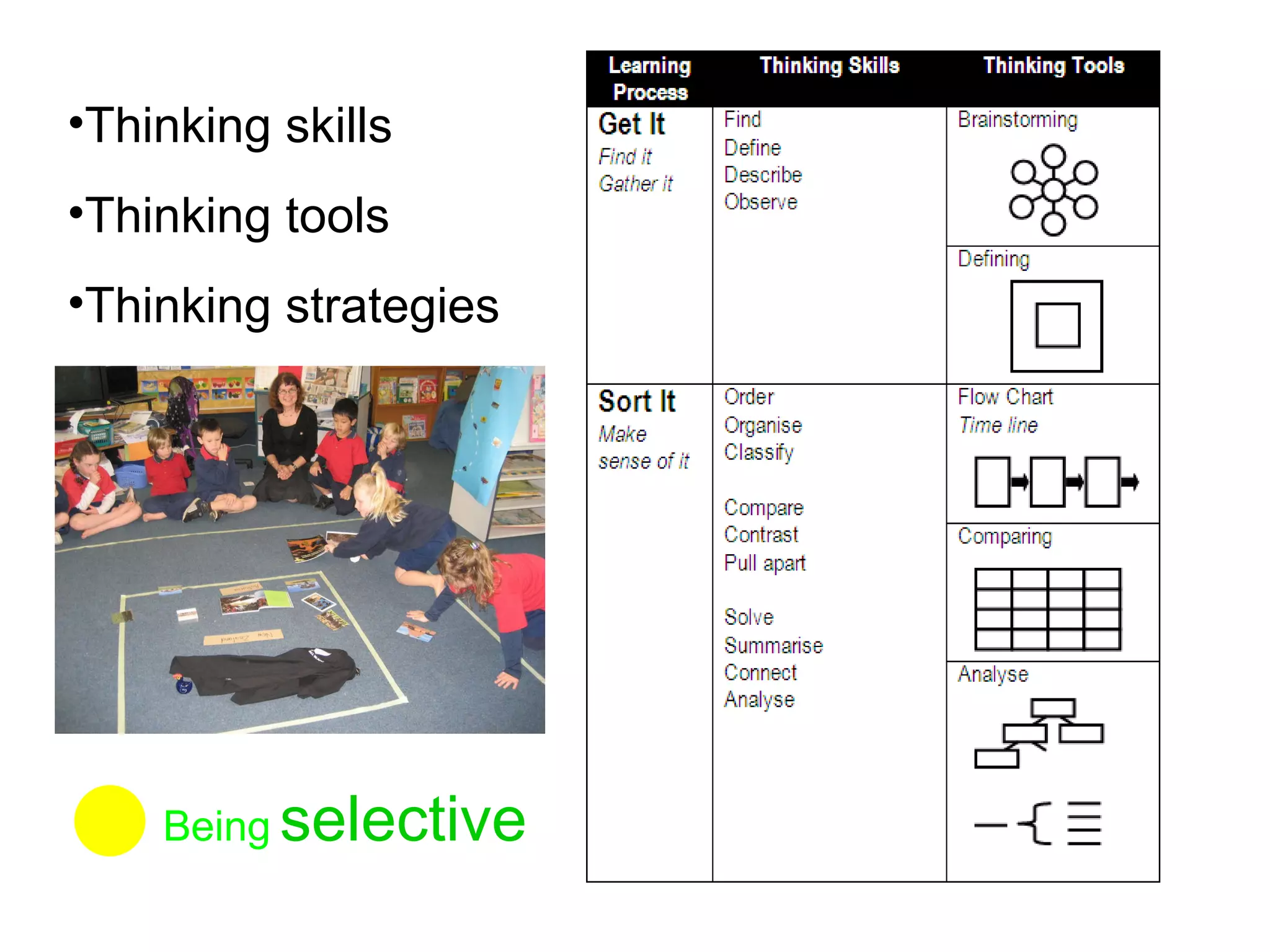
Hub Reflect Dialogue Question Imagine Sort It Analyse Classify Compare Contrast Pull apart Explain (why) Understand Order Solve Summarise Connect Collaborate Sort It Order (sequence) Organise Classify Compare Contrast Pull Apart (Part-whole) Solve Summarise  Connect Analyse ( Cause and effect ) ( Analogy ) Where  does the  thinking  fit? Get It Define Describe Identify Observe Recall Scan Select List Find Record Check source Get It Find Define Describe Observe Use It Create Debate Design/make/evaluate Evaluate Find a better solution Generalise Imagine Apply Predict Problem solve Synthesize “ What if?” Use It Debate Generalise Imagine Predict Justify “ What if?” Evaluate Find a better solution Synthesize Being  selective Solo   embedded
Being   selective Thinking skills Thinking tools Thinking strategies
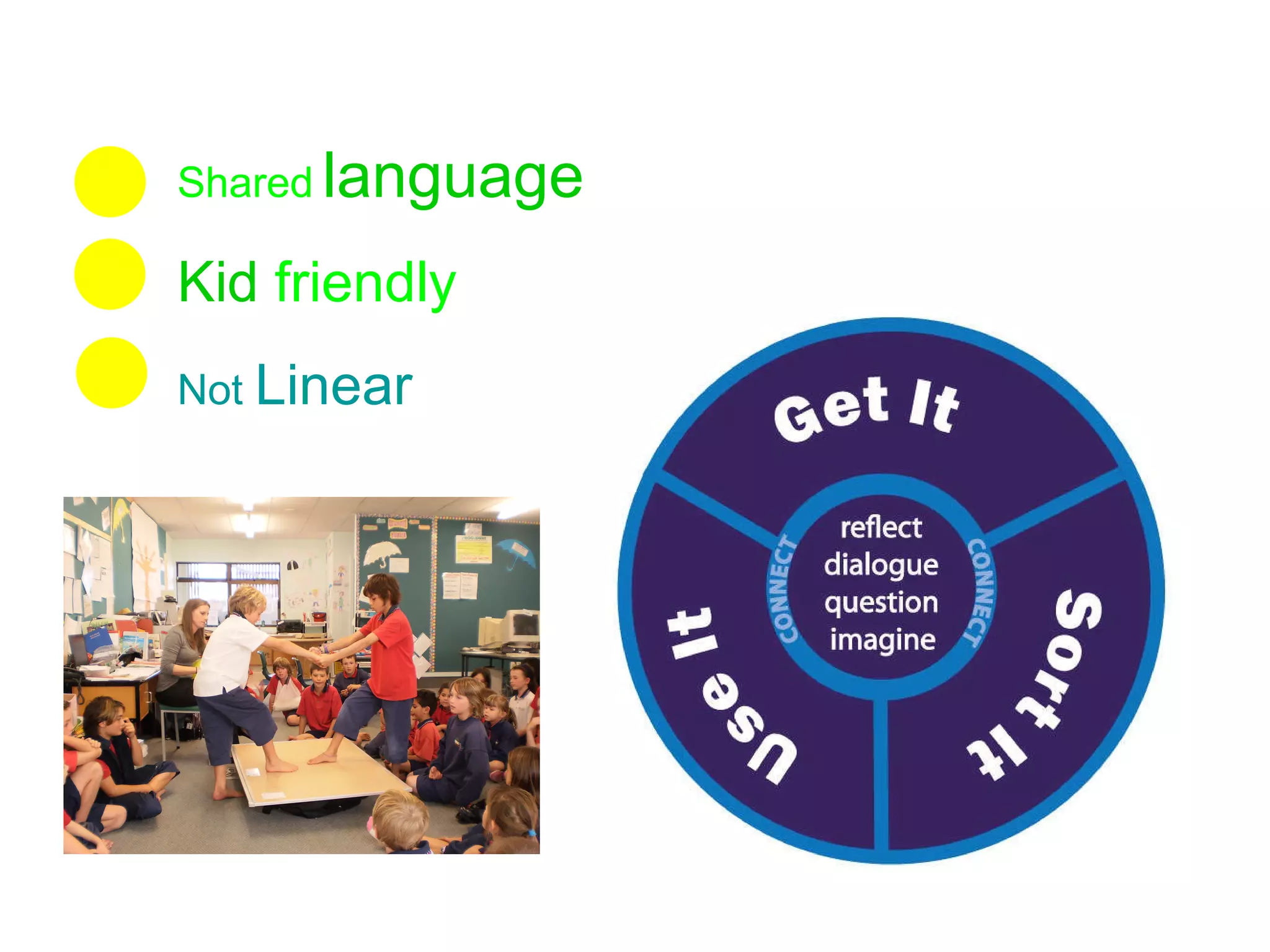
Shared   language Kid  friendly Not  Linear
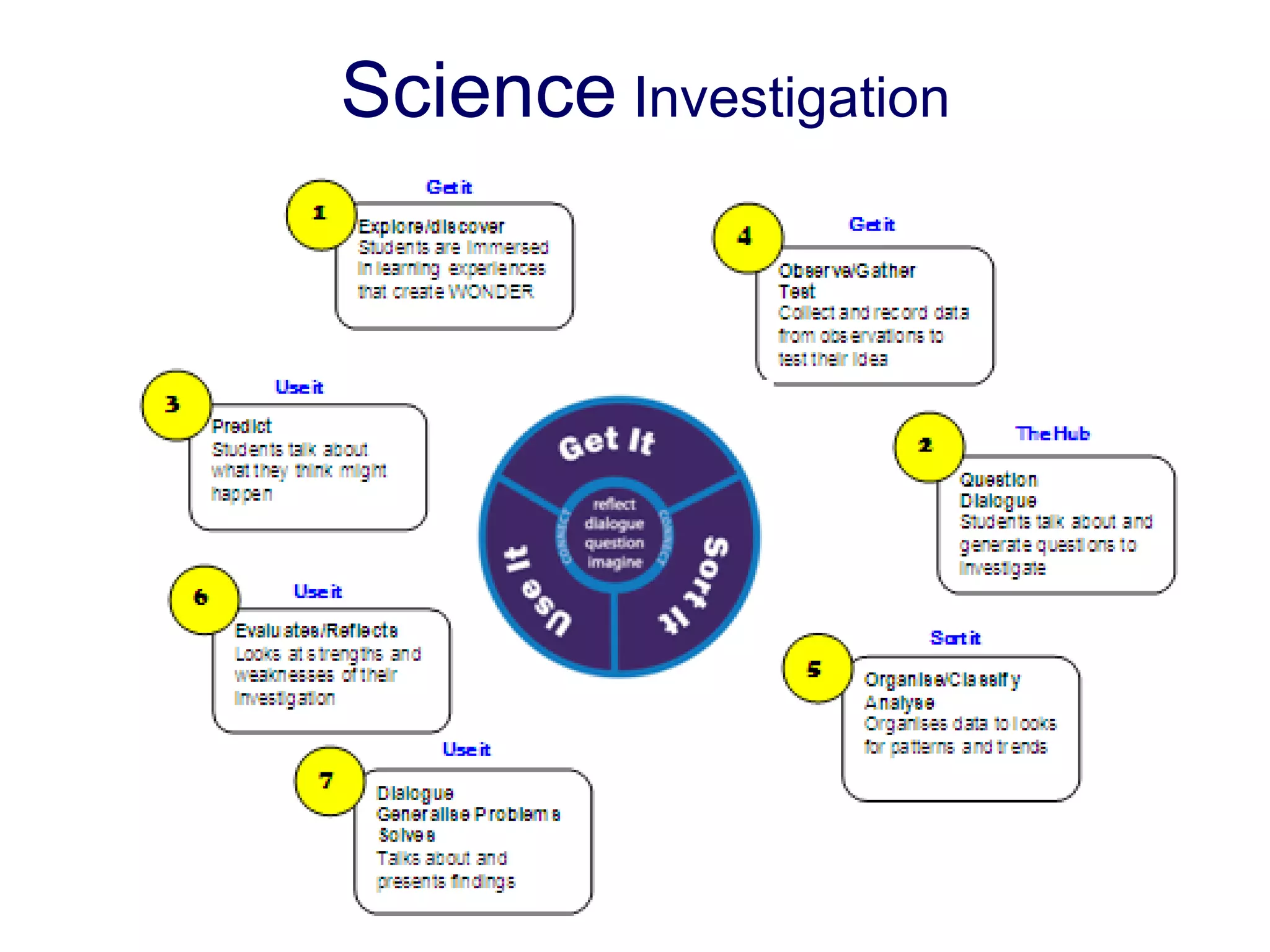
Science  Investigation
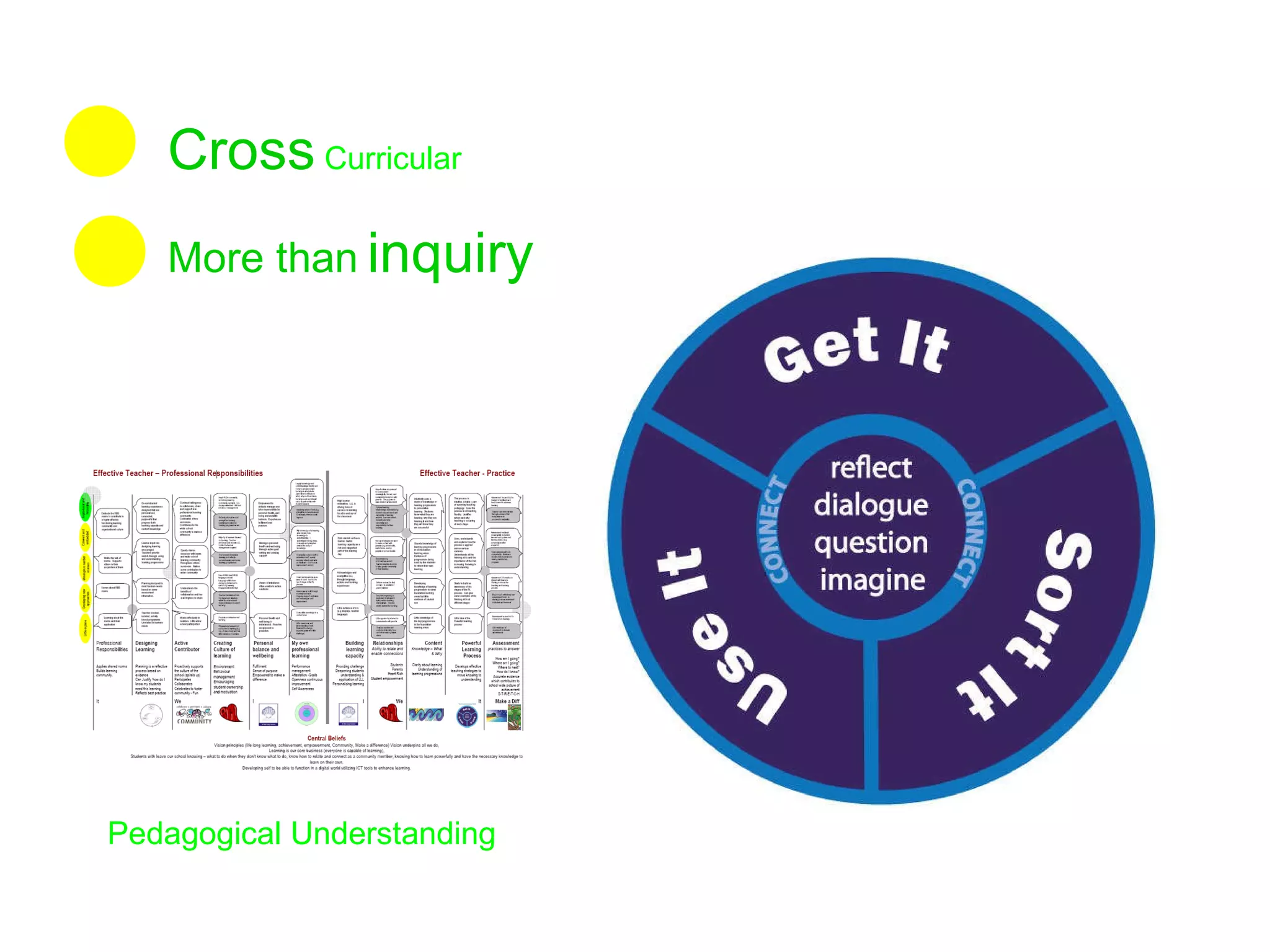
Cross   Curricular More than   inquiry Pedagogical Understanding
What do you understand by the phrase More than Inquiry?
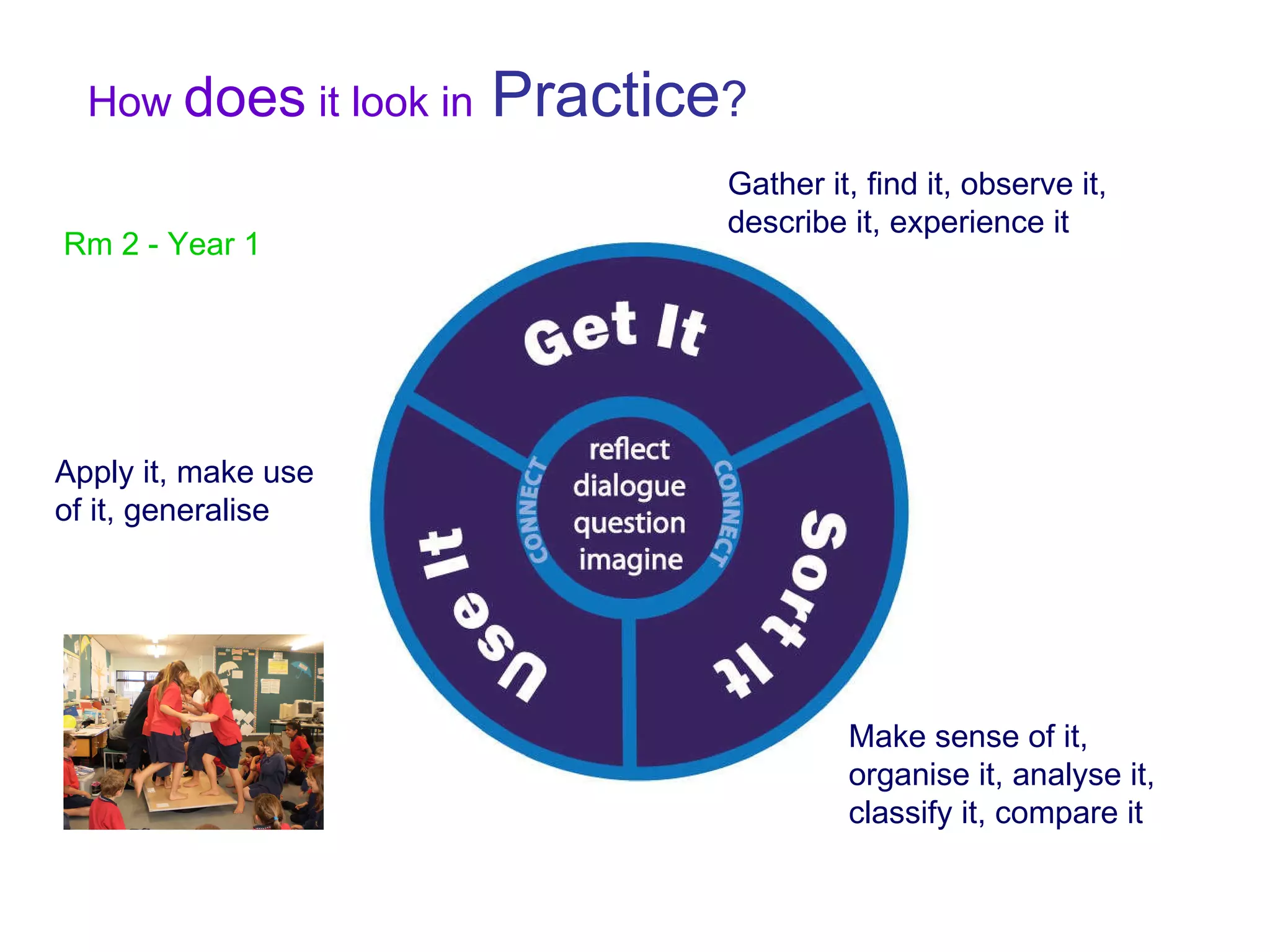
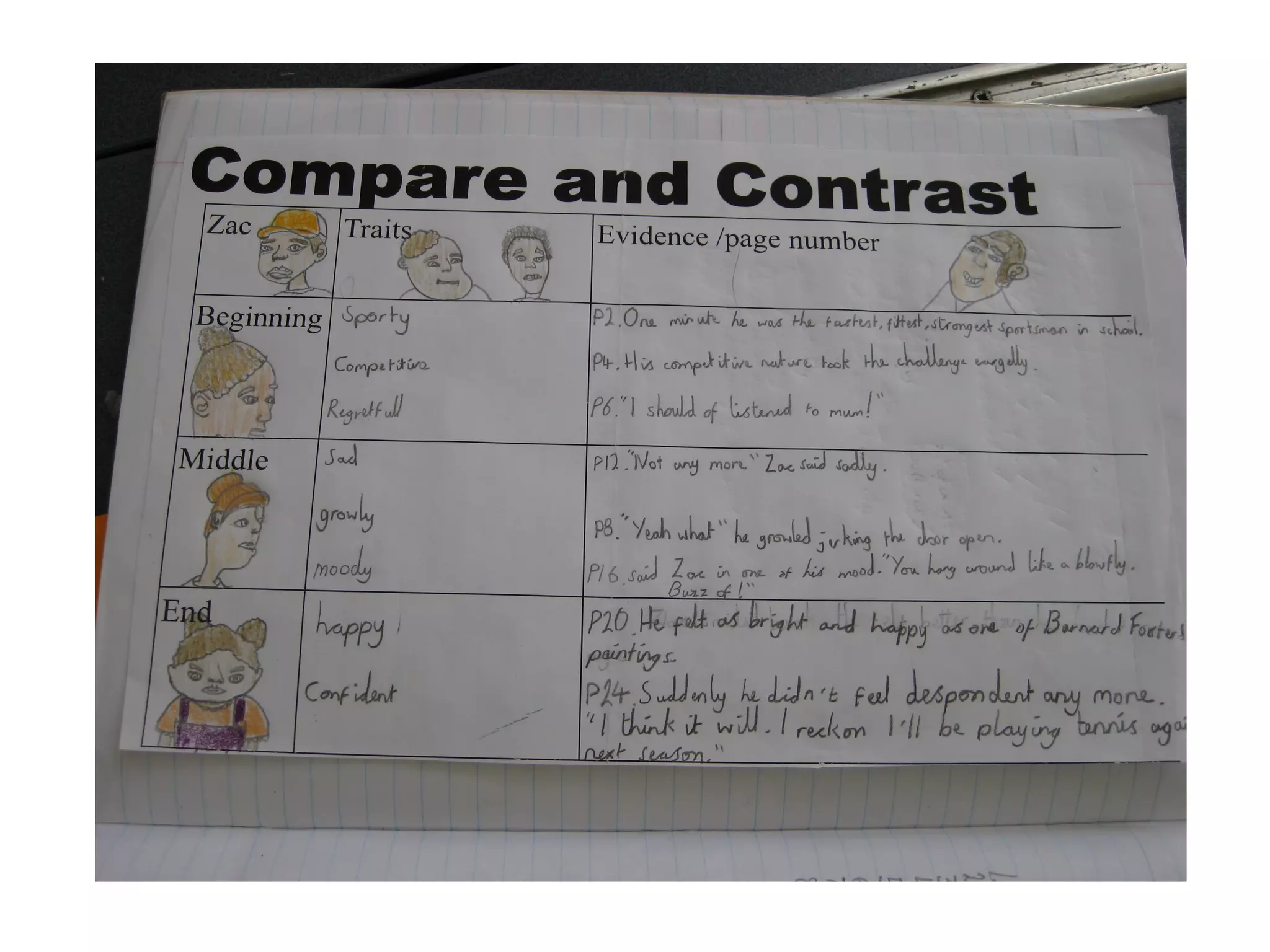
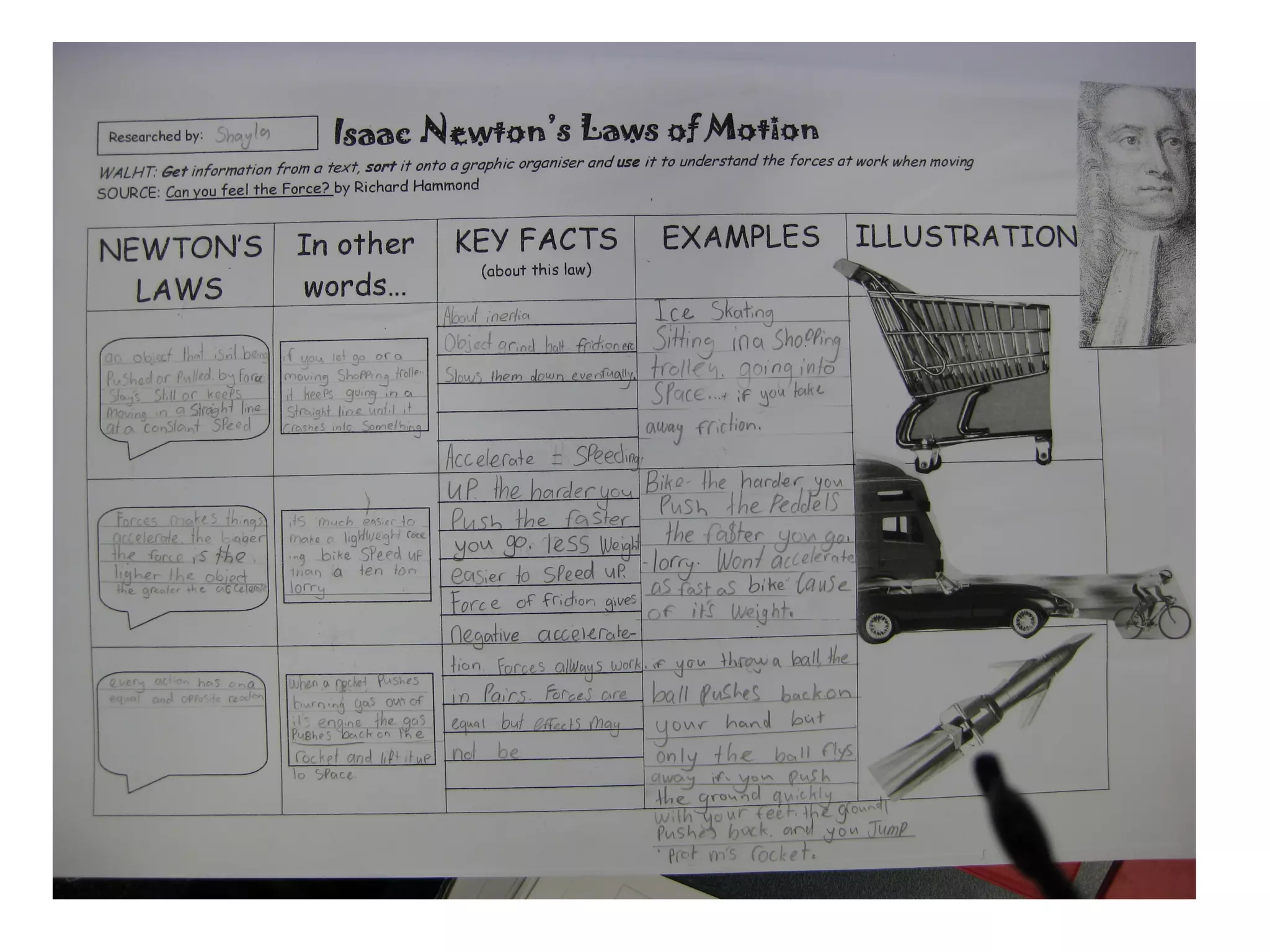
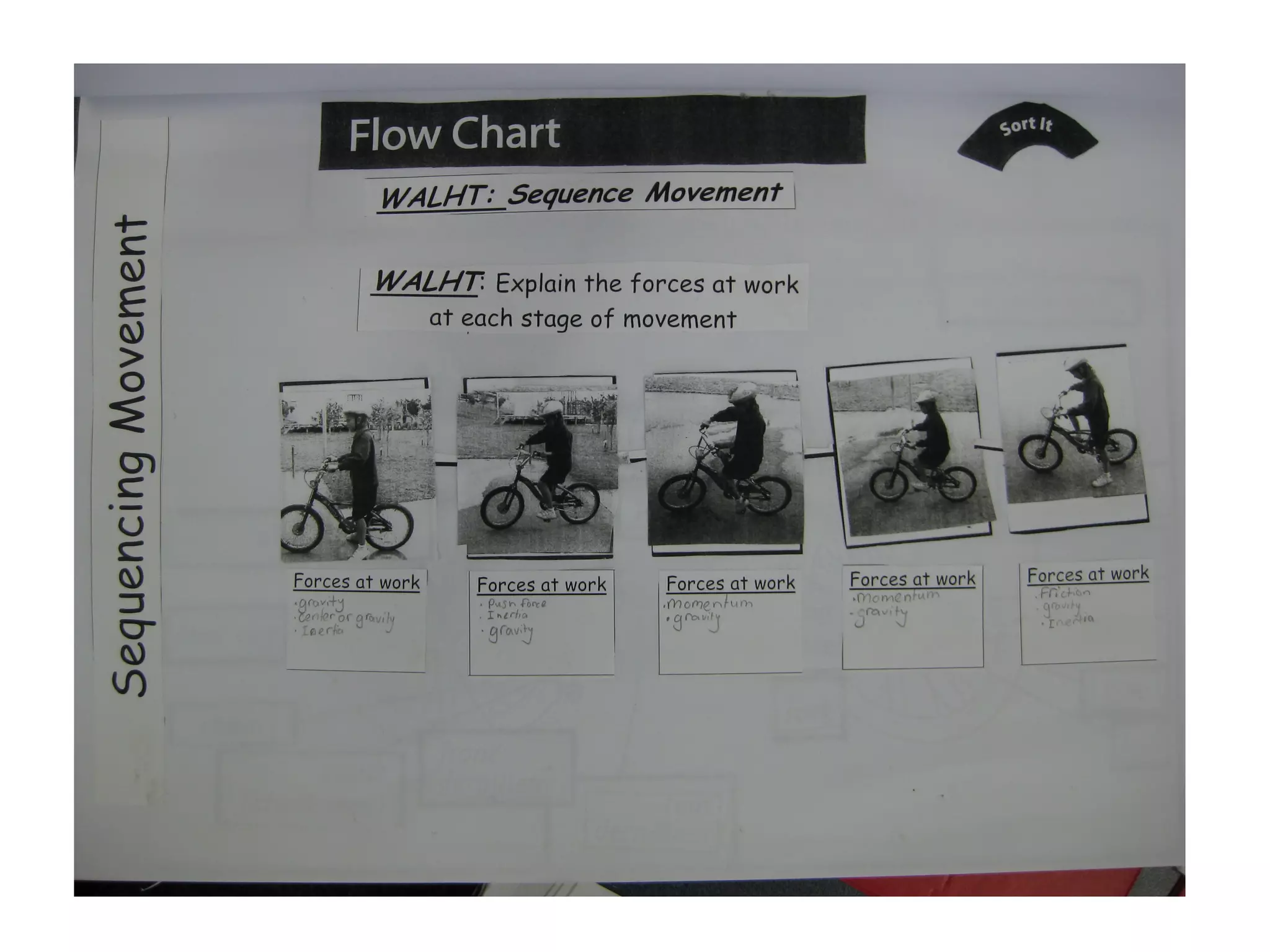
Gather it, find it, observe it, describe it, experience it Make sense of it, organise it, analyse it, classify it, compare it Apply it, make use of it, generalise How  does  it look   in  Practice ? Rm 2 - Year 1
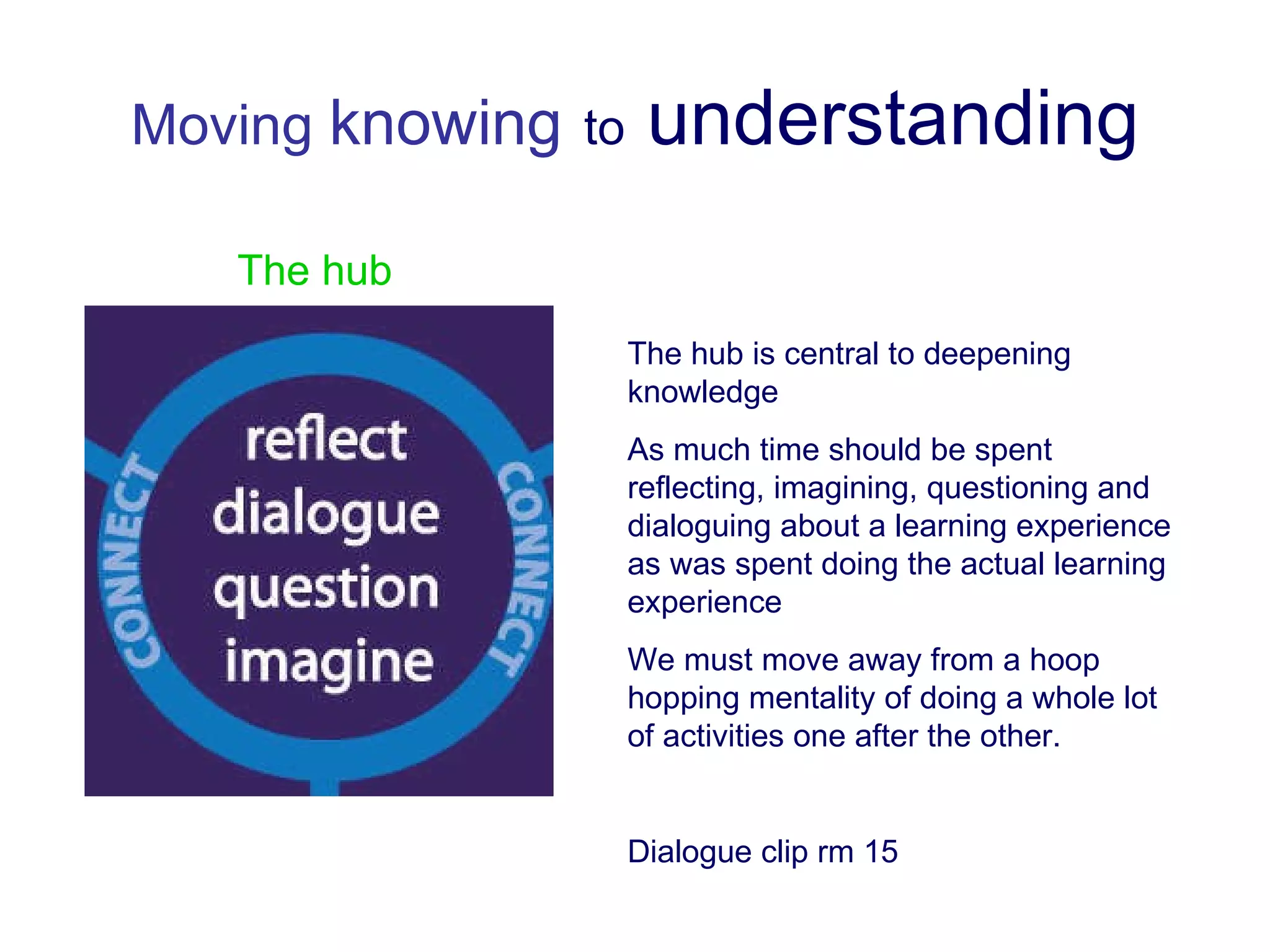
Moving  knowing   to  understanding The hub is central to deepening knowledge As much time should be spent reflecting, imagining, questioning and dialoguing about a learning experience as was spent doing the actual learning experience We must move away from a hoop hopping mentality of doing a whole lot of activities one after the other. Dialogue clip rm 15 The hub
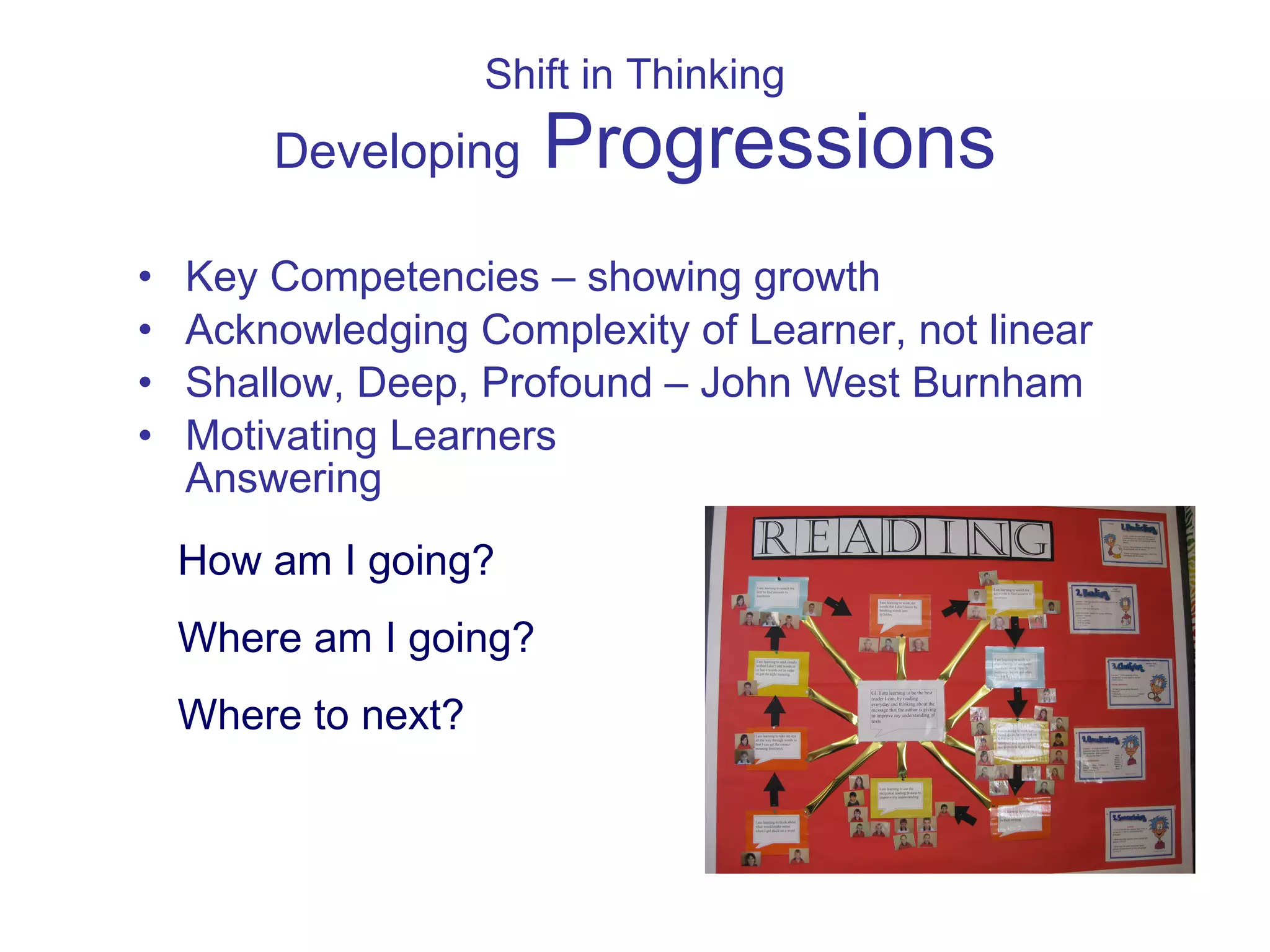
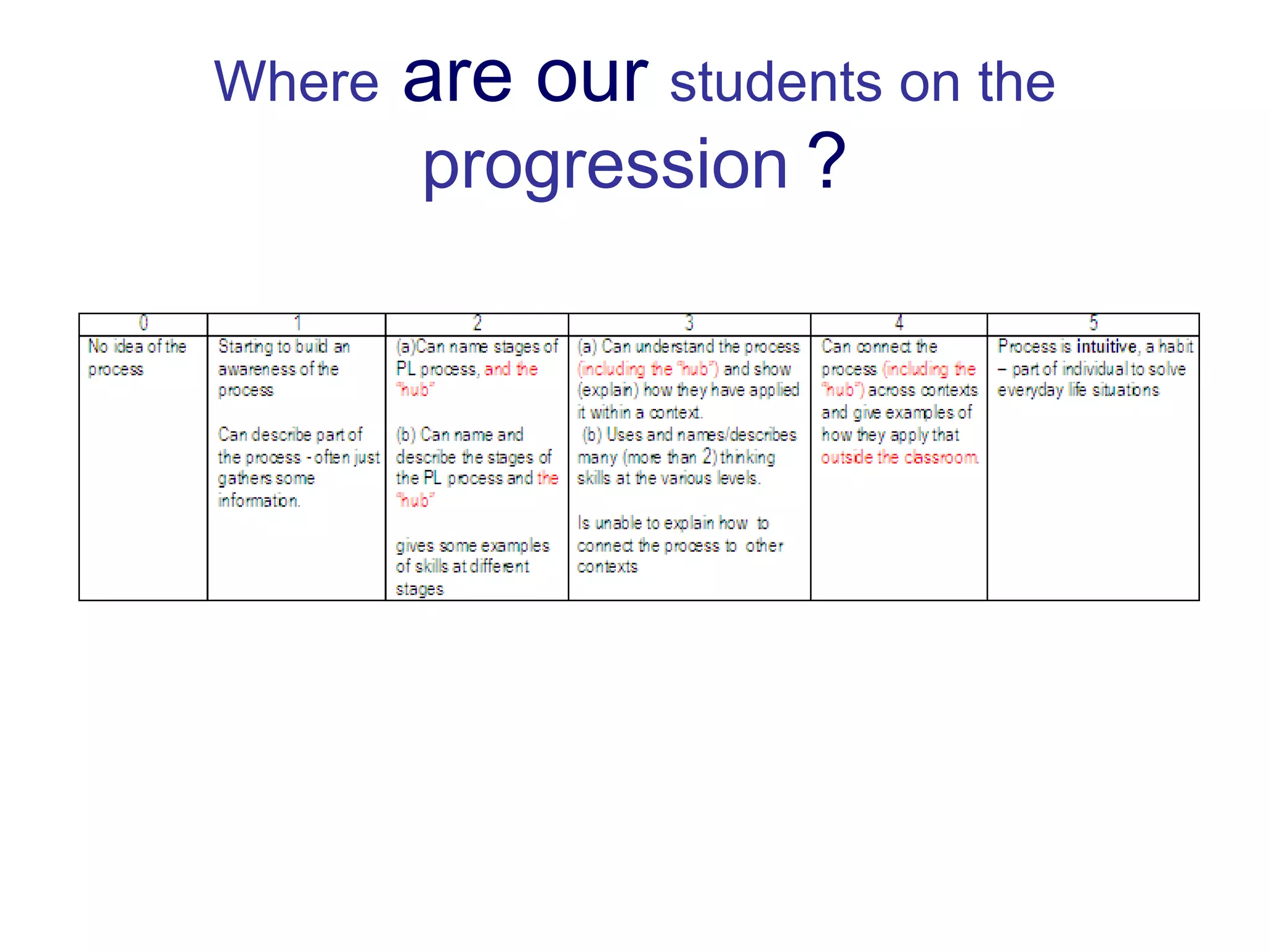
Shift in Thinking Developing  Progressions Key Competencies – showing growth Acknowledging Complexity of Learner, not linear  Shallow, Deep, Profound – John West Burnham Motivating Learners  Answering How am I going? Where am I going? Where to next?
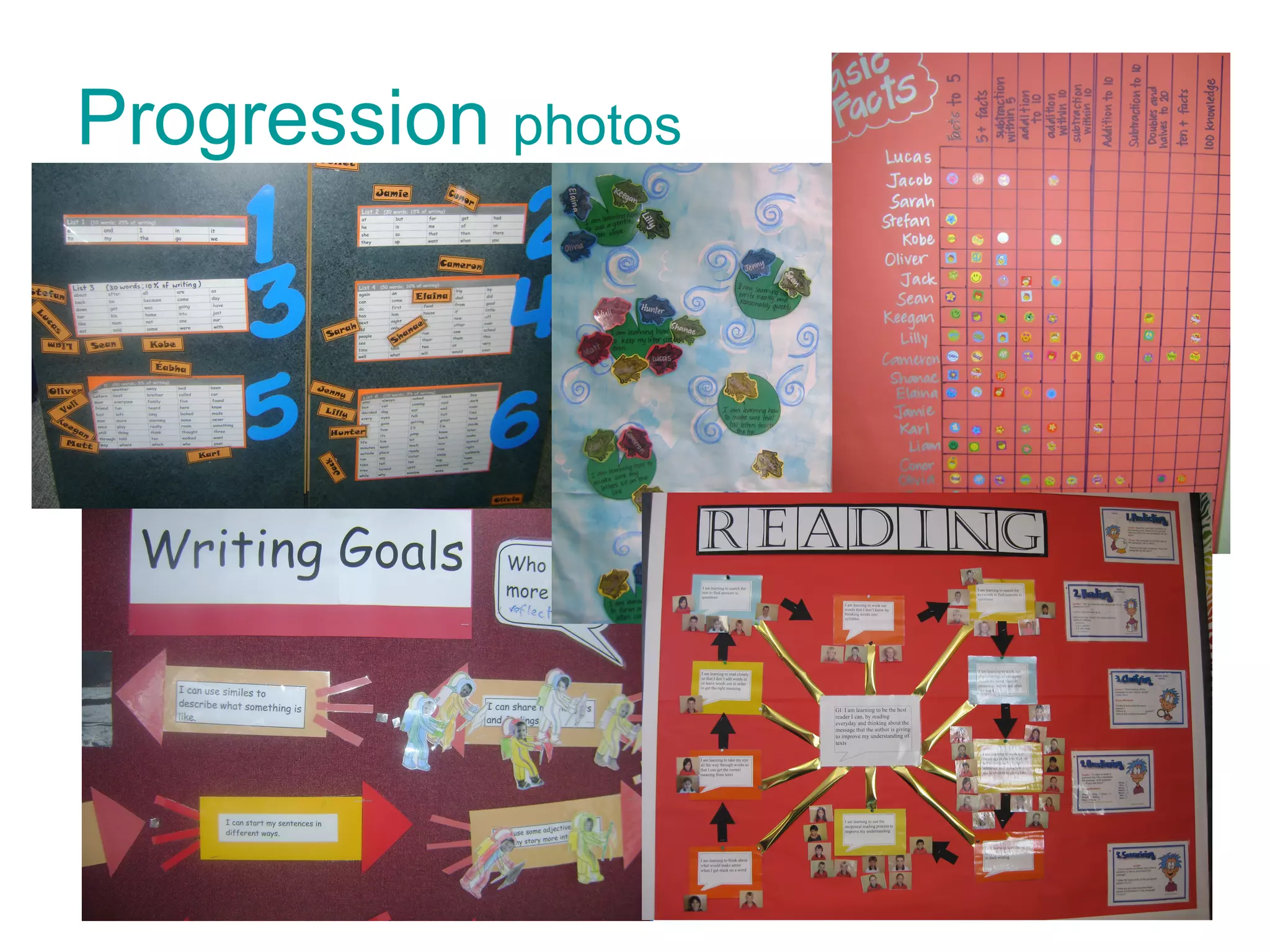
Progression  photos
Where  are our  students on the  progression   ?
Is there a hierarchy of thinking?
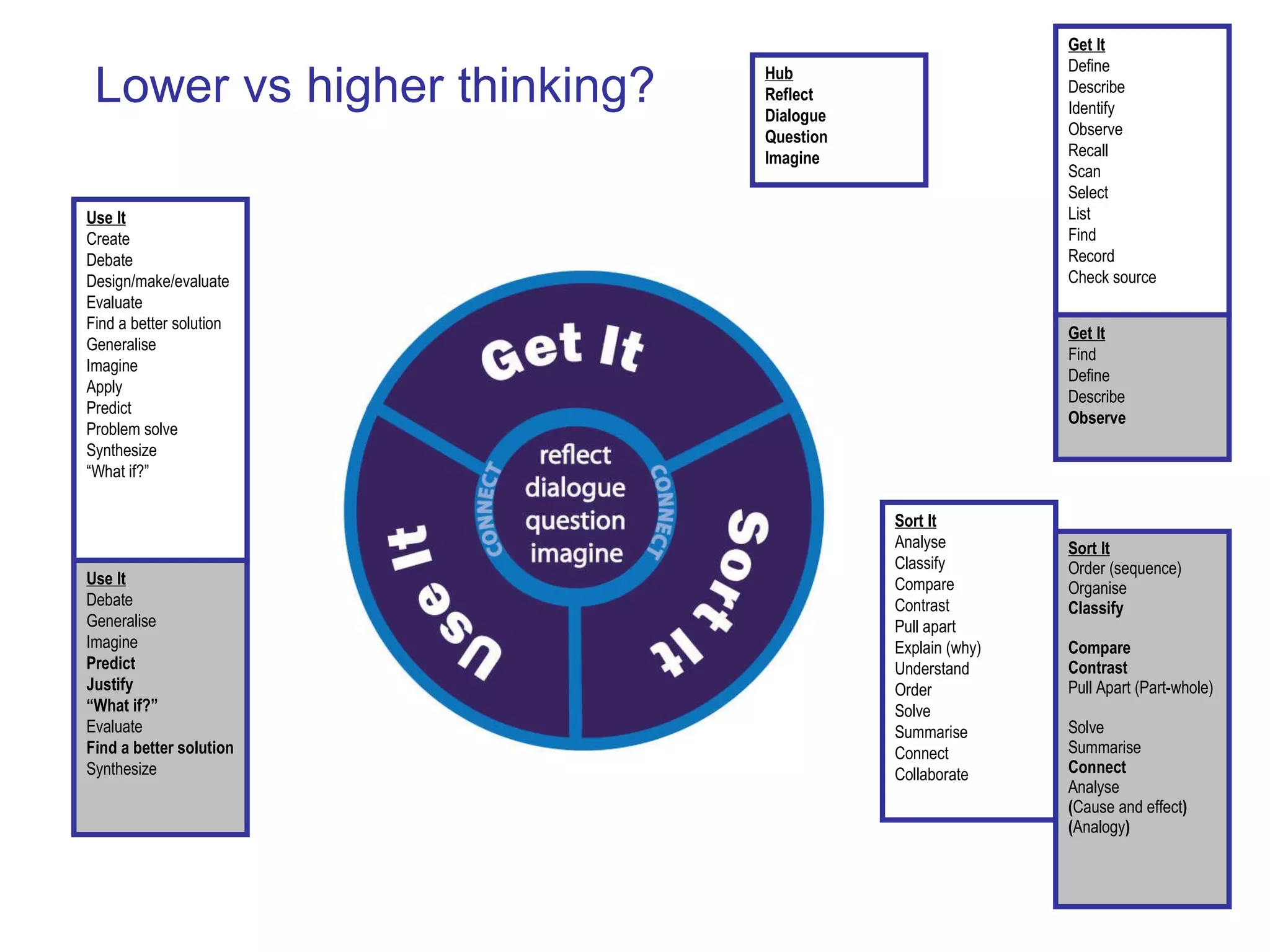
Hub Reflect Dialogue Question Imagine Sort It Analyse Classify Compare Contrast Pull apart Explain (why) Understand Order Solve Summarise Connect Collaborate Sort It Order (sequence) Organise Classify Compare Contrast Pull Apart (Part-whole) Solve Summarise  Connect Analyse ( Cause and effect ) ( Analogy ) Lower vs higher thinking? Get It Define Describe Identify Observe Recall Scan Select List Find Record Check source Get It Find Define Describe Observe Use It Create Debate Design/make/evaluate Evaluate Find a better solution Generalise Imagine Apply Predict Problem solve Synthesize “ What if?” Use It Debate Generalise Imagine Predict Justify “ What if?” Evaluate Find a better solution Synthesize
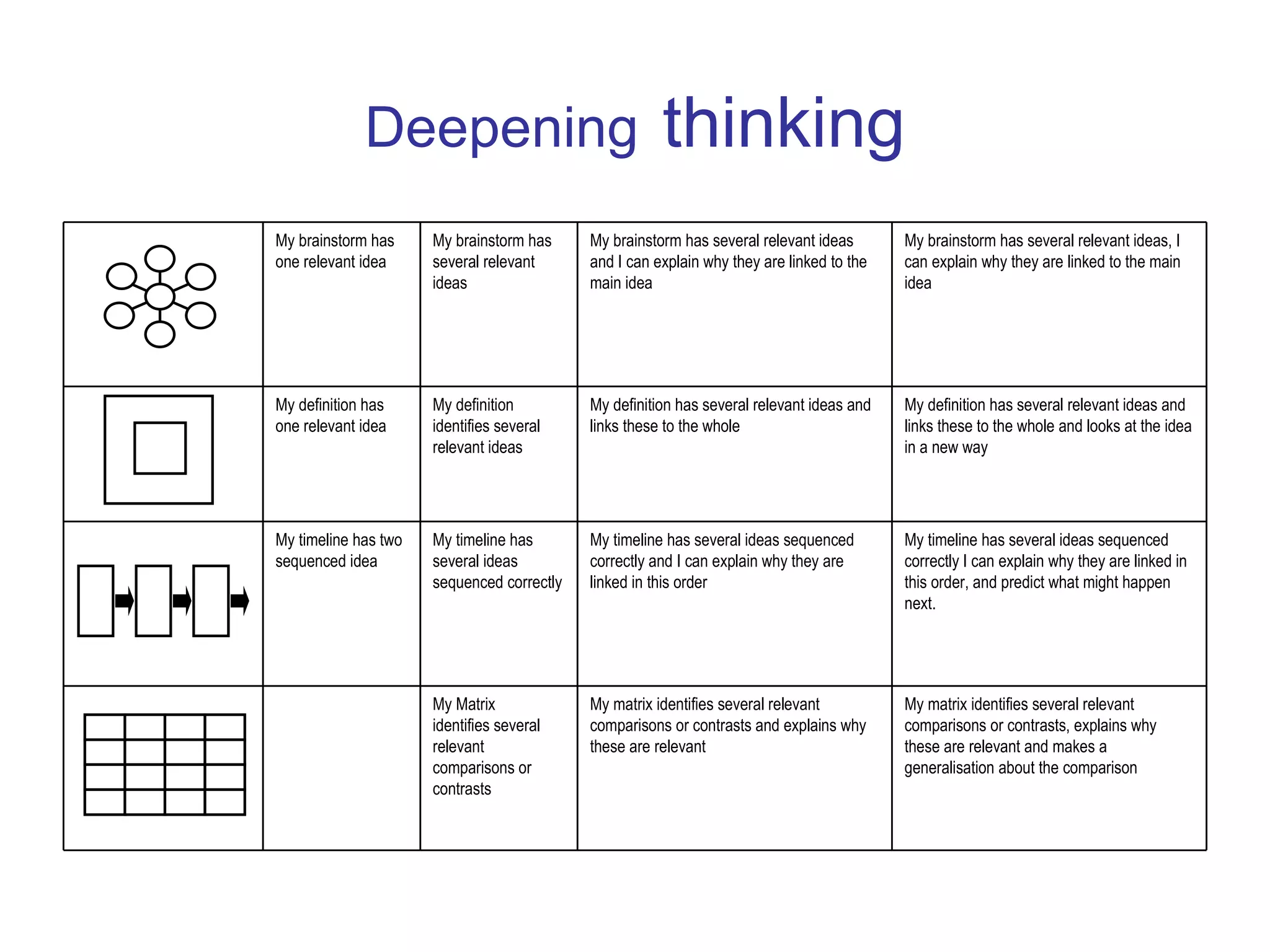
Deepening   thinking My matrix identifies several relevant comparisons or contrasts, explains why these are relevant and makes a generalisation about the comparison  My matrix identifies several relevant comparisons or contrasts and explains why these are relevant My Matrix identifies several relevant comparisons or contrasts My timeline has several ideas sequenced correctly I can explain why they are linked in this order, and predict what might happen next.  My timeline has several ideas sequenced correctly and I can explain why they are linked in this order  My timeline has several ideas sequenced correctly My timeline has two sequenced idea My definition has several relevant ideas and links these to the whole and looks at the idea in a new way My definition has several relevant ideas and links these to the whole My definition identifies several relevant ideas My definition has one relevant idea My brainstorm has several relevant ideas, I can explain why they are linked to the main idea  My brainstorm has several relevant ideas and I can explain why they are linked to the main idea  My brainstorm has several relevant ideas My brainstorm has one relevant idea
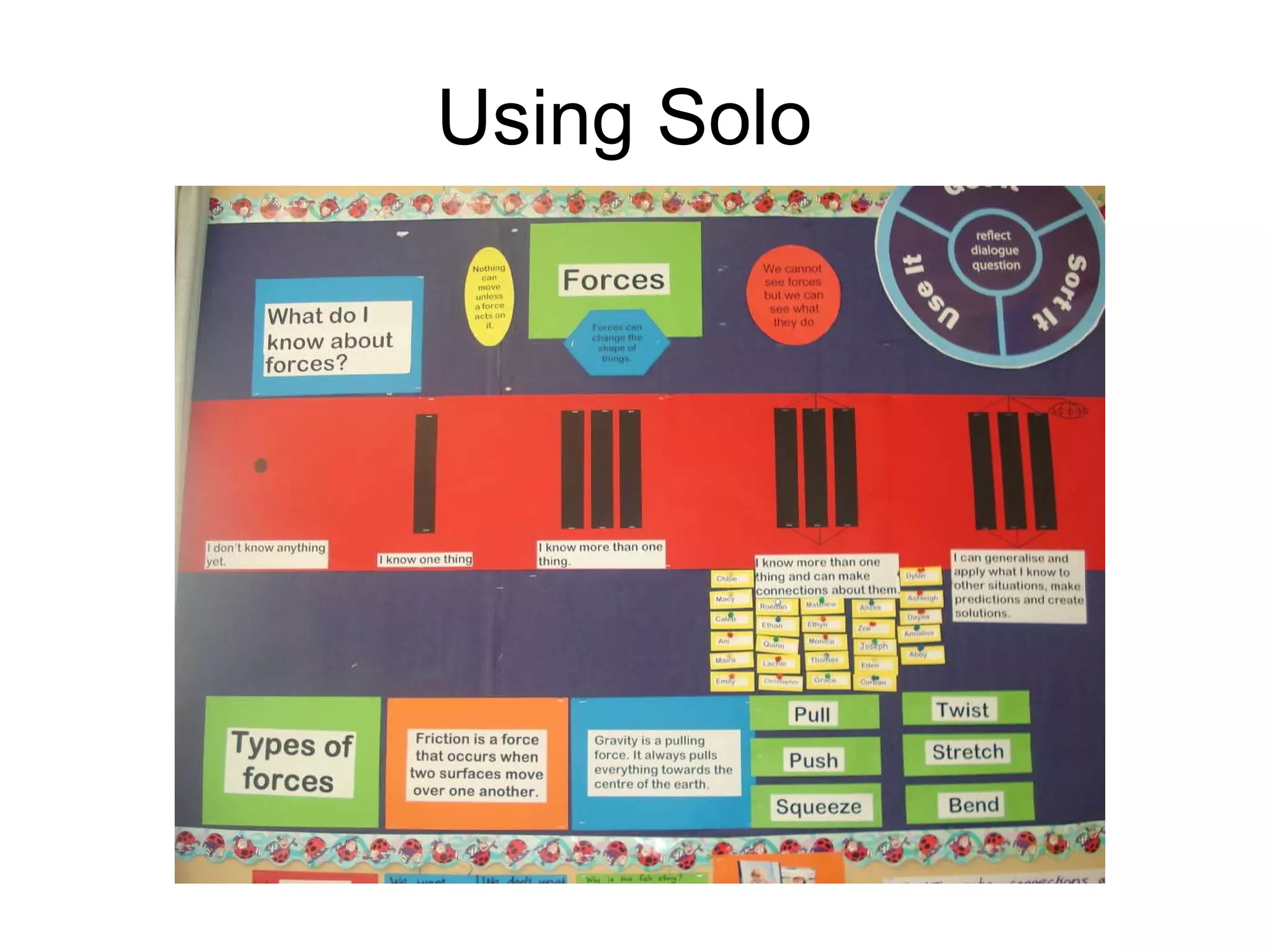
Using Solo
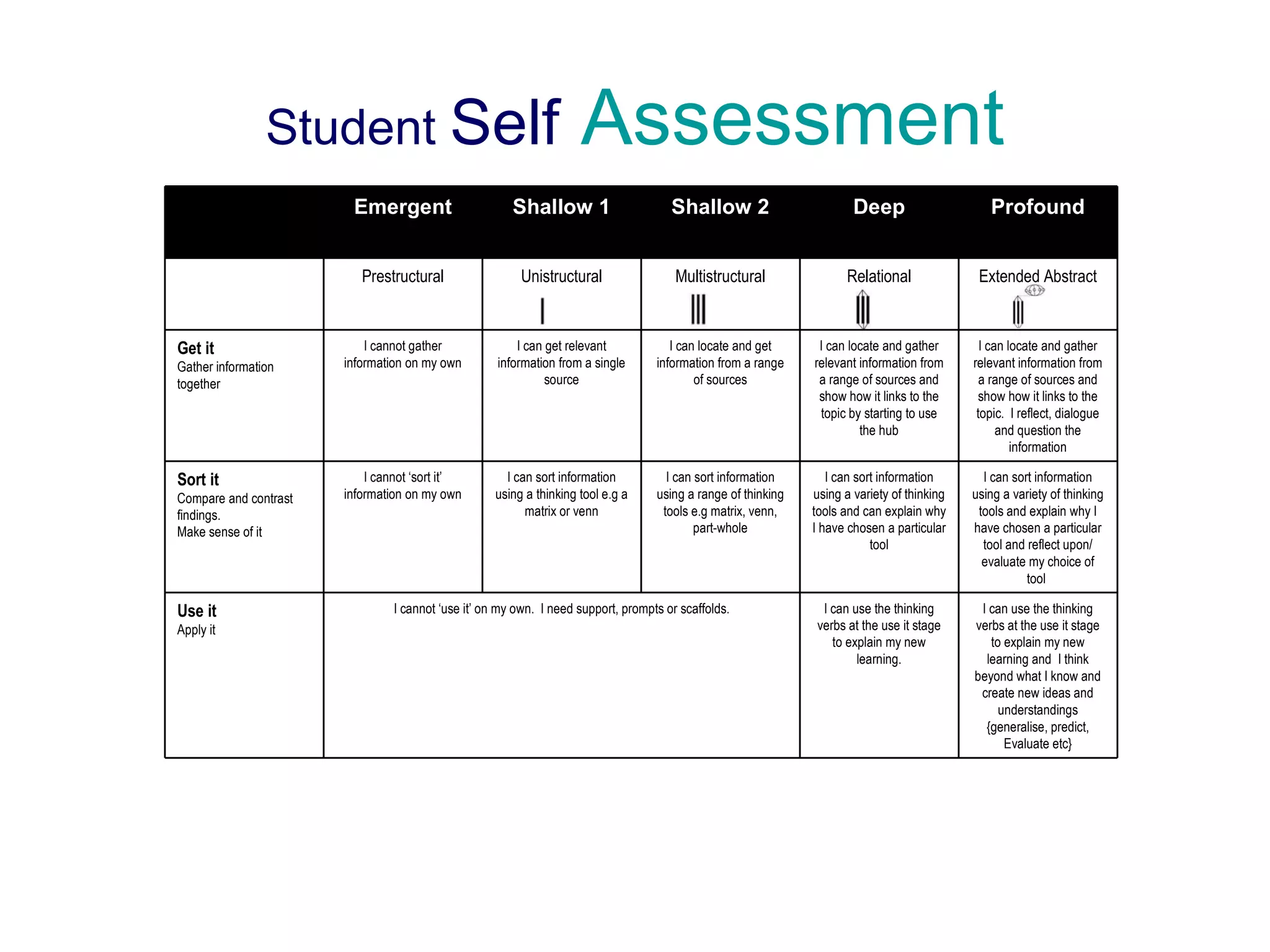
Student  Self   Assessment I can use the thinking verbs at the use it stage to explain my new learning and  I think beyond what I know and create new ideas and understandings {generalise, predict, Evaluate etc} I can use the thinking verbs at the use it stage to explain my new learning. I cannot ‘use it’ on my own.  I need support, prompts or scaffolds. Use it Apply it I can sort information using a variety of thinking tools and explain why I have chosen a particular tool and reflect upon/ evaluate my choice of tool  I can sort information using a variety of thinking tools and can explain why I have chosen a particular tool I can sort information using a range of thinking tools e.g matrix, venn, part-whole I can sort information using a thinking tool e.g a matrix or venn I cannot ‘sort it’ information on my own Sort it Compare and contrast findings. Make sense of it I can locate and gather relevant information from a range of sources and show how it links to the topic.  I reflect, dialogue and question the information I can locate and gather relevant information from a range of sources and show how it links to the topic by starting to use the hub I can locate and get information from a range of sources I can get relevant information from a single source I cannot gather information on my own Get it Gather information together Extended Abstract Relational Multistructural Unistructural Prestructural Profound Deep Shallow 2 Shallow 1 Emergent
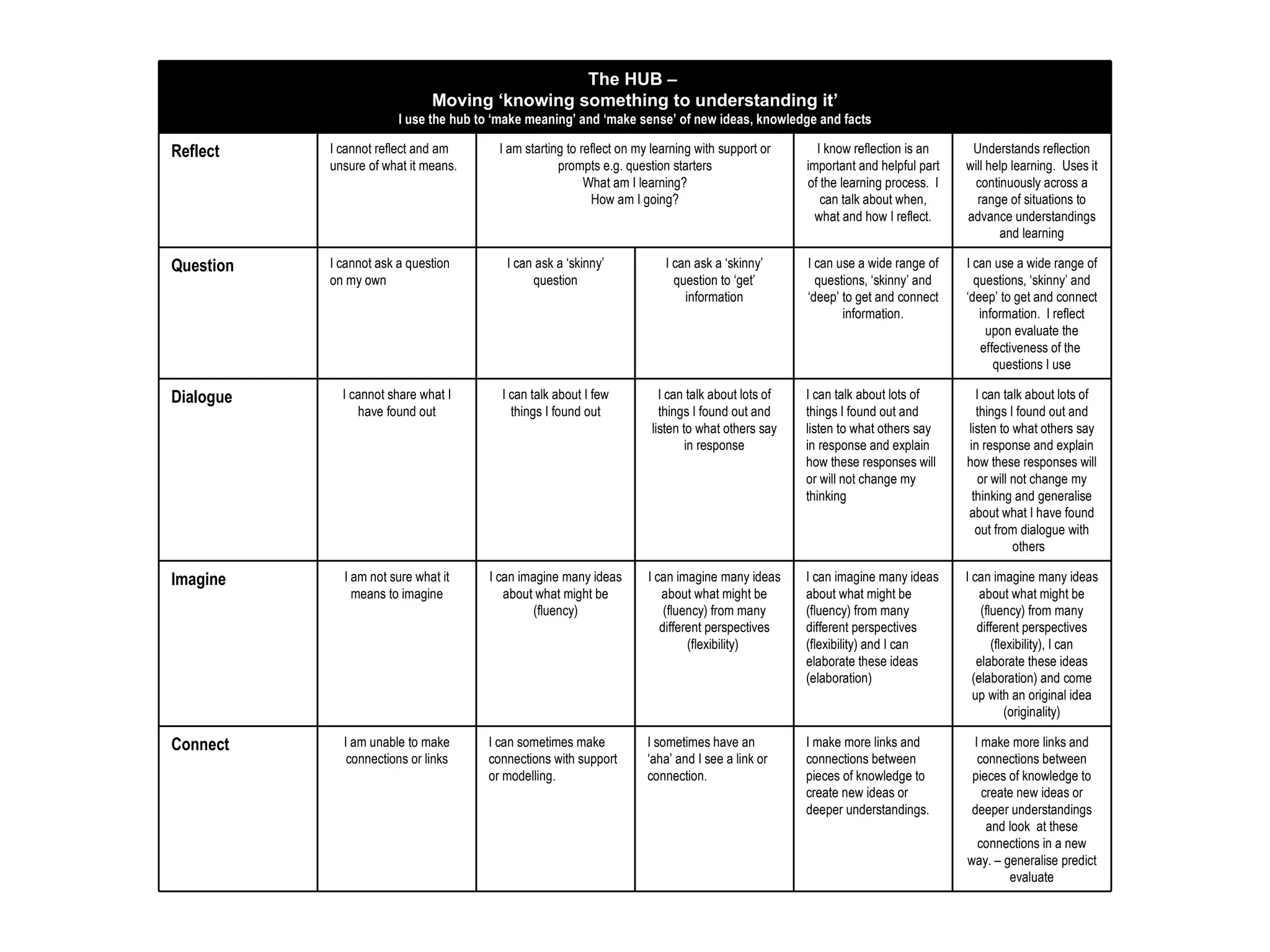
I make more links and connections between pieces of knowledge to create new ideas or deeper understandings and look  at these connections in a new way. – generalise predict evaluate I make more links and connections between pieces of knowledge to create new ideas or deeper understandings. I sometimes have an ‘aha’ and I see a link or connection. I can sometimes make connections with support or modelling. I am unable to make connections or links Connect I can imagine many ideas about what might be (fluency) from many different perspectives (flexibility), I can elaborate these ideas (elaboration) and come up with an original idea (originality) I can imagine many ideas about what might be (fluency) from many different perspectives (flexibility) and I can elaborate these ideas (elaboration) I can imagine many ideas about what might be (fluency) from many different perspectives (flexibility)  I can imagine many ideas about what might be (fluency) I am not sure what it means to imagine Imagine I can talk about lots of things I found out and listen to what others say in response and explain how these responses will or will not change my thinking and generalise about what I have found out from dialogue with others  I can talk about lots of things I found out and listen to what others say in response and explain how these responses will or will not change my thinking  I can talk about lots of things I found out and listen to what others say in response I can talk about I few things I found out I cannot share what I have found out Dialogue I can use a wide range of questions, ‘skinny’ and ‘deep’ to get and connect information.  I reflect upon evaluate the effectiveness of the  questions I use I can use a wide range of questions, ‘skinny’ and ‘deep’ to get and connect information. I can ask a ‘skinny’ question to ‘get’ information I can ask a ‘skinny’ question I cannot ask a question on my own Question Understands reflection will help learning.  Uses it continuously across a range of situations to advance understandings and learning I know reflection is an important and helpful part of the learning process.  I can talk about when, what and how I reflect. I am starting to reflect on my learning with support or prompts e.g. question starters What am I learning? How am I going? I cannot reflect and am unsure of what it means. Reflect The HUB –  Moving ‘knowing something to understanding it’ I use the hub to ‘make meaning’ and ‘make sense’ of new ideas, knowledge and facts
Learning  Intentions I am learning … where the Powerful Learning Process fits in the big picture why/how the Powerful Learning Process evolved. how thinking is embedded as part of the Powerful Learning Process and can be activated at different levels How are learners (teachers and students) supported in the development of PL?
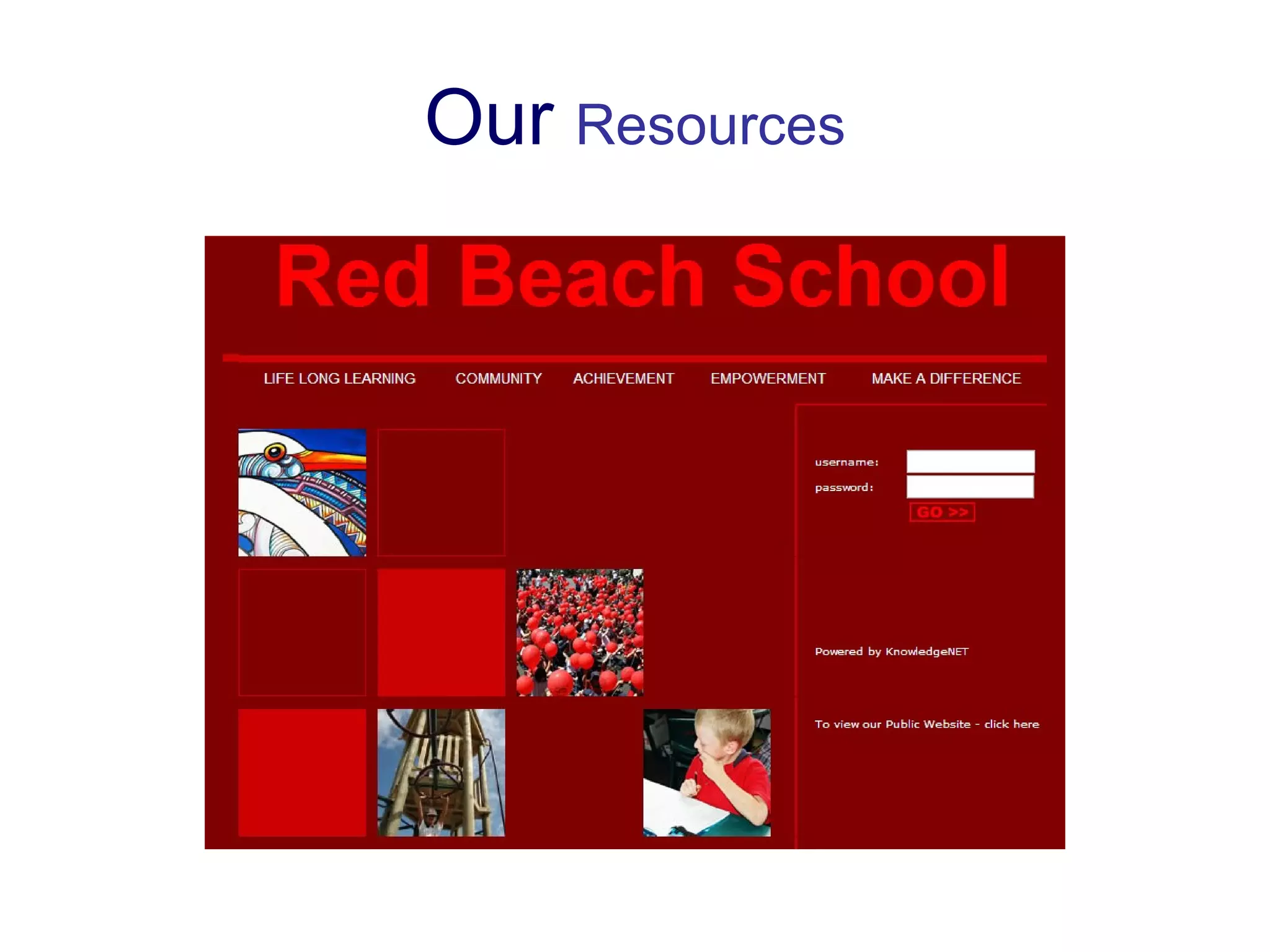
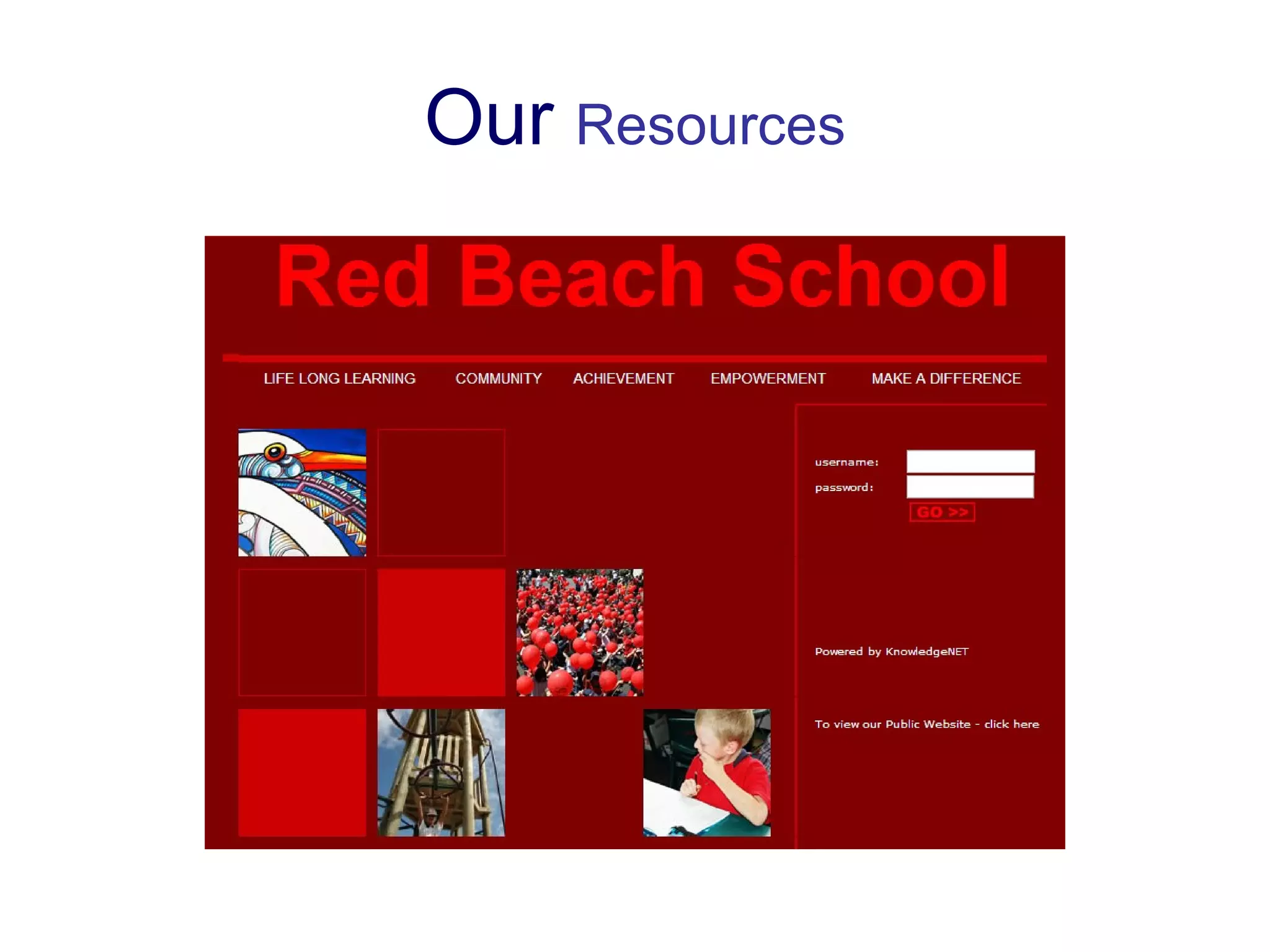
Our   Resources
Where to from here? Continue to experiment and use PL in all curriculum areas Dialogue whether we use the term Powerful Learning correctly Deepen depth of thinking  Further develop student self assessment in PL Exemplify use of process out of school context Parent education  Continue to expand Teacher and Student resource on KN
Promoting  Depth  of  Learning   Time  to get  Practical Workshop and Discussion Tawa ICT Cluster Jan 2010
Workshop  Intentions to clarify any questions, wonderings, thoughts, areas you would like expanded from the previous session. to encourage you to reflect on current practice to begin to think about and intentionally design learning experiences for students that activate deep and engaging thinking and learning.
Take a moment to record your questions and wonderings from this morning?
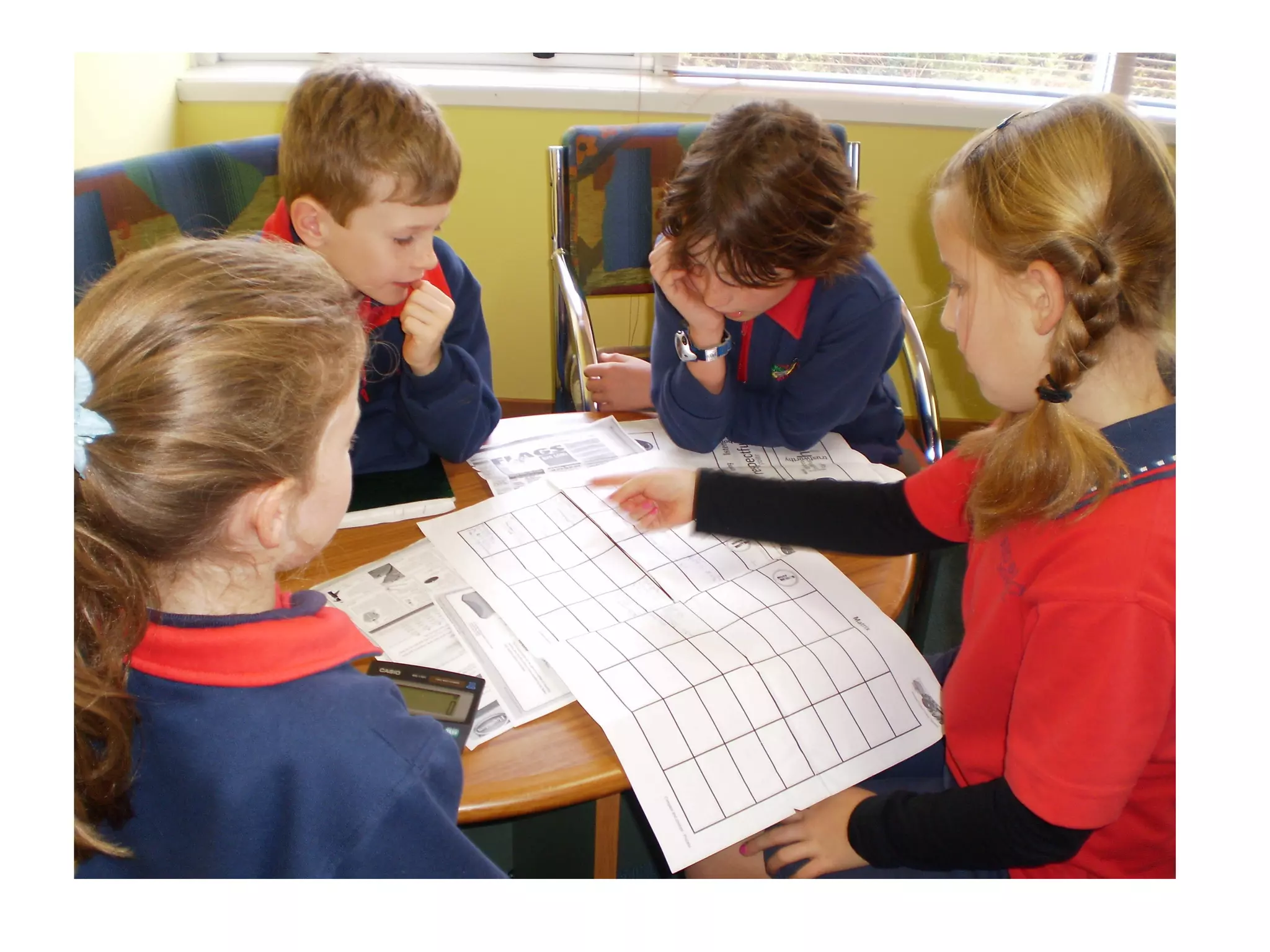
Warming up - Have a Think How do you currently design learning so that it promotes deep engaging learning and thinking? In Maths? Reading? Key competency? Break into groups of 4 and share an example of a task that you feel extended and stretched students thinking?
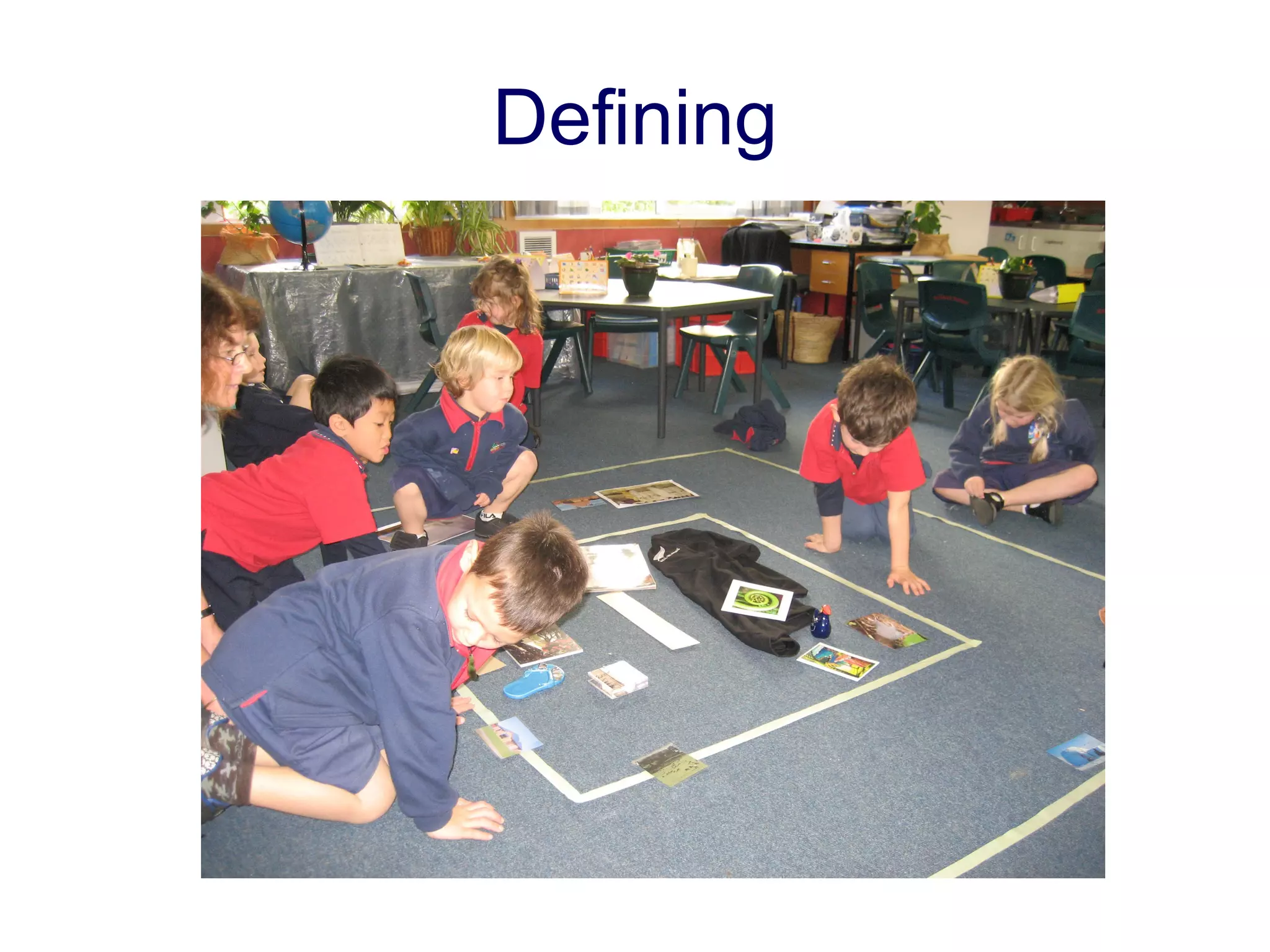
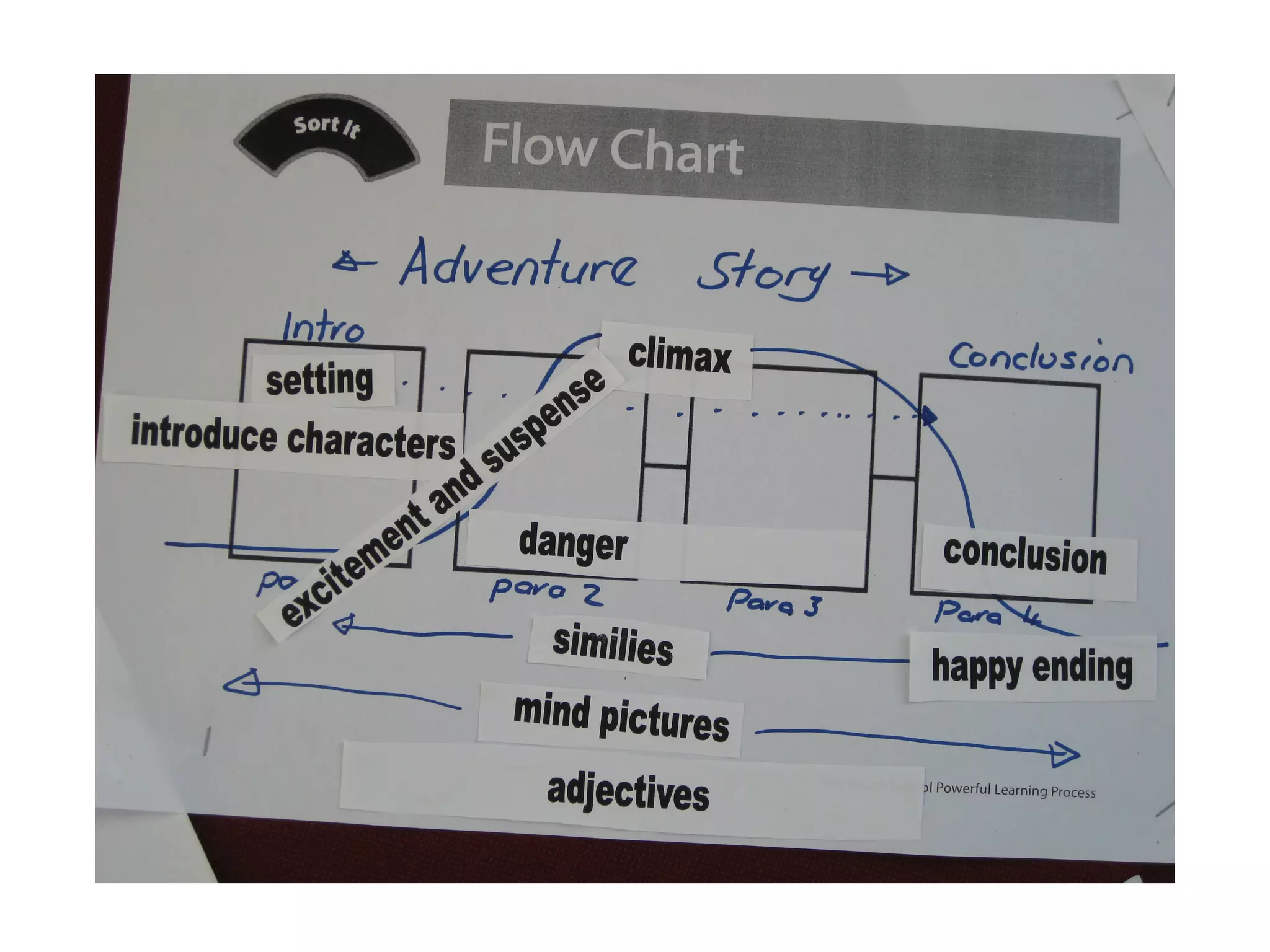
Defining
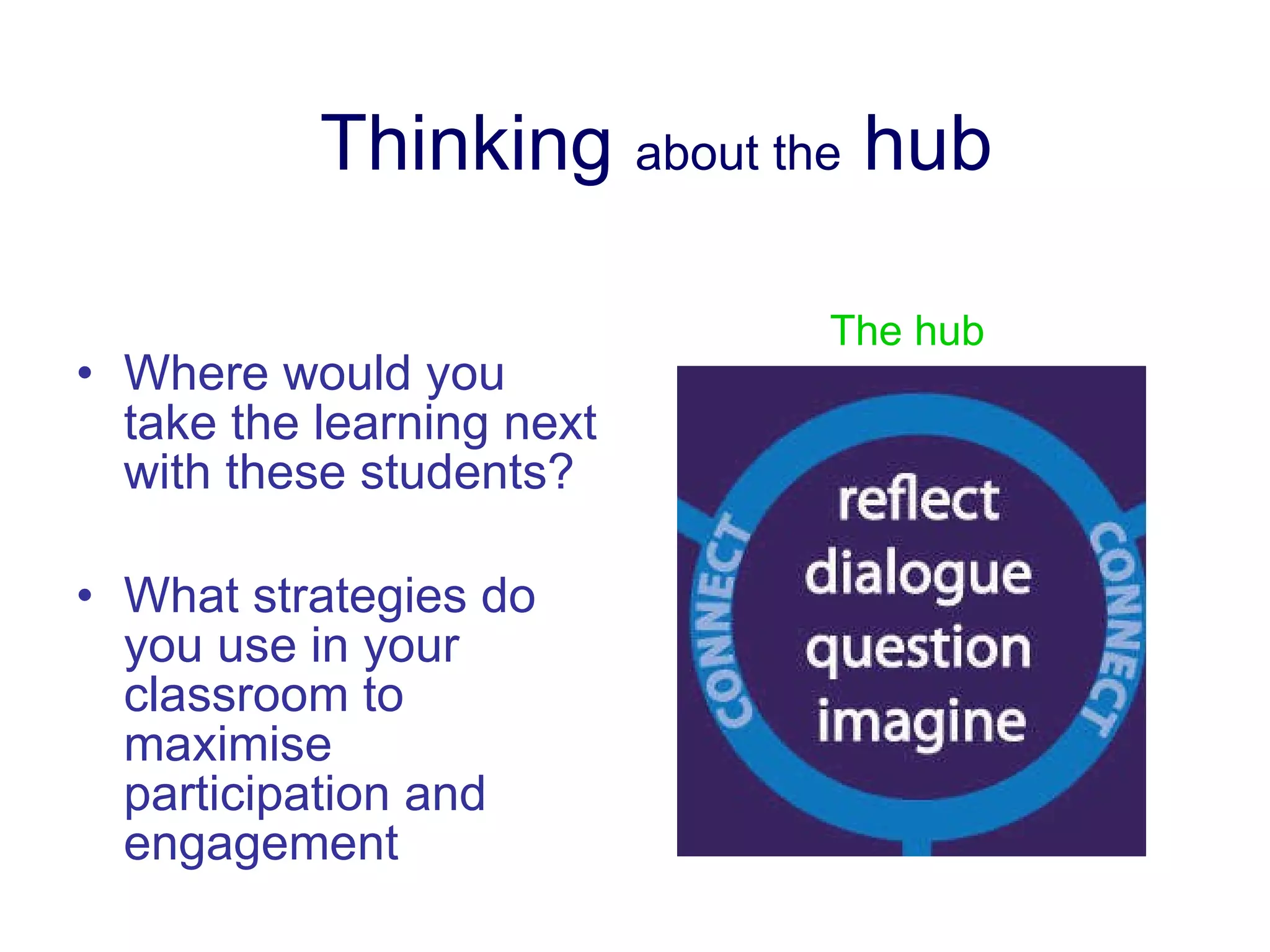
Thinking  about the  hub Where would you take the learning next with these students? What strategies do you use in your classroom to maximise participation and engagement The hub
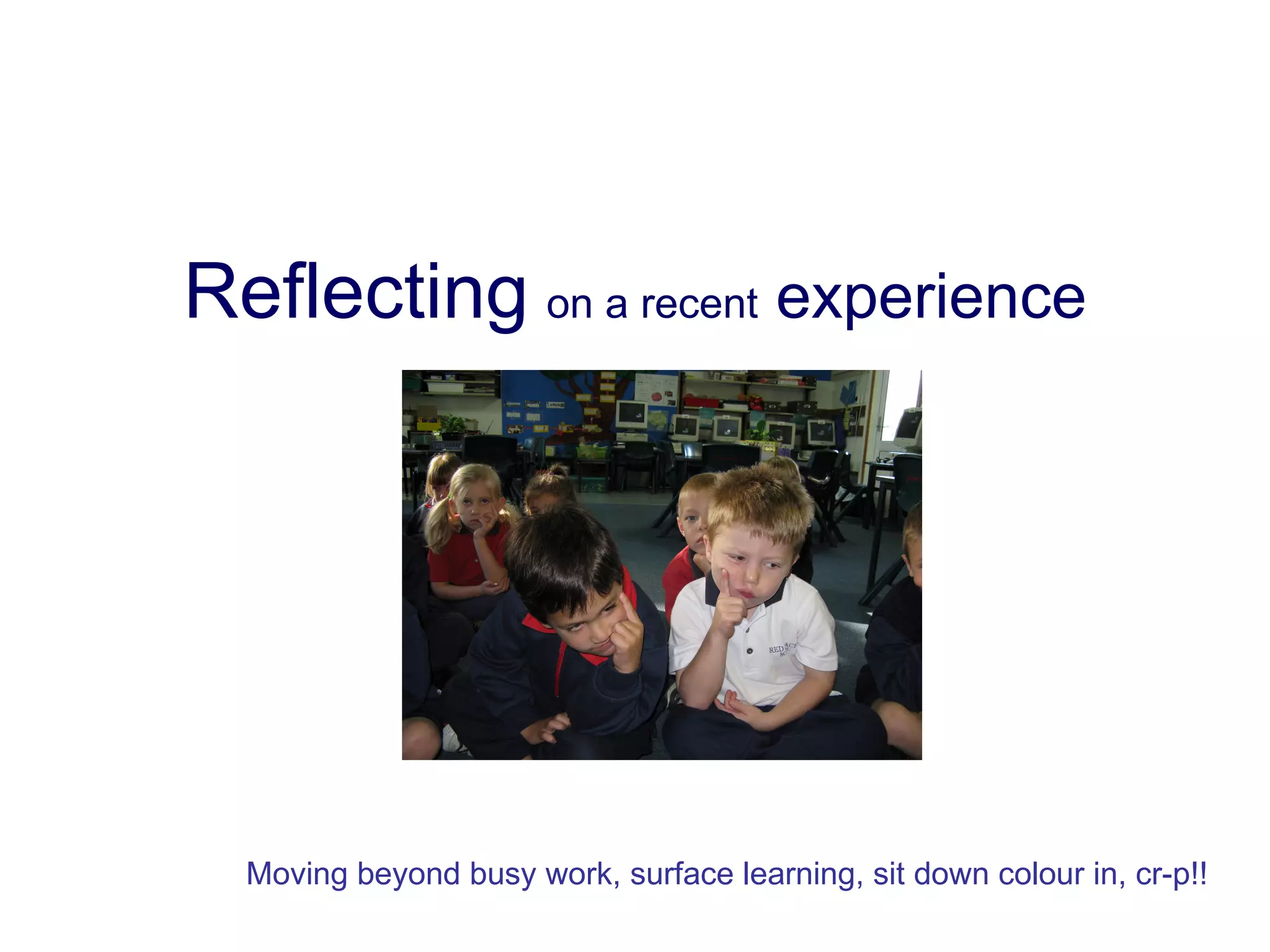
Reflecting   on a recent  experience Moving beyond busy work, surface learning, sit down colour in, cr-p!!
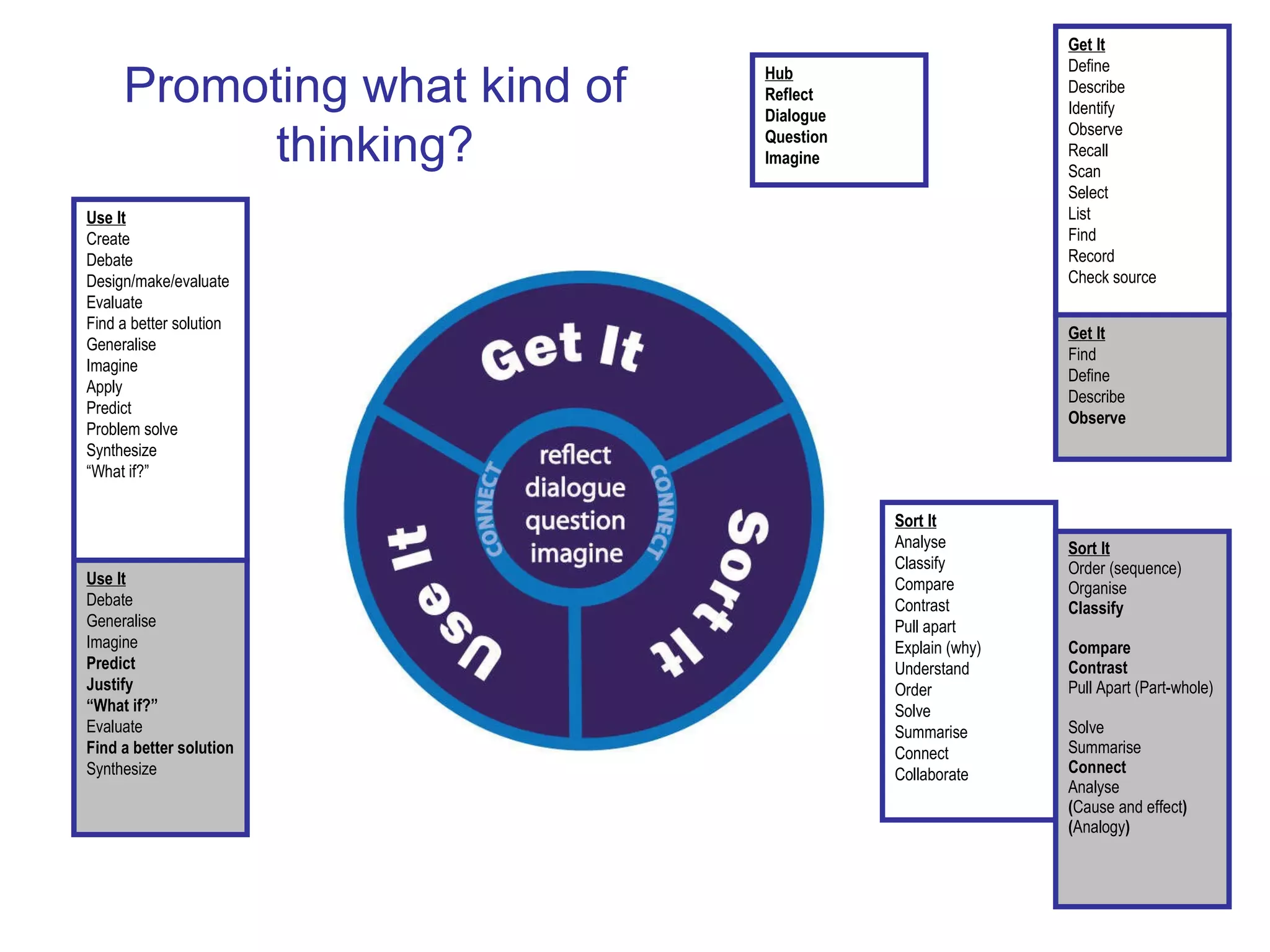
Hub Reflect Dialogue Question Imagine Sort It Analyse Classify Compare Contrast Pull apart Explain (why) Understand Order Solve Summarise Connect Collaborate Sort It Order (sequence) Organise Classify Compare Contrast Pull Apart (Part-whole) Solve Summarise  Connect Analyse ( Cause and effect ) ( Analogy ) Promoting what kind of thinking? Get It Define Describe Identify Observe Recall Scan Select List Find Record Check source Get It Find Define Describe Observe Use It Create Debate Design/make/evaluate Evaluate Find a better solution Generalise Imagine Apply Predict Problem solve Synthesize “ What if?” Use It Debate Generalise Imagine Predict Justify “ What if?” Evaluate Find a better solution Synthesize
Scenario Take a reading lesson for example – students are working independently of the teacher – what learning experience could they be involved in that encourages learners to engage in ‘Sort it’ or ‘Use it’ thinking?


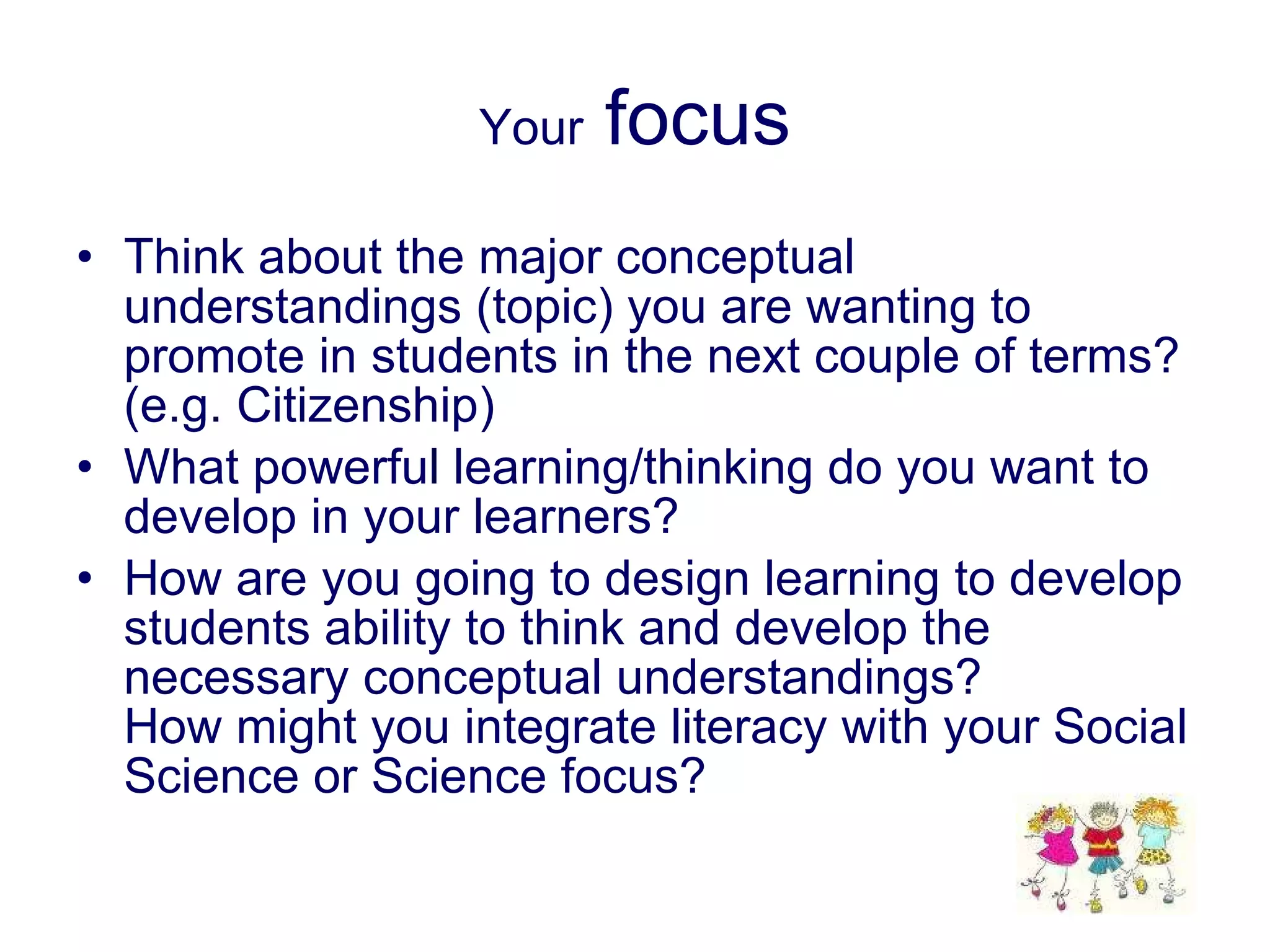
Your  focus Think about the major conceptual understandings (topic) you are wanting to promote in students in the next couple of terms? (e.g. Citizenship) What powerful learning/thinking do you want to develop in your learners? How are you going to design learning to develop students ability to think and develop the necessary conceptual understandings? How might you integrate literacy with your Social Science or Science focus?
Designing  Learning Get it (Input) Sort it (process) Use it (Output) Less is more - what will you go deep with?
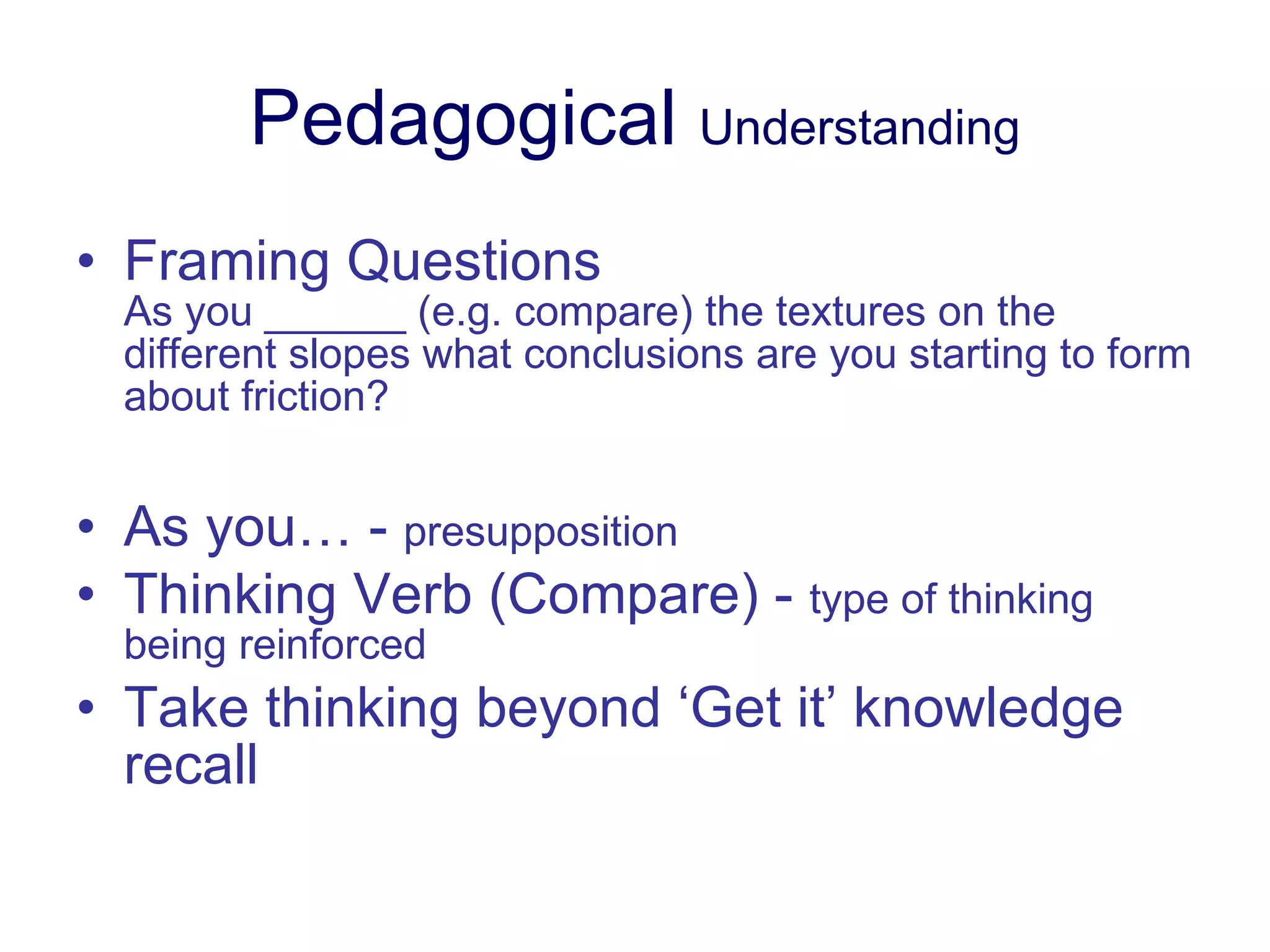
Pedagogical  Understanding Framing Questions As you ______ (e.g. compare) the textures on the different slopes what conclusions are you starting to form about friction? As you… -  presupposition Thinking Verb (Compare) -  type of thinking being reinforced Take thinking beyond ‘Get it’ knowledge recall
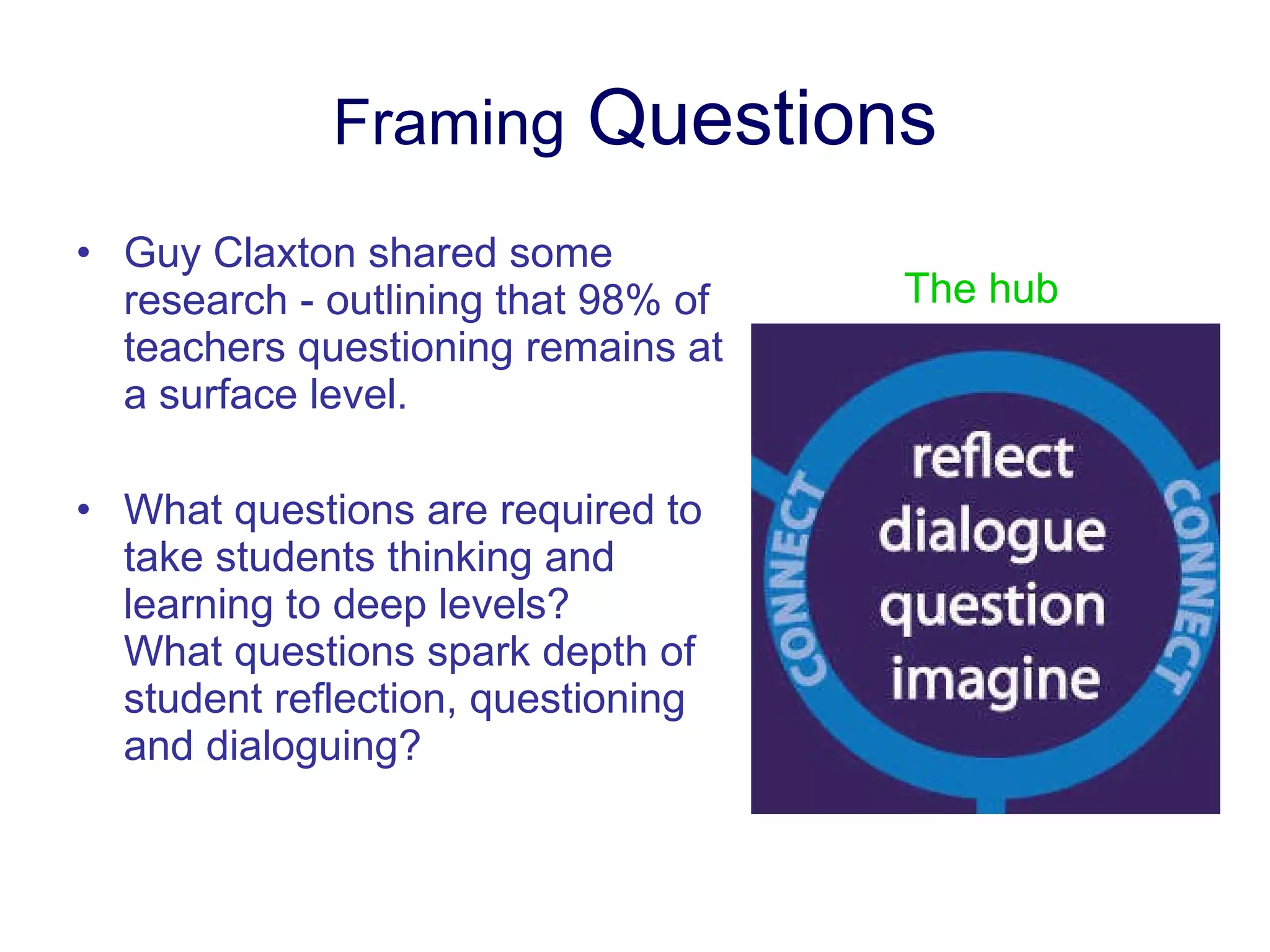
Framing  Questions Guy Claxton shared some research - outlining that 98% of teachers questioning remains at a surface level. What questions are required to take students thinking and learning to deep levels?  What questions spark depth of student reflection, questioning and dialoguing? The hub
Our   Resources

Powerful Learning Presentation

  • 1.
    Promoting Deep Learning & Thinking the development of a Powerful Learning Process ...a glimpse of one school’s Journey Online Bridges ICT Cluster Jan 2010
  • 2.
    our Powerful Learning Process
  • 3.
    Agenda -Learning Intentions To learn … where the RBS Powerful Learning Process fits in the big picture why/how the Powerful Learning Process evolved. how thinking is embedded as part of the Powerful Learning Process and can be activated at different levels How are learners (teachers and students) supported in the development of PL?
  • 4.
  • 5.
    Imagine the learners world like this So What – to make a difference It – has lots of knowledge, understandings and concepts to explore We – situated in a community I – learner sits at the centre
  • 6.
    Key competencies ? Connecting to the NZ Curriculum So What – applying key competencies meaningfully It – Using symbols, language and texts Thinking We – relating to others Participating and contributing I – Managing self
  • 7.
    The thinking required in such a world ? So What – design, problem solve, innovate and create the unknown It – Thinking with, in and about knowledge and understandings We – Caring thinking, emotional intelligence I – Metacognition, thinking about my thinking
  • 8.
  • 9.
    Change Fundamental – Creating a vision Ensuring the vision lives
  • 10.
    3 Keys to Change - Keeping it Simple Vision - Collective direction and purpose Student Profile- What will the student leave the school being able to do as a result of the vision principles Teaching Practice – What pedagogical practices are required to ensure that each student will leave after 6 years as the profile outlines
  • 11.
    Student ProfileStudent voice
  • 12.
    Detailed StudentProfile Concepts and Competencies
  • 13.
  • 14.
    How am Igoing? Where am I going? Where to next?
  • 15.
    Align Practice with Belief
  • 16.
    Powerful Learning wherein the big picture does it fit?
  • 17.
    RBS Vision PowerfulLearning Developed to help learners deal with the ‘IT’ thinking - that is to make sense of and deal with a multitude of knowledge and understandings
  • 18.
    Learning IntentionsI am learning … where the Powerful Learning Process fits in the big picture why /how the Powerful Learning Process evolved. how thinking is embedded as part of the Powerful Learning Process and can be activated at different levels How are learners (teachers and students) supported in the development of PL?
  • 19.
  • 20.
    There are noeasy answers to future problems. Art Costa
  • 21.
    One of thecore functions of 21st century education is learning to learn in preparation for a lifetime of change. David Miliband, 2003
  • 22.
    We need toproduce people who know how to act when they are faced with situations for which they were not specifically prepared. Seymour Papert, 1998
  • 23.
    Learning IntentionsI am learning … where the Powerful Learning Process fits in the big picture why/ how the Powerful Learning Process evolved. how thinking is embedded as part of the Powerful Learning Process and can be activated at different levels How are learners (teachers and students) supported in the development of PL?
  • 24.
    Unpacked LLL Embed/AbandonVision What does the teaching practice look like? 05 05 Interviewing students Strategic direction Student profile clarity Using images Collective AFL Context PL lead teachers 07 Power of student voice Inquiry team 06 08 Lead teachers continued with PL Science Split screen thinking One process not linear Being selective – thinking tools Thinking embedded Based on Solo same as NCEA More than inquiry Cross curricular Creating a shared language 09 PL school wide focus Going deep – using the hub Our Audience PL Pedagogical understanding Change influences Change fundamentals Our steps Ahas
  • 25.
    The test ofsuccessful education is not the amount of knowledge that pupils take away from school, but their appetite to think, know and their capacity to learn. Sir Richard Livingstone, 1941
  • 26.
    Pedagogy should atits best be about what teachers do that not only helps students to learn but actively strengthens their capacity to think and learn David Hargreaves, 2004
  • 27.
    To survive , thrive and learn successfully in the predicted future one needs to be able to think!
  • 28.
    Take a minuteto share with the people sitting next to you what tools, strategies, techniques you use in the classroom to promote thinking.
  • 29.
  • 30.
    Thinking – What’s out there? Caring, Critical, Creative Michael Pohl Emotional Intelligence Coleman Habits of Mind Art Costa Learning muscles Guy Claxton Thinking Maps David Heryle Organisers Venn Double Bubble T-chart Matrix Define square Part-whole Analysis Sequence Association Thinking Hats De Bono Multiple Intelligences Gardener Whole Brain Thinking Hermann Learning to Learn Thinkers Keys Tony Ryan Questioning Toolkit Jamie MacKenzie Creative Thinking Scamper BAR SCORT Attribute Modification Bloom’s Taxonomy 3 story Intellect Solo Taxonomy Anderson’s Revised Bloom’s Wiederhold’s Questions Matrix (1991) Inspiration Kidspiration Strategies KWHL Think Pair Share Donut 5 senses PMI SWOT Y chart Brainstorming Extended brainstorming Short, long term memory Brain Theory How the brain learns Sensory, auditory, kinesthetic Mapping Memorising Visualising Philosophy for kids
  • 31.
    What should one cling on to ? Where to start ?
  • 32.
    Learning IntentionsI am learning … where the Powerful Learning Process fits in the big picture why/how the Powerful Learning Process evolved. how thinking is embedded as part of the Powerful Learning Process and can be activated at different levels How are learners (teachers and students) supported in the development of PL?
  • 33.
    Hub Reflect DialogueQuestion Imagine Sort It Analyse Classify Compare Contrast Pull apart Explain (why) Understand Order Solve Summarise Connect Collaborate Sort It Order (sequence) Organise Classify Compare Contrast Pull Apart (Part-whole) Solve Summarise Connect Analyse ( Cause and effect ) ( Analogy ) Where does the thinking fit? Get It Define Describe Identify Observe Recall Scan Select List Find Record Check source Get It Find Define Describe Observe Use It Create Debate Design/make/evaluate Evaluate Find a better solution Generalise Imagine Apply Predict Problem solve Synthesize “ What if?” Use It Debate Generalise Imagine Predict Justify “ What if?” Evaluate Find a better solution Synthesize Being selective Solo embedded
  • 34.
    Being selective Thinking skills Thinking tools Thinking strategies
  • 35.
    Shared language Kid friendly Not Linear
  • 36.
  • 37.
    Cross Curricular More than inquiry Pedagogical Understanding
  • 38.
    What do youunderstand by the phrase More than Inquiry?
  • 39.
    Gather it, findit, observe it, describe it, experience it Make sense of it, organise it, analyse it, classify it, compare it Apply it, make use of it, generalise How does it look in Practice ? Rm 2 - Year 1
  • 40.
    Moving knowing to understanding The hub is central to deepening knowledge As much time should be spent reflecting, imagining, questioning and dialoguing about a learning experience as was spent doing the actual learning experience We must move away from a hoop hopping mentality of doing a whole lot of activities one after the other. Dialogue clip rm 15 The hub
  • 41.
    Shift in ThinkingDeveloping Progressions Key Competencies – showing growth Acknowledging Complexity of Learner, not linear Shallow, Deep, Profound – John West Burnham Motivating Learners Answering How am I going? Where am I going? Where to next?
  • 42.
  • 43.
    Where areour students on the progression ?
  • 44.
    Is there ahierarchy of thinking?
  • 45.
    Hub Reflect DialogueQuestion Imagine Sort It Analyse Classify Compare Contrast Pull apart Explain (why) Understand Order Solve Summarise Connect Collaborate Sort It Order (sequence) Organise Classify Compare Contrast Pull Apart (Part-whole) Solve Summarise Connect Analyse ( Cause and effect ) ( Analogy ) Lower vs higher thinking? Get It Define Describe Identify Observe Recall Scan Select List Find Record Check source Get It Find Define Describe Observe Use It Create Debate Design/make/evaluate Evaluate Find a better solution Generalise Imagine Apply Predict Problem solve Synthesize “ What if?” Use It Debate Generalise Imagine Predict Justify “ What if?” Evaluate Find a better solution Synthesize
  • 46.
    Deepening thinking My matrix identifies several relevant comparisons or contrasts, explains why these are relevant and makes a generalisation about the comparison My matrix identifies several relevant comparisons or contrasts and explains why these are relevant My Matrix identifies several relevant comparisons or contrasts My timeline has several ideas sequenced correctly I can explain why they are linked in this order, and predict what might happen next. My timeline has several ideas sequenced correctly and I can explain why they are linked in this order My timeline has several ideas sequenced correctly My timeline has two sequenced idea My definition has several relevant ideas and links these to the whole and looks at the idea in a new way My definition has several relevant ideas and links these to the whole My definition identifies several relevant ideas My definition has one relevant idea My brainstorm has several relevant ideas, I can explain why they are linked to the main idea My brainstorm has several relevant ideas and I can explain why they are linked to the main idea My brainstorm has several relevant ideas My brainstorm has one relevant idea
  • 47.
  • 48.
    Student Self Assessment I can use the thinking verbs at the use it stage to explain my new learning and I think beyond what I know and create new ideas and understandings {generalise, predict, Evaluate etc} I can use the thinking verbs at the use it stage to explain my new learning. I cannot ‘use it’ on my own. I need support, prompts or scaffolds. Use it Apply it I can sort information using a variety of thinking tools and explain why I have chosen a particular tool and reflect upon/ evaluate my choice of tool I can sort information using a variety of thinking tools and can explain why I have chosen a particular tool I can sort information using a range of thinking tools e.g matrix, venn, part-whole I can sort information using a thinking tool e.g a matrix or venn I cannot ‘sort it’ information on my own Sort it Compare and contrast findings. Make sense of it I can locate and gather relevant information from a range of sources and show how it links to the topic. I reflect, dialogue and question the information I can locate and gather relevant information from a range of sources and show how it links to the topic by starting to use the hub I can locate and get information from a range of sources I can get relevant information from a single source I cannot gather information on my own Get it Gather information together Extended Abstract Relational Multistructural Unistructural Prestructural Profound Deep Shallow 2 Shallow 1 Emergent
  • 49.
    I make morelinks and connections between pieces of knowledge to create new ideas or deeper understandings and look at these connections in a new way. – generalise predict evaluate I make more links and connections between pieces of knowledge to create new ideas or deeper understandings. I sometimes have an ‘aha’ and I see a link or connection. I can sometimes make connections with support or modelling. I am unable to make connections or links Connect I can imagine many ideas about what might be (fluency) from many different perspectives (flexibility), I can elaborate these ideas (elaboration) and come up with an original idea (originality) I can imagine many ideas about what might be (fluency) from many different perspectives (flexibility) and I can elaborate these ideas (elaboration) I can imagine many ideas about what might be (fluency) from many different perspectives (flexibility) I can imagine many ideas about what might be (fluency) I am not sure what it means to imagine Imagine I can talk about lots of things I found out and listen to what others say in response and explain how these responses will or will not change my thinking and generalise about what I have found out from dialogue with others I can talk about lots of things I found out and listen to what others say in response and explain how these responses will or will not change my thinking I can talk about lots of things I found out and listen to what others say in response I can talk about I few things I found out I cannot share what I have found out Dialogue I can use a wide range of questions, ‘skinny’ and ‘deep’ to get and connect information. I reflect upon evaluate the effectiveness of the questions I use I can use a wide range of questions, ‘skinny’ and ‘deep’ to get and connect information. I can ask a ‘skinny’ question to ‘get’ information I can ask a ‘skinny’ question I cannot ask a question on my own Question Understands reflection will help learning. Uses it continuously across a range of situations to advance understandings and learning I know reflection is an important and helpful part of the learning process. I can talk about when, what and how I reflect. I am starting to reflect on my learning with support or prompts e.g. question starters What am I learning? How am I going? I cannot reflect and am unsure of what it means. Reflect The HUB – Moving ‘knowing something to understanding it’ I use the hub to ‘make meaning’ and ‘make sense’ of new ideas, knowledge and facts
  • 50.
    Learning IntentionsI am learning … where the Powerful Learning Process fits in the big picture why/how the Powerful Learning Process evolved. how thinking is embedded as part of the Powerful Learning Process and can be activated at different levels How are learners (teachers and students) supported in the development of PL?
  • 51.
    Our Resources
  • 52.
    Where to fromhere? Continue to experiment and use PL in all curriculum areas Dialogue whether we use the term Powerful Learning correctly Deepen depth of thinking Further develop student self assessment in PL Exemplify use of process out of school context Parent education Continue to expand Teacher and Student resource on KN
  • 53.
    Promoting Depth of Learning Time to get Practical Workshop and Discussion Tawa ICT Cluster Jan 2010
  • 54.
    Workshop Intentionsto clarify any questions, wonderings, thoughts, areas you would like expanded from the previous session. to encourage you to reflect on current practice to begin to think about and intentionally design learning experiences for students that activate deep and engaging thinking and learning.
  • 55.
    Take a momentto record your questions and wonderings from this morning?
  • 56.
    Warming up -Have a Think How do you currently design learning so that it promotes deep engaging learning and thinking? In Maths? Reading? Key competency? Break into groups of 4 and share an example of a task that you feel extended and stretched students thinking?
  • 57.
  • 58.
    Thinking aboutthe hub Where would you take the learning next with these students? What strategies do you use in your classroom to maximise participation and engagement The hub
  • 59.
    Reflecting on a recent experience Moving beyond busy work, surface learning, sit down colour in, cr-p!!
  • 60.
    Hub Reflect DialogueQuestion Imagine Sort It Analyse Classify Compare Contrast Pull apart Explain (why) Understand Order Solve Summarise Connect Collaborate Sort It Order (sequence) Organise Classify Compare Contrast Pull Apart (Part-whole) Solve Summarise Connect Analyse ( Cause and effect ) ( Analogy ) Promoting what kind of thinking? Get It Define Describe Identify Observe Recall Scan Select List Find Record Check source Get It Find Define Describe Observe Use It Create Debate Design/make/evaluate Evaluate Find a better solution Generalise Imagine Apply Predict Problem solve Synthesize “ What if?” Use It Debate Generalise Imagine Predict Justify “ What if?” Evaluate Find a better solution Synthesize
  • 61.
    Scenario Take areading lesson for example – students are working independently of the teacher – what learning experience could they be involved in that encourages learners to engage in ‘Sort it’ or ‘Use it’ thinking?
  • 62.
  • 63.
  • 64.
  • 65.
  • 66.
  • 67.
    Your focusThink about the major conceptual understandings (topic) you are wanting to promote in students in the next couple of terms? (e.g. Citizenship) What powerful learning/thinking do you want to develop in your learners? How are you going to design learning to develop students ability to think and develop the necessary conceptual understandings? How might you integrate literacy with your Social Science or Science focus?
  • 68.
    Designing LearningGet it (Input) Sort it (process) Use it (Output) Less is more - what will you go deep with?
  • 69.
    Pedagogical UnderstandingFraming Questions As you ______ (e.g. compare) the textures on the different slopes what conclusions are you starting to form about friction? As you… - presupposition Thinking Verb (Compare) - type of thinking being reinforced Take thinking beyond ‘Get it’ knowledge recall
  • 70.
    Framing QuestionsGuy Claxton shared some research - outlining that 98% of teachers questioning remains at a surface level. What questions are required to take students thinking and learning to deep levels? What questions spark depth of student reflection, questioning and dialoguing? The hub
  • 71.
    Our Resources

Editor's Notes

  • #8 This frame helps to think about the thinking
  • #9 Show how I, we, it Make a Difference is embedded in the vision principles
  • #11 Futuristic verses traditional
  • #28 Future predictions indicate the need to be flexible and creative thinkers Importantly thinking is one of the 5 key competencies