Angelo Baggini, angelo.baggini@unibg.it, Bergamo University - Engineering Department
Via Marconi 5, 24044 Dalmine (BG) – Italy
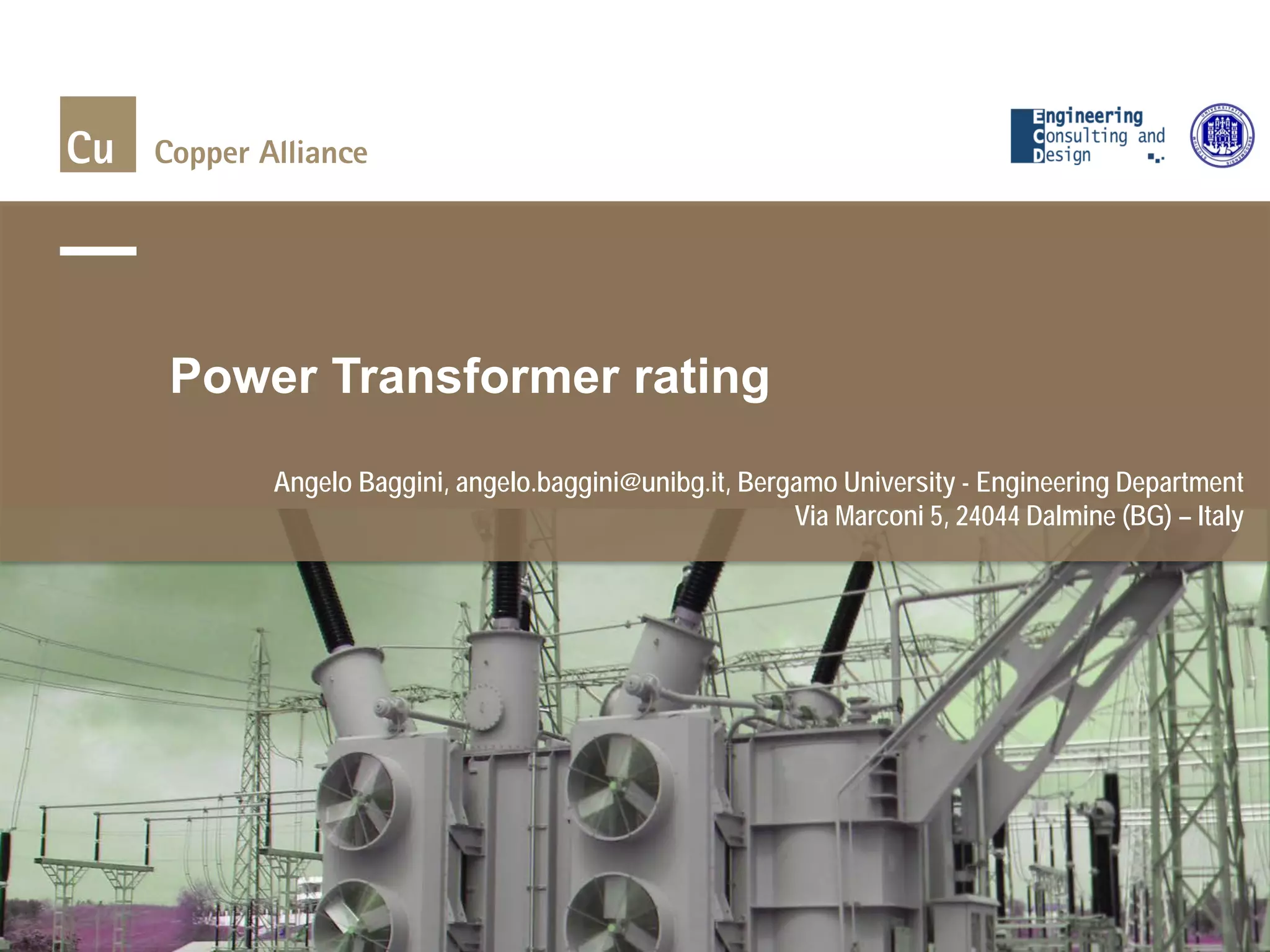
Power Transformer rating
1. Rated power
2. Rated voltages
3. Tapping
4. Short circuit voltage
5. No-Load and Load losses
6. Clock hour figure
7. Liquid immersed and dry type
Min Input data
• Load power and location
• Network Voltage level
• Short circuit level
• Reliability and continuity of electrical service
• Fire and environmental
safety issues
3
Power Transformer rating
Rated power
… and number of units
… and cooling mode
Rated power
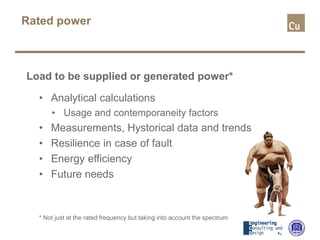
Load to be supplied or generated power*
• Analytical calculations
• Usage and contemporaneity factors
• Measurements, Hystorical data and trends
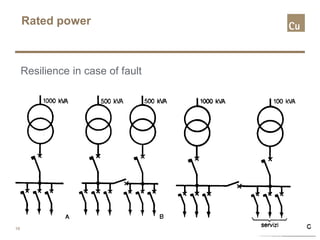
• Resilience in case of fault
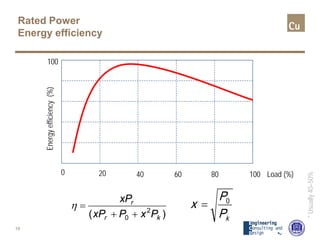
• Energy efficiency
• Future needs
* Not just at the rated frequency but taking into account the spectrum
Rated power
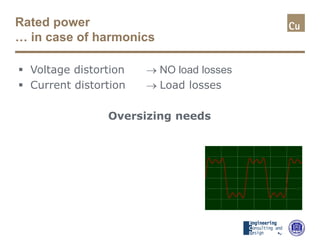
… in case of harmonics
 Voltage distortion → NO load losses
 Current distortion → Load losses
Oversizing needs
Rated
Analytical calculation
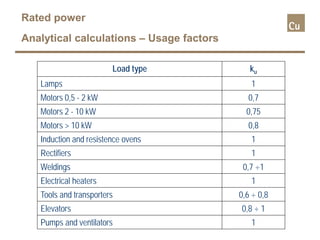
Load type ku
Lamps 1
Motors 0,5 - 2 kW 0,7
Motors 2 - 10 kW 0,75
Motors > 10 kW 0,8
Induction and resistence ovens 1
Rectifiers 1
Weldings 0,7 ÷1
Electrical heaters 1
Tools and transporters 0,6 ÷ 0,8
Elevators 0,8 ÷ 1
Pumps and ventilators 1
Rated power
Analytical calculations – Usage factors
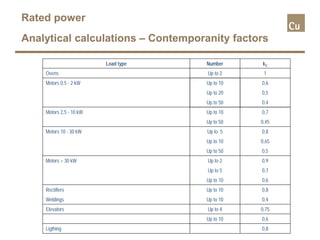
Load type Number kC
Ovens Up to 2 1
Motors 0,5 - 2 kW Up to 10 0,6
Up to 20 0,5
Up to 50 0,4
Motors 2,5 - 10 kW Up to 10 0,7
Up to 50 0,45
Motors 10 - 30 kW Up to 5 0,8
Up to 10 0,65
Up to 50 0,5
Motors > 30 kW Up to 2 0,9
Up to 5 0,7
Up to 10 0,6
Rectifiers Up to 10 0,8
Weldings Up to 10 0,4
Elevators Up to 4 0,75
Up to 10 0,6
Ligthing 0,8
Rated power
Analytical calculations – Contemporanity factors
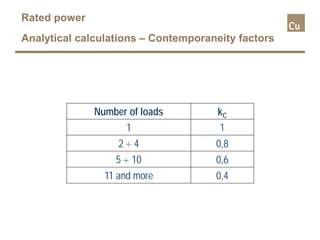
Number of loads kC
1 1
2 ÷ 4 0,8
5 ÷ 10 0,6
11 and more 0,4
Rated power
Analytical calculations – Contemporaneity factors
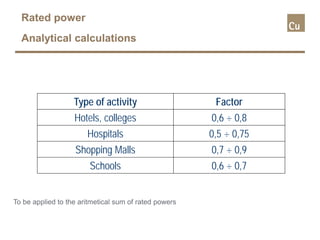
Type of activity Factor
Hotels, colleges 0,6 ÷ 0,8
Hospitals 0,5 ÷ 0,75
Shopping Malls 0,7 ÷ 0,9
Schools 0,6 ÷ 0,7
Rated power
Analytical calculations
To be applied to the aritmetical sum of rated powers
Rated Power
Measurements, Hystorical data
and trends
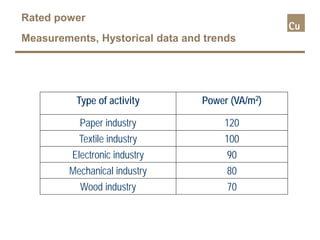
Type of activity Power (VA/m2)
Paper industry 120
Textile industry 100
Electronic industry 90
Mechanical industry 80
Wood industry 70
Rated power
Measurements, Hystorical data and trends
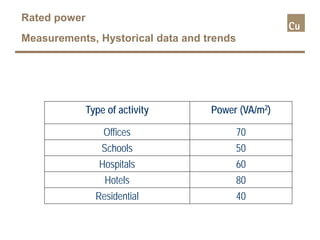
Type of activity Power (VA/m2)
Offices 70
Schools 50
Hospitals 60
Hotels 80
Residential 40
Rated power
Measurements, Hystorical data and trends
Rated Power
Resilience in case of fault
Rated power
16
Resilience in case of fault
Rated Power
Energy efficiency
Rated Power
Energy efficiency
18
*Usually40–50%
)( 2
0 kr
r
PxPxP
xP
++
=η
kP
P
x 0
=
Energyefficiency(%)
Load (%)
100
0 20 40 60 80 100
Rated Power
Future needs
Rated power
Future needs
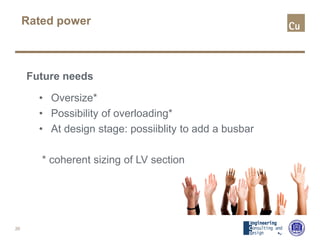
• Oversize*
• Possibility of overloading*
• At design stage: possiiblity to add a busbar
* coherent sizing of LV section
20
Rated power
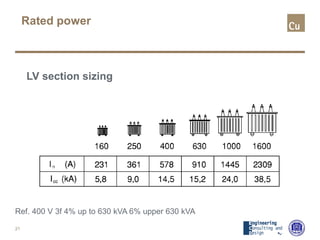
LV section sizing
21
Ref. 400 V 3f 4% up to 630 kVA 6% upper 630 kVA
Rated power
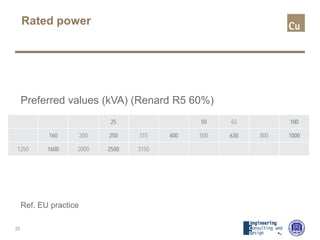
Preferred values (kVA) (Renard R5 60%)
22
25 50 63 100
160 200 250 315 400 500 630 800 1000
1250 1600 2000 2500 3150
Ref. EU practice
Power Transformer rating
Rated voltages
Rated voltages
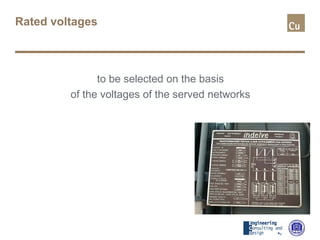
to be selected on the basis
of the voltages of the served networks
Rated voltages
for winding with Um > 1,1 kV
Highest voltages for equipment
3,6 kV– 7,2 kV – 12 kV – 17,5 kV – 24 kV – 36 kV
National practices may require the use of highest voltages for equipment up to (but not including) 52 kV,
when the rated voltage is less than 36 kV (such as Um = 38,5 kV or Um = 40,5 kV).
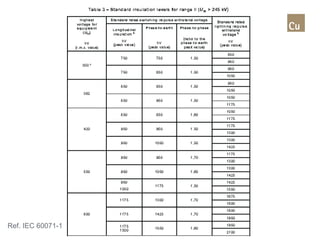
Insulation levels and dielectric test shall be in accordance with the requirements of IEC 60076-3.
Ref. EN 50588-1
Rated voltages
for winding with Um ≤ 1,1 kV
Rated voltages
400 V – 410 V – 415 V – 420 V – 433 V – 690 V
National practices may require the use of highest voltages for equipment up to (but not including) 52 kV,
when the rated voltage is less than 36 kV (such as Um = 38,5 kV or Um = 40,5 kV).
Insulation levels and dielectric test shall be in accordance with the requirements of IEC 60076-3.
Ref. EN 50588-1
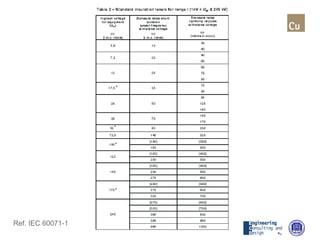
Ref. IEC 60071-1
Ref. IEC 60071-1
Power Transformer rating
Tappings
Tappings
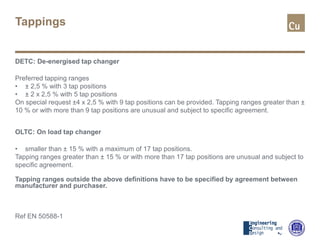
DETC: De-energised tap changer
Preferred tapping ranges
• ± 2,5 % with 3 tap positions
• ± 2 x 2,5 % with 5 tap positions
On special request ±4 x 2,5 % with 9 tap positions can be provided. Tapping ranges greater than ±
10 % or with more than 9 tap positions are unusual and subject to specific agreement.
OLTC: On load tap changer
• smaller than ± 15 % with a maximum of 17 tap positions.
Tapping ranges greater than ± 15 % or with more than 17 tap positions are unusual and subject to
specific agreement.
Tapping ranges outside the above definitions have to be specified by agreement between
manufacturer and purchaser.
Ref EN 50588-1
Power Transformer rating
Short circuit impedance
Shortcircuit impedance
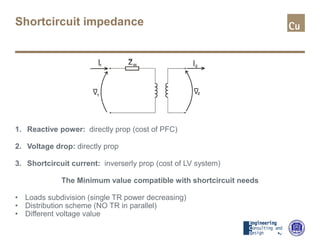
1. Reactive power: directly prop (cost of PFC)
2. Voltage drop: directly prop
3. Shortcircuit current: inverserly prop (cost of LV system)
The Minimum value compatible with shortcircuit needs
• Loads subdivision (single TR power decreasing)
• Distribution scheme (NO TR in parallel)
• Different voltage value
I Z
V
I
V
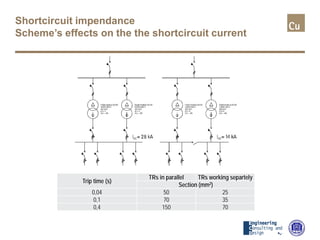
Shortcircuit impendance
Scheme’s effects on the the shortcircuit current
Trip time (s)
TRs in parallel TRs working separtely
Section (mm2)
0,04 50 25
0,1 70 35
0,4 150 70
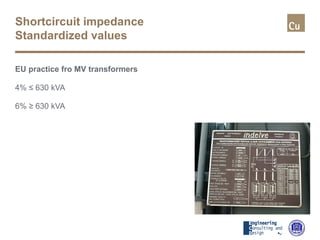
Shortcircuit impedance
Standardized values
EU practice fro MV transformers
4% ≤ 630 kVA
6% ≥ 630 kVA
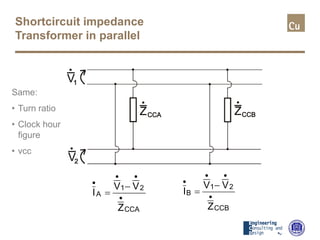
Shortcircuit impedance
Transformer in parallel
Z
V
V
Z
CCA
21
A
Z
VV
I •
••
•
−
=
CCB
21
B
Z
VV
I •
••
•
−
=
Same:
• Turn ratio
• Clock hour
figure
• vcc
Power Transformer rating
Load and no-load losses
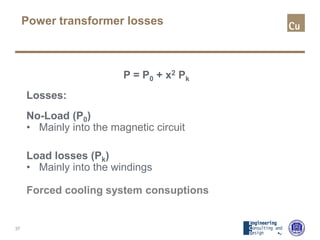
Power transformer losses
P = P0 + x2 Pk
Losses:
No-Load (P0)
• Mainly into the magnetic circuit
Load losses (Pk)
• Mainly into the windings
Forced cooling system consuptions
37
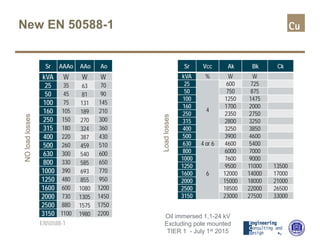
New EN 50588-1
Oil immersed 1,1-24 kV
Excluding pole mounted
TIER 1 - July 1st 2015
Sr AAAo AAo Ao
kVA W W W
25 35 63 70
50 45 81 90
100 75 131 145
160 105 189 210
250 150 270 300
315 180 324 360
400 220 387 430
500 260 459 510
630 300 540 600
800 330 585 650
1000 390 693 770
1250 480 855 950
1600 600 1080 1200
2000 730 1305 1450
2500 880 1575 1750
3150 1100 1980 2200
Sr Vcc Ak Bk Ck
kVA % W W
25
4
600 725
50 750 875
100 1250 1475
160 1700 2000
250 2350 2750
315 2800 3250
400 3250 3850
500 3900 4600
630 4 or 6 4600 5400
800
6
6000 7000
1000 7600 9000
1250 9500 11000 13500
1600 12000 14000 17000
2000 15000 18000 21000
2500 18500 22000 26500
3150 23000 27500 33000
NOloadlosses
Loadlosses
EN50588-1
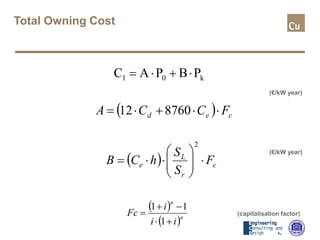
Total Owning Cost
(€/kW year)
(€/kW year)
(capitalisation factor)
k0l PBPAC ⋅+⋅=
( ) c
r
L
e F
S
S
hCB ⋅





⋅⋅=
2
( )
( )n
n
ii
i
Fc
+⋅
−+
=
1
11
( ) ced FCCA ⋅⋅+⋅= 876012
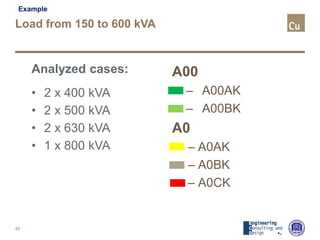
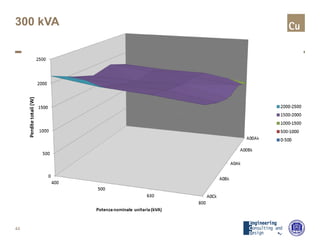
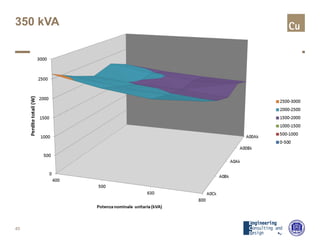
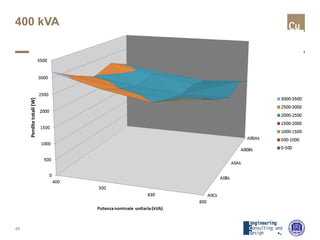
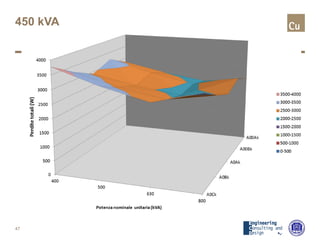
Load from 150 to 600 kVA
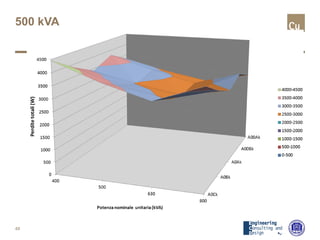
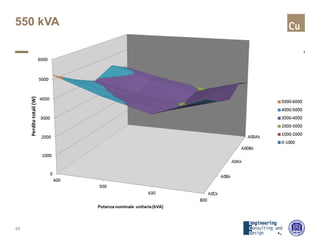
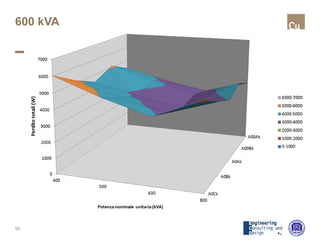
Analyzed cases:
• 2 x 400 kVA
• 2 x 500 kVA
• 2 x 630 kVA
• 1 x 800 kVA
40
Example
A00
– A00AK
– A00BK
A0
– A0AK
– A0BK
– A0CK
41
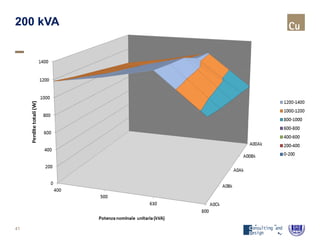
200 kVA
42
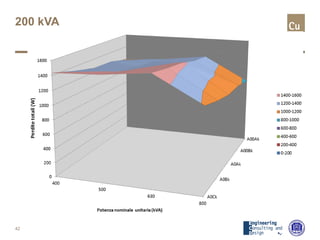
200 kVA
43
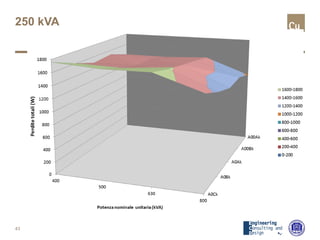
250 kVA
44
300 kVA
45
350 kVA
46
400 kVA
47
450 kVA
48
500 kVA
49
550 kVA
50
600 kVA
Power Transformer rating
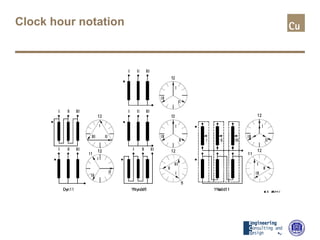
Clock hour notation
Clock hour notation
Power Transformer rating
Liquid immersed
and dry type
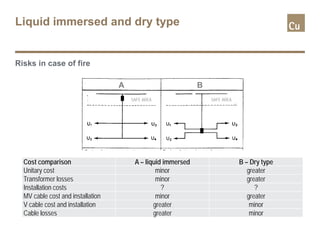
Liquid immersed and dry type
Risks in case of fire
A B
SAFE AREA SAFE AREA
Cost comparison A – liquid immersed B – Dry type
Unitary cost minor greater
Transformer losses minor greater
Installation costs ? ?
MV cable cost and installation minor greater
V cable cost and installation greater minor
Cable losses greater minor
Power Transformer rating
1. Rated power
2. Rated voltages
3. Tapping
4. Short circuit voltage
5. No-Load and Load losses
6. Clock hour notation
7. Liquid immersed and dry type
Thank you
| Presentation title and date
For more information please contact
Angelo Baggini
Università di Bergamo
Dipartimento di Ingegneria
Viale Marconi 5,
24044 Dalmine (BG) Italy
email: angelo.baggini@unibg.it
ECD Engineering Consulting and Design
Via Maffi 21 27100 PAVIA Italy

Power transformers rating

  • 1.
    Angelo Baggini, angelo.baggini@unibg.it,Bergamo University - Engineering Department Via Marconi 5, 24044 Dalmine (BG) – Italy Power Transformer rating
  • 2.
    Power Transformer rating 1.Rated power 2. Rated voltages 3. Tapping 4. Short circuit voltage 5. No-Load and Load losses 6. Clock hour figure 7. Liquid immersed and dry type
  • 3.
    Min Input data •Load power and location • Network Voltage level • Short circuit level • Reliability and continuity of electrical service • Fire and environmental safety issues 3
  • 4.
    Power Transformer rating Ratedpower … and number of units … and cooling mode
  • 5.
    Rated power Load tobe supplied or generated power* • Analytical calculations • Usage and contemporaneity factors • Measurements, Hystorical data and trends • Resilience in case of fault • Energy efficiency • Future needs * Not just at the rated frequency but taking into account the spectrum
  • 6.
    Rated power … incase of harmonics  Voltage distortion → NO load losses  Current distortion → Load losses Oversizing needs
  • 7.
  • 8.
    Load type ku Lamps1 Motors 0,5 - 2 kW 0,7 Motors 2 - 10 kW 0,75 Motors > 10 kW 0,8 Induction and resistence ovens 1 Rectifiers 1 Weldings 0,7 ÷1 Electrical heaters 1 Tools and transporters 0,6 ÷ 0,8 Elevators 0,8 ÷ 1 Pumps and ventilators 1 Rated power Analytical calculations – Usage factors
  • 9.
    Load type NumberkC Ovens Up to 2 1 Motors 0,5 - 2 kW Up to 10 0,6 Up to 20 0,5 Up to 50 0,4 Motors 2,5 - 10 kW Up to 10 0,7 Up to 50 0,45 Motors 10 - 30 kW Up to 5 0,8 Up to 10 0,65 Up to 50 0,5 Motors > 30 kW Up to 2 0,9 Up to 5 0,7 Up to 10 0,6 Rectifiers Up to 10 0,8 Weldings Up to 10 0,4 Elevators Up to 4 0,75 Up to 10 0,6 Ligthing 0,8 Rated power Analytical calculations – Contemporanity factors
  • 10.
    Number of loadskC 1 1 2 ÷ 4 0,8 5 ÷ 10 0,6 11 and more 0,4 Rated power Analytical calculations – Contemporaneity factors
  • 11.
    Type of activityFactor Hotels, colleges 0,6 ÷ 0,8 Hospitals 0,5 ÷ 0,75 Shopping Malls 0,7 ÷ 0,9 Schools 0,6 ÷ 0,7 Rated power Analytical calculations To be applied to the aritmetical sum of rated powers
  • 12.
  • 13.
    Type of activityPower (VA/m2) Paper industry 120 Textile industry 100 Electronic industry 90 Mechanical industry 80 Wood industry 70 Rated power Measurements, Hystorical data and trends
  • 14.
    Type of activityPower (VA/m2) Offices 70 Schools 50 Hospitals 60 Hotels 80 Residential 40 Rated power Measurements, Hystorical data and trends
  • 15.
  • 16.
  • 17.
  • 18.
    Rated Power Energy efficiency 18 *Usually40–50% )(2 0 kr r PxPxP xP ++ =η kP P x 0 = Energyefficiency(%) Load (%) 100 0 20 40 60 80 100
  • 19.
  • 20.
    Rated power Future needs •Oversize* • Possibility of overloading* • At design stage: possiiblity to add a busbar * coherent sizing of LV section 20
  • 21.
    Rated power LV sectionsizing 21 Ref. 400 V 3f 4% up to 630 kVA 6% upper 630 kVA
  • 22.
    Rated power Preferred values(kVA) (Renard R5 60%) 22 25 50 63 100 160 200 250 315 400 500 630 800 1000 1250 1600 2000 2500 3150 Ref. EU practice
  • 23.
  • 24.
    Rated voltages to beselected on the basis of the voltages of the served networks
  • 25.
    Rated voltages for windingwith Um > 1,1 kV Highest voltages for equipment 3,6 kV– 7,2 kV – 12 kV – 17,5 kV – 24 kV – 36 kV National practices may require the use of highest voltages for equipment up to (but not including) 52 kV, when the rated voltage is less than 36 kV (such as Um = 38,5 kV or Um = 40,5 kV). Insulation levels and dielectric test shall be in accordance with the requirements of IEC 60076-3. Ref. EN 50588-1
  • 26.
    Rated voltages for windingwith Um ≤ 1,1 kV Rated voltages 400 V – 410 V – 415 V – 420 V – 433 V – 690 V National practices may require the use of highest voltages for equipment up to (but not including) 52 kV, when the rated voltage is less than 36 kV (such as Um = 38,5 kV or Um = 40,5 kV). Insulation levels and dielectric test shall be in accordance with the requirements of IEC 60076-3. Ref. EN 50588-1
  • 27.
  • 28.
  • 29.
  • 30.
    Tappings DETC: De-energised tapchanger Preferred tapping ranges • ± 2,5 % with 3 tap positions • ± 2 x 2,5 % with 5 tap positions On special request ±4 x 2,5 % with 9 tap positions can be provided. Tapping ranges greater than ± 10 % or with more than 9 tap positions are unusual and subject to specific agreement. OLTC: On load tap changer • smaller than ± 15 % with a maximum of 17 tap positions. Tapping ranges greater than ± 15 % or with more than 17 tap positions are unusual and subject to specific agreement. Tapping ranges outside the above definitions have to be specified by agreement between manufacturer and purchaser. Ref EN 50588-1
  • 31.
  • 32.
    Shortcircuit impedance 1. Reactivepower: directly prop (cost of PFC) 2. Voltage drop: directly prop 3. Shortcircuit current: inverserly prop (cost of LV system) The Minimum value compatible with shortcircuit needs • Loads subdivision (single TR power decreasing) • Distribution scheme (NO TR in parallel) • Different voltage value I Z V I V
  • 33.
    Shortcircuit impendance Scheme’s effectson the the shortcircuit current Trip time (s) TRs in parallel TRs working separtely Section (mm2) 0,04 50 25 0,1 70 35 0,4 150 70
  • 34.
    Shortcircuit impedance Standardized values EUpractice fro MV transformers 4% ≤ 630 kVA 6% ≥ 630 kVA
  • 35.
    Shortcircuit impedance Transformer inparallel Z V V Z CCA 21 A Z VV I • •• • − = CCB 21 B Z VV I • •• • − = Same: • Turn ratio • Clock hour figure • vcc
  • 36.
  • 37.
    Power transformer losses P= P0 + x2 Pk Losses: No-Load (P0) • Mainly into the magnetic circuit Load losses (Pk) • Mainly into the windings Forced cooling system consuptions 37
  • 38.
    New EN 50588-1 Oilimmersed 1,1-24 kV Excluding pole mounted TIER 1 - July 1st 2015 Sr AAAo AAo Ao kVA W W W 25 35 63 70 50 45 81 90 100 75 131 145 160 105 189 210 250 150 270 300 315 180 324 360 400 220 387 430 500 260 459 510 630 300 540 600 800 330 585 650 1000 390 693 770 1250 480 855 950 1600 600 1080 1200 2000 730 1305 1450 2500 880 1575 1750 3150 1100 1980 2200 Sr Vcc Ak Bk Ck kVA % W W 25 4 600 725 50 750 875 100 1250 1475 160 1700 2000 250 2350 2750 315 2800 3250 400 3250 3850 500 3900 4600 630 4 or 6 4600 5400 800 6 6000 7000 1000 7600 9000 1250 9500 11000 13500 1600 12000 14000 17000 2000 15000 18000 21000 2500 18500 22000 26500 3150 23000 27500 33000 NOloadlosses Loadlosses EN50588-1
  • 39.
    Total Owning Cost (€/kWyear) (€/kW year) (capitalisation factor) k0l PBPAC ⋅+⋅= ( ) c r L e F S S hCB ⋅      ⋅⋅= 2 ( ) ( )n n ii i Fc +⋅ −+ = 1 11 ( ) ced FCCA ⋅⋅+⋅= 876012
  • 40.
    Load from 150to 600 kVA Analyzed cases: • 2 x 400 kVA • 2 x 500 kVA • 2 x 630 kVA • 1 x 800 kVA 40 Example A00 – A00AK – A00BK A0 – A0AK – A0BK – A0CK
  • 41.
  • 42.
  • 43.
  • 44.
  • 45.
  • 46.
  • 47.
  • 48.
  • 49.
  • 50.
  • 51.
  • 52.
  • 53.
    Power Transformer rating Liquidimmersed and dry type
  • 54.
    Liquid immersed anddry type Risks in case of fire A B SAFE AREA SAFE AREA Cost comparison A – liquid immersed B – Dry type Unitary cost minor greater Transformer losses minor greater Installation costs ? ? MV cable cost and installation minor greater V cable cost and installation greater minor Cable losses greater minor
  • 55.
    Power Transformer rating 1.Rated power 2. Rated voltages 3. Tapping 4. Short circuit voltage 5. No-Load and Load losses 6. Clock hour notation 7. Liquid immersed and dry type
  • 56.
    Thank you | Presentationtitle and date For more information please contact Angelo Baggini Università di Bergamo Dipartimento di Ingegneria Viale Marconi 5, 24044 Dalmine (BG) Italy email: angelo.baggini@unibg.it ECD Engineering Consulting and Design Via Maffi 21 27100 PAVIA Italy