POWER GRID 
OPERATION 
IN INDIA 
PREPARED BY:- 
MAHIM SRIVASTAVA 
EN-3RD YEAR
WHAT IS A “GRID” ? 
An Interconnected power system covering a major portion of a country’s territory 
(or state) is called a Grid. The different state grids may be a interconnected through 
transmission lines to form a Grid. 
WHAT IS AN “INTER-CONNECTION” ? 
Two or more generating stations are interconnected by tie lines. Interconnection 
provides the best use of power resources and ensures greater security of supply. 
WHY DO WE NEED THIS INTER-CONNECTION ? 
1)Reliability 
2)Economy 
3)Proper Load Sharing
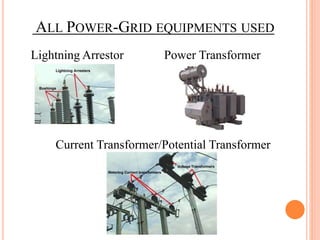
ALL POWER-GRID EQUIPMENTS USED 
Lightning Arrestor Power Transformer 
Current Transformer/Potential Transformer
Circuit Breakers Insulators Isolators 
Wave Trap
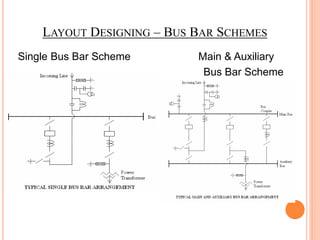
LAYOUT DESIGNING – BUS BAR SCHEMES 
Single Bus Bar Scheme Main & Auxiliary 
Bus Bar Scheme
LAYOUT DESIGNING – BUS BAR SCHEMES 
Double Bus Bar Scheme Double main & 
Aux Bus Bar Scheme
THE ELECTRICITY ACT (OVERVIEW) 
•The electricity Act, 2003 provides for open access. 
•This would create demand from third party for wheeling of 
Power. 
•No additional wheeling charges unless any new system is 
added 
•The Electricity (Supply) Act, 1948 was amended in 
1991 to provide for creation of private generating 
companies for setting up power generating facilities 
and selling the power in bulk to the grid or other 
persons.
CENTRALAUTHORITY SYSTEM 
COORDINATE WITH 
OTHER 
SYSNCHRONOUS GRIDS 
(EX NR, ER,NER) 
REGIONAL (SYNCHRONOUS GRID) 
LOAD DESPATCH CENTRE 
STATE LOAD 
DESPATCH 
CENTRES 
CENTRALLY 
OWNED LINES 
CENTRALLY 
OWNED PLANTS 
INTER-STATE TIE 
LINES 
STATE OWNED 
HVDC LINES 
DISTRIBUTION 
SUBSTATION 
POWERPLANT 
OPERATORS
Central Authority System (contd.) 
•The Central Electricity Authority of India (CEA) is a statutory 
organisation constituted under section 3(1) of Electricity Supply Act 1948 
•To develop a sound adequate and uniform national power policy, 
formulate short-term and perspective plans for power development 
and co-ordinate the activities of planning agencies in relation to the 
control and utilisation of national power resources. 
•To collect and record the data concerning generation, distribution 
and utilisation of power and carry out studies relating to cost, 
efficiency, losses, benefits and such like matters.
WHAT IS A NATIONAL LOAD DESPATCH CENTRE ? 
The main functions assigned to NLDC are: 
 Supervision Over the Regional Load Despatch Centres. 
 Scheduling and dispatch of electricity over the inter-regional 
links in accordance with grid standards specified by the 
authority and grid code specified by Central Commission in 
coordination with Regional Load Despatch Centres. 
 Coordination with Regional Load Despatch Centres for 
achieving maximum economy and efficiency in the operation 
of National Grid. 
 Monitoring of operations and grid security of the National 
Grid. 
 Coordination for restoration of synchronous operation of 
national grid with Regional Load Despatch Centres.
SHARING OF TRANSMISSION CHARGES 
•Charges for inter-regional lines may be shared by two 
contiguous regions on 50 : 50 basis. 
•Charges for the regional assets may be shared by the 
regional beneficiaries 
•If an inter regional asset is used for wheeling by a third 
party the balance transmission charges may be shared by 
the beneficiaries of the contiguous region on 50 : 50 basis. 
WHEELING CHARGES: 
•Wheeling is the transportation of electric power (megawatts 
or megavolt-amperes) over transmission lines. 
•An entity that generates power does not have to own 
power transmission lines 
•The entity then pays the owner of the transmission 
line based on how much power is being moved and 
how congested the line is.
OWNERSHIP AND COORDINATION 
• Inter-State and other transmission links may be owned by 
other independent entity (Ex: PGCIL). 
• State Electricity Boards can Import or Export a pre decided 
amount of power from neighboring states or generators 
owned by other entities like National Thermal Power 
Corporation. 
• State Electricity Boards are divided into 
1) Generation companies (GENCOs) 
2) Distribution Companies (DISCOs) 
3) Transmission Companies(TRANSCOs) 
• Overall coordination is done by a Load Dispatch Centre.
GENCOS: 
The companies which are responsible for power generation are 
called as Generation Companies(GENCOs) ex: NTPC 
TRANSCOS: 
The companies which are responsible for transmission of large 
amounts of power are called as Transmission 
companies(TRANSCOs) Ex: PowerGrid 
DISCOS: 
The companies which are responsible for Distribution of the 
large amounts of power to the general public are called as 
Distribution Companies(DISCOs) Ex: UP-RVVNL
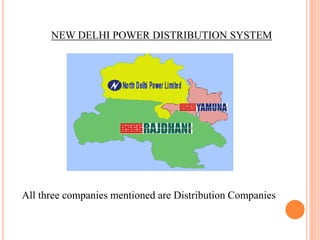
NEW DELHI POWER DISTRIBUTION SYSTEM 
All three companies mentioned are Distribution Companies
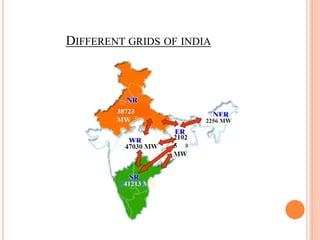
DIFFERENT GRIDS OF INDIA
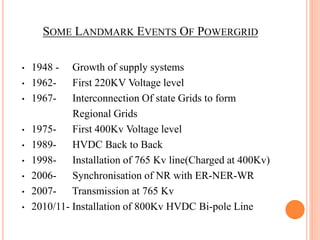
SOME LANDMARK EVENTS OF POWERGRID 
• 1948 - Growth of supply systems 
• 1962- First 220KV Voltage level 
• 1967- Interconnection Of state Grids to form 
Regional Grids 
• 1975- First 400Kv Voltage level 
• 1989- HVDC Back to Back 
• 1998- Installation of 765 Kv line(Charged at 400Kv) 
• 2006- Synchronisation of NR with ER-NER-WR 
• 2007- Transmission at 765 Kv 
• 2010/11- Installation of 800Kv HVDC Bi-pole Line
ANY QUESTIONS ??? 
Gmail Id: mahim.ims@gmail.com 
Facebook : Fb.com/Mahimsrivastava

Power grid operation in India

  • 1.
    POWER GRID OPERATION IN INDIA PREPARED BY:- MAHIM SRIVASTAVA EN-3RD YEAR
  • 2.
    WHAT IS A“GRID” ? An Interconnected power system covering a major portion of a country’s territory (or state) is called a Grid. The different state grids may be a interconnected through transmission lines to form a Grid. WHAT IS AN “INTER-CONNECTION” ? Two or more generating stations are interconnected by tie lines. Interconnection provides the best use of power resources and ensures greater security of supply. WHY DO WE NEED THIS INTER-CONNECTION ? 1)Reliability 2)Economy 3)Proper Load Sharing
  • 3.
    ALL POWER-GRID EQUIPMENTSUSED Lightning Arrestor Power Transformer Current Transformer/Potential Transformer
  • 4.
    Circuit Breakers InsulatorsIsolators Wave Trap
  • 5.
    LAYOUT DESIGNING –BUS BAR SCHEMES Single Bus Bar Scheme Main & Auxiliary Bus Bar Scheme
  • 6.
    LAYOUT DESIGNING –BUS BAR SCHEMES Double Bus Bar Scheme Double main & Aux Bus Bar Scheme
  • 7.
    THE ELECTRICITY ACT(OVERVIEW) •The electricity Act, 2003 provides for open access. •This would create demand from third party for wheeling of Power. •No additional wheeling charges unless any new system is added •The Electricity (Supply) Act, 1948 was amended in 1991 to provide for creation of private generating companies for setting up power generating facilities and selling the power in bulk to the grid or other persons.
  • 8.
    CENTRALAUTHORITY SYSTEM COORDINATEWITH OTHER SYSNCHRONOUS GRIDS (EX NR, ER,NER) REGIONAL (SYNCHRONOUS GRID) LOAD DESPATCH CENTRE STATE LOAD DESPATCH CENTRES CENTRALLY OWNED LINES CENTRALLY OWNED PLANTS INTER-STATE TIE LINES STATE OWNED HVDC LINES DISTRIBUTION SUBSTATION POWERPLANT OPERATORS
  • 9.
    Central Authority System(contd.) •The Central Electricity Authority of India (CEA) is a statutory organisation constituted under section 3(1) of Electricity Supply Act 1948 •To develop a sound adequate and uniform national power policy, formulate short-term and perspective plans for power development and co-ordinate the activities of planning agencies in relation to the control and utilisation of national power resources. •To collect and record the data concerning generation, distribution and utilisation of power and carry out studies relating to cost, efficiency, losses, benefits and such like matters.
  • 10.
    WHAT IS ANATIONAL LOAD DESPATCH CENTRE ? The main functions assigned to NLDC are:  Supervision Over the Regional Load Despatch Centres.  Scheduling and dispatch of electricity over the inter-regional links in accordance with grid standards specified by the authority and grid code specified by Central Commission in coordination with Regional Load Despatch Centres.  Coordination with Regional Load Despatch Centres for achieving maximum economy and efficiency in the operation of National Grid.  Monitoring of operations and grid security of the National Grid.  Coordination for restoration of synchronous operation of national grid with Regional Load Despatch Centres.
  • 11.
    SHARING OF TRANSMISSIONCHARGES •Charges for inter-regional lines may be shared by two contiguous regions on 50 : 50 basis. •Charges for the regional assets may be shared by the regional beneficiaries •If an inter regional asset is used for wheeling by a third party the balance transmission charges may be shared by the beneficiaries of the contiguous region on 50 : 50 basis. WHEELING CHARGES: •Wheeling is the transportation of electric power (megawatts or megavolt-amperes) over transmission lines. •An entity that generates power does not have to own power transmission lines •The entity then pays the owner of the transmission line based on how much power is being moved and how congested the line is.
  • 12.
    OWNERSHIP AND COORDINATION • Inter-State and other transmission links may be owned by other independent entity (Ex: PGCIL). • State Electricity Boards can Import or Export a pre decided amount of power from neighboring states or generators owned by other entities like National Thermal Power Corporation. • State Electricity Boards are divided into 1) Generation companies (GENCOs) 2) Distribution Companies (DISCOs) 3) Transmission Companies(TRANSCOs) • Overall coordination is done by a Load Dispatch Centre.
  • 13.
    GENCOS: The companieswhich are responsible for power generation are called as Generation Companies(GENCOs) ex: NTPC TRANSCOS: The companies which are responsible for transmission of large amounts of power are called as Transmission companies(TRANSCOs) Ex: PowerGrid DISCOS: The companies which are responsible for Distribution of the large amounts of power to the general public are called as Distribution Companies(DISCOs) Ex: UP-RVVNL
  • 14.
    NEW DELHI POWERDISTRIBUTION SYSTEM All three companies mentioned are Distribution Companies
  • 15.
  • 16.
    SOME LANDMARK EVENTSOF POWERGRID • 1948 - Growth of supply systems • 1962- First 220KV Voltage level • 1967- Interconnection Of state Grids to form Regional Grids • 1975- First 400Kv Voltage level • 1989- HVDC Back to Back • 1998- Installation of 765 Kv line(Charged at 400Kv) • 2006- Synchronisation of NR with ER-NER-WR • 2007- Transmission at 765 Kv • 2010/11- Installation of 800Kv HVDC Bi-pole Line
  • 18.
    ANY QUESTIONS ??? Gmail Id: mahim.ims@gmail.com Facebook : Fb.com/Mahimsrivastava