Role of substation in smart grid
by
Mangesh S Kulkarni
Sharad Institute of Technology College of Engineering, Yadrav Ichalkaranji
What is smart grid, Why Now?
• Essential component to address energy demand, security and
environmental challenges
• Smart Grid an electricity network that can intelligently
integrate the actions of all users connected to it—generators,
consumers and those that do both, in order to efficiently
deliver sustainable, economic and secure electricity supply
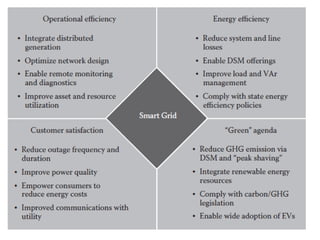
Smart Grid Drivers
• Policy and Legislative Drivers
• Economic competitiveness
• Energy reliability and security
• Customer empowerment
• Environmental sustainability
Policy and Legislative Drivers
• Electric market rules that create comparability and monetize
benefits
• Electricity pricing and access to enable Smart Grid options
• State regulations to allow Smart Grid deferral of capital and
operating costs
• Compatible National and state policies to enable full integration
of Smart Grid benefits
Economic competitiveness
• Creating new businesses, new business models, adding “green”
jobs
• Technology regionalization
• Alleviate the challenge of a drain of technical resources in an
aging workforce
Energy reliability and security
• Improve reliability through decreased outage duration and frequency
• Reduce labor costs, such as manual meter reading and field
maintenance, etc.
• Reduce nonlabor costs, such as the use of field service vehicles,
insurance, damage, etc.
• Reduce T&D system delivery losses through improved system
planning and asset management
• Protect revenues with improved billing accuracy and prevention and
detection of theft and fraud
• Provide new sources of revenue with consumer programs, such as
energy management
• Defer capital expenditures as a result of increased grid efficiencies
and reduced generation requirements
• Fulfill national security objectives
• Improve wholesale market efficiency
Customer empowerment
• Respond to consumer demand for sustainable energy resources
• Respond to customers’ increasing demand for uninterruptible
power
• Empower customers so that they have more control over their
own energy usage with minimal compromise in their lifestyle
• Facilitate performance-based rate behavior
Environmental sustainability
• Response to governmental mandates
• Support the addition of renewable and distributed generation to
the grid
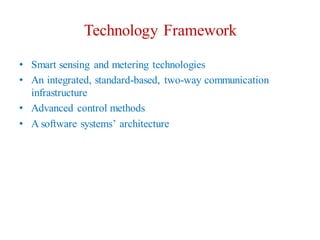
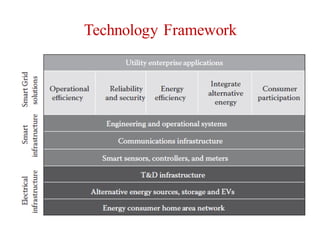
Technology Framework
• Smart sensing and metering technologies
• An integrated, standard-based, two-way communication
infrastructure
• Advanced control methods
• A software systems’ architecture
Technology Framework
Transformation of the Grid
• Advances in technology
• increase in energy resources
• increased amounts of power exchanges
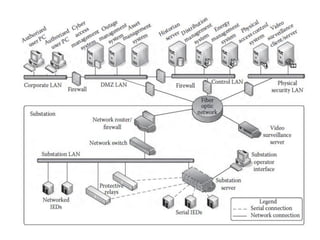
• smart substation
Smart Substation
• Engineering and Design
• retrofitting existing substations
• deploying brand new substation designs
• Information Infrastructure
• Operation and Maintenance
• Enterprise Integration
• Testing and Commissioning
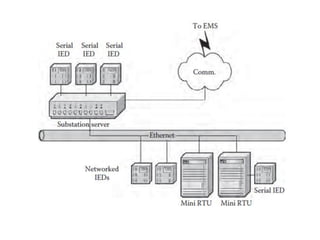
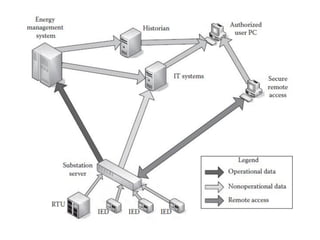
Substation Technology Advances
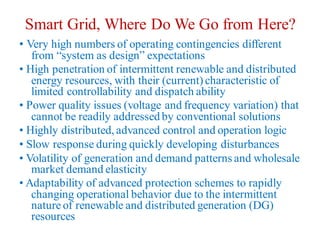
Smart Grid, Where Do We Go from Here?
• Very high numbers of operating contingencies different
from “system as design” expectations
• High penetration of intermittent renewable and distributed
energy resources, with their (current) characteristic of
limited controllability and dispatch ability
• Power quality issues (voltage and frequency variation) that
cannot be readily addressed by conventional solutions
• Highly distributed,advanced control and operation logic
• Slow response during quickly developing disturbances
• Volatility of generation and demand patterns and wholesale
market demand elasticity
• Adaptability of advanced protection schemes to rapidly
changing operational behavior due to the intermittent
nature of renewable and distributed generation (DG)
resources

Role of substation in smart grid

  • 1.
    Role of substationin smart grid by Mangesh S Kulkarni Sharad Institute of Technology College of Engineering, Yadrav Ichalkaranji
  • 2.
    What is smartgrid, Why Now? • Essential component to address energy demand, security and environmental challenges • Smart Grid an electricity network that can intelligently integrate the actions of all users connected to it—generators, consumers and those that do both, in order to efficiently deliver sustainable, economic and secure electricity supply
  • 3.
    Smart Grid Drivers •Policy and Legislative Drivers • Economic competitiveness • Energy reliability and security • Customer empowerment • Environmental sustainability
  • 4.
    Policy and LegislativeDrivers • Electric market rules that create comparability and monetize benefits • Electricity pricing and access to enable Smart Grid options • State regulations to allow Smart Grid deferral of capital and operating costs • Compatible National and state policies to enable full integration of Smart Grid benefits
  • 5.
    Economic competitiveness • Creatingnew businesses, new business models, adding “green” jobs • Technology regionalization • Alleviate the challenge of a drain of technical resources in an aging workforce
  • 6.
    Energy reliability andsecurity • Improve reliability through decreased outage duration and frequency • Reduce labor costs, such as manual meter reading and field maintenance, etc. • Reduce nonlabor costs, such as the use of field service vehicles, insurance, damage, etc. • Reduce T&D system delivery losses through improved system planning and asset management • Protect revenues with improved billing accuracy and prevention and detection of theft and fraud • Provide new sources of revenue with consumer programs, such as energy management • Defer capital expenditures as a result of increased grid efficiencies and reduced generation requirements • Fulfill national security objectives • Improve wholesale market efficiency
  • 7.
    Customer empowerment • Respondto consumer demand for sustainable energy resources • Respond to customers’ increasing demand for uninterruptible power • Empower customers so that they have more control over their own energy usage with minimal compromise in their lifestyle • Facilitate performance-based rate behavior
  • 8.
    Environmental sustainability • Responseto governmental mandates • Support the addition of renewable and distributed generation to the grid
  • 10.
    Technology Framework • Smartsensing and metering technologies • An integrated, standard-based, two-way communication infrastructure • Advanced control methods • A software systems’ architecture
  • 11.
  • 12.
    Transformation of theGrid • Advances in technology • increase in energy resources • increased amounts of power exchanges • smart substation
  • 13.
    Smart Substation • Engineeringand Design • retrofitting existing substations • deploying brand new substation designs • Information Infrastructure • Operation and Maintenance • Enterprise Integration • Testing and Commissioning
  • 14.
  • 18.
    Smart Grid, WhereDo We Go from Here? • Very high numbers of operating contingencies different from “system as design” expectations • High penetration of intermittent renewable and distributed energy resources, with their (current) characteristic of limited controllability and dispatch ability • Power quality issues (voltage and frequency variation) that cannot be readily addressed by conventional solutions • Highly distributed,advanced control and operation logic • Slow response during quickly developing disturbances • Volatility of generation and demand patterns and wholesale market demand elasticity • Adaptability of advanced protection schemes to rapidly changing operational behavior due to the intermittent nature of renewable and distributed generation (DG) resources