Power Quality Disturbances
By
Dr. Sunil Singh
Associate Professor
Department of EE
GB Pant University of Ag and Tech Pantnagar
Introduction
 Increased use of automated control devices, computers,
PLC, and other safety devices quality of power become
very important issue.
 Power quality, or more specifically, a power quality
disturbance, is generally defined as any change in voltage,
current, or frequency that interferes with the normal
operation of electrical equipment.
 Cause of poor power quality: nonlinear loads, adjustable-
speed drives, traction drives, computers, UPS, battery
chargers, variable frequency drives and other power
electronics or electronic based equipments, load
unbalancing etc.
Classification of PQ Disturbances
 Sag (dip)
 Swell
 Overvoltage and Under voltage
 Voltage Imbalance
 Voltage fluctuations
 Frequency variations
 Waveform distortion
 Transients
 Interruptions
Power Quality Disturbances
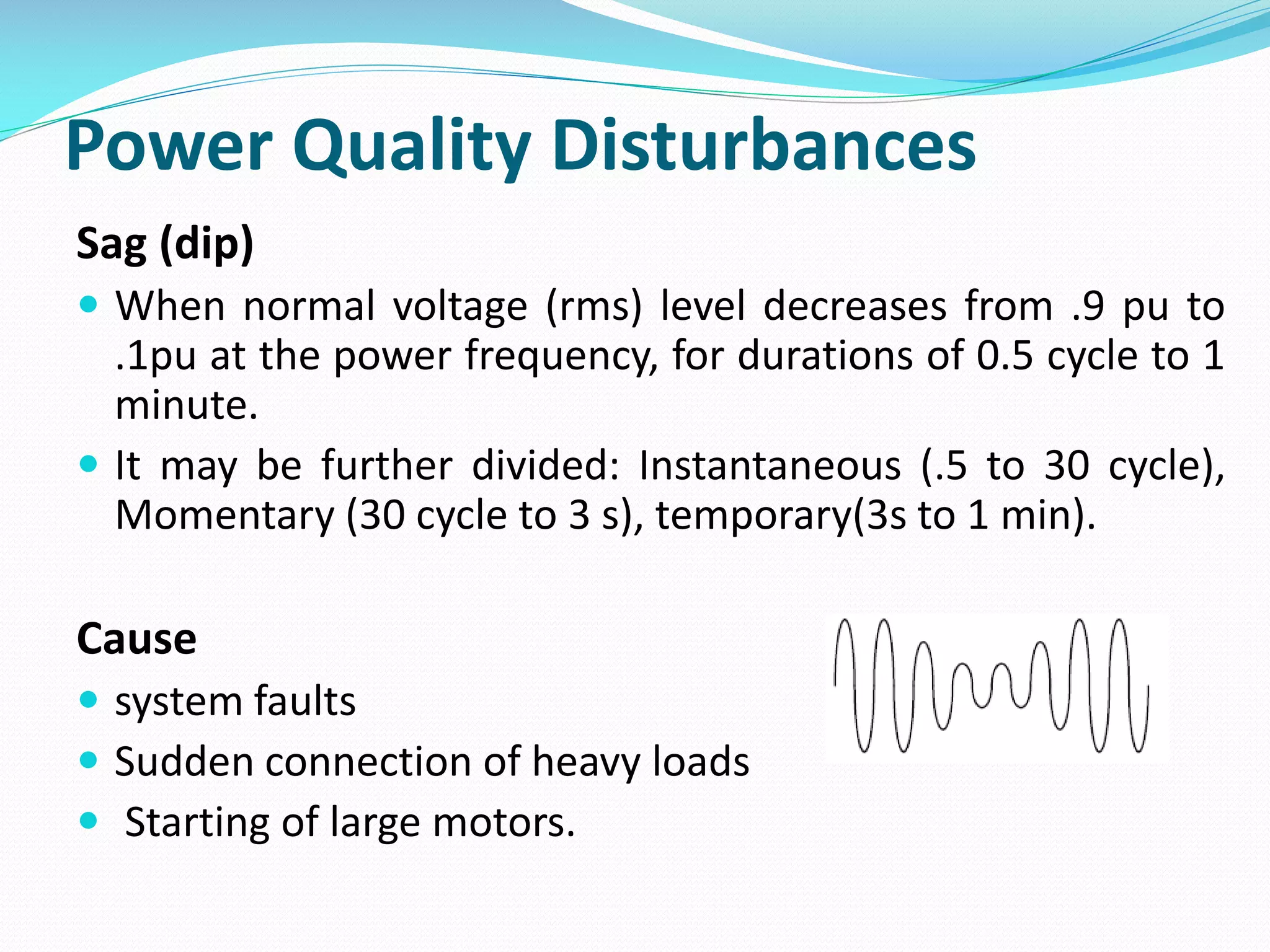
Sag (dip)
 When normal voltage (rms) level decreases from .9 pu to
.1pu at the power frequency, for durations of 0.5 cycle to 1
minute.
 It may be further divided: Instantaneous (.5 to 30 cycle),
Momentary (30 cycle to 3 s), temporary(3s to 1 min).
Cause
 system faults
 Sudden connection of heavy loads
 Starting of large motors.
Swells
 A swell is defined as an increase in voltage to between 1.1
and 1.8 pu of the nominal voltage or current at the power
frequency for durations from 0.5 cycle to 1 min.
 It may be further divided: Instantaneous (.5 to 30 cycle),
Momentary (30 cycle to 3 s), temporary(3s to 1 min).
Causes:
 Fault
 switching off a large load or energizing a large capacitor
bank.
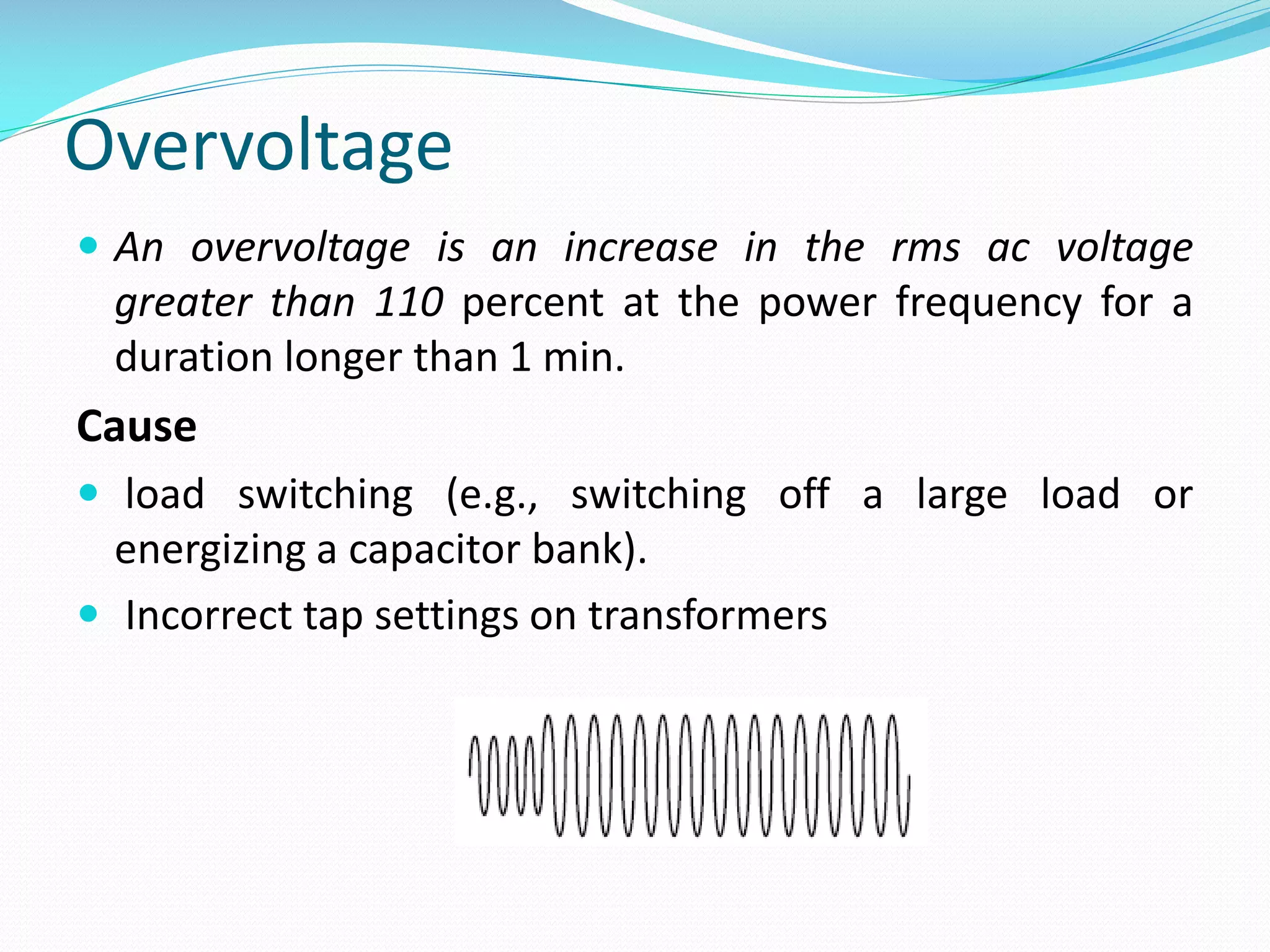
Overvoltage
 An overvoltage is an increase in the rms ac voltage
greater than 110 percent at the power frequency for a
duration longer than 1 min.
Cause
 load switching (e.g., switching off a large load or
energizing a capacitor bank).
 Incorrect tap settings on transformers
Under voltage
 An under voltage is a decrease in the rms ac voltage to
less than .9 pu at the power frequency for a duration
longer than 1 min.
Cause
 Switching on loads
 Switching off capacitor bank
Voltage Imbalance/ unbalance
 If magnitude of all phases are not equal
 Phase angle differences is deviates from 120
Causes:
 Large single-phase loads (induction furnaces, traction
loads), incorrect distribution of single-phase loads on
three phase supply
Voltage fluctuations
 A voltage fluctuation is a systematic variation of the
voltage waveform or a series of random voltage changes,
of small dimensions, namely 95 to 105% of nominal at a
low frequency, generally below 25 Hz.
Cause
 Arc furnaces
Frequency variations
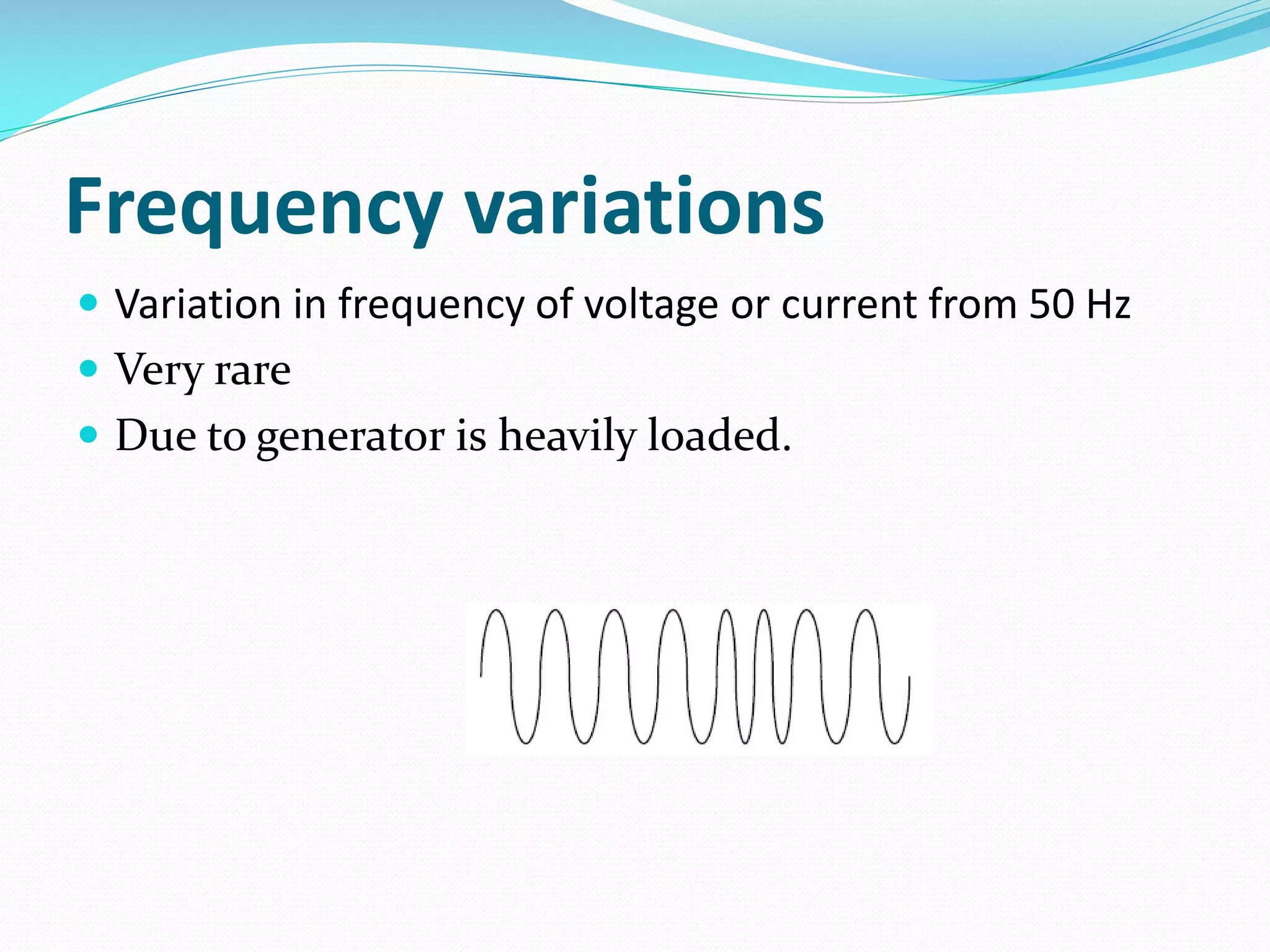
 Variation in frequency of voltage or current from 50 Hz
 Very rare
 Due to generator is heavily loaded.
Waveform Distortion
 Waveform distortion is defined as a steady-state
deviation from an ideal sine wave of power frequency
principally characterized by the spectral content of the
deviation
 There are five primary types of waveform distortion:
■ Harmonics
■ DC offset
■ Inter-harmonics
■ Notching
■ Noise
Harmonics
 A non sinusoidal periodic waveform can be represented
as a sum of different sine-waves with different magnitude
and phase, having frequencies that are multiples of
power-system frequency. These components are known
as harmonics
Causes
 Classic sources: electric machines working above the
knee of the magnetization curve (magnetic saturation),
arc furnaces, welding machines, rectifiers, and DC brush
motors.
 Modern sources: all non-linear loads, such as power
electronics equipment including ASDs.
Continue.....
 THD (total harmonic distortion) is a measure of
effective value of harmonic distortion.
Voltage fluctuations
 A voltage fluctuation is a systematic variation of the
voltage waveform or a series of random voltage changes,
of small dimensions, namely 95 to 105% of nominal at a
low frequency, generally below 25 Hz.
Cause
 Arc furnaces
Transients
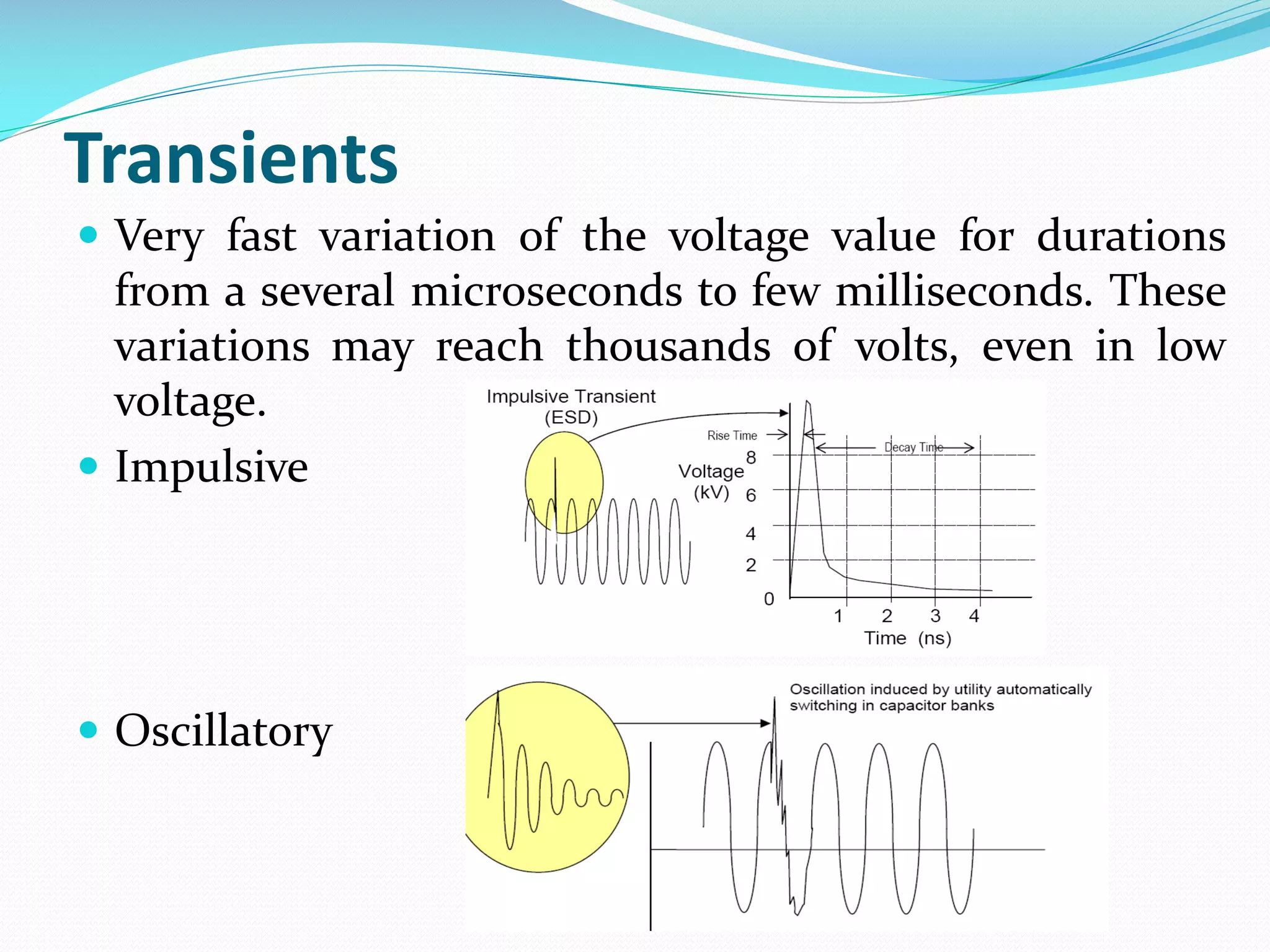
 Very fast variation of the voltage value for durations
from a several microseconds to few milliseconds. These
variations may reach thousands of volts, even in low
voltage.
 Impulsive
 Oscillatory
Interruptions
 An interruption is a condition in which voltage at supply
terminal is close to zero for less then one minuets
(less then 10% of nominal voltage, as per IEEE Std 1159).
 If interruption more then one minuets then it is called
sustained interruption
Thank You
For your kind attention

Power quality disturbances

  • 1.
    Power Quality Disturbances By Dr.Sunil Singh Associate Professor Department of EE GB Pant University of Ag and Tech Pantnagar
  • 2.
    Introduction  Increased useof automated control devices, computers, PLC, and other safety devices quality of power become very important issue.  Power quality, or more specifically, a power quality disturbance, is generally defined as any change in voltage, current, or frequency that interferes with the normal operation of electrical equipment.  Cause of poor power quality: nonlinear loads, adjustable- speed drives, traction drives, computers, UPS, battery chargers, variable frequency drives and other power electronics or electronic based equipments, load unbalancing etc.
  • 3.
    Classification of PQDisturbances  Sag (dip)  Swell  Overvoltage and Under voltage  Voltage Imbalance  Voltage fluctuations  Frequency variations  Waveform distortion  Transients  Interruptions
  • 4.
    Power Quality Disturbances Sag(dip)  When normal voltage (rms) level decreases from .9 pu to .1pu at the power frequency, for durations of 0.5 cycle to 1 minute.  It may be further divided: Instantaneous (.5 to 30 cycle), Momentary (30 cycle to 3 s), temporary(3s to 1 min). Cause  system faults  Sudden connection of heavy loads  Starting of large motors.
  • 5.
    Swells  A swellis defined as an increase in voltage to between 1.1 and 1.8 pu of the nominal voltage or current at the power frequency for durations from 0.5 cycle to 1 min.  It may be further divided: Instantaneous (.5 to 30 cycle), Momentary (30 cycle to 3 s), temporary(3s to 1 min). Causes:  Fault  switching off a large load or energizing a large capacitor bank.
  • 6.
    Overvoltage  An overvoltageis an increase in the rms ac voltage greater than 110 percent at the power frequency for a duration longer than 1 min. Cause  load switching (e.g., switching off a large load or energizing a capacitor bank).  Incorrect tap settings on transformers
  • 7.
    Under voltage  Anunder voltage is a decrease in the rms ac voltage to less than .9 pu at the power frequency for a duration longer than 1 min. Cause  Switching on loads  Switching off capacitor bank
  • 8.
    Voltage Imbalance/ unbalance If magnitude of all phases are not equal  Phase angle differences is deviates from 120 Causes:  Large single-phase loads (induction furnaces, traction loads), incorrect distribution of single-phase loads on three phase supply
  • 9.
    Voltage fluctuations  Avoltage fluctuation is a systematic variation of the voltage waveform or a series of random voltage changes, of small dimensions, namely 95 to 105% of nominal at a low frequency, generally below 25 Hz. Cause  Arc furnaces
  • 10.
    Frequency variations  Variationin frequency of voltage or current from 50 Hz  Very rare  Due to generator is heavily loaded.
  • 11.
    Waveform Distortion  Waveformdistortion is defined as a steady-state deviation from an ideal sine wave of power frequency principally characterized by the spectral content of the deviation  There are five primary types of waveform distortion: ■ Harmonics ■ DC offset ■ Inter-harmonics ■ Notching ■ Noise
  • 12.
    Harmonics  A nonsinusoidal periodic waveform can be represented as a sum of different sine-waves with different magnitude and phase, having frequencies that are multiples of power-system frequency. These components are known as harmonics Causes  Classic sources: electric machines working above the knee of the magnetization curve (magnetic saturation), arc furnaces, welding machines, rectifiers, and DC brush motors.  Modern sources: all non-linear loads, such as power electronics equipment including ASDs.
  • 13.
    Continue.....  THD (totalharmonic distortion) is a measure of effective value of harmonic distortion.
  • 14.
    Voltage fluctuations  Avoltage fluctuation is a systematic variation of the voltage waveform or a series of random voltage changes, of small dimensions, namely 95 to 105% of nominal at a low frequency, generally below 25 Hz. Cause  Arc furnaces
  • 15.
    Transients  Very fastvariation of the voltage value for durations from a several microseconds to few milliseconds. These variations may reach thousands of volts, even in low voltage.  Impulsive  Oscillatory
  • 16.
    Interruptions  An interruptionis a condition in which voltage at supply terminal is close to zero for less then one minuets (less then 10% of nominal voltage, as per IEEE Std 1159).  If interruption more then one minuets then it is called sustained interruption
  • 17.
    Thank You For yourkind attention