Sharad Institute of Technology, College of Engineering, Yadrav
Electrical Engineering Department
Presented By:
Ms. Patil P. B.
Ass. Professor
Topic: Power Quality Issues
Power Quality Issues
a. Short duration voltage variation
1) Voltage Sag
2) Voltage Swell
3) Voltage Imbalance Fluctuations
4) Interruption
5) Voltage Spikes
b. Long duration voltage variation
1) Overvoltage
2) Under voltage
c. Harmonic Distortion
Content:
a. A sag is decrease to between 0.1& 0.9 p.u. in rms voltage or
current at the power frequency for duration from 0.5 cycle to 1
min.
b. Voltage Sag is also known as Voltage dip.
c. Causes:
1. Electric motor draws heavy current at starting
2. Line to ground fault
3. Various accidents in power lines
4. Due to excessive loads
d. Voltage Sag Occurs at:
1. Utility System
2. Inside industrial plant
1. VOLTAGE SAG
e. Effect of Voltage Sag On Commercial Installation:
1. Flickering Of Light
2. Tripping Of MCB
3. PLC of escalator may drop off
1. A swell is defined as an increase to between 1.1 & 1.8 p.u. in rms
voltage or current at the power frequency for duration from 0.5
cycle to 1.0 min.
2. The voltage swell is mainly due to Start/stop of heavy loads,
badly dimensioned power sources, badly regulated transformers
during off peak hours.
2. VOLTAGE SWELL:
1. Loads that can exhibit continuous, rapid variations in the load
current magnitude can cause voltage variations that are often
referred as flicker,
2. Effects of Voltage Fluctuations
a. Hardware failure
b. Crashes in PLC
3. Causes Of Voltage Fluctuations
a. Oscillating Load
b. Loads with continuous variation in current
3. VOLTAGE FLUCTUATIONS:
 A notch is a condition when the magnitude of voltage decreases
towards zero for a short period of time (usually in
microseconds).
 Duration: Microseconds
 Causes: Utility switching operations, starting and stopping
equipment or machinery, static discharges, lightning
 Effect: Processing errors, data loss, burned circuit boards
4.Notch
 Description: Power quality noise is unwanted high-frequency
electrical signals that can disrupt equipment.
 Duration: Sporadic
 Causes: Electromagnetic interference: from appliances,
microwave and radar transmissions; from radio and TV
broadcasts, arc welding, heaters; from laser printers,
thermostats, loose wiring; or from improper grounding.
 Effect: Disturbs sensitive electronic equipment, but is usually
not destructive. It can cause processing errors and data loss.
5.Noise
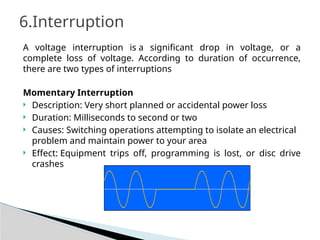
A voltage interruption is a significant drop in voltage, or a
complete loss of voltage. According to duration of occurrence,
there are two types of interruptions
Momentary Interruption
 Description: Very short planned or accidental power loss
 Duration: Milliseconds to second or two
 Causes: Switching operations attempting to isolate an electrical
problem and maintain power to your area
 Effect: Equipment trips off, programming is lost, or disc drive
crashes
6.Interruption
Long Term Interruption
 Description: Planned or accidental total loss of power in a
localized area of community
 Duration: Over 2 minutes
 Causes: Equipment failure, weather, animals, human error (auto
accidents, kites, etc.)
 Effect: Systems shut down
1. An under voltage is a decrease in the rms ac voltage to less than
90% at the power frequency for a duration longer than I min.
2. Under voltage & Overvoltage comes under long duration Voltage
variations.
3. An Overvoltage is an increase in the rms ac voltage greater than
10% at the power frequency for a duration longer than 1 min.
4.Causes
a. Power System Faults
b. Equipment Failure
c. Control Malfunction
d. Loose Connection
7. Over-Voltage & Under-Voltage:
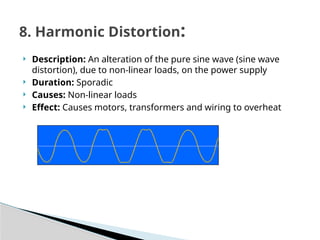
 Description: An alteration of the pure sine wave (sine wave
distortion), due to non-linear loads, on the power supply
 Duration: Sporadic
 Causes: Non-linear loads
 Effect: Causes motors, transformers and wiring to overheat
8. Harmonic Distortion:
Thank You….

Power Quality Issues.pptx

  • 1.
    Sharad Institute ofTechnology, College of Engineering, Yadrav Electrical Engineering Department Presented By: Ms. Patil P. B. Ass. Professor Topic: Power Quality Issues
  • 2.
    Power Quality Issues a.Short duration voltage variation 1) Voltage Sag 2) Voltage Swell 3) Voltage Imbalance Fluctuations 4) Interruption 5) Voltage Spikes b. Long duration voltage variation 1) Overvoltage 2) Under voltage c. Harmonic Distortion Content:
  • 3.
    a. A sagis decrease to between 0.1& 0.9 p.u. in rms voltage or current at the power frequency for duration from 0.5 cycle to 1 min. b. Voltage Sag is also known as Voltage dip. c. Causes: 1. Electric motor draws heavy current at starting 2. Line to ground fault 3. Various accidents in power lines 4. Due to excessive loads d. Voltage Sag Occurs at: 1. Utility System 2. Inside industrial plant 1. VOLTAGE SAG
  • 4.
    e. Effect ofVoltage Sag On Commercial Installation: 1. Flickering Of Light 2. Tripping Of MCB 3. PLC of escalator may drop off
  • 5.
    1. A swellis defined as an increase to between 1.1 & 1.8 p.u. in rms voltage or current at the power frequency for duration from 0.5 cycle to 1.0 min. 2. The voltage swell is mainly due to Start/stop of heavy loads, badly dimensioned power sources, badly regulated transformers during off peak hours. 2. VOLTAGE SWELL:
  • 6.
    1. Loads thatcan exhibit continuous, rapid variations in the load current magnitude can cause voltage variations that are often referred as flicker, 2. Effects of Voltage Fluctuations a. Hardware failure b. Crashes in PLC 3. Causes Of Voltage Fluctuations a. Oscillating Load b. Loads with continuous variation in current 3. VOLTAGE FLUCTUATIONS:
  • 7.
     A notchis a condition when the magnitude of voltage decreases towards zero for a short period of time (usually in microseconds).  Duration: Microseconds  Causes: Utility switching operations, starting and stopping equipment or machinery, static discharges, lightning  Effect: Processing errors, data loss, burned circuit boards 4.Notch
  • 8.
     Description: Powerquality noise is unwanted high-frequency electrical signals that can disrupt equipment.  Duration: Sporadic  Causes: Electromagnetic interference: from appliances, microwave and radar transmissions; from radio and TV broadcasts, arc welding, heaters; from laser printers, thermostats, loose wiring; or from improper grounding.  Effect: Disturbs sensitive electronic equipment, but is usually not destructive. It can cause processing errors and data loss. 5.Noise
  • 9.
    A voltage interruptionis a significant drop in voltage, or a complete loss of voltage. According to duration of occurrence, there are two types of interruptions Momentary Interruption  Description: Very short planned or accidental power loss  Duration: Milliseconds to second or two  Causes: Switching operations attempting to isolate an electrical problem and maintain power to your area  Effect: Equipment trips off, programming is lost, or disc drive crashes 6.Interruption
  • 10.
    Long Term Interruption Description: Planned or accidental total loss of power in a localized area of community  Duration: Over 2 minutes  Causes: Equipment failure, weather, animals, human error (auto accidents, kites, etc.)  Effect: Systems shut down
  • 11.
    1. An undervoltage is a decrease in the rms ac voltage to less than 90% at the power frequency for a duration longer than I min. 2. Under voltage & Overvoltage comes under long duration Voltage variations. 3. An Overvoltage is an increase in the rms ac voltage greater than 10% at the power frequency for a duration longer than 1 min. 4.Causes a. Power System Faults b. Equipment Failure c. Control Malfunction d. Loose Connection 7. Over-Voltage & Under-Voltage:
  • 12.
     Description: Analteration of the pure sine wave (sine wave distortion), due to non-linear loads, on the power supply  Duration: Sporadic  Causes: Non-linear loads  Effect: Causes motors, transformers and wiring to overheat 8. Harmonic Distortion:
  • 13.