Chapter 9: Electronic Commerce Software Electronic Commerce, Sixth Edition
Objectives In this chapter, you will learn about: Finding and evaluating Web hosting services Basic functions of electronic commerce software Advanced functions of electronic commerce software
Objectives (continued) Electronic commerce software for small and midsize businesses Electronic commerce software for midsize to large businesses Electronic commerce software for large businesses that have an existing information technology infrastructure
Web Hosting Alternatives Self-hosting Running servers in-house Commerce service providers (CSPs) Provide Internet access to companies and individuals Offer Web server management and the renting of application software
Web Hosting Alternatives (continued) Shared hosting Client’s Web site is on a server that hosts other Web sites simultaneously  Dedicated hosting Service provider makes a Web server available to a client Co-location Service provider rents a physical space to the client to install its own server hardware
Basic Functions of Electronic Commerce Software  All electronic commerce solutions must provide A catalog display Shopping cart capabilities Transaction processing
Basic Functions of Electronic Commerce Software (continued) Additional software components Middleware  Application integration Web services Integration with enterprise resource planning (ERP) software Supply chain management (SCM) software
Catalog Display Catalog Listing of goods and services Static catalog Simple list written in HTML that appears on a Web page  Dynamic catalog Stores information about items in a database
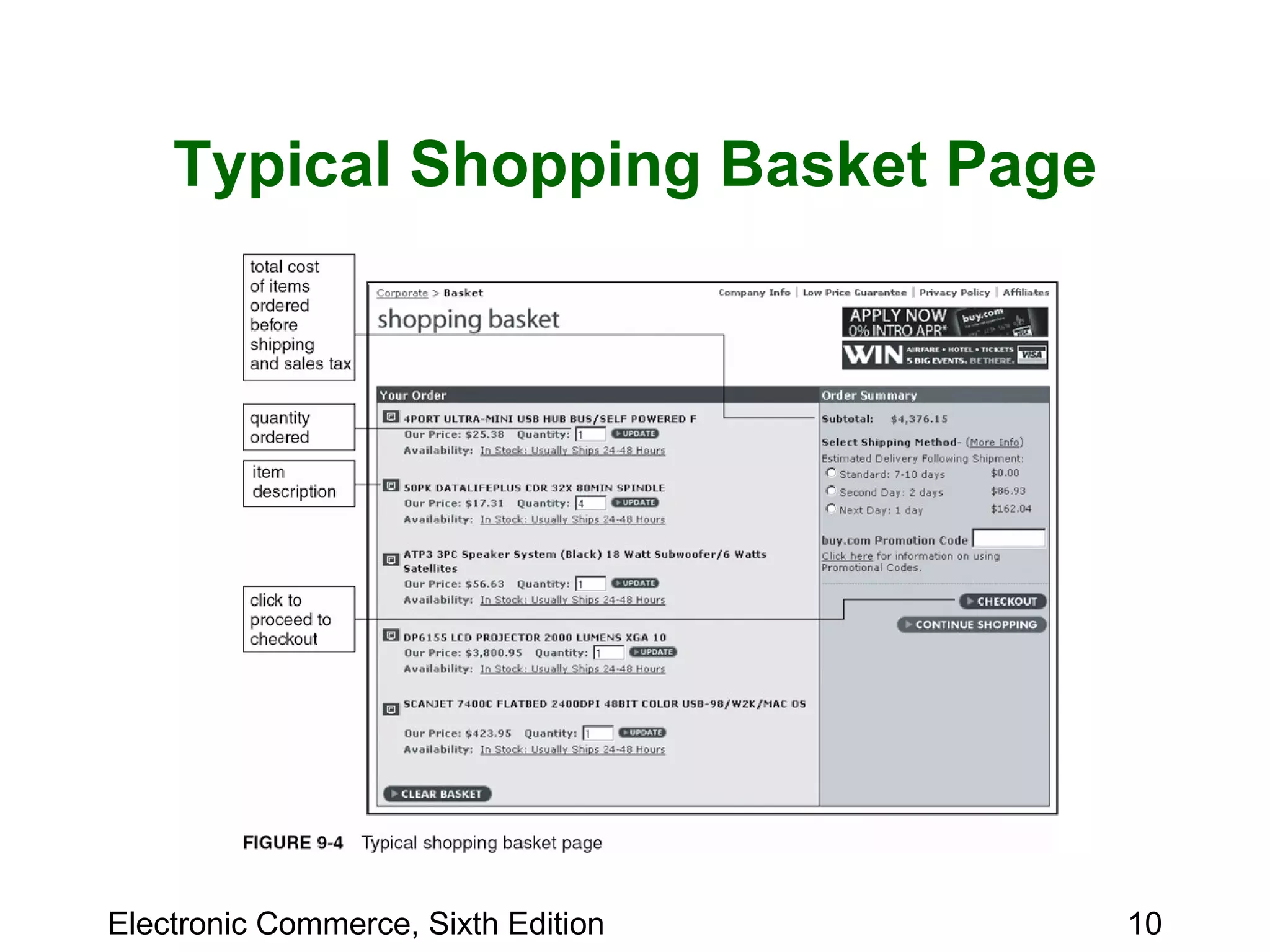
Shopping Cart Shopping cart Keeps track of items a customer has selected  Allows customers to view contents of their carts, add new items, or remove items
Typical Shopping Basket Page
Transaction Processing Occurs when a shopper proceeds to the virtual checkout counter by clicking a checkout button Calculation complications Computing taxes and shipping costs Provisions for coupons, special promotions, and time-sensitive offers
Advanced Functions of Electronic Commerce Software Middleware Establishes a connection between electronic commerce software and an accounting system Interoperability Making a company’s information systems work together
Enterprise Application Integration and Databases Application program Program that performs a specific function Application server Computer that takes request messages received by the Web server and runs application programs  Business logic Rules used in the business
Application Integration and Databases (continued) Page-based application systems   Return pages generated by scripts  Component-based application system   Separates presentation logic from business logic Database manager Software that stores information in a highly structured way
Application Integration and Databases (continued) Distributed information systems Large information systems that store the same data in many different physical locations Distributed database systems Databases within distributed information systems
Web Services Combination of software tools that let application software in one organization communicate with other applications over a network A self-contained, modular unit of application logic that provides some business functionality to other applications through an Internet connection Companies are using Web services to offer improved customer service and reduce costs
SOAP, UDDI, and WSDL Simple Object Access Protocol (SOAP)  Message-passing protocol  Web Services Description Language (WSDL) Describes characteristics of logic units that make up specific Web services Universal Description, Discovery, and Integration (UDDI) specification Set of protocols that identify locations of Web services and their associated WSDL descriptions
Integration with ERP Systems Enterprise resource planning (ERP) software packages  Business systems that integrate all facets of a business Major ERP vendors Baan, Oracle, PeopleSoft, and SAP Typical installation of ERP software costs between $2 million and $25 million
Electronic Commerce Software for Small and Midsize Companies CSPs Have same advantages as ISP hosting services Low cost is biggest single advantage  Offer free or low-cost electronic commerce software for building electronic commerce sites
Mall-Style Commerce Service Providers Provide small businesses with  Internet connection Web site creation tools Little or no banner advertising clutter Provide shopping cart software  CSPs that offer mall-style commerce services eBay Stores and Yahoo! Store
Electronic Commerce Software for Midsize to Large Businesses Midrange packages allow a merchant to have explicit control over  Merchandising choices Site layout Internal architecture Remote and local management options
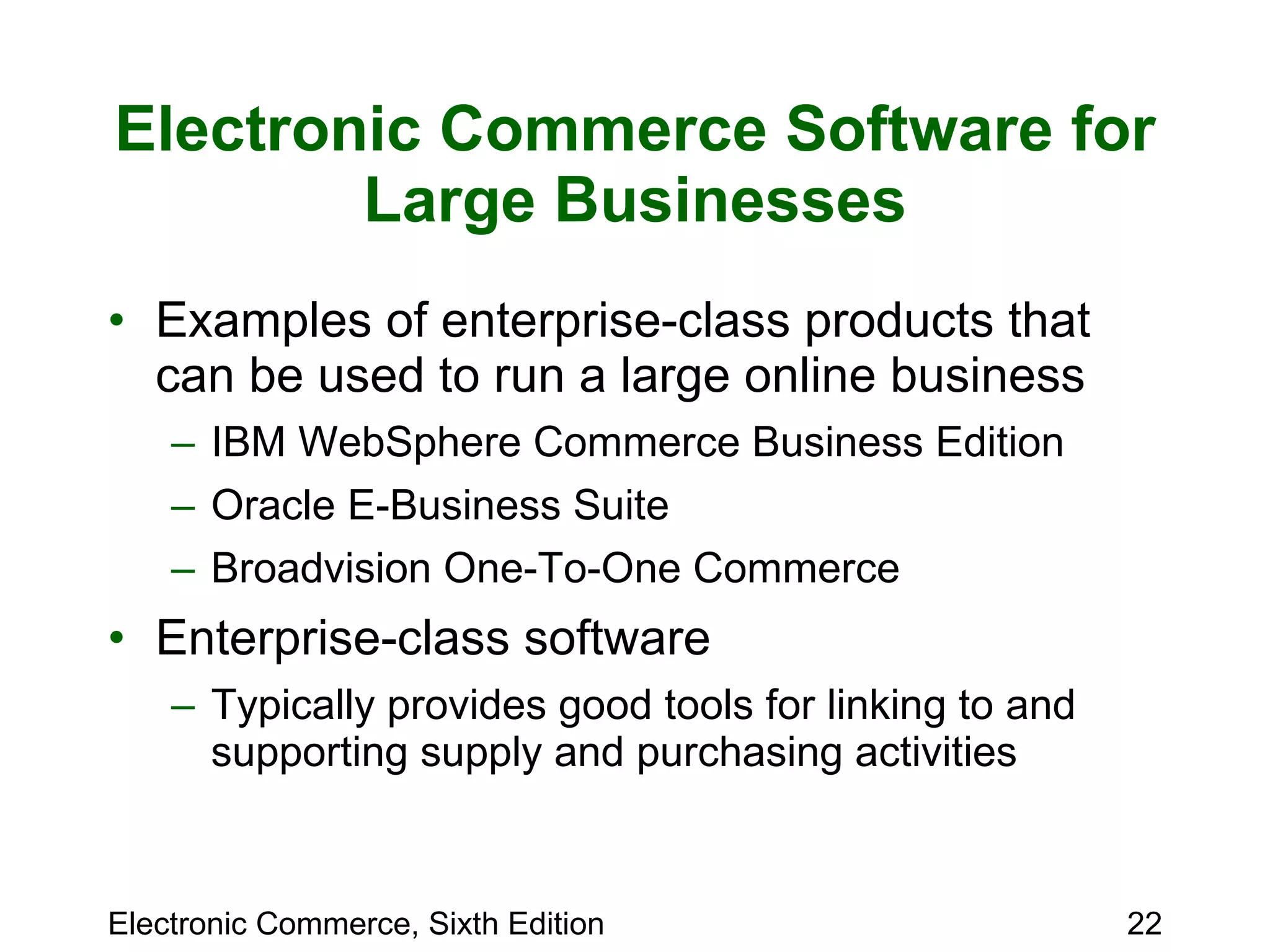
Electronic Commerce Software for Large Businesses Examples of enterprise-class products that can be used to run a large online business IBM WebSphere Commerce Business Edition Oracle E-Business Suite Broadvision One-To-One Commerce Enterprise-class software Typically provides good tools for linking to and supporting supply and purchasing activities
Typical Enterprise-Class Electronic Commerce Architecture
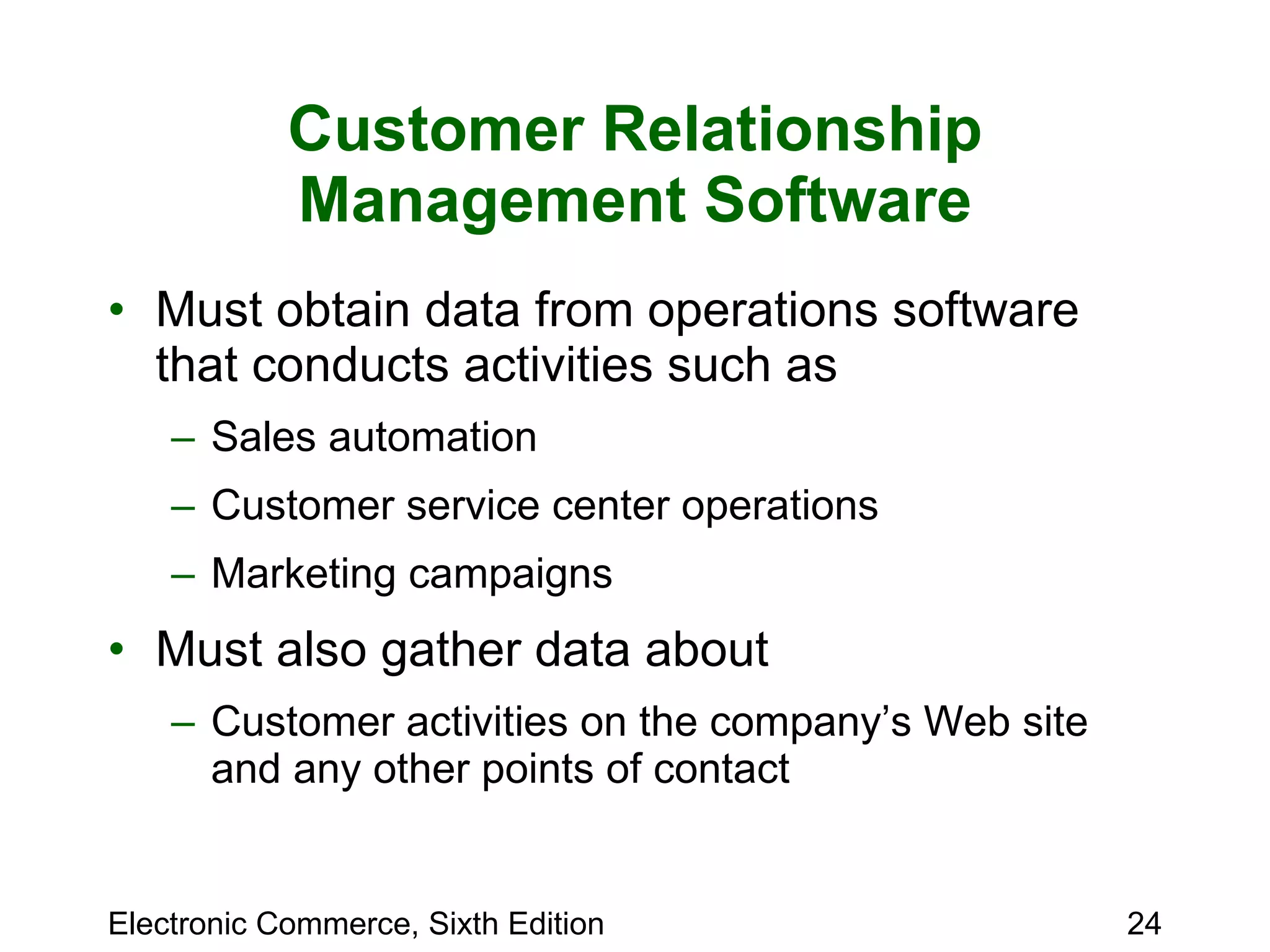
Customer Relationship Management Software Must obtain data from operations software that conducts activities such as Sales automation Customer service center operations Marketing campaigns Must also gather data about  Customer activities on the company’s Web site and any other points of contact
Supply Chain Management Software Helps companies to coordinate planning and operations with their partners in the industry supply chains  Performs two general types of functions Planning Execution
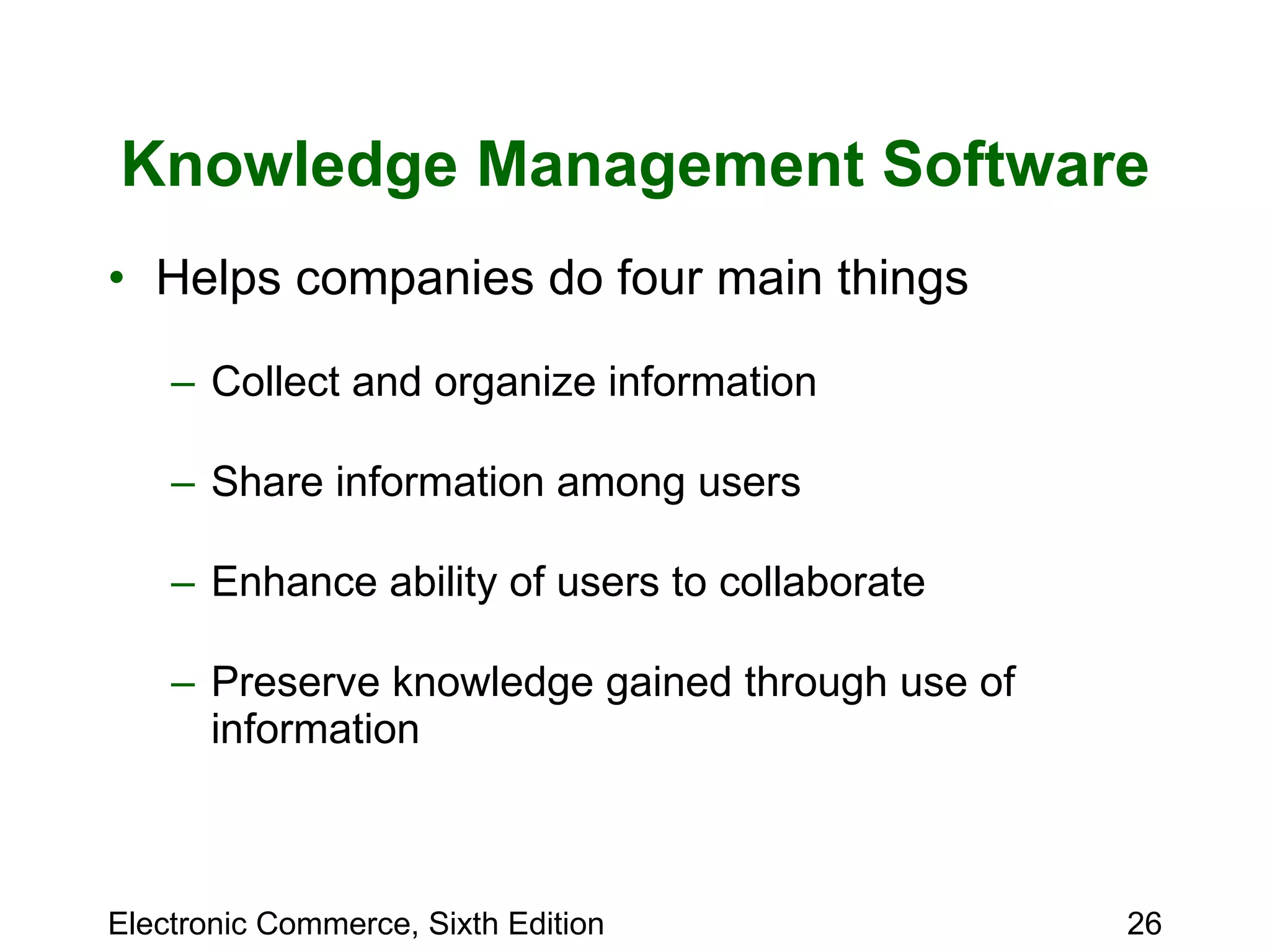
Knowledge Management Software Helps companies do four main things Collect and organize information Share information among users Enhance ability of users to collaborate Preserve knowledge gained through use of information
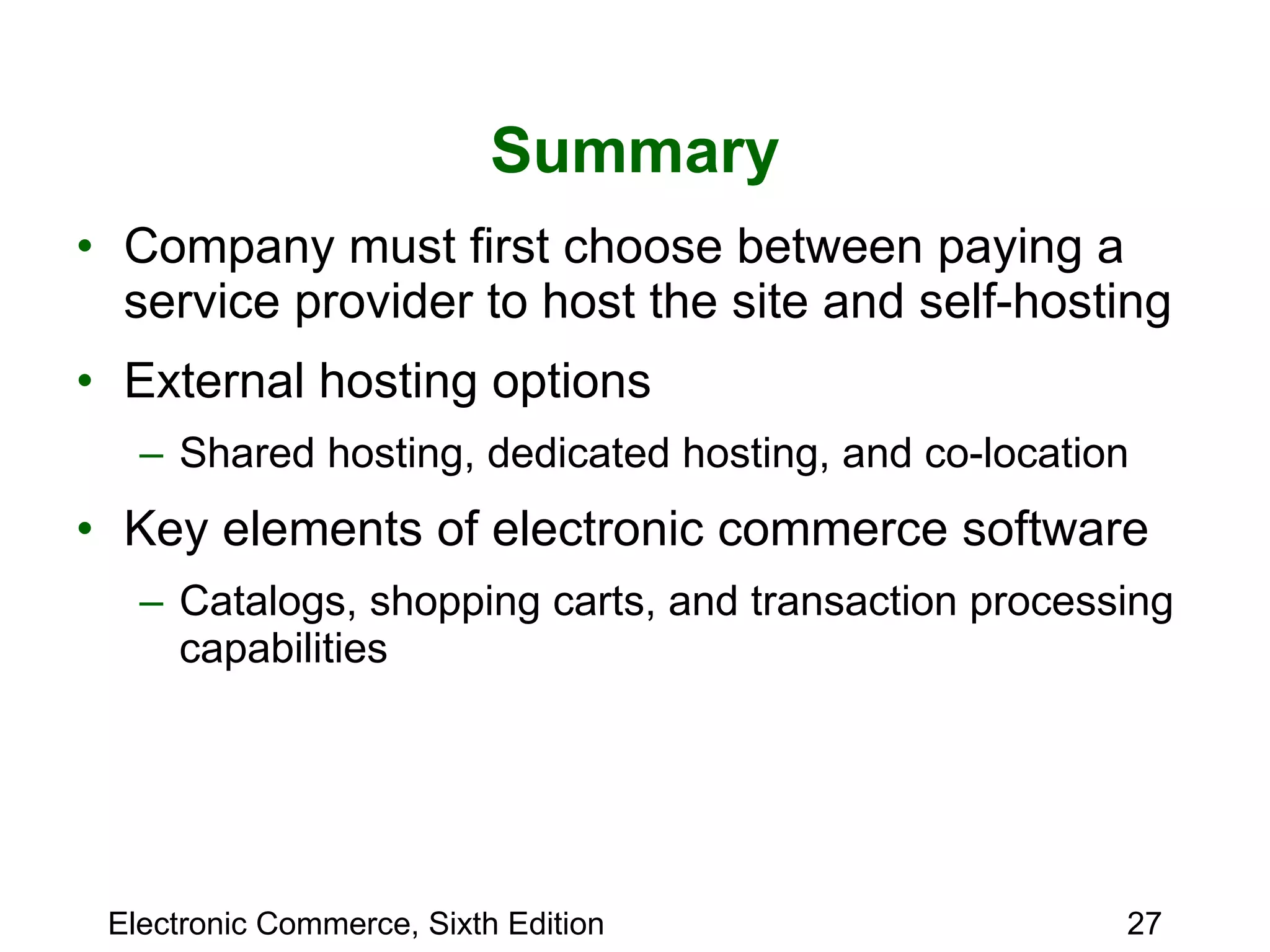
Summary Company must first choose between paying a service provider to host the site and self-hosting External hosting options  Shared hosting, dedicated hosting, and co-location Key elements of electronic commerce software Catalogs, shopping carts, and transaction processing capabilities
Summary (continued) Commerce service provider (CSP) Used by small enterprises just starting an electronic commerce initiative  If a company already has computing equipment and staff in place purchasing a midrange electronic commerce software package provides more control over a site Large enterprises with high transaction rates need to invest in larger, more customizable systems

Power Point

  • 1.
    Chapter 9: ElectronicCommerce Software Electronic Commerce, Sixth Edition
  • 2.
    Objectives In thischapter, you will learn about: Finding and evaluating Web hosting services Basic functions of electronic commerce software Advanced functions of electronic commerce software
  • 3.
    Objectives (continued) Electroniccommerce software for small and midsize businesses Electronic commerce software for midsize to large businesses Electronic commerce software for large businesses that have an existing information technology infrastructure
  • 4.
    Web Hosting AlternativesSelf-hosting Running servers in-house Commerce service providers (CSPs) Provide Internet access to companies and individuals Offer Web server management and the renting of application software
  • 5.
    Web Hosting Alternatives(continued) Shared hosting Client’s Web site is on a server that hosts other Web sites simultaneously Dedicated hosting Service provider makes a Web server available to a client Co-location Service provider rents a physical space to the client to install its own server hardware
  • 6.
    Basic Functions ofElectronic Commerce Software All electronic commerce solutions must provide A catalog display Shopping cart capabilities Transaction processing
  • 7.
    Basic Functions ofElectronic Commerce Software (continued) Additional software components Middleware Application integration Web services Integration with enterprise resource planning (ERP) software Supply chain management (SCM) software
  • 8.
    Catalog Display CatalogListing of goods and services Static catalog Simple list written in HTML that appears on a Web page Dynamic catalog Stores information about items in a database
  • 9.
    Shopping Cart Shoppingcart Keeps track of items a customer has selected Allows customers to view contents of their carts, add new items, or remove items
  • 10.
  • 11.
    Transaction Processing Occurswhen a shopper proceeds to the virtual checkout counter by clicking a checkout button Calculation complications Computing taxes and shipping costs Provisions for coupons, special promotions, and time-sensitive offers
  • 12.
    Advanced Functions ofElectronic Commerce Software Middleware Establishes a connection between electronic commerce software and an accounting system Interoperability Making a company’s information systems work together
  • 13.
    Enterprise Application Integrationand Databases Application program Program that performs a specific function Application server Computer that takes request messages received by the Web server and runs application programs Business logic Rules used in the business
  • 14.
    Application Integration andDatabases (continued) Page-based application systems Return pages generated by scripts Component-based application system Separates presentation logic from business logic Database manager Software that stores information in a highly structured way
  • 15.
    Application Integration andDatabases (continued) Distributed information systems Large information systems that store the same data in many different physical locations Distributed database systems Databases within distributed information systems
  • 16.
    Web Services Combinationof software tools that let application software in one organization communicate with other applications over a network A self-contained, modular unit of application logic that provides some business functionality to other applications through an Internet connection Companies are using Web services to offer improved customer service and reduce costs
  • 17.
    SOAP, UDDI, andWSDL Simple Object Access Protocol (SOAP) Message-passing protocol Web Services Description Language (WSDL) Describes characteristics of logic units that make up specific Web services Universal Description, Discovery, and Integration (UDDI) specification Set of protocols that identify locations of Web services and their associated WSDL descriptions
  • 18.
    Integration with ERPSystems Enterprise resource planning (ERP) software packages Business systems that integrate all facets of a business Major ERP vendors Baan, Oracle, PeopleSoft, and SAP Typical installation of ERP software costs between $2 million and $25 million
  • 19.
    Electronic Commerce Softwarefor Small and Midsize Companies CSPs Have same advantages as ISP hosting services Low cost is biggest single advantage Offer free or low-cost electronic commerce software for building electronic commerce sites
  • 20.
    Mall-Style Commerce ServiceProviders Provide small businesses with Internet connection Web site creation tools Little or no banner advertising clutter Provide shopping cart software CSPs that offer mall-style commerce services eBay Stores and Yahoo! Store
  • 21.
    Electronic Commerce Softwarefor Midsize to Large Businesses Midrange packages allow a merchant to have explicit control over Merchandising choices Site layout Internal architecture Remote and local management options
  • 22.
    Electronic Commerce Softwarefor Large Businesses Examples of enterprise-class products that can be used to run a large online business IBM WebSphere Commerce Business Edition Oracle E-Business Suite Broadvision One-To-One Commerce Enterprise-class software Typically provides good tools for linking to and supporting supply and purchasing activities
  • 23.
  • 24.
    Customer Relationship ManagementSoftware Must obtain data from operations software that conducts activities such as Sales automation Customer service center operations Marketing campaigns Must also gather data about Customer activities on the company’s Web site and any other points of contact
  • 25.
    Supply Chain ManagementSoftware Helps companies to coordinate planning and operations with their partners in the industry supply chains Performs two general types of functions Planning Execution
  • 26.
    Knowledge Management SoftwareHelps companies do four main things Collect and organize information Share information among users Enhance ability of users to collaborate Preserve knowledge gained through use of information
  • 27.
    Summary Company mustfirst choose between paying a service provider to host the site and self-hosting External hosting options Shared hosting, dedicated hosting, and co-location Key elements of electronic commerce software Catalogs, shopping carts, and transaction processing capabilities
  • 28.
    Summary (continued) Commerceservice provider (CSP) Used by small enterprises just starting an electronic commerce initiative If a company already has computing equipment and staff in place purchasing a midrange electronic commerce software package provides more control over a site Large enterprises with high transaction rates need to invest in larger, more customizable systems