• NÚRIA GÁLVEZ
• TEO VIZUETE
• MAHAMADOU
SUMBUNDU
• CLAUIDA GARCIA
HYDROSPHERE
• The hydrosphere in physical geography describes the
combined mass of water found on, under, and over the
surface of a planet.
• In the planet there are 1386 million cubic kilometers of water
on earth. This includes water in liquid and frozen forms in
groundwater's, glaciers, oceans, lakes and streams. Saline
water account for 97.5% of this amount.
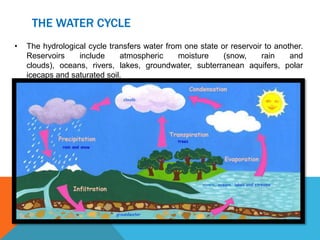
THE WATER CYCLE
•

The hydrological cycle transfers water from one state or reservoir to another.
Reservoirs
include
atmospheric
moisture
(snow,
rain
and
clouds), oceans, rivers, lakes, groundwater, subterranean aquifers, polar
icecaps and saturated soil.
HOW MUCH WATER ARE ON THE EARTH
•

The Earth is a watery place. But just how much water exists
on, in, and above our planet? About 70 percent of the Earth's surface
is water-covered, and the oceans hold about 96.5 percent of all
Earth's water. But water also exists in the air as water vapor, in rivers
and lakes, in icecaps and glaciers.
EXPERIMENT 1

1. Assemble the instrument that we use.
2. Put the water into the burette.
3. After five minutes we see that inside the vessel of
precipitates there are 12 ml.
EXPERIMENT 2

1. Cut the bottle to the bottom.
2. PESAR the beaker without water.
3. PESAR the beaker with water.
4. PESAR the beaker with water mixed with soil .
5. PESAR the beaker with water mixed with other soil.
REASONS FOR SAVING WATER
• We spend a lot of water
• When the water seeps into the ground, all of the water don’t
arrive to the sea.
• Not all the countries rain the same quantity of water.

• In this society we have many factories and we also have
washing machines
Power point 2na ii+d

Power point 2na ii+d

  • 1.
    • NÚRIA GÁLVEZ •TEO VIZUETE • MAHAMADOU SUMBUNDU • CLAUIDA GARCIA
  • 2.
    HYDROSPHERE • The hydrospherein physical geography describes the combined mass of water found on, under, and over the surface of a planet. • In the planet there are 1386 million cubic kilometers of water on earth. This includes water in liquid and frozen forms in groundwater's, glaciers, oceans, lakes and streams. Saline water account for 97.5% of this amount.
  • 3.
    THE WATER CYCLE • Thehydrological cycle transfers water from one state or reservoir to another. Reservoirs include atmospheric moisture (snow, rain and clouds), oceans, rivers, lakes, groundwater, subterranean aquifers, polar icecaps and saturated soil.
  • 4.
    HOW MUCH WATERARE ON THE EARTH • The Earth is a watery place. But just how much water exists on, in, and above our planet? About 70 percent of the Earth's surface is water-covered, and the oceans hold about 96.5 percent of all Earth's water. But water also exists in the air as water vapor, in rivers and lakes, in icecaps and glaciers.
  • 5.
    EXPERIMENT 1 1. Assemblethe instrument that we use. 2. Put the water into the burette. 3. After five minutes we see that inside the vessel of precipitates there are 12 ml.
  • 6.
    EXPERIMENT 2 1. Cutthe bottle to the bottom. 2. PESAR the beaker without water. 3. PESAR the beaker with water. 4. PESAR the beaker with water mixed with soil . 5. PESAR the beaker with water mixed with other soil.
  • 7.
    REASONS FOR SAVINGWATER • We spend a lot of water • When the water seeps into the ground, all of the water don’t arrive to the sea. • Not all the countries rain the same quantity of water. • In this society we have many factories and we also have washing machines