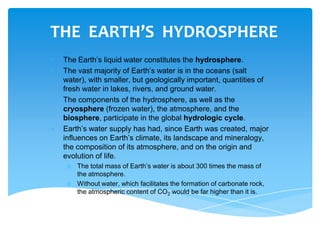
THE  EARTH’S  HYDROSPHEREThe Earth’s liquid water constitutes the hydrosphere.
The vast majority of Earth’s water is in the oceans (salt water), with smaller, but geologically important, quantities of fresh water in lakes, rivers, and ground water.
The components of the hydrosphere, as well as the cryosphere (frozen water), the atmosphere, and the biosphere, participate in the global hydrologic cycle.
Earth’s water supply has had, since Earth was created, major influences on Earth’s climate, its landscape and mineralogy, the composition of its atmosphere, and on the origin and evolution of life.
The total mass of Earth’s water is about 300 times the mass of the atmosphere.
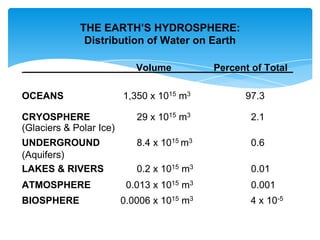
Without water, which facilitates the formation of carbonate rock, the atmospheric content of CO2 would be far higher than it is.                                          Volume		Percent of Total_OCEANS	   	  1,350 x 1015 m3		97.3CRYOSPHERE	       29 x 1015 m3		  2.1(Glaciers & Polar Ice)UNDERGROUND	       8.4 x 10¹⁵ m3		  0.6(Aquifers)LAKES & RIVERS	       0.2 x 10¹⁵ m3		  0.01ATMOSPHERE	   0.013 x 10¹⁵ m3	  	  0.001BIOSPHERE		 0.0006 x 10¹⁵ m3                        4 x 10⁻⁵THE EARTH’S HYDROSPHERE:Distribution of Water on Earth
		Distribution of Water on Earth
The Hydrologic Cycle

The earth’s hydrosphere

  • 1.
    THE EARTH’S HYDROSPHEREThe Earth’s liquid water constitutes the hydrosphere.
  • 2.
    The vast majorityof Earth’s water is in the oceans (salt water), with smaller, but geologically important, quantities of fresh water in lakes, rivers, and ground water.
  • 3.
    The components ofthe hydrosphere, as well as the cryosphere (frozen water), the atmosphere, and the biosphere, participate in the global hydrologic cycle.
  • 4.
    Earth’s water supplyhas had, since Earth was created, major influences on Earth’s climate, its landscape and mineralogy, the composition of its atmosphere, and on the origin and evolution of life.
  • 5.
    The total massof Earth’s water is about 300 times the mass of the atmosphere.
  • 6.
    Without water, whichfacilitates the formation of carbonate rock, the atmospheric content of CO2 would be far higher than it is. Volume Percent of Total_OCEANS 1,350 x 1015 m3 97.3CRYOSPHERE 29 x 1015 m3 2.1(Glaciers & Polar Ice)UNDERGROUND 8.4 x 10¹⁵ m3 0.6(Aquifers)LAKES & RIVERS 0.2 x 10¹⁵ m3 0.01ATMOSPHERE 0.013 x 10¹⁵ m3 0.001BIOSPHERE 0.0006 x 10¹⁵ m3 4 x 10⁻⁵THE EARTH’S HYDROSPHERE:Distribution of Water on Earth
  • 7.
  • 9.