The Hydrosphere, Freshwater
Distribution, and the Water Cycle
ENGAGE
You walk by this stream every day on your way
home from school. But today, something is
different – you notice some dead fish in the water!
?What might have caused this?
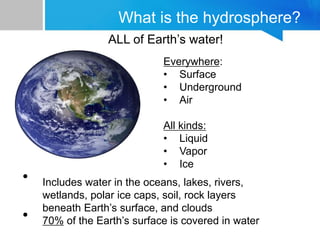
What is the hydrosphere?
ALL of Earth’s water!
Everywhere:
• Surface
• Underground
• Air
All kinds:
• Liquid
• Vapor
• Ice
• Includes water in the oceans, lakes, rivers,
wetlands, polar ice caps, soil, rock layers
beneath Earth’s surface, and clouds
• 70% of the Earth’s surface is covered in water
Why is water important?
 Supports life
 Helps form weather
 Shapes the surface of Earth
PROPERTIES OF WATER
1. Could be in liquid form, not just solid or
and gas
- can travel different places and reach
organisms
- it picks up nutrients and other
materials that oanisms need to survive.
- its being liquid form makes it easy to
circulate in the system of organisms.
PROPERTIES OF WATER
2. Has neutral pH
- neither acidic nor alkaline
- can be tolerated by organisms without any
harmful reaction to the body
3. Good conductor of heat and energy
- help regulate the overall temperature of Earth
4. High specific heat
- give time to the organism to adapt to any
changes in atmospheric heat like climat change
PROPERTIES OF WATER
5. Univesal solvent
- some of the minerals and substances
needed by organsims can be dissolved by
water.
• 97.2% of all of the water on Earth is found in the
oceans
• Due to the salt content of ocean water, we are
unable to use it
– Salt water can be cleaned by a process known as
desalination
• This leaves only 2.8% of the Earth’s water as
freshwater
• Only 0.8% of which is drinkable
The Earth’s Water
• The 2.8% of
freshwater is
divided into:
– Glaciers and Ice
Caps = 2.15%
– Groundwater =
0.62%
– Surface Water =
0.03%
Freshwater Distribution
• The 0.03% of surface
water is divided into:
– Lakes = 0.017%
– Soil = 0.005%
– Atmosphere = 0.001%
• This refers to water vapor
in the air
– Streams = 0.0001%
Surface Water Distribution
• The previous percentages referred to
all the world’s water but it can be
adjusted to reflect percentages based
on a 100% scale
• Water constantly
moves among the
oceans, the
atmosphere, the
solid Earth, and the
biosphere. This
unending
circulation of
Earth’s water
supply is the water
cycle
The Water Cycle
• _____________________ – the process in which
water pools in large bodies (like oceans, seas and
lakes)
• _____________________ – the process in which
water vapor (a gas) in the air turns into liquid water
– Process by which water forms clouds in the sky
– Process by which water drops form on the outside of a glass
of icy water on a hot day
• _____________________ – the process in which
liquid water becomes water vapor (a gas)
– Water vaporizes from the surfaces of oceans and lakes, from
the surface of the land, and from melts in snow fields
Steps of the Water Cycle
Accumulation
Condensation
Evaporation
• _____________________ – the process in
which water (in the form of rain, snow, sleet,
or hail) falls from clouds in the sky
• _____________________ – the draining
away of water (or substances carried in it)
from the surface of an area
• _____________________ – the process in
which some water within plants evaporates
into the atmosphere
– Water is first absorbed by the plant's roots, then
later exits by evaporating through pores in the
plant.
Steps of the Water Cycle
Precipitation
Runoff
Transpiration
Condensation
Transpiration
Runoff
Precipitation
Accumulation
Evaporation
Condensation
• In the animation, what step of the
water cycle does the rain correspond
to?
• Are there other items in the animation
that correspond to steps of the water
cycle?
Water Cycle Animation

hydrosphere.pptx

  • 1.
  • 2.
    ENGAGE You walk bythis stream every day on your way home from school. But today, something is different – you notice some dead fish in the water! ?What might have caused this?
  • 3.
    What is thehydrosphere? ALL of Earth’s water! Everywhere: • Surface • Underground • Air All kinds: • Liquid • Vapor • Ice • Includes water in the oceans, lakes, rivers, wetlands, polar ice caps, soil, rock layers beneath Earth’s surface, and clouds • 70% of the Earth’s surface is covered in water
  • 4.
    Why is waterimportant?  Supports life  Helps form weather  Shapes the surface of Earth
  • 5.
    PROPERTIES OF WATER 1.Could be in liquid form, not just solid or and gas - can travel different places and reach organisms - it picks up nutrients and other materials that oanisms need to survive. - its being liquid form makes it easy to circulate in the system of organisms.
  • 6.
    PROPERTIES OF WATER 2.Has neutral pH - neither acidic nor alkaline - can be tolerated by organisms without any harmful reaction to the body 3. Good conductor of heat and energy - help regulate the overall temperature of Earth 4. High specific heat - give time to the organism to adapt to any changes in atmospheric heat like climat change
  • 7.
    PROPERTIES OF WATER 5.Univesal solvent - some of the minerals and substances needed by organsims can be dissolved by water.
  • 8.
    • 97.2% ofall of the water on Earth is found in the oceans • Due to the salt content of ocean water, we are unable to use it – Salt water can be cleaned by a process known as desalination • This leaves only 2.8% of the Earth’s water as freshwater • Only 0.8% of which is drinkable The Earth’s Water
  • 9.
    • The 2.8%of freshwater is divided into: – Glaciers and Ice Caps = 2.15% – Groundwater = 0.62% – Surface Water = 0.03% Freshwater Distribution
  • 10.
    • The 0.03%of surface water is divided into: – Lakes = 0.017% – Soil = 0.005% – Atmosphere = 0.001% • This refers to water vapor in the air – Streams = 0.0001% Surface Water Distribution
  • 11.
    • The previouspercentages referred to all the world’s water but it can be adjusted to reflect percentages based on a 100% scale
  • 12.
    • Water constantly movesamong the oceans, the atmosphere, the solid Earth, and the biosphere. This unending circulation of Earth’s water supply is the water cycle The Water Cycle
  • 13.
    • _____________________ –the process in which water pools in large bodies (like oceans, seas and lakes) • _____________________ – the process in which water vapor (a gas) in the air turns into liquid water – Process by which water forms clouds in the sky – Process by which water drops form on the outside of a glass of icy water on a hot day • _____________________ – the process in which liquid water becomes water vapor (a gas) – Water vaporizes from the surfaces of oceans and lakes, from the surface of the land, and from melts in snow fields Steps of the Water Cycle Accumulation Condensation Evaporation
  • 14.
    • _____________________ –the process in which water (in the form of rain, snow, sleet, or hail) falls from clouds in the sky • _____________________ – the draining away of water (or substances carried in it) from the surface of an area • _____________________ – the process in which some water within plants evaporates into the atmosphere – Water is first absorbed by the plant's roots, then later exits by evaporating through pores in the plant. Steps of the Water Cycle Precipitation Runoff Transpiration
  • 15.
  • 16.
    • In theanimation, what step of the water cycle does the rain correspond to? • Are there other items in the animation that correspond to steps of the water cycle? Water Cycle Animation

Editor's Notes

  • #3 Show this picture to the class/groups. Ask them to brainstorm ideas on their capture sheets. Then, share ideas as a class. Photo credits: http://graduallygreener.wordpress.com/2009/09/06/sunday-photos-mushroom-hunting/ http://www.thegoldqueen.com/blog-news/love-mystery/attachment/15-sleuth-large/ http://www.clipartguide.com/_pages/0511-1001-1820-1911.html