Institute Of Textile And Fashion
Technology/EiTEX/
Bahir Dar University
Prep. By:- Beyene Dumecha
May, 2008 E.C
Advisor:-
Dr.Solomon T.
MSc in Textile Chemistry
Seminar presentation on power factor
Introduction
• Power Factor gives a reading of overall electricity use
efficiency.
• High power factor indicates that the amount of power
doing real work is operating at a high level of efficiency.
• Conversely, low power factor means poor electricity
efficiency which is always costly.
• Improving power factor can reduce billed peak demand
and enhance equipment reliability.
POWER FACTOR
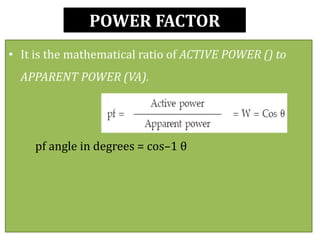
• It is the mathematical ratio of ACTIVE POWER () to
APPARENT POWER (VA).
pf angle in degrees = cos–1 θ
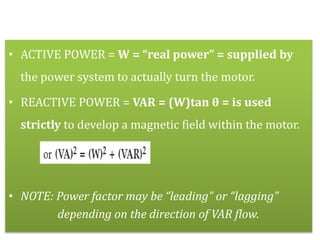
• ACTIVE POWER = W = “real power” = supplied by
the power system to actually turn the motor.
• REACTIVE POWER = VAR = (W)tan θ = is used
strictly to develop a magnetic field within the motor.
• NOTE: Power factor may be “leading” or “lagging”
depending on the direction of VAR flow.
WHY RAISE POWER FACTOR (pf)?
• Low (or “unsatisfactory”) power factor is caused by the
use of inductive (magnetic) devices and can indicate
possible low system electrical operating efficiency.
 These devices are:
• non-power factor corrected fluorescent and high intensity
discharge lighting fixture ballasts (40%-80% pf).
• arc welders (50%-70% pf)
• solenoids (20%-50% pf)
• induction heating equipment (60%-90% pf)
• lifting magnets (20%-50% pf)
• small “dry-pack” transformers (30%-95% pf) and
• most significantly, induction motors (55%-90% pf)
• Induction motors are generally the principal cause of
low power factor because there are so many in use,
and they are usually not fully loaded.
• The correction of the condition of LOW power factor is
a problem of vital economic importance in the
generation, distribution and utilization of A-C power.
• MAJOR BENEFITS OF POWER FACTOR IMPROVEMENT
ARE:
– increased plant capacity,
– reduced power factor “penalty” charges for the electric
utility,
– improvement of voltage supply,
– less power losses in feeders, transformers and
distribution equipment.
WHERE TO CORRECT POWER FACTOR?
• Capacitor correction is relatively inexpensive both in material
and installation costs.
• Capacitors can be installed at any point in the electrical system,
and will improve the power factor between the point of
application and the power source.
• However, the power factor between the utilization equipment
and the capacitor will remain unchanged.
• Capacitors are usually added at each piece of offending
equipment, ahead of groups of small motors (ahead of motor
CAPACITORS
• CAPACITORS can be used to improve the power factor
of a circuit with a large inductive load.
• Current through capacitor LEADS the applied voltage by
90 electrical degrees (VAC), and has the effect of
“opposing” the inductive “LAGGING” current on a
“one-for-one” (VAR) basis.
CAPACITORS
Advantages and Disadvantages of
Capacitor
 Capacitor on each piece of equipment (1,2)
ADVANTAGES
• increases load capabilities of distribution system.
• can be switched with equipment; no additional switching is
required.
• better voltage regulation because capacitor use follows load.
• capacitor sizing is simplified
• capacitors are coupled with equipment and move with equipment if
rearrangements are instituted.
small capacitors cost more per KVAC than larger.
DISADVANTAGES
 Capacitor with equipment group (3)
ADVANTAGES
• increased load capabilities of the service,
• reduced material costs relative to individual correction
• reduced installation costs relative to individual correction
DISADVANTAGES
• switching means may be required to control amount of capacitance
used.
 Capacitor at main service (4,5, & 6)
ADVANTAGES
• low material installation costs.
DISADVANTAGES
• switching will usually be required to control the amount
of capacitance used.
• does not improve the load capabilities of the distribution
system.
OTHER CONSIDERATIONS
• Where the loads contributing to power factor are relatively constant, and
system load capabilities are not a factor, correcting at the main service
could provide a cost advantage.
• When the low power factor is derived from a few selected pieces of
equipment, individual equipment correction would be cost effective.
• Most capacitors used for power factor correction have built-in fusing; if
not, fusing must be provided.
• The application of pf correction capacitors without a thorough analysis of
the system can aggravate rather than correct the problem, particularly if
the fifth and seventh harmonics are present.
• The electronic circuits used in ASDs may be susceptible
to power quality related problems if care is not taken
during application, specification and installation.
• The most common problems include transient over
voltages, voltage sag and harmonic distortion.
• These power quality problems are usually manifested in
the form of nuisance/trouble/ tripping.
POWER QUALITY REQUIREMENTS
• TRANSIENT OVERVOLTAGES—Capacitors are devices
used in the utility power system to provide power factor
correction and voltage stability during periods of heavy
loading.
• Customers may also use capacitors for power factor
correction within their facility.
• When capacitors are energized, a large transient
overvoltage may develop causing the ASD to trip.
• VOLTAGE SAGS—ASDs are very sensitive to temporary reductions in
nominal voltage.
• Typically, voltage sags are caused by faults on either the customer’s or
the utility's electrical system.
• HARMONIC DISTORTION—ASDs introduce harmonics into the power
system due to nonlinear characteristics of power electronics operation.
• Harmonics are components of current and voltage that are multiples of
the normal 60Hz ac sine wave.
• ASDs produce harmonics which, if severe, can cause motor, transformer
and conductor overheating, capacitor failures mis-operation of relays
and controls and reduce system efficiencies.
THANK YOU!!

Power factor

  • 1.
    Institute Of TextileAnd Fashion Technology/EiTEX/ Bahir Dar University Prep. By:- Beyene Dumecha May, 2008 E.C Advisor:- Dr.Solomon T. MSc in Textile Chemistry Seminar presentation on power factor
  • 2.
    Introduction • Power Factorgives a reading of overall electricity use efficiency. • High power factor indicates that the amount of power doing real work is operating at a high level of efficiency. • Conversely, low power factor means poor electricity efficiency which is always costly. • Improving power factor can reduce billed peak demand and enhance equipment reliability.
  • 3.
    POWER FACTOR • Itis the mathematical ratio of ACTIVE POWER () to APPARENT POWER (VA). pf angle in degrees = cos–1 θ
  • 4.
    • ACTIVE POWER= W = “real power” = supplied by the power system to actually turn the motor. • REACTIVE POWER = VAR = (W)tan θ = is used strictly to develop a magnetic field within the motor. • NOTE: Power factor may be “leading” or “lagging” depending on the direction of VAR flow.
  • 5.
    WHY RAISE POWERFACTOR (pf)? • Low (or “unsatisfactory”) power factor is caused by the use of inductive (magnetic) devices and can indicate possible low system electrical operating efficiency.  These devices are: • non-power factor corrected fluorescent and high intensity discharge lighting fixture ballasts (40%-80% pf). • arc welders (50%-70% pf)
  • 6.
    • solenoids (20%-50%pf) • induction heating equipment (60%-90% pf) • lifting magnets (20%-50% pf) • small “dry-pack” transformers (30%-95% pf) and • most significantly, induction motors (55%-90% pf)
  • 7.
    • Induction motorsare generally the principal cause of low power factor because there are so many in use, and they are usually not fully loaded. • The correction of the condition of LOW power factor is a problem of vital economic importance in the generation, distribution and utilization of A-C power.
  • 8.
    • MAJOR BENEFITSOF POWER FACTOR IMPROVEMENT ARE: – increased plant capacity, – reduced power factor “penalty” charges for the electric utility, – improvement of voltage supply, – less power losses in feeders, transformers and distribution equipment.
  • 9.
    WHERE TO CORRECTPOWER FACTOR? • Capacitor correction is relatively inexpensive both in material and installation costs. • Capacitors can be installed at any point in the electrical system, and will improve the power factor between the point of application and the power source. • However, the power factor between the utilization equipment and the capacitor will remain unchanged. • Capacitors are usually added at each piece of offending equipment, ahead of groups of small motors (ahead of motor
  • 10.
    CAPACITORS • CAPACITORS canbe used to improve the power factor of a circuit with a large inductive load. • Current through capacitor LEADS the applied voltage by 90 electrical degrees (VAC), and has the effect of “opposing” the inductive “LAGGING” current on a “one-for-one” (VAR) basis.
  • 11.
  • 12.
  • 13.
     Capacitor oneach piece of equipment (1,2) ADVANTAGES • increases load capabilities of distribution system. • can be switched with equipment; no additional switching is required. • better voltage regulation because capacitor use follows load. • capacitor sizing is simplified • capacitors are coupled with equipment and move with equipment if rearrangements are instituted. small capacitors cost more per KVAC than larger. DISADVANTAGES
  • 14.
     Capacitor withequipment group (3) ADVANTAGES • increased load capabilities of the service, • reduced material costs relative to individual correction • reduced installation costs relative to individual correction DISADVANTAGES • switching means may be required to control amount of capacitance used.
  • 15.
     Capacitor atmain service (4,5, & 6) ADVANTAGES • low material installation costs. DISADVANTAGES • switching will usually be required to control the amount of capacitance used. • does not improve the load capabilities of the distribution system.
  • 16.
    OTHER CONSIDERATIONS • Wherethe loads contributing to power factor are relatively constant, and system load capabilities are not a factor, correcting at the main service could provide a cost advantage. • When the low power factor is derived from a few selected pieces of equipment, individual equipment correction would be cost effective. • Most capacitors used for power factor correction have built-in fusing; if not, fusing must be provided. • The application of pf correction capacitors without a thorough analysis of the system can aggravate rather than correct the problem, particularly if the fifth and seventh harmonics are present.
  • 17.
    • The electroniccircuits used in ASDs may be susceptible to power quality related problems if care is not taken during application, specification and installation. • The most common problems include transient over voltages, voltage sag and harmonic distortion. • These power quality problems are usually manifested in the form of nuisance/trouble/ tripping. POWER QUALITY REQUIREMENTS
  • 18.
    • TRANSIENT OVERVOLTAGES—Capacitorsare devices used in the utility power system to provide power factor correction and voltage stability during periods of heavy loading. • Customers may also use capacitors for power factor correction within their facility. • When capacitors are energized, a large transient overvoltage may develop causing the ASD to trip.
  • 19.
    • VOLTAGE SAGS—ASDsare very sensitive to temporary reductions in nominal voltage. • Typically, voltage sags are caused by faults on either the customer’s or the utility's electrical system. • HARMONIC DISTORTION—ASDs introduce harmonics into the power system due to nonlinear characteristics of power electronics operation. • Harmonics are components of current and voltage that are multiples of the normal 60Hz ac sine wave. • ASDs produce harmonics which, if severe, can cause motor, transformer and conductor overheating, capacitor failures mis-operation of relays and controls and reduce system efficiencies.
  • 20.

Editor's Notes

  • #19  ASDadjustable speed device