UEEC010 –POWER ELECTRONICS
Introduction
D.Poornima,AP/ EEE 1
CONTENTS
What is Power Electronics?
01
Why Power Electronics?
02
Multidisciplinary Nature of
Power Electronics
03
Scope of Power Electronics
04
Applications of Power Electronics
05
D.Poornima,AP/ EEE 2
Types of Power Electronic
Circuits
06
What is Power Electronics??
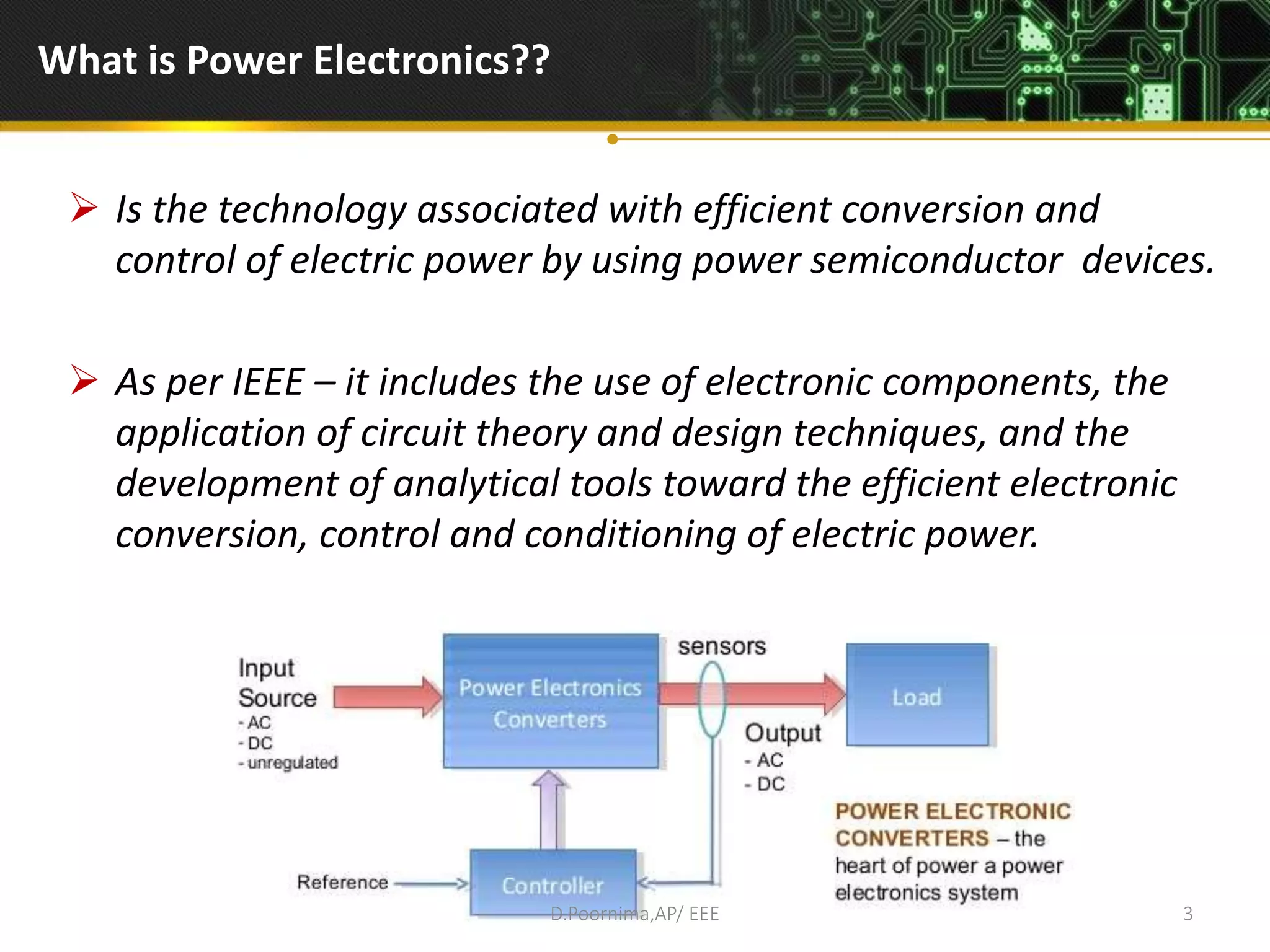
 Is the technology associated with efficient conversion and
control of electric power by using power semiconductor devices.
 As per IEEE – it includes the use of electronic components, the
application of circuit theory and design techniques, and the
development of analytical tools toward the efficient electronic
conversion, control and conditioning of electric power.
D.Poornima,AP/ EEE 3
What is Power Electronics??
 The future of global society will be dominated by :
Computers and Power Electronics : the former provides intelligence
for “what to do” and the latter provides the “means to do it”.
D.Poornima,AP/ EEE 4
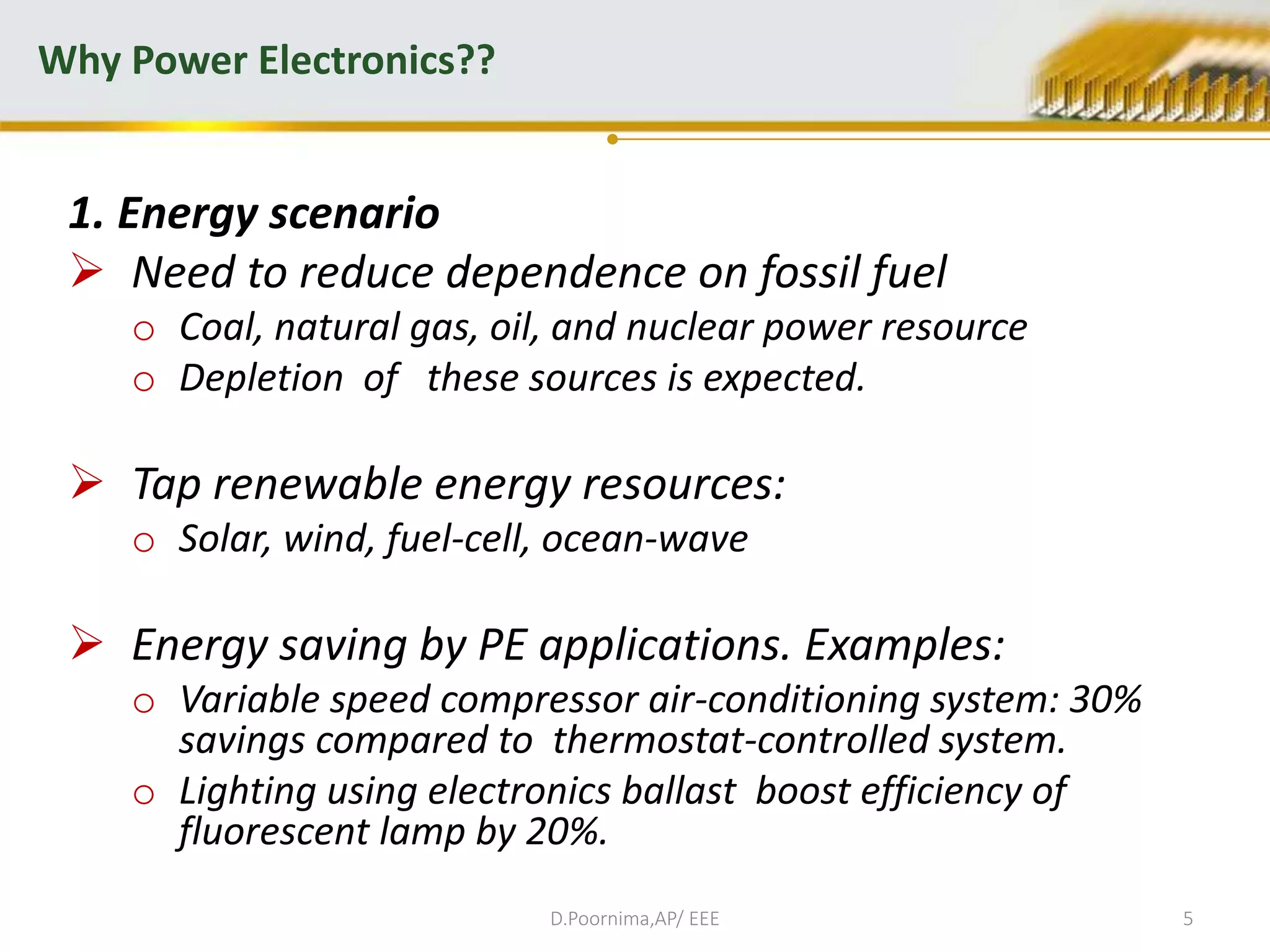
1. Energy scenario
 Need to reduce dependence on fossil fuel
o Coal, natural gas, oil, and nuclear power resource
o Depletion of these sources is expected.
 Tap renewable energy resources:
o Solar, wind, fuel-cell, ocean-wave
 Energy saving by PE applications. Examples:
o Variable speed compressor air-conditioning system: 30%
savings compared to thermostat-controlled system.
o Lighting using electronics ballast boost efficiency of
fluorescent lamp by 20%.
Why Power Electronics??
D.Poornima,AP/ EEE 5
Why Power Electronics??..........
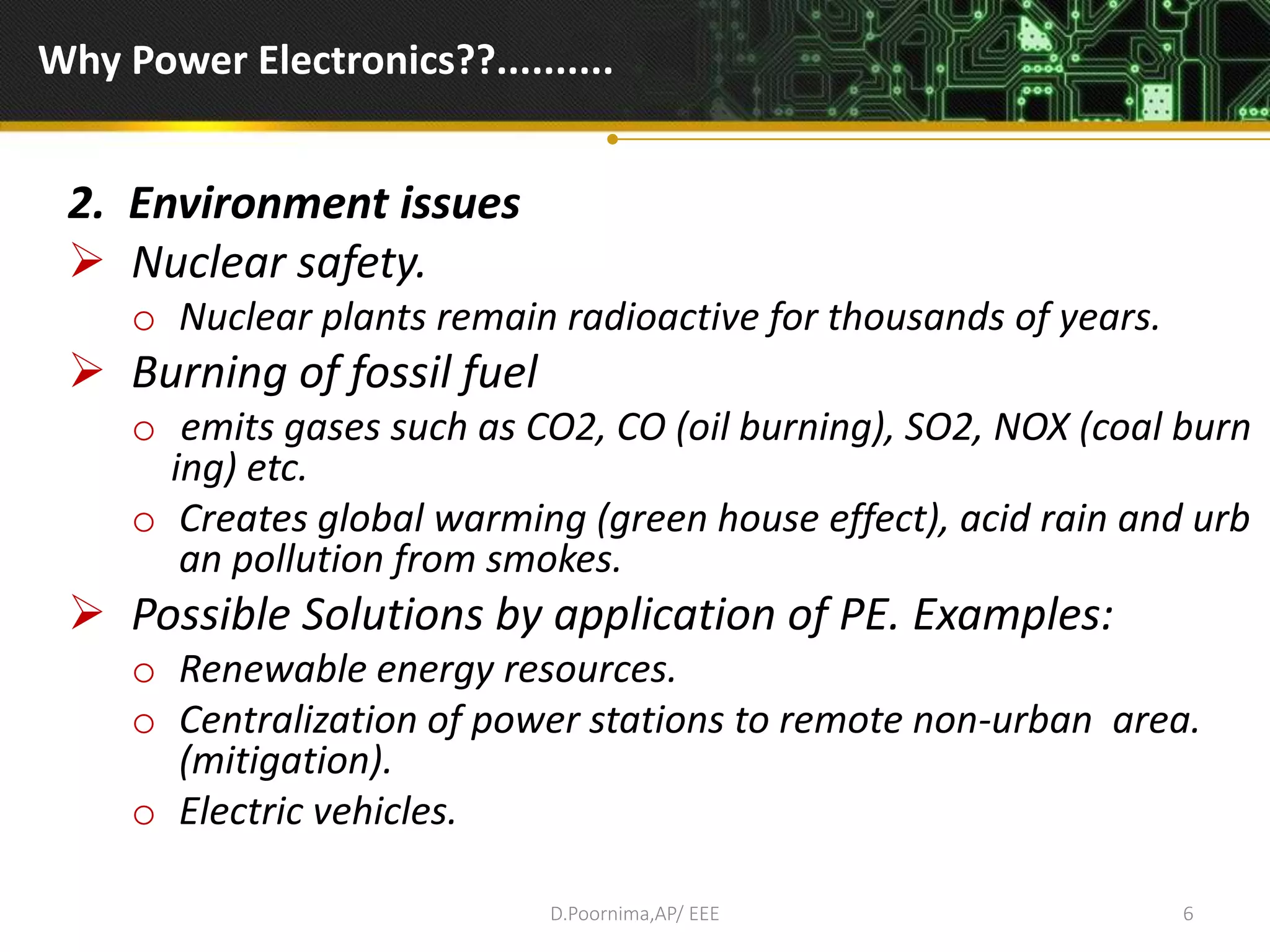
2. Environment issues
 Nuclear safety.
o Nuclear plants remain radioactive for thousands of years.
 Burning of fossil fuel
o emits gases such as CO2, CO (oil burning), SO2, NOX (coal burn
ing) etc.
o Creates global warming (green house effect), acid rain and urb
an pollution from smokes.
 Possible Solutions by application of PE. Examples:
o Renewable energy resources.
o Centralization of power stations to remote non-urban area.
(mitigation).
o Electric vehicles.
D.Poornima,AP/ EEE 6
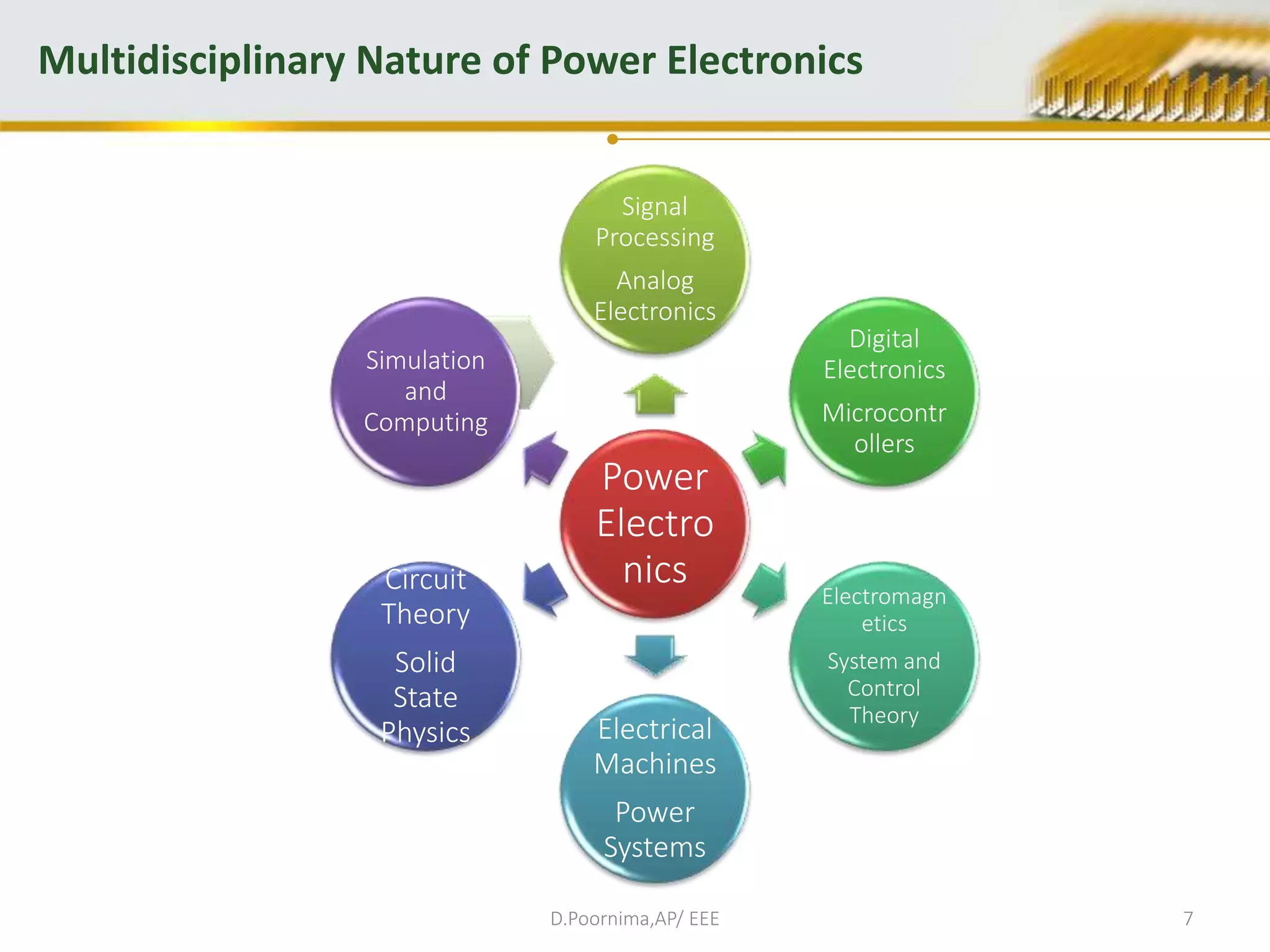
Power
Electro
nics
Signal
Processing
Analog
Electronics
Digital
Electronics
Microcontr
ollers
Electromagn
etics
System and
Control
Theory
Electrical
Machines
Power
Systems
Circuit
Theory
Solid
State
Physics
Simulation
and
Computing
Multidisciplinary Nature of Power Electronics
D.Poornima,AP/ EEE 7
D.Poornima,AP/ EEE 8
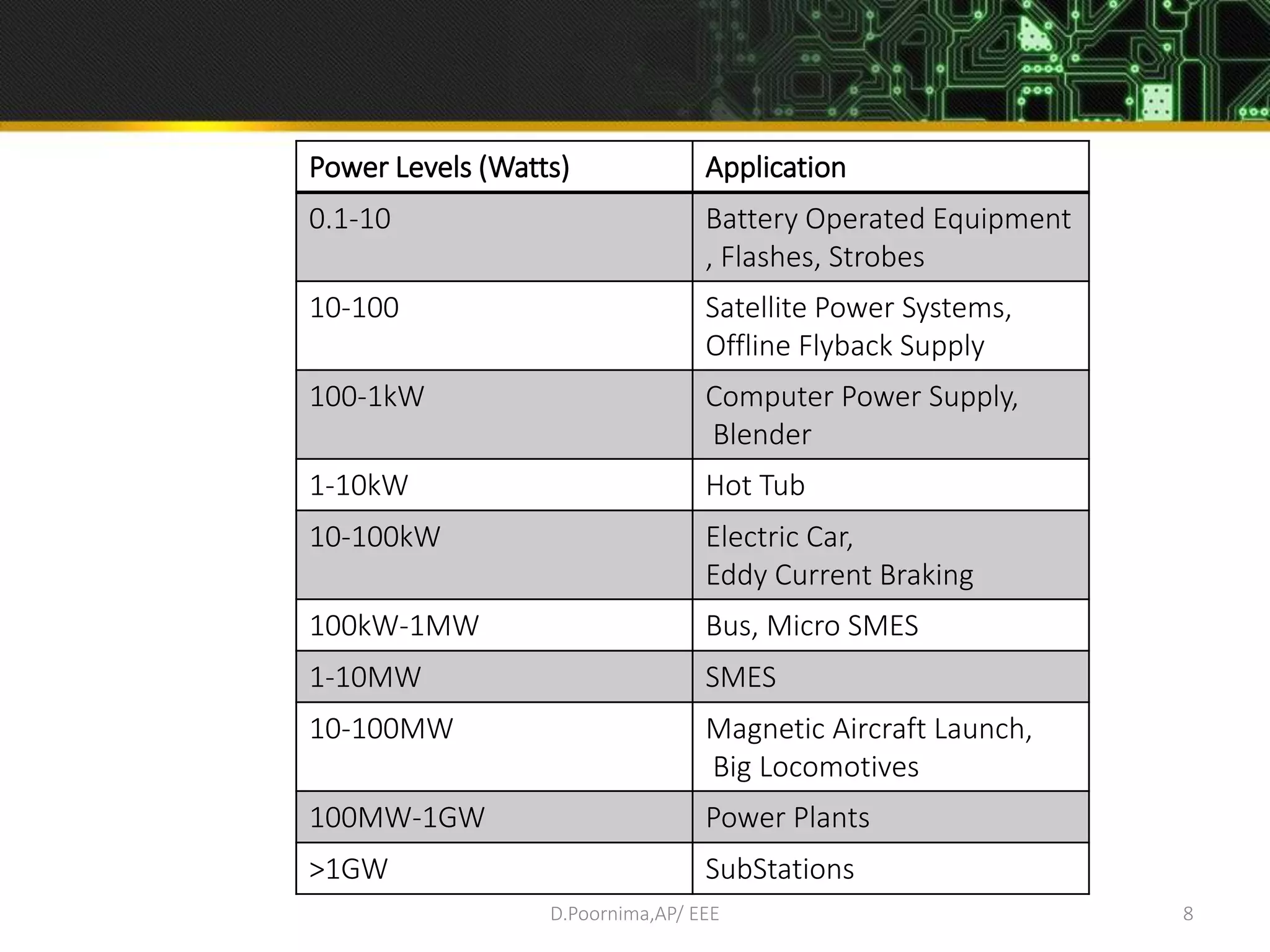
Power Levels (Watts) Application
0.1-10 Battery Operated Equipment
, Flashes, Strobes
10-100 Satellite Power Systems,
Offline Flyback Supply
100-1kW Computer Power Supply,
Blender
1-10kW Hot Tub
10-100kW Electric Car,
Eddy Current Braking
100kW-1MW Bus, Micro SMES
1-10MW SMES
10-100MW Magnetic Aircraft Launch,
Big Locomotives
100MW-1GW Power Plants
>1GW SubStations
Applications of Power Electronics
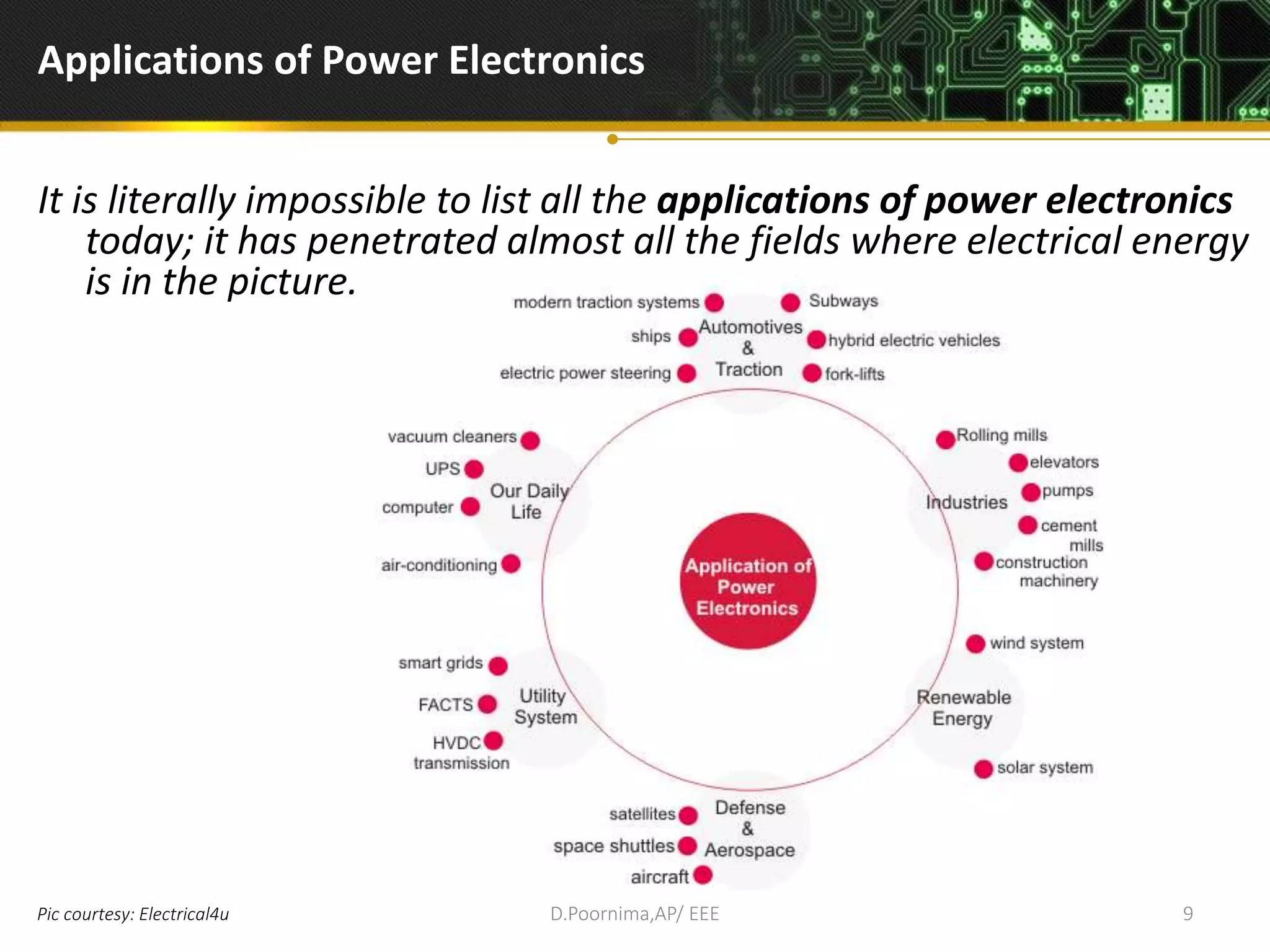
It is literally impossible to list all the applications of power electronics
today; it has penetrated almost all the fields where electrical energy
is in the picture.
D.Poornima,AP/ EEE 9
Pic courtesy: Electrical4u
 Our Daily Life:
o Fan regulator, light dimmer, air-conditioning, induction cook
ing, emergency lights, personal computers, vacuum cleaners
, UPS (uninterrupted power system), battery charges, etc.
 Automotives and Traction:
o Subways, hybrid electric vehicles, trolley,fork-lifts, and many
more.
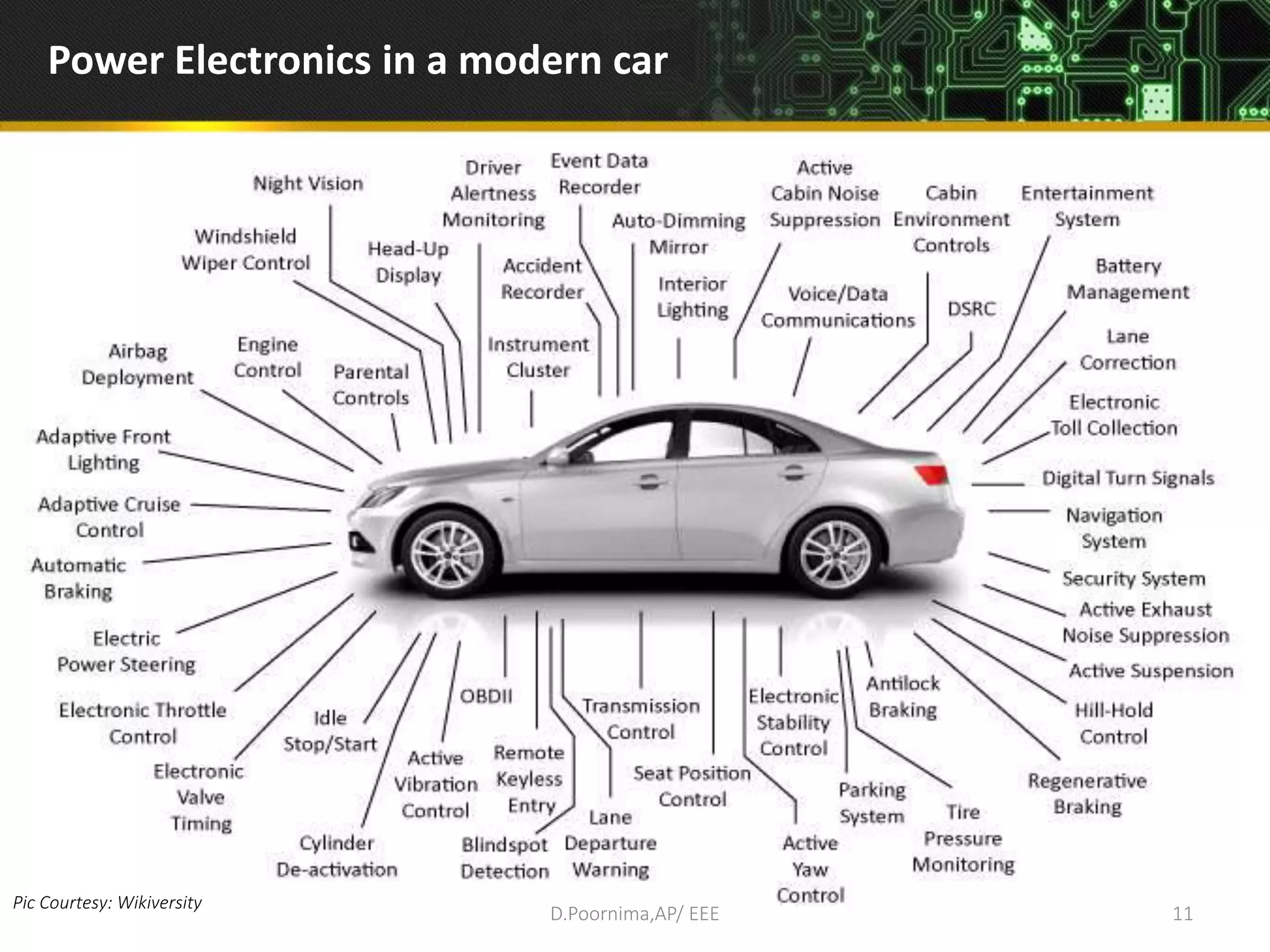
o A modern car itself has so many components where power
electronic is used such as ignition switch, windshield wiper
control, adaptive front lighting, interior lighting, electric
power steering and so on.
o Power electronics are extensively used in modern traction
systems and ships.
Applications of Power Electronics……
D.Poornima,AP/ EEE 10
Power Electronics in a modern car
D.Poornima,AP/ EEE 11
Pic Courtesy: Wikiversity
Applications of Power Electronics…….
 Industries:
o Almost all the motors employed in the industries are controlled by
power electronic drives, for eg. Rolling mills, textile mills, cement mills,
compressors, pumps, fans, blowers, elevators, rotary kilns etc.
o Welding, arc furnace, cranes, heating applications, emergency power
systems, construction machinery, excavators etc.
 Defense and Aerospace:
o Power supplies in aircraft, satellites, space shuttles, advance control in
missiles, unmanned vehicles and other defense equipment.
 Renewable Energy:
o Solar, wind etc. needs power conditioning systems, storage systems
and conversion systems in order to become usable..
 Utility System:
o HVDC transmission, VAR compensation (SVC), static circuit breakers,
generator excitation systems, FACTS, smart grids, etc.
D.Poornima,AP/ EEE 12
D.Poornima,AP/ EEE 13
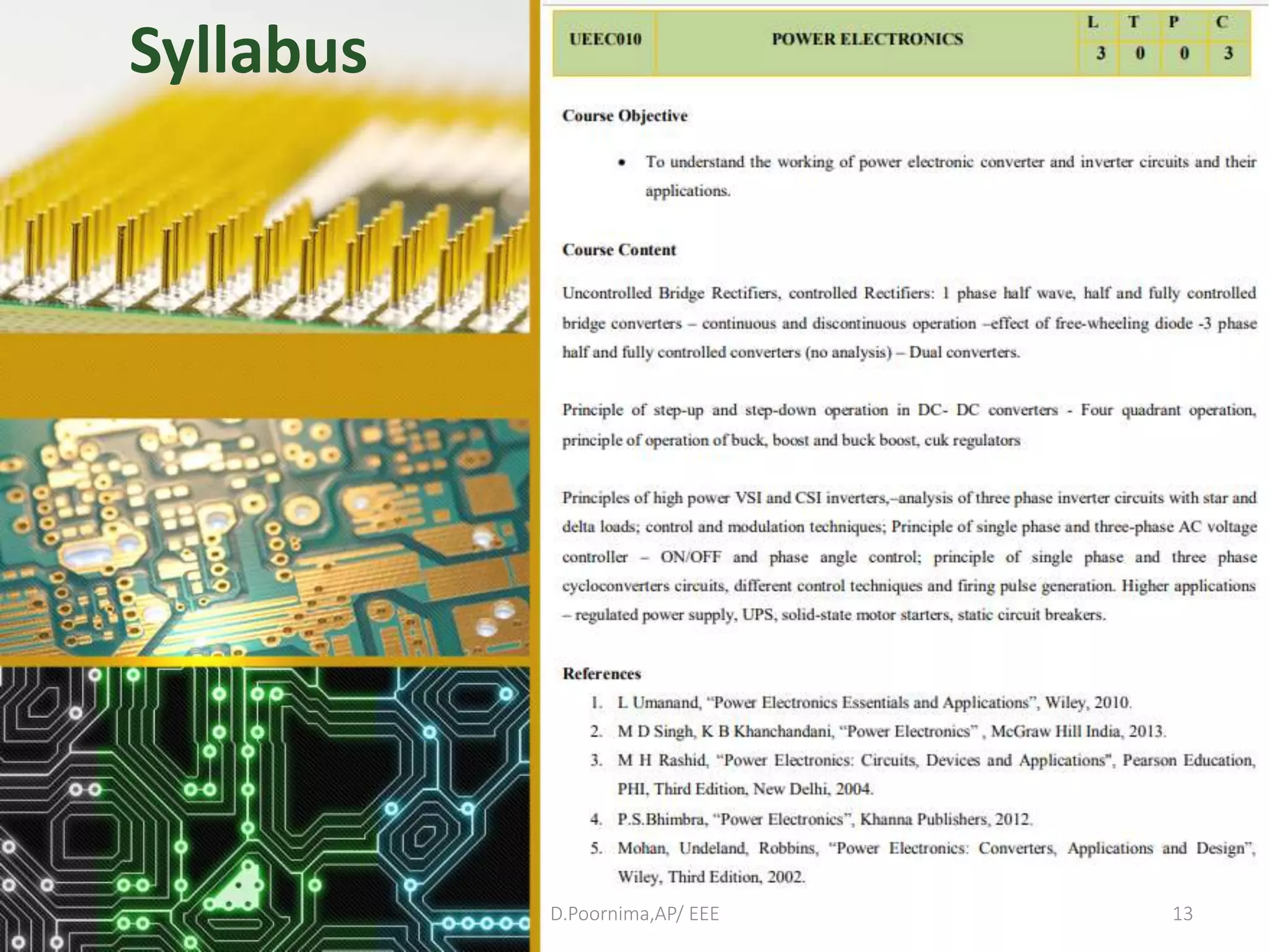
Syllabus
Base of Power Electronics
 Power Semiconductor devices used as Switches – heart of Power
Electronic Devices
 Classification of Power Semiconductor Switches:
 in terms of their number of terminals
 two-terminal devices (diodes)
 three-terminal devices
 type of charge carriers they use
 majority carrier devices(Schottky diode, MOSFET, JFET) -use only one type of charge
carriers (i.e., either electrons or holes)
 minority carrier devices(p-n diode, Thyristor, BJT, IGBT) -use both charge carriers (i.e.
electrons and holes).
 degree of controllability
 uncontrollable switches (diodes)
 semi-controllable switches (thyristors)
 fully-controllable switches (BJT, MOSFET, JFET, IGBT, GTO, MCT)
D.Poornima,AP/ EEE 14
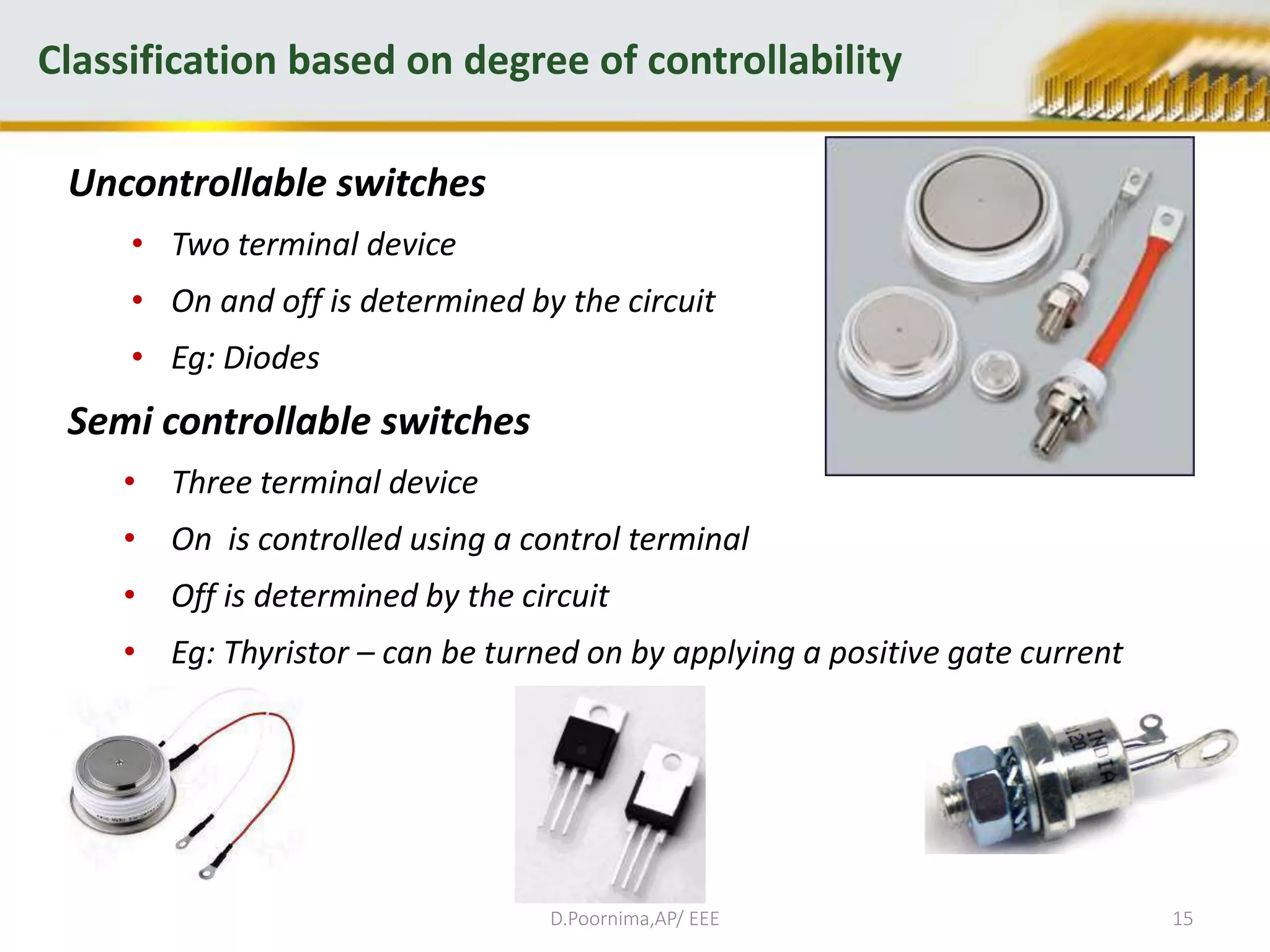
Uncontrollable switches
• Two terminal device
• On and off is determined by the circuit
• Eg: Diodes
Semi controllable switches
• Three terminal device
• On is controlled using a control terminal
• Off is determined by the circuit
• Eg: Thyristor – can be turned on by applying a positive gate current
Classification based on degree of controllability
D.Poornima,AP/ EEE 15
Classification based on degree of controllability…..
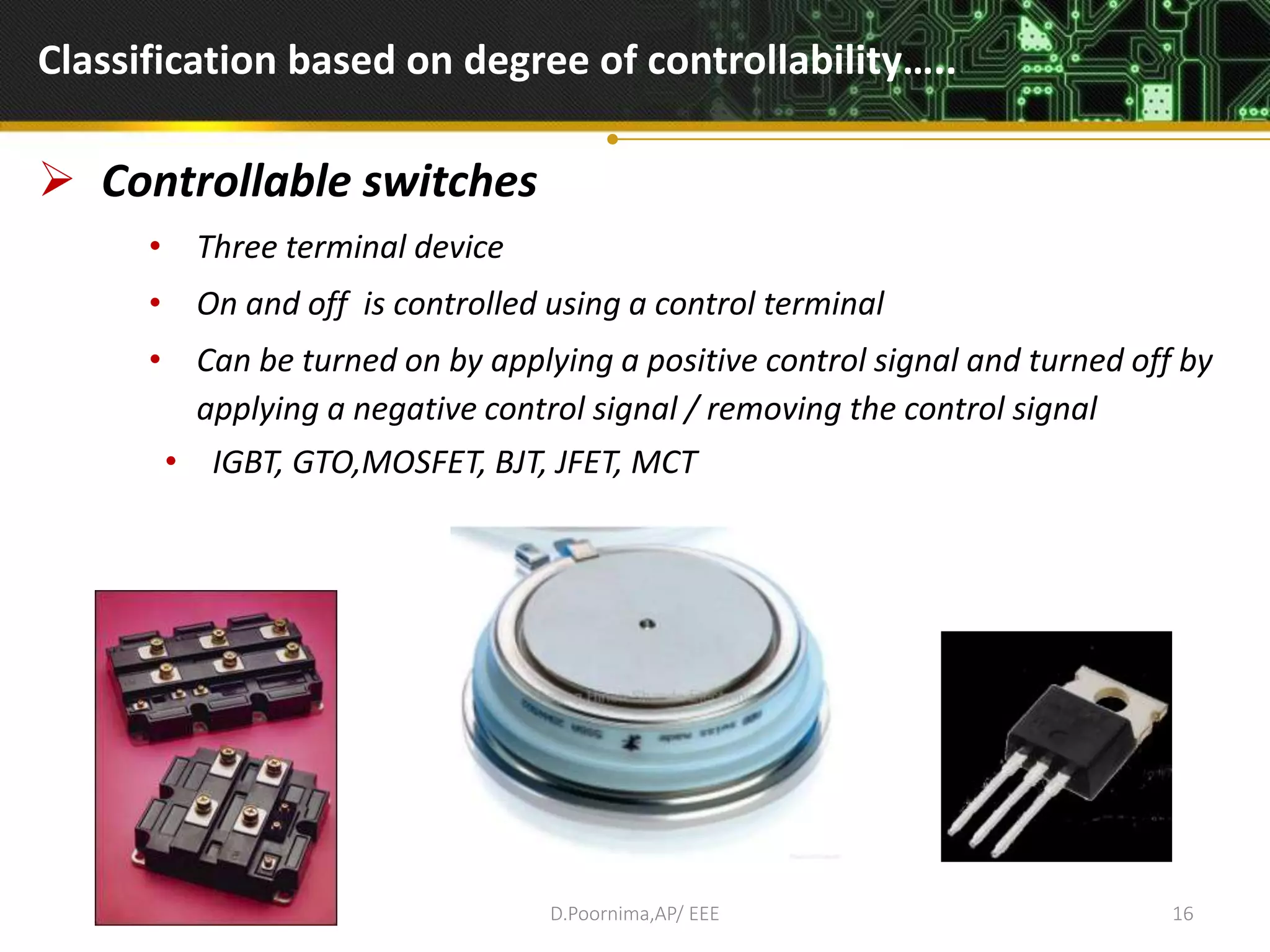
 Controllable switches
• Three terminal device
• On and off is controlled using a control terminal
• Can be turned on by applying a positive control signal and turned off by
applying a negative control signal / removing the control signal
• IGBT, GTO,MOSFET, BJT, JFET, MCT
D.Poornima,AP/ EEE 16
 Power Converter Circuits – types
• Diode Rectifiers
• AC-DC Converters/ Converters
• DC-DC Converters/ Choppers
• DC-AC Converters/ Inverters
• AC-AC Converters
 AC Voltage Controller
 Cyclo converters
Power Electronics Circuits
D.Poornima,AP/ EEE 17
Types of Power Converter Circuits
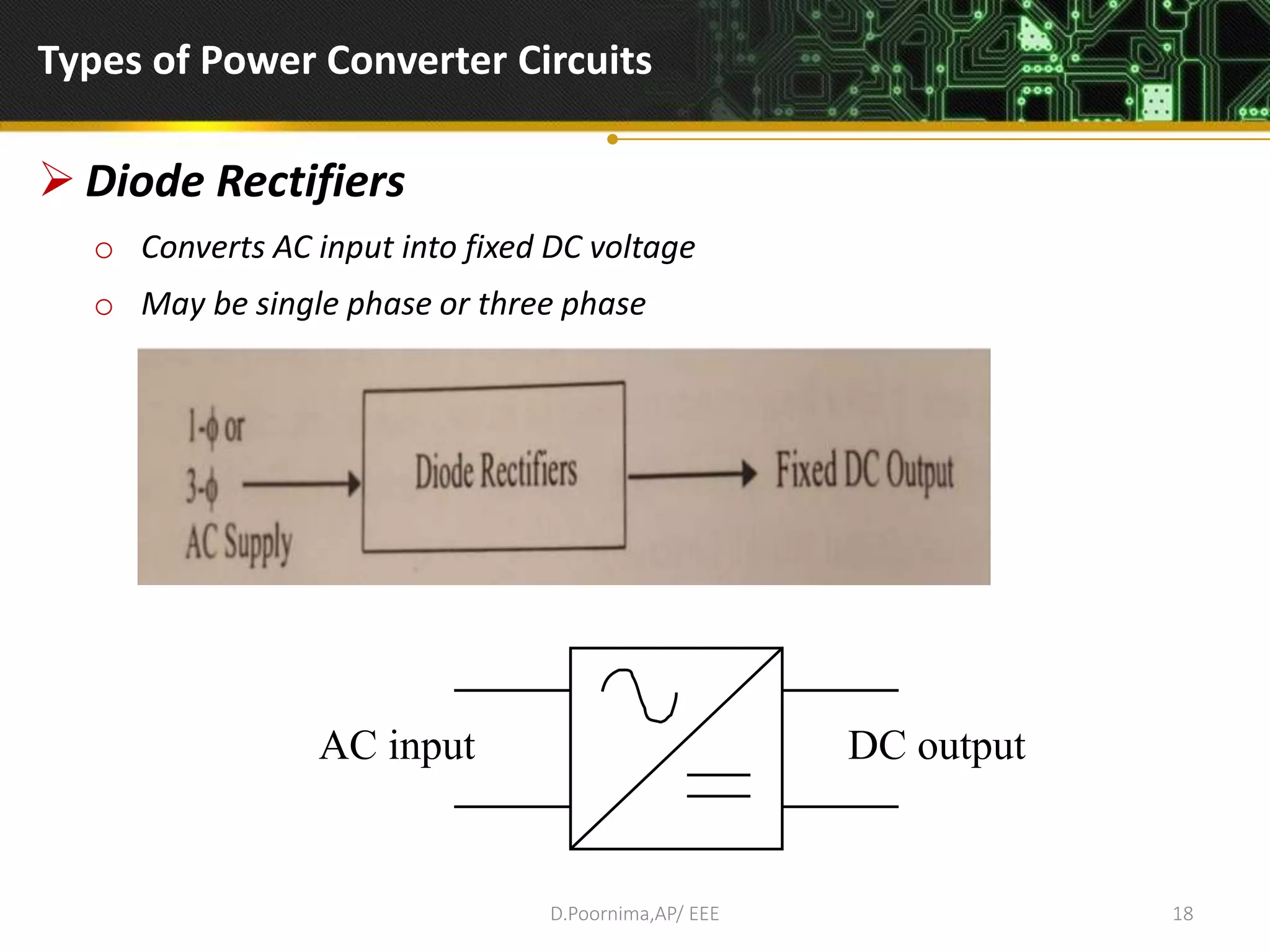
 Diode Rectifiers
o Converts AC input into fixed DC voltage
o May be single phase or three phase
D.Poornima,AP/ EEE 18
AC input DC output
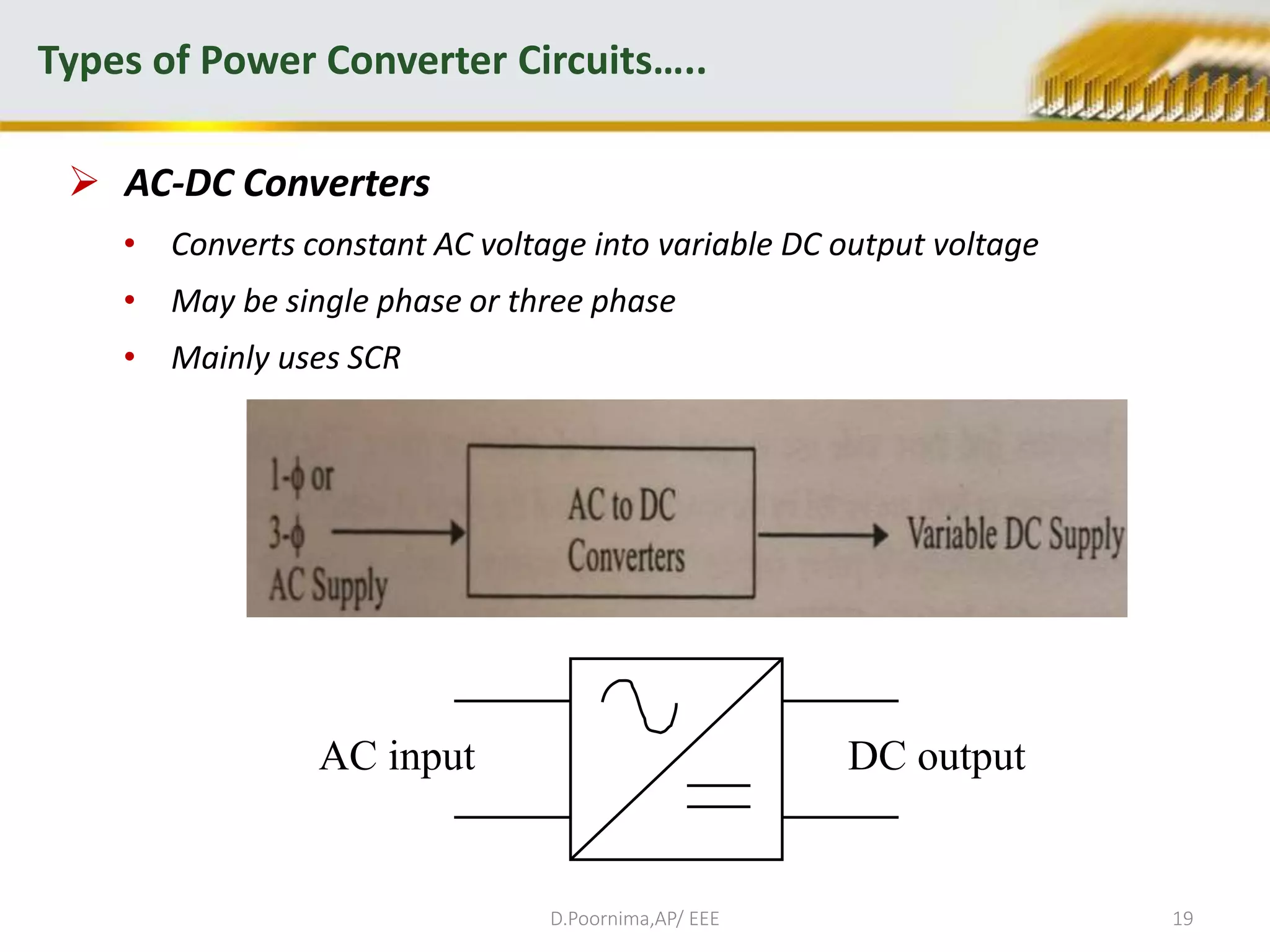
 AC-DC Converters
• Converts constant AC voltage into variable DC output voltage
• May be single phase or three phase
• Mainly uses SCR
Types of Power Converter Circuits…..
D.Poornima,AP/ EEE 19
AC input DC output
Types of Power Converter Circuits……
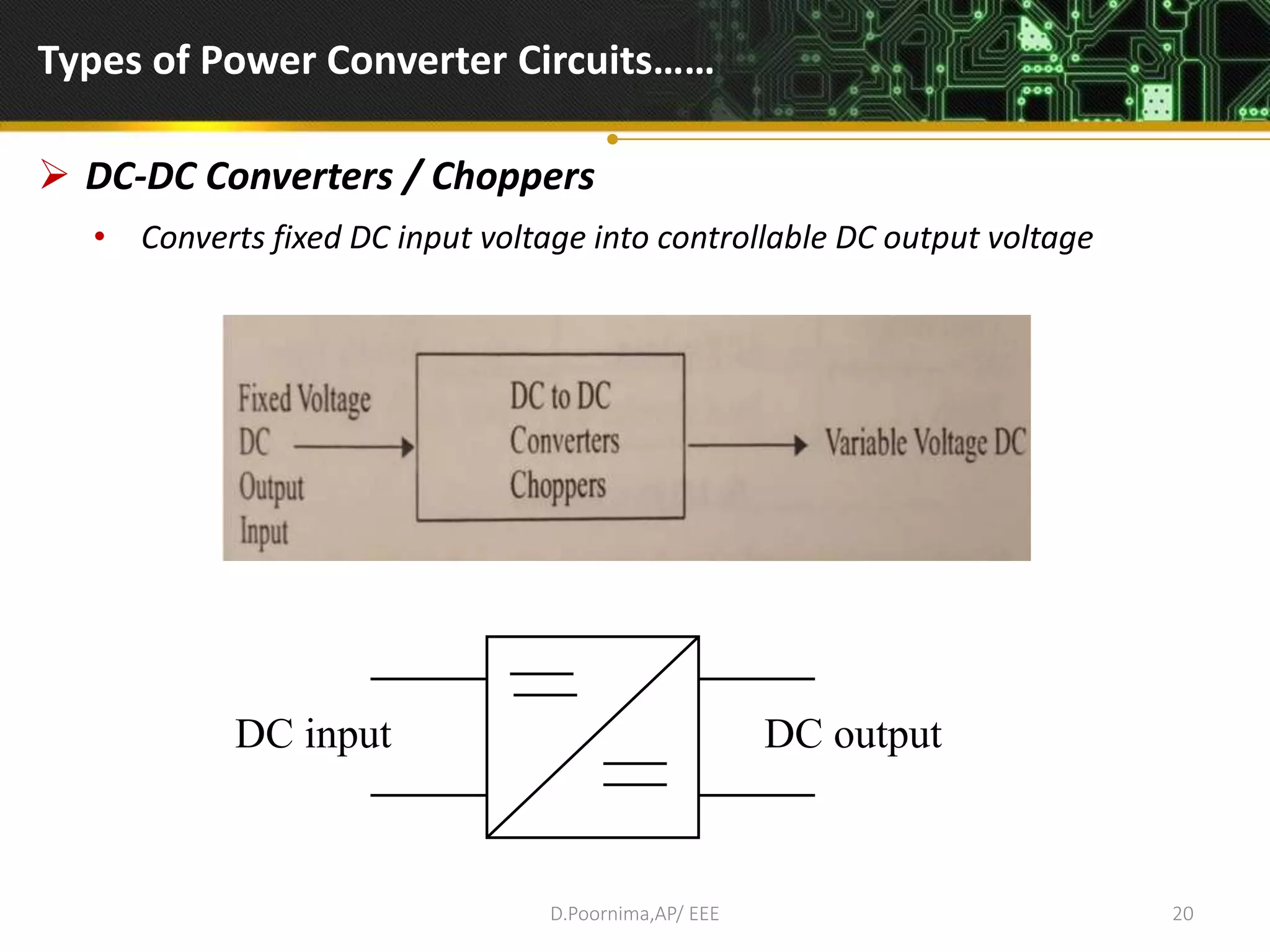
 DC-DC Converters / Choppers
• Converts fixed DC input voltage into controllable DC output voltage
D.Poornima,AP/ EEE 20
DC input DC output
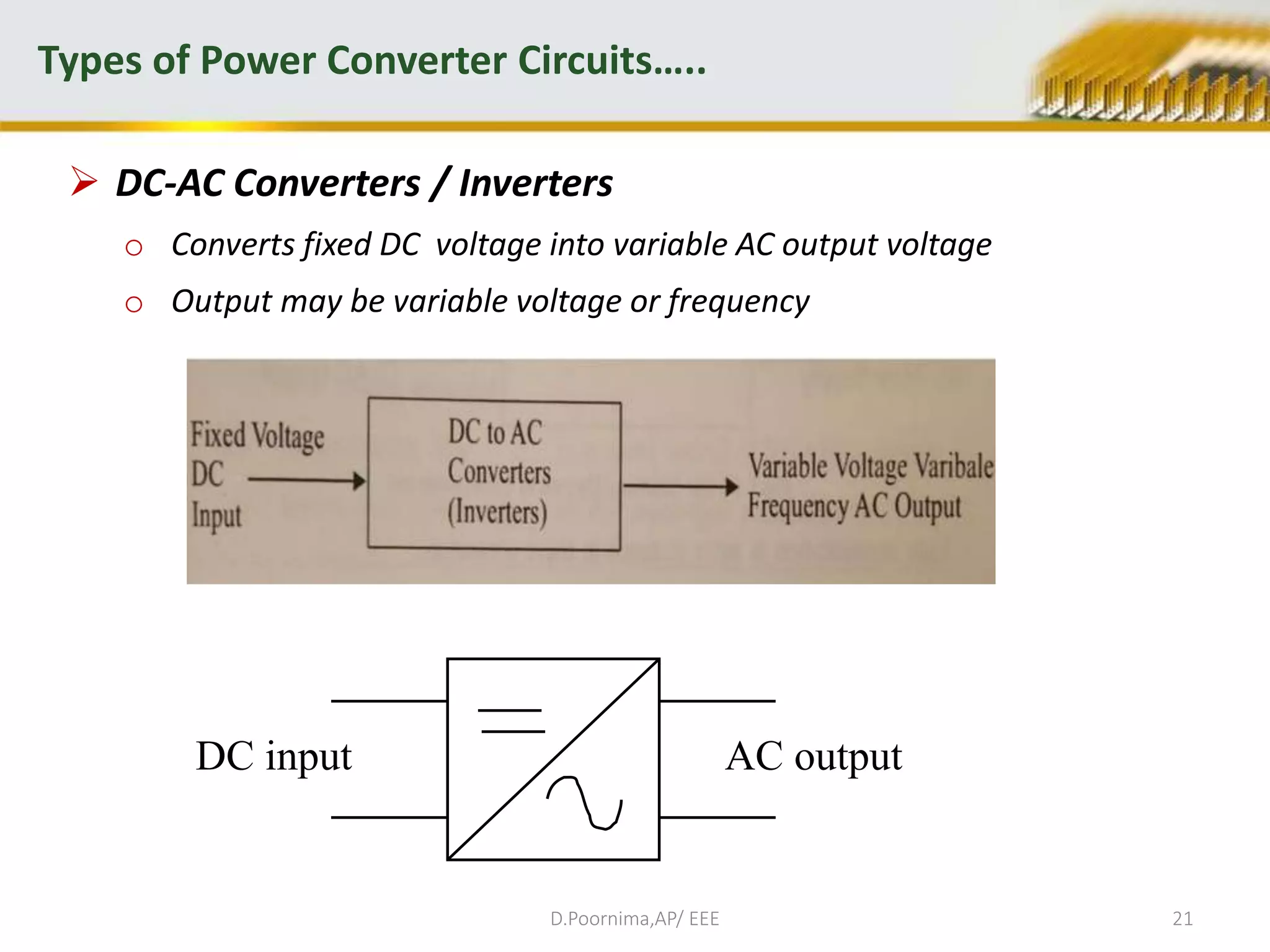
 DC-AC Converters / Inverters
o Converts fixed DC voltage into variable AC output voltage
o Output may be variable voltage or frequency
Types of Power Converter Circuits…..
D.Poornima,AP/ EEE 21
DC input AC output
Types of Power Converter Circuits….
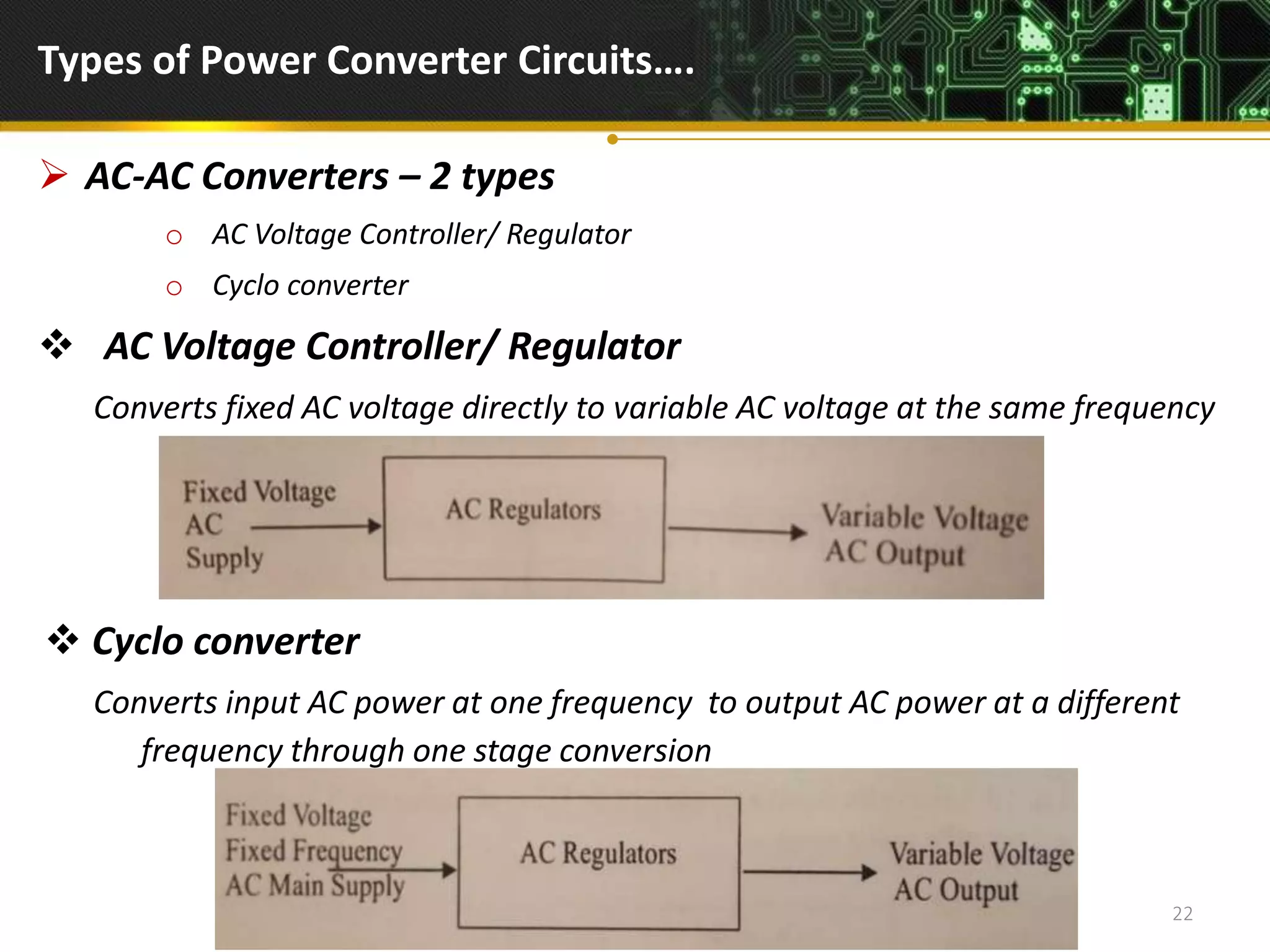
 AC-AC Converters – 2 types
o AC Voltage Controller/ Regulator
o Cyclo converter
 AC Voltage Controller/ Regulator
Converts fixed AC voltage directly to variable AC voltage at the same frequency
 Cyclo converter
Converts input AC power at one frequency to output AC power at a different
frequency through one stage conversion
D.Poornima,AP/ EEE 22
THANK YOU
D.Poornima,AP/ EEE 23

Power Electronics Introduction

  • 1.
  • 2.
    CONTENTS What is PowerElectronics? 01 Why Power Electronics? 02 Multidisciplinary Nature of Power Electronics 03 Scope of Power Electronics 04 Applications of Power Electronics 05 D.Poornima,AP/ EEE 2 Types of Power Electronic Circuits 06
  • 3.
    What is PowerElectronics??  Is the technology associated with efficient conversion and control of electric power by using power semiconductor devices.  As per IEEE – it includes the use of electronic components, the application of circuit theory and design techniques, and the development of analytical tools toward the efficient electronic conversion, control and conditioning of electric power. D.Poornima,AP/ EEE 3
  • 4.
    What is PowerElectronics??  The future of global society will be dominated by : Computers and Power Electronics : the former provides intelligence for “what to do” and the latter provides the “means to do it”. D.Poornima,AP/ EEE 4
  • 5.
    1. Energy scenario Need to reduce dependence on fossil fuel o Coal, natural gas, oil, and nuclear power resource o Depletion of these sources is expected.  Tap renewable energy resources: o Solar, wind, fuel-cell, ocean-wave  Energy saving by PE applications. Examples: o Variable speed compressor air-conditioning system: 30% savings compared to thermostat-controlled system. o Lighting using electronics ballast boost efficiency of fluorescent lamp by 20%. Why Power Electronics?? D.Poornima,AP/ EEE 5
  • 6.
    Why Power Electronics??.......... 2.Environment issues  Nuclear safety. o Nuclear plants remain radioactive for thousands of years.  Burning of fossil fuel o emits gases such as CO2, CO (oil burning), SO2, NOX (coal burn ing) etc. o Creates global warming (green house effect), acid rain and urb an pollution from smokes.  Possible Solutions by application of PE. Examples: o Renewable energy resources. o Centralization of power stations to remote non-urban area. (mitigation). o Electric vehicles. D.Poornima,AP/ EEE 6
  • 7.
  • 8.
    D.Poornima,AP/ EEE 8 PowerLevels (Watts) Application 0.1-10 Battery Operated Equipment , Flashes, Strobes 10-100 Satellite Power Systems, Offline Flyback Supply 100-1kW Computer Power Supply, Blender 1-10kW Hot Tub 10-100kW Electric Car, Eddy Current Braking 100kW-1MW Bus, Micro SMES 1-10MW SMES 10-100MW Magnetic Aircraft Launch, Big Locomotives 100MW-1GW Power Plants >1GW SubStations
  • 9.
    Applications of PowerElectronics It is literally impossible to list all the applications of power electronics today; it has penetrated almost all the fields where electrical energy is in the picture. D.Poornima,AP/ EEE 9 Pic courtesy: Electrical4u
  • 10.
     Our DailyLife: o Fan regulator, light dimmer, air-conditioning, induction cook ing, emergency lights, personal computers, vacuum cleaners , UPS (uninterrupted power system), battery charges, etc.  Automotives and Traction: o Subways, hybrid electric vehicles, trolley,fork-lifts, and many more. o A modern car itself has so many components where power electronic is used such as ignition switch, windshield wiper control, adaptive front lighting, interior lighting, electric power steering and so on. o Power electronics are extensively used in modern traction systems and ships. Applications of Power Electronics…… D.Poornima,AP/ EEE 10
  • 11.
    Power Electronics ina modern car D.Poornima,AP/ EEE 11 Pic Courtesy: Wikiversity
  • 12.
    Applications of PowerElectronics…….  Industries: o Almost all the motors employed in the industries are controlled by power electronic drives, for eg. Rolling mills, textile mills, cement mills, compressors, pumps, fans, blowers, elevators, rotary kilns etc. o Welding, arc furnace, cranes, heating applications, emergency power systems, construction machinery, excavators etc.  Defense and Aerospace: o Power supplies in aircraft, satellites, space shuttles, advance control in missiles, unmanned vehicles and other defense equipment.  Renewable Energy: o Solar, wind etc. needs power conditioning systems, storage systems and conversion systems in order to become usable..  Utility System: o HVDC transmission, VAR compensation (SVC), static circuit breakers, generator excitation systems, FACTS, smart grids, etc. D.Poornima,AP/ EEE 12
  • 13.
  • 14.
    Base of PowerElectronics  Power Semiconductor devices used as Switches – heart of Power Electronic Devices  Classification of Power Semiconductor Switches:  in terms of their number of terminals  two-terminal devices (diodes)  three-terminal devices  type of charge carriers they use  majority carrier devices(Schottky diode, MOSFET, JFET) -use only one type of charge carriers (i.e., either electrons or holes)  minority carrier devices(p-n diode, Thyristor, BJT, IGBT) -use both charge carriers (i.e. electrons and holes).  degree of controllability  uncontrollable switches (diodes)  semi-controllable switches (thyristors)  fully-controllable switches (BJT, MOSFET, JFET, IGBT, GTO, MCT) D.Poornima,AP/ EEE 14
  • 15.
    Uncontrollable switches • Twoterminal device • On and off is determined by the circuit • Eg: Diodes Semi controllable switches • Three terminal device • On is controlled using a control terminal • Off is determined by the circuit • Eg: Thyristor – can be turned on by applying a positive gate current Classification based on degree of controllability D.Poornima,AP/ EEE 15
  • 16.
    Classification based ondegree of controllability…..  Controllable switches • Three terminal device • On and off is controlled using a control terminal • Can be turned on by applying a positive control signal and turned off by applying a negative control signal / removing the control signal • IGBT, GTO,MOSFET, BJT, JFET, MCT D.Poornima,AP/ EEE 16
  • 17.
     Power ConverterCircuits – types • Diode Rectifiers • AC-DC Converters/ Converters • DC-DC Converters/ Choppers • DC-AC Converters/ Inverters • AC-AC Converters  AC Voltage Controller  Cyclo converters Power Electronics Circuits D.Poornima,AP/ EEE 17
  • 18.
    Types of PowerConverter Circuits  Diode Rectifiers o Converts AC input into fixed DC voltage o May be single phase or three phase D.Poornima,AP/ EEE 18 AC input DC output
  • 19.
     AC-DC Converters •Converts constant AC voltage into variable DC output voltage • May be single phase or three phase • Mainly uses SCR Types of Power Converter Circuits….. D.Poornima,AP/ EEE 19 AC input DC output
  • 20.
    Types of PowerConverter Circuits……  DC-DC Converters / Choppers • Converts fixed DC input voltage into controllable DC output voltage D.Poornima,AP/ EEE 20 DC input DC output
  • 21.
     DC-AC Converters/ Inverters o Converts fixed DC voltage into variable AC output voltage o Output may be variable voltage or frequency Types of Power Converter Circuits….. D.Poornima,AP/ EEE 21 DC input AC output
  • 22.
    Types of PowerConverter Circuits….  AC-AC Converters – 2 types o AC Voltage Controller/ Regulator o Cyclo converter  AC Voltage Controller/ Regulator Converts fixed AC voltage directly to variable AC voltage at the same frequency  Cyclo converter Converts input AC power at one frequency to output AC power at a different frequency through one stage conversion D.Poornima,AP/ EEE 22
  • 23.