
Study of solid lubrication with
MoS2 coating in the presence of
additives
Space Applications
• Gassing under the vacuum
• High temperature conditions
Food and Textile industries
• Contamination of product
 Low, constant and controlled friction between the two
surfaces.
 Chemically stable and inert over the required
temperature range.
 Adhere strongly to one or both the surfaces.
 Sufficient resistance to wear.
 Non toxic and economical.
 Very low volatility.
 Chemical inertness.
 Stable to radioactivity.
 Oxidises to molybdic oxide (MoO3) at higher
temperatures, a fair
lubricant itself.
 Good load carrying capacity (hexagonal layer-lattice
structure).
 Doesn’t depend on presence of adsorbed vapors to act
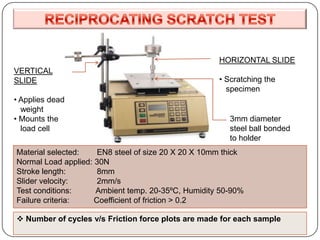
VERTICAL
SLIDE
• Applies dead
weight
• Mounts the
load cell
HORIZONTAL SLIDE
• Scratching the
specimen
3mm diameter
steel ball bonded
to holder
Material selected: EN8 steel of size 20 X 20 X 10mm thick
Normal Load applied: 30N
Stroke length: 8mm
Slider velocity: 2mm/s
Test conditions: Ambient temp. 20-35ºC, Humidity 50-90%
Failure criteria: Coefficient of friction > 0.2
 Number of cycles v/s Friction force plots are made for each sample
1. Experiments were carried out to study the dry friction characteristics
of the rubbing surfaces of steel specimen having roughness, Ra =
0·19μm. The initial coefficient of friction was around 0·13 and
attained a value of 0·5 within 20 cycles.
2. Similar tests were conducted on the specimen having Ra = 0·39μm.
The initial
coefficient of friction was around 0·15 and attained a value of 0·5
within 20 cycles.
RESULT: The coefficient of friction between two steel surfaces is
greater than 0·5 under non- lubricated conditions.
TEST 1. Scratch test under “dry sliding
conditions”
between steel specimen and steel ball
TEST 2. Scratch test between MoS2 coated steel
specimen
and steel ball
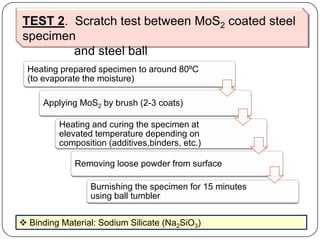
Heating prepared specimen to around 80ºC
(to evaporate the moisture)
Applying MoS2 by brush (2-3 coats)
Heating and curing the specimen at
elevated temperature depending on
composition (additives,binders, etc.)
Removing loose powder from surface
Burnishing the specimen for 15 minutes
using ball tumbler
 Binding Material: Sodium Silicate (Na2SiO3)
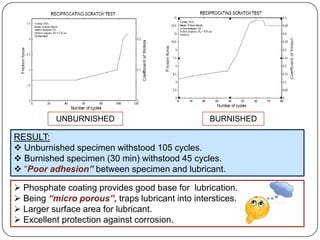
UNBURNISHED BURNISHED
 Phosphate coating provides good base for lubrication.
 Being “micro porous”, traps lubricant into interstices.
 Larger surface area for lubricant.
 Excellent protection against corrosion.
RESULT:
 Unburnished specimen withstood 105 cycles.
 Burnished specimen (30 min) withstood 45 cycles.
 “Poor adhesion” between specimen and lubricant.
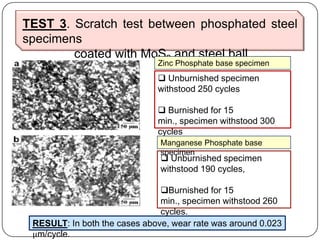
TEST 3. Scratch test between phosphated steel
specimens
coated with MoS2 and steel ball
RESULT: In both the cases above, wear rate was around 0.023
μm/cycle.
 Unburnished specimen
withstood 250 cycles
 Burnished for 15
min., specimen withstood 300
cycles
Zinc Phosphate base specimen
 Unburnished specimen
withstood 190 cycles,
Burnished for 15
min., specimen withstood 260
cycles.
Manganese Phosphate base
specimen
TEST 4. Scratch test between MoS2 coated phospated
steel specimen with zirconia as an
additive, steel ball
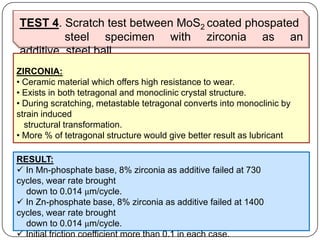
ZIRCONIA:
• Ceramic material which offers high resistance to wear.
• Exists in both tetragonal and monoclinic crystal structure.
• During scratching, metastable tetragonal converts into monoclinic by
strain induced
structural transformation.
• More % of tetragonal structure would give better result as lubricant
RESULT:
 In Mn-phosphate base, 8% zirconia as additive failed at 730
cycles, wear rate brought
down to 0.014 μm/cycle.
 In Zn-phosphate base, 8% zirconia as additive failed at 1400
cycles, wear rate brought
down to 0.014 μm/cycle.
 Initial friction coefficient more than 0.1 in each case.
TEST 5. Scratch test between MoS2 coated phosphated
steel
specimen with zirconia and graphite as additives
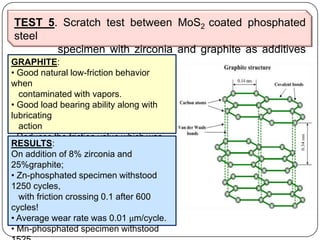
and steel ballGRAPHITE:
• Good natural low-friction behavior
when
contaminated with vapors.
• Good load bearing ability along with
lubricating
action
• Reduces the friction value which was
increased
by additive zirconia.
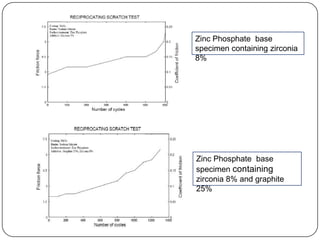
RESULTS:
On addition of 8% zirconia and
25%graphite;
• Zn-phosphated specimen withstood
1250 cycles,
with friction crossing 0.1 after 600
cycles!
• Average wear rate was 0.01 μm/cycle.
• Mn-phosphated specimen withstood
Zinc Phosphate base
specimen containing zirconia
8%
Zinc Phosphate base
specimen containing
zirconia 8% and graphite
25%
TEST 6. HIGH TEMPERATURE SCRATCH TESTS
1. Reciprocating Scratch test at 200ºC.
• Test carried for 5500 cycles
• Friction as low as 0.05 even after 5500 cycles.
• No sign of failure, because all moisture has been evaporated.
2. Reciprocating Scratch test after 90minutes of cooling to room
temperature from 200ºC.
• Specimen withstood 3000 cycles.
• Sufficient time not given to absorb moisture completely.
3. Reciprocating Scratch test after two days of cooling to room
temperature 200ºC.
• Specimen failed at 600 cycles.
• Result coherent with ambient conditions, as moisture had been
absorbed to saturation level.
RESULT: Humidity affects the adhesion component of friction and
therefore the
intercrystallite forces, wear rate also increases as more
moisture is absorbed.
•The addition of zirconia and graphite into the
lubricant improves its properties in terms of both
friction and wear.
• The moisture present in air also plays an
important role in reducing friction and wear rate. As
the moisture reduces, coating performance of the
film is enhanced.
Study of solid lubrication with MoS2 coating

Study of solid lubrication with MoS2 coating

  • 1.
    Study of solidlubrication with MoS2 coating in the presence of additives
  • 2.
    Space Applications • Gassingunder the vacuum • High temperature conditions Food and Textile industries • Contamination of product
  • 3.
     Low, constantand controlled friction between the two surfaces.  Chemically stable and inert over the required temperature range.  Adhere strongly to one or both the surfaces.  Sufficient resistance to wear.  Non toxic and economical.
  • 4.
     Very lowvolatility.  Chemical inertness.  Stable to radioactivity.  Oxidises to molybdic oxide (MoO3) at higher temperatures, a fair lubricant itself.  Good load carrying capacity (hexagonal layer-lattice structure).  Doesn’t depend on presence of adsorbed vapors to act
  • 5.
    VERTICAL SLIDE • Applies dead weight •Mounts the load cell HORIZONTAL SLIDE • Scratching the specimen 3mm diameter steel ball bonded to holder Material selected: EN8 steel of size 20 X 20 X 10mm thick Normal Load applied: 30N Stroke length: 8mm Slider velocity: 2mm/s Test conditions: Ambient temp. 20-35ºC, Humidity 50-90% Failure criteria: Coefficient of friction > 0.2  Number of cycles v/s Friction force plots are made for each sample
  • 6.
    1. Experiments werecarried out to study the dry friction characteristics of the rubbing surfaces of steel specimen having roughness, Ra = 0·19μm. The initial coefficient of friction was around 0·13 and attained a value of 0·5 within 20 cycles. 2. Similar tests were conducted on the specimen having Ra = 0·39μm. The initial coefficient of friction was around 0·15 and attained a value of 0·5 within 20 cycles. RESULT: The coefficient of friction between two steel surfaces is greater than 0·5 under non- lubricated conditions. TEST 1. Scratch test under “dry sliding conditions” between steel specimen and steel ball
  • 7.
    TEST 2. Scratchtest between MoS2 coated steel specimen and steel ball Heating prepared specimen to around 80ºC (to evaporate the moisture) Applying MoS2 by brush (2-3 coats) Heating and curing the specimen at elevated temperature depending on composition (additives,binders, etc.) Removing loose powder from surface Burnishing the specimen for 15 minutes using ball tumbler  Binding Material: Sodium Silicate (Na2SiO3)
  • 8.
    UNBURNISHED BURNISHED  Phosphatecoating provides good base for lubrication.  Being “micro porous”, traps lubricant into interstices.  Larger surface area for lubricant.  Excellent protection against corrosion. RESULT:  Unburnished specimen withstood 105 cycles.  Burnished specimen (30 min) withstood 45 cycles.  “Poor adhesion” between specimen and lubricant.
  • 9.
    TEST 3. Scratchtest between phosphated steel specimens coated with MoS2 and steel ball RESULT: In both the cases above, wear rate was around 0.023 μm/cycle.  Unburnished specimen withstood 250 cycles  Burnished for 15 min., specimen withstood 300 cycles Zinc Phosphate base specimen  Unburnished specimen withstood 190 cycles, Burnished for 15 min., specimen withstood 260 cycles. Manganese Phosphate base specimen
  • 10.
    TEST 4. Scratchtest between MoS2 coated phospated steel specimen with zirconia as an additive, steel ball ZIRCONIA: • Ceramic material which offers high resistance to wear. • Exists in both tetragonal and monoclinic crystal structure. • During scratching, metastable tetragonal converts into monoclinic by strain induced structural transformation. • More % of tetragonal structure would give better result as lubricant RESULT:  In Mn-phosphate base, 8% zirconia as additive failed at 730 cycles, wear rate brought down to 0.014 μm/cycle.  In Zn-phosphate base, 8% zirconia as additive failed at 1400 cycles, wear rate brought down to 0.014 μm/cycle.  Initial friction coefficient more than 0.1 in each case.
  • 11.
    TEST 5. Scratchtest between MoS2 coated phosphated steel specimen with zirconia and graphite as additives and steel ballGRAPHITE: • Good natural low-friction behavior when contaminated with vapors. • Good load bearing ability along with lubricating action • Reduces the friction value which was increased by additive zirconia. RESULTS: On addition of 8% zirconia and 25%graphite; • Zn-phosphated specimen withstood 1250 cycles, with friction crossing 0.1 after 600 cycles! • Average wear rate was 0.01 μm/cycle. • Mn-phosphated specimen withstood
  • 12.
    Zinc Phosphate base specimencontaining zirconia 8% Zinc Phosphate base specimen containing zirconia 8% and graphite 25%
  • 13.
    TEST 6. HIGHTEMPERATURE SCRATCH TESTS 1. Reciprocating Scratch test at 200ºC. • Test carried for 5500 cycles • Friction as low as 0.05 even after 5500 cycles. • No sign of failure, because all moisture has been evaporated. 2. Reciprocating Scratch test after 90minutes of cooling to room temperature from 200ºC. • Specimen withstood 3000 cycles. • Sufficient time not given to absorb moisture completely. 3. Reciprocating Scratch test after two days of cooling to room temperature 200ºC. • Specimen failed at 600 cycles. • Result coherent with ambient conditions, as moisture had been absorbed to saturation level. RESULT: Humidity affects the adhesion component of friction and therefore the intercrystallite forces, wear rate also increases as more moisture is absorbed.
  • 14.
    •The addition ofzirconia and graphite into the lubricant improves its properties in terms of both friction and wear. • The moisture present in air also plays an important role in reducing friction and wear rate. As the moisture reduces, coating performance of the film is enhanced.