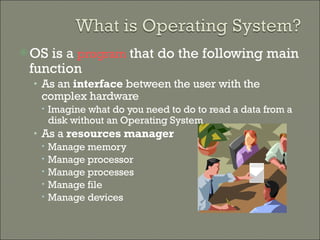
OS is a  program  that do the following main function As an  interface  between the user with the complex hardware Imagine what do you need to do to read a data from a disk without an Operating System As a  resources manager   Manage memory Manage processor Manage processes Manage file  Manage devices
Organize and monitor its resources continuously. Enforce the policies that determine who gets what, when, and how much. Allocate the resource when it’s appropriate. Deallocate the resource –reclaim it when appropriate.
Organize the memory accordingly e.q whether it’s a fixed partition, dynamic partition, paging or segments Check the validity of each request for memory space. Allocates a portion for legal request using certain policies. Sets up a table to keep track of who is using  which section of memory. Finally when the time comes to reclaim the memory, the memory manager deallocates the memory.
Types of Operating Systems  (continued) Operating systems for computers fall into following five  categories : Batch Interactive Real-time Hybrid Embedded Distinguished by response time and how data is entered into the system
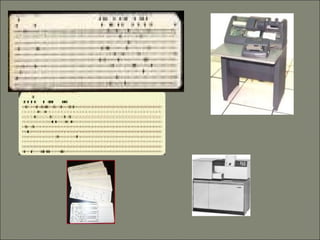
Batch Systems Program are run in group or batch Process in serial, one by one Using punched card or tape (not limited in present day) Efficiency measured in  throughput  --  number of jobs/ given amount of time (e.g. 30 jobs/hour) Turnarround – in hours or days
 
Types of Operating System Interactive Systems ( time-sharing systems) Required time-sharing software, which allow each user to interact directly with the computer. Give a faster turn-around time and Provides immediate feedback  Respond time measured in minutes or seconds depending on number of users
Real-Time Systems Fastest and are used in time-critical environment Data must be processed extremely quickly because the output influence immediate decisions Must be 100% responsive 100% of the time. Response time measured in fraction of sec Used in space flight, military system, airport traffic control, high-speed aircraft, industrial processes, sophisticated medical equipment etc.
Types of Operating System Hybrid Systems Combination of batch and interactive User can access the system interactively and get fast response Also accepts and runs batch programs in background when the interactive load is light Can take advantage of the free time Most large computer system are hybrid
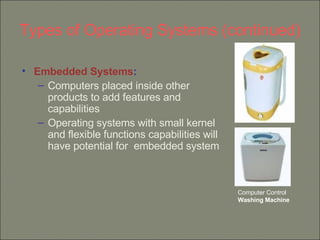
Types of Operating Systems  (continued) Embedded Systems : Computers placed inside other products to add features and capabilities Operating systems with small kernel and flexible functions capabilities will have potential for  embedded system Computer Control  Washing Machine

Types of os

  • 1.
  • 2.
    OS is a program that do the following main function As an interface between the user with the complex hardware Imagine what do you need to do to read a data from a disk without an Operating System As a resources manager Manage memory Manage processor Manage processes Manage file Manage devices
  • 3.
    Organize and monitorits resources continuously. Enforce the policies that determine who gets what, when, and how much. Allocate the resource when it’s appropriate. Deallocate the resource –reclaim it when appropriate.
  • 4.
    Organize the memoryaccordingly e.q whether it’s a fixed partition, dynamic partition, paging or segments Check the validity of each request for memory space. Allocates a portion for legal request using certain policies. Sets up a table to keep track of who is using which section of memory. Finally when the time comes to reclaim the memory, the memory manager deallocates the memory.
  • 5.
    Types of OperatingSystems (continued) Operating systems for computers fall into following five categories : Batch Interactive Real-time Hybrid Embedded Distinguished by response time and how data is entered into the system
  • 6.
    Batch Systems Programare run in group or batch Process in serial, one by one Using punched card or tape (not limited in present day) Efficiency measured in throughput -- number of jobs/ given amount of time (e.g. 30 jobs/hour) Turnarround – in hours or days
  • 7.
  • 8.
    Types of OperatingSystem Interactive Systems ( time-sharing systems) Required time-sharing software, which allow each user to interact directly with the computer. Give a faster turn-around time and Provides immediate feedback Respond time measured in minutes or seconds depending on number of users
  • 9.
    Real-Time Systems Fastestand are used in time-critical environment Data must be processed extremely quickly because the output influence immediate decisions Must be 100% responsive 100% of the time. Response time measured in fraction of sec Used in space flight, military system, airport traffic control, high-speed aircraft, industrial processes, sophisticated medical equipment etc.
  • 10.
    Types of OperatingSystem Hybrid Systems Combination of batch and interactive User can access the system interactively and get fast response Also accepts and runs batch programs in background when the interactive load is light Can take advantage of the free time Most large computer system are hybrid
  • 11.
    Types of OperatingSystems (continued) Embedded Systems : Computers placed inside other products to add features and capabilities Operating systems with small kernel and flexible functions capabilities will have potential for embedded system Computer Control Washing Machine