DRYING
By: Chernet Tafere
1
Love each other
Objective
 At the end of this sub-topic, the student will be able to:
 Define drying
 Describe the applications of drying
 Discuss the drying of different dosage forms
2
Drying
• Drying can be defined as the process of removal of solvents (i.e. water
or other liquid) from a formulation with the help of heat
• It involves evaporation or sublimation of the liquid phase and results in
dry solid or powder
• What is the difference between drying and filtration??
• The change of phase from liquid to vapor distinguishes drying
from mechanical methods of separating solids from liquids such as
filtration
3
 Why drying?
 To avoid moisture which may decrease product stability.
 aid preservation by minimizing mold or bacterial growth
 To stabilize moisture sensitive materials
 prevent deterioration of the drugs by moisture
 To prepare granules for tablets & capsules.
 To reduce the cost of transportation and storage
 By reducing bulk density and weight.
 To facilitate comminution
4
Choice of drying method
 When considering how to dry a material, the following points
should be considered:
 Heat sensitivity of the material being dried
 Physical characteristics of the material
 Nature of the liquid to be removed
 The scale of the operation
 The necessity for asepsis
5
Dryers
 Dryers can be categorized based on mode of operation
into
 Dryers for solid materials
 Compartment/tray/shelf dryer (Hot air ovens)
 Vacuum oven dryer
 Fluidized bed dryer
 Freeze dyer/sublimation dryer (Special dryer)
 Dryers for dilute solutions and suspensions
 Drum dryer (film dryer)
 Spray dryer
6
Dryers for solid
 Hot Air Ovens
• Operates by passing hot air over the
surface of a wet solid that is spread over
trays arranged in racks
• Fan: Circulate the air
• Trays containing the load remain in the
dryer until drying is complete
• After w/h they will be emptied &
recharge for the next batch
7
 Advantages
 Low initial cost
 Different products can be dried
 Versatility
 Materials of almost any physical form may be dried (sticky materials,
granular mass, crude drugs, paste..
 Limitations
 A large floor space is required for the oven and tray-loading facilities
Labor cost for loading and unloading the trays is high
8
Drying…
Limitation…
drying process is time consuming
Not good for thermolabile products
Usually used for small sized batch
Solvents recovery from the air is difficult
 Not connected to condenser
9
 Vacuum oven dryer
 The oven is connected to a vacuum pump through a condenser
Pressure decreased by vacuum pump
 The operating pressure is usually about 0.03 to 0.06 bar
• At this pressure water boils at 25 to 35oC
10
 Advantages
 Suitable for materials that are unstable at highT⸰
 low oxygen content when drying under low pressure prevents oxidation
Easy for batch process of different compounds.
The use of condenser enables solvents to be recovered, which is useful
with expensive or inflammable solvents
• Disadvantage
• Higher investment cost
• Labor and running costs are high
• Low production efficiency-low output
11
 Fluidized Bed Dryers
• Fluidization
Principal: hot air through a bed of granules
Materials will be loaded – detachable perforated basket (bowl).
• Fresh air enter – inlet- heater- hot air- passes through bed of
granules with optimum velocity.
• Granules lifted from bottom & suspend in air (Fluidized state).
Then drying from individual particles takes place.
12
13
 Advantage
 Efficient heat transfer gives fast drying rate than static bed dryers
The fluidized state of the particles enables drying from individual
particles
 Easy handling reduce labor cost
High output from a small floor space
Heating time of thermo labile substance is minimized-
Disadvantage
• The turbulence may cause attrition of some material, with the production
of fines
14
 Freeze drying (Sublimation drying)
(lyophilization)
Lyophilization or freeze drying is a process in which water is frozen
followed by its removal from the sample.
• Drying takes place by subliming the frozen solid.
Dehydration process is performed under vacuum while the
substance is in a frozen state
15
16
The phase diagram for water with freeze drying process
super imposed.
• The drying is initiated by reducing the surrounding
pressure (below the triple point).
• Stages of the freeze-drying process
 Freezing stage
• The product is placed into the lyophilizer chamber and
frozen
Results is an amorphous solid product and water crystals
Temperature necessary to achieve complete freezing of
formulation will depend on the nature of solution
17
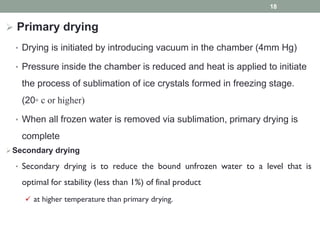
 Primary drying
• Drying is initiated by introducing vacuum in the chamber (4mm Hg)
• Pressure inside the chamber is reduced and heat is applied to initiate
the process of sublimation of ice crystals formed in freezing stage.
(20⸰ c or higher)
• When all frozen water is removed via sublimation, primary drying is
complete
Secondary drying
• Secondary drying is to reduce the bound unfrozen water to a level that is
optimal for stability (less than 1%) of final product
 at higher temperature than primary drying.
18
 Advantages
• Drying takes place at very low temperature,
• Suitable for thermolabile products
• This reduces the extent of decomposition or loss of activity in biological
products,…..
• The product is light and porous
• Easy for reconstitution and transportation
• Oxidation is minimized
Under high vacuum there is no contact with oxygen
• less chances of contamination as its operated in a controlled
environment
19
Disadvantages
• Should be dried in the final container
• The process is very slow and very expensive.
• Limited to certain types of valuable products that cannot be dried by any
other means
 Biological products (antibiotics, vaccine, blood products etc.)
20
Dryers for dilute solutions and
suspensions
21
 Spray Dryers
 The solution or suspension to be dried is sprayed into a hot airstream.
Each droplet dries to an individual solid particle
The process can be described in three major phases:
(Atomization- droplet to particle conversion-collection)
22
 Advantage
• drying takes only few seconds
 The droplets are small, giving a large surface area for heat
and mass transfer
• Uniform and controllable particle size
• The product is free-flowing
 Spherical particle
23
Disadvantage
• Expensive
Drum dryers
• Working principle:
• heated drum is slowly rotated – through feed pan.
• Material adhere to pan and a thin layer form.
• Material dry during rotation.
• knife- Dry material is scrap –fall in storage bin.
24
Drum Dryers
25
 Advantage
 Rapid drying
The thin film spread over a large area resulting in rapid heat and
mass transfer
 The equipment is compact
Occupy less space
26
 Disadvantage
 High maintenance cost.
 Skilled operator required
27
summary
 Drying- vaporization and removal of water or other liquid from a
product to form a dry solid
 Why drying? To stabilize, improve flow and compression, ease
handling and transportation, facilitate size reduction
 Dryers for solid materials: hot air oven dryers, vacuum oven dryers
Fluidized bed dryer, Freeze dyer/sublimation dryer
 Dryers for dilute solutions and suspensions: Drum dryer (film
dryer), Spray dryer
28
29

Chernet DryingFi.pdf

  • 1.
  • 2.
    Objective  At theend of this sub-topic, the student will be able to:  Define drying  Describe the applications of drying  Discuss the drying of different dosage forms 2
  • 3.
    Drying • Drying canbe defined as the process of removal of solvents (i.e. water or other liquid) from a formulation with the help of heat • It involves evaporation or sublimation of the liquid phase and results in dry solid or powder • What is the difference between drying and filtration?? • The change of phase from liquid to vapor distinguishes drying from mechanical methods of separating solids from liquids such as filtration 3
  • 4.
     Why drying? To avoid moisture which may decrease product stability.  aid preservation by minimizing mold or bacterial growth  To stabilize moisture sensitive materials  prevent deterioration of the drugs by moisture  To prepare granules for tablets & capsules.  To reduce the cost of transportation and storage  By reducing bulk density and weight.  To facilitate comminution 4
  • 5.
    Choice of dryingmethod  When considering how to dry a material, the following points should be considered:  Heat sensitivity of the material being dried  Physical characteristics of the material  Nature of the liquid to be removed  The scale of the operation  The necessity for asepsis 5
  • 6.
    Dryers  Dryers canbe categorized based on mode of operation into  Dryers for solid materials  Compartment/tray/shelf dryer (Hot air ovens)  Vacuum oven dryer  Fluidized bed dryer  Freeze dyer/sublimation dryer (Special dryer)  Dryers for dilute solutions and suspensions  Drum dryer (film dryer)  Spray dryer 6
  • 7.
    Dryers for solid Hot Air Ovens • Operates by passing hot air over the surface of a wet solid that is spread over trays arranged in racks • Fan: Circulate the air • Trays containing the load remain in the dryer until drying is complete • After w/h they will be emptied & recharge for the next batch 7
  • 8.
     Advantages  Lowinitial cost  Different products can be dried  Versatility  Materials of almost any physical form may be dried (sticky materials, granular mass, crude drugs, paste..  Limitations  A large floor space is required for the oven and tray-loading facilities Labor cost for loading and unloading the trays is high 8
  • 9.
    Drying… Limitation… drying process istime consuming Not good for thermolabile products Usually used for small sized batch Solvents recovery from the air is difficult  Not connected to condenser 9
  • 10.
     Vacuum ovendryer  The oven is connected to a vacuum pump through a condenser Pressure decreased by vacuum pump  The operating pressure is usually about 0.03 to 0.06 bar • At this pressure water boils at 25 to 35oC 10
  • 11.
     Advantages  Suitablefor materials that are unstable at highT⸰  low oxygen content when drying under low pressure prevents oxidation Easy for batch process of different compounds. The use of condenser enables solvents to be recovered, which is useful with expensive or inflammable solvents • Disadvantage • Higher investment cost • Labor and running costs are high • Low production efficiency-low output 11
  • 12.
     Fluidized BedDryers • Fluidization Principal: hot air through a bed of granules Materials will be loaded – detachable perforated basket (bowl). • Fresh air enter – inlet- heater- hot air- passes through bed of granules with optimum velocity. • Granules lifted from bottom & suspend in air (Fluidized state). Then drying from individual particles takes place. 12
  • 13.
  • 14.
     Advantage  Efficientheat transfer gives fast drying rate than static bed dryers The fluidized state of the particles enables drying from individual particles  Easy handling reduce labor cost High output from a small floor space Heating time of thermo labile substance is minimized- Disadvantage • The turbulence may cause attrition of some material, with the production of fines 14
  • 15.
     Freeze drying(Sublimation drying) (lyophilization) Lyophilization or freeze drying is a process in which water is frozen followed by its removal from the sample. • Drying takes place by subliming the frozen solid. Dehydration process is performed under vacuum while the substance is in a frozen state 15
  • 16.
    16 The phase diagramfor water with freeze drying process super imposed. • The drying is initiated by reducing the surrounding pressure (below the triple point).
  • 17.
    • Stages ofthe freeze-drying process  Freezing stage • The product is placed into the lyophilizer chamber and frozen Results is an amorphous solid product and water crystals Temperature necessary to achieve complete freezing of formulation will depend on the nature of solution 17
  • 18.
     Primary drying •Drying is initiated by introducing vacuum in the chamber (4mm Hg) • Pressure inside the chamber is reduced and heat is applied to initiate the process of sublimation of ice crystals formed in freezing stage. (20⸰ c or higher) • When all frozen water is removed via sublimation, primary drying is complete Secondary drying • Secondary drying is to reduce the bound unfrozen water to a level that is optimal for stability (less than 1%) of final product  at higher temperature than primary drying. 18
  • 19.
     Advantages • Dryingtakes place at very low temperature, • Suitable for thermolabile products • This reduces the extent of decomposition or loss of activity in biological products,….. • The product is light and porous • Easy for reconstitution and transportation • Oxidation is minimized Under high vacuum there is no contact with oxygen • less chances of contamination as its operated in a controlled environment 19
  • 20.
    Disadvantages • Should bedried in the final container • The process is very slow and very expensive. • Limited to certain types of valuable products that cannot be dried by any other means  Biological products (antibiotics, vaccine, blood products etc.) 20
  • 21.
    Dryers for dilutesolutions and suspensions 21
  • 22.
     Spray Dryers The solution or suspension to be dried is sprayed into a hot airstream. Each droplet dries to an individual solid particle The process can be described in three major phases: (Atomization- droplet to particle conversion-collection) 22
  • 23.
     Advantage • dryingtakes only few seconds  The droplets are small, giving a large surface area for heat and mass transfer • Uniform and controllable particle size • The product is free-flowing  Spherical particle 23 Disadvantage • Expensive
  • 24.
    Drum dryers • Workingprinciple: • heated drum is slowly rotated – through feed pan. • Material adhere to pan and a thin layer form. • Material dry during rotation. • knife- Dry material is scrap –fall in storage bin. 24
  • 25.
  • 26.
     Advantage  Rapiddrying The thin film spread over a large area resulting in rapid heat and mass transfer  The equipment is compact Occupy less space 26
  • 27.
     Disadvantage  Highmaintenance cost.  Skilled operator required 27
  • 28.
    summary  Drying- vaporizationand removal of water or other liquid from a product to form a dry solid  Why drying? To stabilize, improve flow and compression, ease handling and transportation, facilitate size reduction  Dryers for solid materials: hot air oven dryers, vacuum oven dryers Fluidized bed dryer, Freeze dyer/sublimation dryer  Dryers for dilute solutions and suspensions: Drum dryer (film dryer), Spray dryer 28
  • 29.