Poultry Value Chain Analysis in Lesotho
Egg Production
Planning, Monitoring and Evaluation Department
Outline
– Introduction
– Background
– Industry developments
– Lesotho Poultry Sector Value Chain Analysis
– Findings
– Challenges
– Opportunities
– Business Opportunities
– Recommendations
Introduction
• The Planning Monitoring and Evaluation Department through its
research division conducted an Egg Production Research
• This research was aimed to inform BEDCO programme development
and the public on business opportunities and challenges in the poultry
sector
• Literature Review
• One on one interviews were conducted with the MSBCM marketing
department officials
• A country wide survey of producers was also conducted ( 3 farmers/
District)
• A draft report has been compiled
Background
Commercial poultry industry in Lesotho, six distinct time periods
 Prior to 1941
– small scale raring of indigenous breeds
 1941-1952
– Department of Agriculture - Poultry Improvement Scheme -
Introduction of improved breeds
 1953-1962
– Poultry plant was built in Maseru which produced improved
chickens which were sold to farmers
Background – Cont.
 1963-1972
– Establishment of Applied Nutrition Programme and the egg
marketing co-operatives
 1973-1994
– Regulated egg marketing system
 Post 1994
– Free market system: poultry farmer’s appealed to the Ministry of
Agriculture to be allowed to sell eggs directly to wholesalers,
retailers and consumer
Industry developments
• Prior to Deregulation
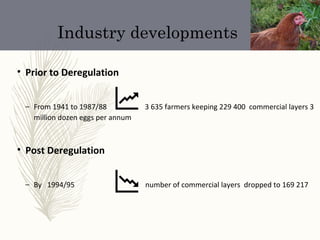
– From 1941 to 1987/88 3 635 farmers keeping 229 400 commercial layers 3
million dozen eggs per annum
• Post Deregulation
– By 1994/95 number of commercial layers dropped to 169 217
Industry developments – Cont.
• The average trend in the years shows an increasing demand for imports into Lesotho.
• Doubling in imported trays from 96 533 trays to 194 626 trays from 2012/13 to
2013/2014 signals an increased national demand for eggs which is being met by
imports.
Industry developments – Cont.
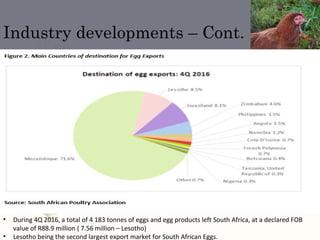
• During 4Q 2016, a total of 4 183 tonnes of eggs and egg products left South Africa, at a declared FOB
value of R88.9 million ( 7.56 million – Lesotho)
• Lesotho being the second largest export market for South African Eggs.
Lesotho Poultry Sector
- Value Chain Analysis
Value Chain Analysis.docxValue Chain Analysis.docx
Findings – Challenges
– There is no Hatchery in Lesotho this creates logistical costs for
farmers who have to order from South Africa
– There are limited suppliers of bird cages in Lesotho, and the few
that exist produce substandard cages
– Farmers claim that Lesotho Flour Mills offers lower grade layer hen
feed which limits produce and is out competed by brands from
South Africa
– Vet clinics are generally understocked
– There need for development of infrastructure specific to layer hen
farming as pollution is a challenge in community-based projects
Findings – Challenges
– Water supply is a challenge in the highlands, where a community tap
is shared this normally creates clashes when water is scarce, and the
farm suffers.
– There is a high cost of entry into the egg production business (Inputs
are expensive),
– The cold weather conditions ( longer winters) in the highlands limits
egg production.
– Need for skills development in the business
– Lack of a readily available and accessible National Supplier Database
Findings – Opportunities
– There is an abundant demand for eggs in Lesotho that has not been met
– Imported eggs are less preferred to locally produced eggs, despite the fact that
imported eggs are cheaper
– The main competitive advantage that Lesotho eggs have over imported eggs is
freshness, this advantage has created an abundant and growing demand for eggs in
Lesotho from local producers
– South Africa is participating actively in input supply industries include hatchery,
cage production, and feed. Creation of businesses in input specific industries will
enhance local production
– There is a growing demand for Layer Hen Chicken Meat as it is considered healthier
than packaged and imported chicken meat
– There is a growing demand for free range hens and their eggs, where a tray of free
range hens is normally twice the price of cage breed hens
Business Opportunities
• Expansion into Value chain opportunities such as:
 Operating national feed depots
 Feed production
 Cage production
 Sale of mechanised systems
 Opening a hatchery
 Opening an abattoir
 Packaging and distribution of Layer Hen Meat
 Hen House Construction
 Borehole drilling
 Egg tray production and sales
 Manure production
 Business Development Services (Business Plan
Development)
Recommendations
• BEDCO should introduce layer hen specific training programmes.
• The Government of Lesotho should work towards creating a national
hatchery that will meet the point of lay hen supply needs of the
country.
• A national database of all value chain practitioners in the egg
production business of Lesotho should be created; with readily
available and accessible supplier information starting an egg
production business will become easier.
• Quality checks should be frequently conducted on national Feed
suppliers
• Quality checks should be frequently conducted on egg farms
Recommendations– Cont.
• Trainings on innovative technologies in the egg production sector
should be pursued so as the scale up production for those
aspiring entrepreneurs
• Equipment Leasing for Start ups will aid in lowering the barriers
to entry into business
• Access to Start up Finance - It requires close to 500 hens to make
reasonable profit in the business, coupled with the high costs for
cages, infrastructure and feed
• Restrict egg imports through Branding Lesotho Eggs.
Poultry Value Chain Analysis in Lesotho - Egg Production

Poultry Value Chain Analysis in Lesotho - Egg Production

  • 1.
    Poultry Value ChainAnalysis in Lesotho Egg Production Planning, Monitoring and Evaluation Department
  • 2.
    Outline – Introduction – Background –Industry developments – Lesotho Poultry Sector Value Chain Analysis – Findings – Challenges – Opportunities – Business Opportunities – Recommendations
  • 3.
    Introduction • The PlanningMonitoring and Evaluation Department through its research division conducted an Egg Production Research • This research was aimed to inform BEDCO programme development and the public on business opportunities and challenges in the poultry sector • Literature Review • One on one interviews were conducted with the MSBCM marketing department officials • A country wide survey of producers was also conducted ( 3 farmers/ District) • A draft report has been compiled
  • 4.
    Background Commercial poultry industryin Lesotho, six distinct time periods  Prior to 1941 – small scale raring of indigenous breeds  1941-1952 – Department of Agriculture - Poultry Improvement Scheme - Introduction of improved breeds  1953-1962 – Poultry plant was built in Maseru which produced improved chickens which were sold to farmers
  • 5.
    Background – Cont. 1963-1972 – Establishment of Applied Nutrition Programme and the egg marketing co-operatives  1973-1994 – Regulated egg marketing system  Post 1994 – Free market system: poultry farmer’s appealed to the Ministry of Agriculture to be allowed to sell eggs directly to wholesalers, retailers and consumer
  • 6.
    Industry developments • Priorto Deregulation – From 1941 to 1987/88 3 635 farmers keeping 229 400 commercial layers 3 million dozen eggs per annum • Post Deregulation – By 1994/95 number of commercial layers dropped to 169 217
  • 7.
    Industry developments –Cont. • The average trend in the years shows an increasing demand for imports into Lesotho. • Doubling in imported trays from 96 533 trays to 194 626 trays from 2012/13 to 2013/2014 signals an increased national demand for eggs which is being met by imports.
  • 8.
    Industry developments –Cont. • During 4Q 2016, a total of 4 183 tonnes of eggs and egg products left South Africa, at a declared FOB value of R88.9 million ( 7.56 million – Lesotho) • Lesotho being the second largest export market for South African Eggs.
  • 9.
    Lesotho Poultry Sector -Value Chain Analysis Value Chain Analysis.docxValue Chain Analysis.docx
  • 10.
    Findings – Challenges –There is no Hatchery in Lesotho this creates logistical costs for farmers who have to order from South Africa – There are limited suppliers of bird cages in Lesotho, and the few that exist produce substandard cages – Farmers claim that Lesotho Flour Mills offers lower grade layer hen feed which limits produce and is out competed by brands from South Africa – Vet clinics are generally understocked – There need for development of infrastructure specific to layer hen farming as pollution is a challenge in community-based projects
  • 11.
    Findings – Challenges –Water supply is a challenge in the highlands, where a community tap is shared this normally creates clashes when water is scarce, and the farm suffers. – There is a high cost of entry into the egg production business (Inputs are expensive), – The cold weather conditions ( longer winters) in the highlands limits egg production. – Need for skills development in the business – Lack of a readily available and accessible National Supplier Database
  • 12.
    Findings – Opportunities –There is an abundant demand for eggs in Lesotho that has not been met – Imported eggs are less preferred to locally produced eggs, despite the fact that imported eggs are cheaper – The main competitive advantage that Lesotho eggs have over imported eggs is freshness, this advantage has created an abundant and growing demand for eggs in Lesotho from local producers – South Africa is participating actively in input supply industries include hatchery, cage production, and feed. Creation of businesses in input specific industries will enhance local production – There is a growing demand for Layer Hen Chicken Meat as it is considered healthier than packaged and imported chicken meat – There is a growing demand for free range hens and their eggs, where a tray of free range hens is normally twice the price of cage breed hens
  • 13.
    Business Opportunities • Expansioninto Value chain opportunities such as:  Operating national feed depots  Feed production  Cage production  Sale of mechanised systems  Opening a hatchery  Opening an abattoir  Packaging and distribution of Layer Hen Meat  Hen House Construction  Borehole drilling  Egg tray production and sales  Manure production  Business Development Services (Business Plan Development)
  • 14.
    Recommendations • BEDCO shouldintroduce layer hen specific training programmes. • The Government of Lesotho should work towards creating a national hatchery that will meet the point of lay hen supply needs of the country. • A national database of all value chain practitioners in the egg production business of Lesotho should be created; with readily available and accessible supplier information starting an egg production business will become easier. • Quality checks should be frequently conducted on national Feed suppliers • Quality checks should be frequently conducted on egg farms
  • 15.
    Recommendations– Cont. • Trainingson innovative technologies in the egg production sector should be pursued so as the scale up production for those aspiring entrepreneurs • Equipment Leasing for Start ups will aid in lowering the barriers to entry into business • Access to Start up Finance - It requires close to 500 hens to make reasonable profit in the business, coupled with the high costs for cages, infrastructure and feed • Restrict egg imports through Branding Lesotho Eggs.