SANJIVANI K. B. P. POLYTECHNIC, KOPARGAON
With NBA ACCREDIATED programs , Approved by AICTE, New Delhi,
Recognized by Govt. of Maharashtra, Affiliated to Maharashtra State Board of Technical Education, Mumbai,
ISO 9001:2015 Certified Institute
Department:- Computer Technology Class:- First Year
Name of Subject:- Basic Chemistry MSBTE Subject Code:- 311305
Syllabus
• Corrosion: Definition and Types of corrosion Dry corrosion:
Mechanism, Types of oxide film, Wet corrosion
• Mechanism hydrogen evolution in acidic medium, oxygen
absorption in neutral or alkaline medium ,Galvanic cell action
by Daniel cell.
• Factors affecting the rate of corrosion.
• Corrosion control: Modification of environment, Use of
protective coatings, coating of less active metal like Tin
(Tinning), coating of more active metal like Zinc (Galvanizing),
Anodic and cathodic protection, Choice of material-using pure
metal and using metal alloy
Sanjivani K.B.P. Polytechnic, Kopargaon Department of Computer Technology Mrs. Bhattad K.S.
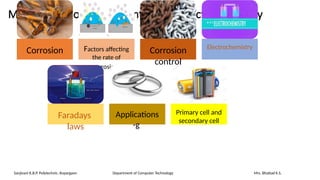
Metal Corrosion, its prevention and Electrochemistry
Corrosion Factors affecting
the rate of
corrosion
Corrosion
control
Electrochemistry
Faradays
laws
Applications
-g
Primary cell and
secondary cell
Sanjivani K.B.P. Polytechnic, Kopargaon Department of Computer Technology Mrs. Bhattad K.S.
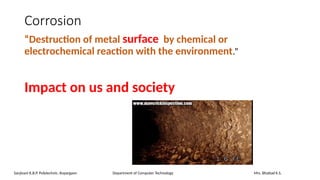
Corrosion
“Destruction of metal surface by chemical or
electrochemical reaction with the environment.”
Impact on us and society
Sanjivani K.B.P. Polytechnic, Kopargaon Department of Computer Technology Mrs. Bhattad K.S.
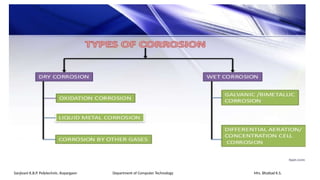
Dry corrosion/Atmospheric/chemical/direct
• This type of corrosion occurs by direct chemical attack of atmospheric
gases like O2, halogen, hydrogen, CO2 etc. on metal surface.
• A. Corrosion due to O2/ Oxidation corrosion
• B. Corrosion due to other gases
Sanjivani K.B.P. Polytechnic, Kopargaon Department of Computer Technology Mrs. Bhattad K.S.
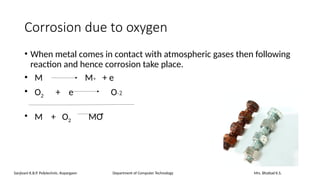
Corrosion due to oxygen
• When metal comes in contact with atmospheric gases then following
reaction and hence corrosion take place.
• M M+ + e
• O2 + e O-2
• M + O2 MO
Sanjivani K.B.P. Polytechnic, Kopargaon Department of Computer Technology Mrs. Bhattad K.S.
Types of oxide film-
Sanjivani K.B.P. Polytechnic, Kopargaon Department of Computer Technology Mrs. Bhattad K.S.
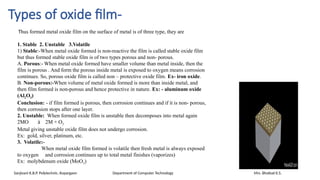
Thus formed metal oxide film on the surface of metal is of three type, they are
1. Stable 2. Unstable 3.Volatile
1) Stable:-When metal oxide formed is non-reactive the film is called stable oxide film
but thus formed stable oxide film is of two types porous and non- porous.
A. Porous:- When metal oxide formed have smaller volume than metal inside, then the
film is porous . And form the porous inside metal is exposed to oxygen means corrosion
continues. So, porous oxide film is called non – protective oxide film. Ex- iron oxide.
B. Non-porous:-When volume of metal oxide formed is more than inside metal, and
then film formed is non-porous and hence protective in nature. Ex: - aluminum oxide
(Al2O3)
Conclusion: - if film formed is porous, then corrosion continues and if it is non- porous,
then corrosion stops after one layer.
2. Unstable: When formed oxide film is unstable then decomposes into metal again
2MO à 2M + O2
Metal giving unstable oxide film does not undergo corrosion.
Ex: gold, silver, platinum, etc.
3. Volatile:-
When metal oxide film formed is volatile then fresh metal is always exposed
to oxygen and corrosion continues up to total metal finishes (vaporizes)
Ex: molybdenum oxide (MoO3)
Electrochemical/Wet/Immersed corrosion
• Corrosion due to ionic reactions in the presence of moisture
or solution as a conducting medium is wet corrosion.
•Situations which faciliates wet corrosion-
• 1. When two dissimilar metal are in contact.
• 2. Formation of anodic and cathodic areas.
• 3. Electrical contact between anode and cathode.
• 4. Presence of medium like moisture or solution.
Sanjivani K.B.P. Polytechnic, Kopargaon Department of Computer Technology Mrs. Bhattad K.S.
Electrochemical/Wet/Immersed corrosion with
the help of Daniel cell
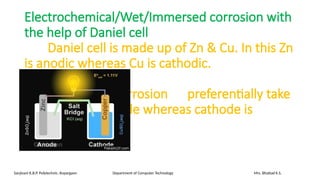
Daniel cell is made up of Zn & Cu. In this Zn
is anodic whereas Cu is cathodic.
Remember corrosion preferentially take
place at anode whereas cathode is
always safe.
Sanjivani K.B.P. Polytechnic, Kopargaon Department of Computer Technology Mrs. Bhattad K.S.
Mechanism of electrochemical corrosion
•This corrosion take place by two ways
•A. With evolution of hydrogen gas (Acidic Medium)
• Consider acid is stored in steel tank
• Containing some plumbing of copper.
• Like welding at joints with copper.
• Now copper joints are cathode and big
• iron tank is anode.
• Smaller areas are cathodic whereas
• larger areas are anodic. Corrosion is
with slower rate.
Sanjivani K.B.P. Polytechnic, Kopargaon Department of Computer Technology Mrs. Bhattad K.S.
B. With absorption of oxygen
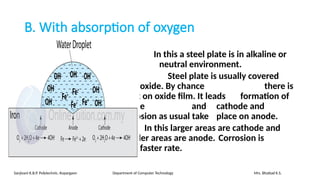
In this a steel plate is in alkaline or
neutral environment.
Steel plate is usually covered
with oxide. By chance there is
crack on oxide film. It leads formation of
anode and cathode and
corrosion as usual take place on anode.
In this larger areas are cathode and
smaller areas are anode. Corrosion is
with faster rate.
Sanjivani K.B.P. Polytechnic, Kopargaon Department of Computer Technology Mrs. Bhattad K.S.
Highlights-
• Corrosion take place at less concentrated of aerated part.
• Corrosion is problem of anode.
• More active metal is anode.
• When anode is smaller in size then corrosion is too much
faster.
• Corrosion is faster in acidic medium compare to alkaline or
neutral.
Sanjivani K.B.P. Polytechnic, Kopargaon Department of Computer Technology Mrs. Bhattad K.S.
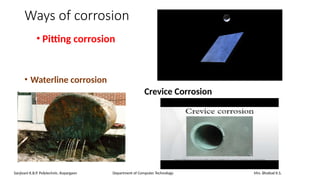
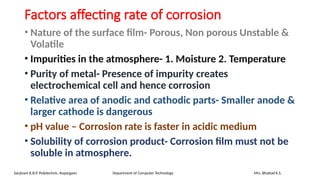
Ways of corrosion
• Pitting corrosion
• Waterline corrosion
Crevice Corrosion
Sanjivani K.B.P. Polytechnic, Kopargaon Department of Computer Technology Mrs. Bhattad K.S.
Factors affecting rate of corrosion
• Nature of the surface film- Porous, Non porous Unstable &
Volatile
• Impurities in the atmosphere- 1. Moisture 2. Temperature
• Purity of metal- Presence of impurity creates
electrochemical cell and hence corrosion
• Relative area of anodic and cathodic parts- Smaller anode &
larger cathode is dangerous
• pH value – Corrosion rate is faster in acidic medium
• Solubility of corrosion product- Corrosion film must not be
soluble in atmosphere.
Sanjivani K.B.P. Polytechnic, Kopargaon Department of Computer Technology Mrs. Bhattad K.S.
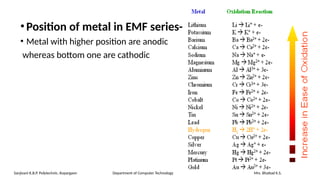
•Position of metal in EMF series-
• Metal with higher position are anodic
whereas bottom one are cathodic
Sanjivani K.B.P. Polytechnic, Kopargaon Department of Computer Technology Mrs. Bhattad K.S.
Protections of metals from corrosion
• Modification of environment
A] Removal of corrosion stimulant-
To avoid corrosion due to oxygen, dissolved oxygen from
water is removed either by deaeration or using reducing
substances like hydrazine N2H4 or sodium sulphite Na2SO3.
* Corrosion of acid is removed by neutralization using lime.
* Corrosion due to moisture or humid air is minimized by
using silica gel.
Sanjivani K.B.P. Polytechnic, Kopargaon Department of Computer Technology Mrs. Bhattad K.S.
•B] Use of inhibitors-
•These are substances added to environment to
reduce corrosion.
•Inhibitors are substance which creates physical
barrier between the metal and environment.
•Quinoline, organic amines, cyanides, chromates are
effective inhibitors
Sanjivani K.B.P. Polytechnic, Kopargaon Department of Computer Technology Mrs. Bhattad K.S.
Cathodic protection
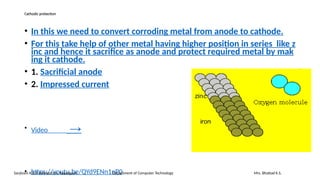
• In this we need to convert corroding metal from anode to cathode.
• For this take help of other metal having higher position in series like z
inc and hence it sacrifice as anode and protect required metal by mak
ing it cathode.
• 1. Sacrificial anode
• 2. Impressed current
• Video →
• https://youtu.be/QYd9ENn1nP0
Sanjivani K.B.P. Polytechnic, Kopargaon Department of Computer Technology Mrs. Bhattad K.S.
Protective coating -Hot Dipping
• A] Galvanizing- The process of coating of more active Zn over less active iron
by hot dipping is known as galvanizing.
• This is anodic coating.
• Zn protect base metal though coating is broken.
• Widely used for roofing sheets, nails
fencing wires, buckets, vehicles, etc.
• Galvanizing is not for food storage.
• As it is poisonous coating.
• If powder coating of Zn is done then
it is called is Sherardizing. Ex Screw,
nut, bolt, gauze etc.
https://www.youtube.com/watch?v=UE7zY9JoVIc
Sanjivani K.B.P. Polytechnic, Kopargaon Department of Computer Technology Mrs. Bhattad K.S.
Protective coating -Hot Dipping
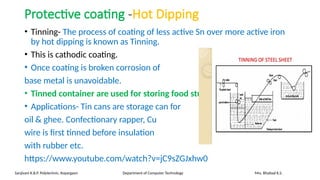
• Tinning- The process of coating of less active Sn over more active iron
by hot dipping is known as Tinning.
• This is cathodic coating.
• Once coating is broken corrosion of
base metal is unavoidable.
• Tinned container are used for storing food stuff.
• Applications- Tin cans are storage can for
oil & ghee. Confectionary rapper, Cu
wire is first tinned before insulation
with rubber etc.
https://www.youtube.com/watch?v=jC9sZGJxhw0
Sanjivani K.B.P. Polytechnic, Kopargaon Department of Computer Technology Mrs. Bhattad K.S.
Choice of material-using pure metal and using metal
alloy
• Selection of marterial- 1. Avoid contact between dissimilar metals.
• 2. Areal of anode should be larger than cathode.
• 3. Two dissimilar metal chosen must be as close as possible in galvanic
series.
• 4. It two dissimilar metals are used then to avoid current flow
introduce insulator to cut contact and to avoid currunt flow.
• 5. Pure metal has more resistance to corrosion due to lack of anode
and cathode formation.
• 6. Corrosion reisitance can be avoided using alloy. eg. Steel, brass.
Sanjivani K.B.P. Polytechnic, Kopargaon Department of Computer Technology Mrs. Bhattad K.S.
Learning outcome
You come to know
1. What is corrosion,when, how and where it take
place.
2. Types and mechanism of corrosion.
3. Factors affecting corrosion.
4. Protection against corrosion.
Sanjivani K.B.P. Polytechnic, Kopargaon Department of Computer Technology Mrs. Bhattad K.S.

Corrosion and its protection........pptx

  • 1.
    SANJIVANI K. B.P. POLYTECHNIC, KOPARGAON With NBA ACCREDIATED programs , Approved by AICTE, New Delhi, Recognized by Govt. of Maharashtra, Affiliated to Maharashtra State Board of Technical Education, Mumbai, ISO 9001:2015 Certified Institute Department:- Computer Technology Class:- First Year Name of Subject:- Basic Chemistry MSBTE Subject Code:- 311305
  • 2.
    Syllabus • Corrosion: Definitionand Types of corrosion Dry corrosion: Mechanism, Types of oxide film, Wet corrosion • Mechanism hydrogen evolution in acidic medium, oxygen absorption in neutral or alkaline medium ,Galvanic cell action by Daniel cell. • Factors affecting the rate of corrosion. • Corrosion control: Modification of environment, Use of protective coatings, coating of less active metal like Tin (Tinning), coating of more active metal like Zinc (Galvanizing), Anodic and cathodic protection, Choice of material-using pure metal and using metal alloy Sanjivani K.B.P. Polytechnic, Kopargaon Department of Computer Technology Mrs. Bhattad K.S.
  • 3.
    Metal Corrosion, itsprevention and Electrochemistry Corrosion Factors affecting the rate of corrosion Corrosion control Electrochemistry Faradays laws Applications -g Primary cell and secondary cell Sanjivani K.B.P. Polytechnic, Kopargaon Department of Computer Technology Mrs. Bhattad K.S.
  • 4.
    Corrosion “Destruction of metalsurface by chemical or electrochemical reaction with the environment.” Impact on us and society Sanjivani K.B.P. Polytechnic, Kopargaon Department of Computer Technology Mrs. Bhattad K.S.
  • 5.
    Sanjivani K.B.P. Polytechnic,Kopargaon Department of Computer Technology Mrs. Bhattad K.S.
  • 6.
    Dry corrosion/Atmospheric/chemical/direct • Thistype of corrosion occurs by direct chemical attack of atmospheric gases like O2, halogen, hydrogen, CO2 etc. on metal surface. • A. Corrosion due to O2/ Oxidation corrosion • B. Corrosion due to other gases Sanjivani K.B.P. Polytechnic, Kopargaon Department of Computer Technology Mrs. Bhattad K.S.
  • 7.
    Corrosion due tooxygen • When metal comes in contact with atmospheric gases then following reaction and hence corrosion take place. • M M+ + e • O2 + e O-2 • M + O2 MO Sanjivani K.B.P. Polytechnic, Kopargaon Department of Computer Technology Mrs. Bhattad K.S.
  • 8.
    Types of oxidefilm- Sanjivani K.B.P. Polytechnic, Kopargaon Department of Computer Technology Mrs. Bhattad K.S. Thus formed metal oxide film on the surface of metal is of three type, they are 1. Stable 2. Unstable 3.Volatile 1) Stable:-When metal oxide formed is non-reactive the film is called stable oxide film but thus formed stable oxide film is of two types porous and non- porous. A. Porous:- When metal oxide formed have smaller volume than metal inside, then the film is porous . And form the porous inside metal is exposed to oxygen means corrosion continues. So, porous oxide film is called non – protective oxide film. Ex- iron oxide. B. Non-porous:-When volume of metal oxide formed is more than inside metal, and then film formed is non-porous and hence protective in nature. Ex: - aluminum oxide (Al2O3) Conclusion: - if film formed is porous, then corrosion continues and if it is non- porous, then corrosion stops after one layer. 2. Unstable: When formed oxide film is unstable then decomposes into metal again 2MO à 2M + O2 Metal giving unstable oxide film does not undergo corrosion. Ex: gold, silver, platinum, etc. 3. Volatile:- When metal oxide film formed is volatile then fresh metal is always exposed to oxygen and corrosion continues up to total metal finishes (vaporizes) Ex: molybdenum oxide (MoO3)
  • 9.
    Electrochemical/Wet/Immersed corrosion • Corrosiondue to ionic reactions in the presence of moisture or solution as a conducting medium is wet corrosion. •Situations which faciliates wet corrosion- • 1. When two dissimilar metal are in contact. • 2. Formation of anodic and cathodic areas. • 3. Electrical contact between anode and cathode. • 4. Presence of medium like moisture or solution. Sanjivani K.B.P. Polytechnic, Kopargaon Department of Computer Technology Mrs. Bhattad K.S.
  • 10.
    Electrochemical/Wet/Immersed corrosion with thehelp of Daniel cell Daniel cell is made up of Zn & Cu. In this Zn is anodic whereas Cu is cathodic. Remember corrosion preferentially take place at anode whereas cathode is always safe. Sanjivani K.B.P. Polytechnic, Kopargaon Department of Computer Technology Mrs. Bhattad K.S.
  • 11.
    Mechanism of electrochemicalcorrosion •This corrosion take place by two ways •A. With evolution of hydrogen gas (Acidic Medium) • Consider acid is stored in steel tank • Containing some plumbing of copper. • Like welding at joints with copper. • Now copper joints are cathode and big • iron tank is anode. • Smaller areas are cathodic whereas • larger areas are anodic. Corrosion is with slower rate. Sanjivani K.B.P. Polytechnic, Kopargaon Department of Computer Technology Mrs. Bhattad K.S.
  • 12.
    B. With absorptionof oxygen In this a steel plate is in alkaline or neutral environment. Steel plate is usually covered with oxide. By chance there is crack on oxide film. It leads formation of anode and cathode and corrosion as usual take place on anode. In this larger areas are cathode and smaller areas are anode. Corrosion is with faster rate. Sanjivani K.B.P. Polytechnic, Kopargaon Department of Computer Technology Mrs. Bhattad K.S.
  • 13.
    Highlights- • Corrosion takeplace at less concentrated of aerated part. • Corrosion is problem of anode. • More active metal is anode. • When anode is smaller in size then corrosion is too much faster. • Corrosion is faster in acidic medium compare to alkaline or neutral. Sanjivani K.B.P. Polytechnic, Kopargaon Department of Computer Technology Mrs. Bhattad K.S.
  • 14.
    Ways of corrosion •Pitting corrosion • Waterline corrosion Crevice Corrosion Sanjivani K.B.P. Polytechnic, Kopargaon Department of Computer Technology Mrs. Bhattad K.S.
  • 15.
    Factors affecting rateof corrosion • Nature of the surface film- Porous, Non porous Unstable & Volatile • Impurities in the atmosphere- 1. Moisture 2. Temperature • Purity of metal- Presence of impurity creates electrochemical cell and hence corrosion • Relative area of anodic and cathodic parts- Smaller anode & larger cathode is dangerous • pH value – Corrosion rate is faster in acidic medium • Solubility of corrosion product- Corrosion film must not be soluble in atmosphere. Sanjivani K.B.P. Polytechnic, Kopargaon Department of Computer Technology Mrs. Bhattad K.S.
  • 16.
    •Position of metalin EMF series- • Metal with higher position are anodic whereas bottom one are cathodic Sanjivani K.B.P. Polytechnic, Kopargaon Department of Computer Technology Mrs. Bhattad K.S.
  • 17.
    Protections of metalsfrom corrosion • Modification of environment A] Removal of corrosion stimulant- To avoid corrosion due to oxygen, dissolved oxygen from water is removed either by deaeration or using reducing substances like hydrazine N2H4 or sodium sulphite Na2SO3. * Corrosion of acid is removed by neutralization using lime. * Corrosion due to moisture or humid air is minimized by using silica gel. Sanjivani K.B.P. Polytechnic, Kopargaon Department of Computer Technology Mrs. Bhattad K.S.
  • 18.
    •B] Use ofinhibitors- •These are substances added to environment to reduce corrosion. •Inhibitors are substance which creates physical barrier between the metal and environment. •Quinoline, organic amines, cyanides, chromates are effective inhibitors Sanjivani K.B.P. Polytechnic, Kopargaon Department of Computer Technology Mrs. Bhattad K.S.
  • 19.
    Cathodic protection • Inthis we need to convert corroding metal from anode to cathode. • For this take help of other metal having higher position in series like z inc and hence it sacrifice as anode and protect required metal by mak ing it cathode. • 1. Sacrificial anode • 2. Impressed current • Video → • https://youtu.be/QYd9ENn1nP0 Sanjivani K.B.P. Polytechnic, Kopargaon Department of Computer Technology Mrs. Bhattad K.S.
  • 20.
    Protective coating -HotDipping • A] Galvanizing- The process of coating of more active Zn over less active iron by hot dipping is known as galvanizing. • This is anodic coating. • Zn protect base metal though coating is broken. • Widely used for roofing sheets, nails fencing wires, buckets, vehicles, etc. • Galvanizing is not for food storage. • As it is poisonous coating. • If powder coating of Zn is done then it is called is Sherardizing. Ex Screw, nut, bolt, gauze etc. https://www.youtube.com/watch?v=UE7zY9JoVIc Sanjivani K.B.P. Polytechnic, Kopargaon Department of Computer Technology Mrs. Bhattad K.S.
  • 21.
    Protective coating -HotDipping • Tinning- The process of coating of less active Sn over more active iron by hot dipping is known as Tinning. • This is cathodic coating. • Once coating is broken corrosion of base metal is unavoidable. • Tinned container are used for storing food stuff. • Applications- Tin cans are storage can for oil & ghee. Confectionary rapper, Cu wire is first tinned before insulation with rubber etc. https://www.youtube.com/watch?v=jC9sZGJxhw0 Sanjivani K.B.P. Polytechnic, Kopargaon Department of Computer Technology Mrs. Bhattad K.S.
  • 22.
    Choice of material-usingpure metal and using metal alloy • Selection of marterial- 1. Avoid contact between dissimilar metals. • 2. Areal of anode should be larger than cathode. • 3. Two dissimilar metal chosen must be as close as possible in galvanic series. • 4. It two dissimilar metals are used then to avoid current flow introduce insulator to cut contact and to avoid currunt flow. • 5. Pure metal has more resistance to corrosion due to lack of anode and cathode formation. • 6. Corrosion reisitance can be avoided using alloy. eg. Steel, brass. Sanjivani K.B.P. Polytechnic, Kopargaon Department of Computer Technology Mrs. Bhattad K.S.
  • 23.
    Learning outcome You cometo know 1. What is corrosion,when, how and where it take place. 2. Types and mechanism of corrosion. 3. Factors affecting corrosion. 4. Protection against corrosion. Sanjivani K.B.P. Polytechnic, Kopargaon Department of Computer Technology Mrs. Bhattad K.S.