Electrochemical Principles of Corrosion
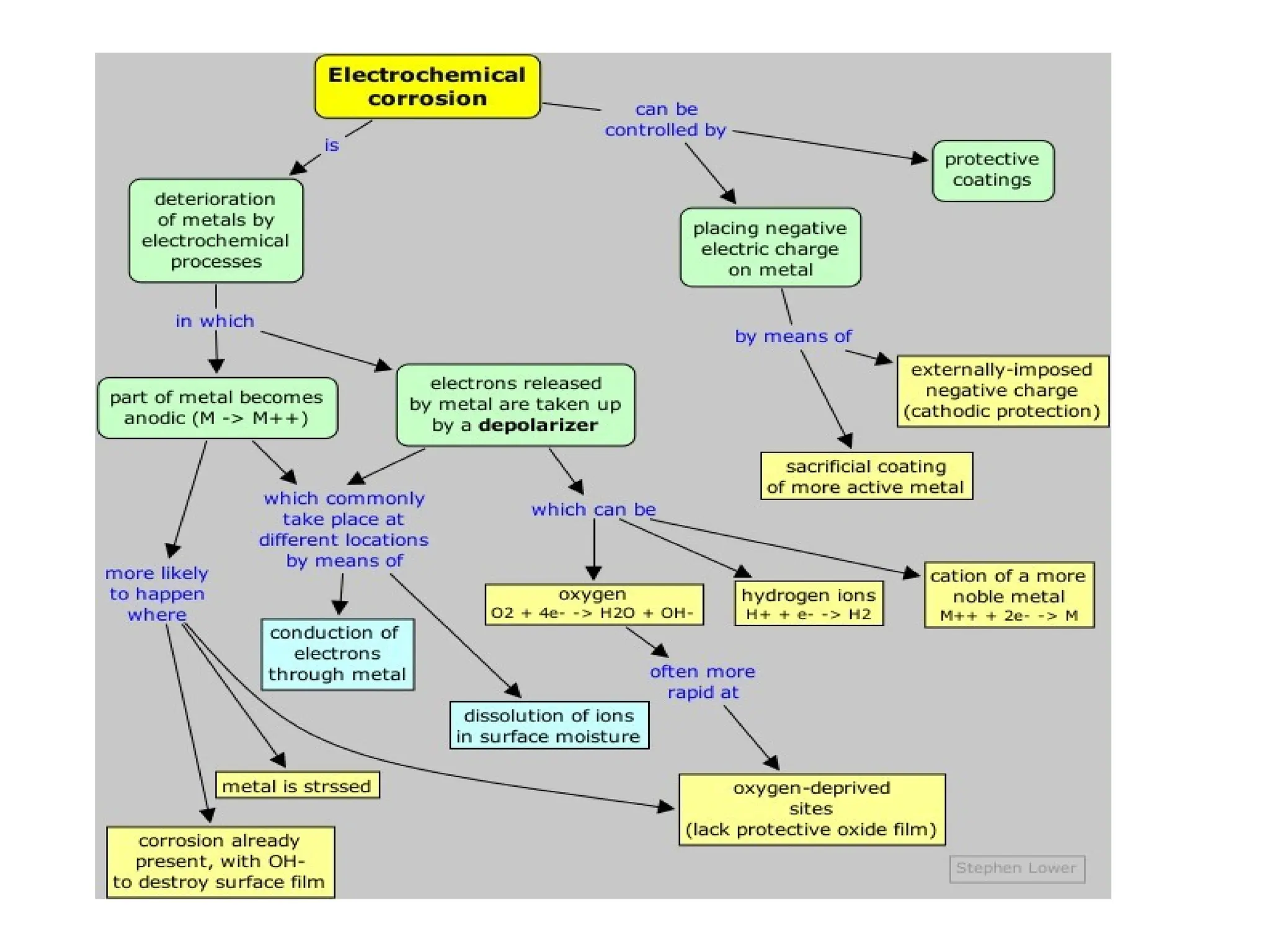
• Corrosion is essentially an electrochemical process resulting in part or
all of the metal being transformed from the metallic to ionic state.
• Corrosion requires a flow of electricity between certain areas of a
metal surface through an electrolyte. An electrolyte is any solution that
contain ions. Ions are electrically charged atoms or group of atoms.
• Pure water , for example, contains positively charged hydrogen ions
and negatively charged hydroxyl ions in equal amounts. Electrolyte
may be plain water, salt water, or acidic or alkaline solutions of any
concentration. To complete the electric circuit, there must be two
electrodes, an anode and a cathode, and they must be connected.
Electrodes may be two different kinds of metals or they may be
different areas on the same piece of metal.
2
Electrochemical Principles of Corrosion
• The connection between the anode and the cathode may be a metallic
bridge, but in corrosion it is usually achieved simply by contact. In
order for electricity to flow there must be a potential difference
between the electrodes.
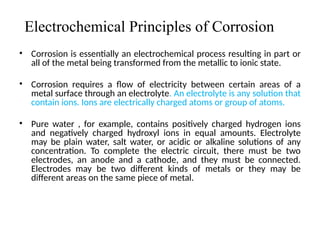
• If a piece of ordinary iron is placed in a solution of HCl, vigorous
bubbling of hydrogen gas is observed. On the surface of the metal
there are numerous tiny anodes and cathode areas caused by the
inclusions in the metal, surface imperfections, localized stresses,
orientation of the grains, or perhaps variations in the environment (See
figure).
• At the anode, positive charged iron atoms detach themselves from the
solid surface and enter the solution as positive ions, while the negative
charges, in the form of electrons, are left behind in the metal.
3
Electrochemical Principles of Corrosion
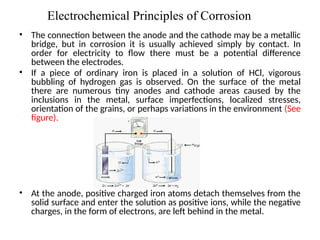
• At the cathode the electrons meet and neutralize some positively
charged hydrogen ions which have arrived at the surface through the
electrolyte. In losing their charge the positive ions become neutral
atoms again and combine to form hydrogen gas.
• So, as this process continues, oxidation and corrosion of iron occurs at
the anodes, and plating out of hydrogen occurs at the cathode. The
amount of metal which dissolves is proportional to the number of
electrons flowing, which in turn is dependent on the potential and the
resistance of the metal.
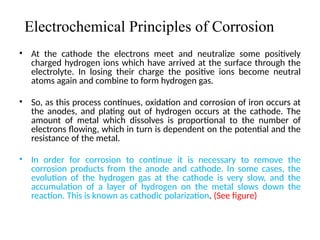
• In order for corrosion to continue it is necessary to remove the
corrosion products from the anode and cathode. In some cases, the
evolution of the hydrogen gas at the cathode is very slow, and the
accumulation of a layer of hydrogen on the metal slows down the
reaction. This is known as cathodic polarization. (See figure)
4
Electrochemical Principles of Corrosion
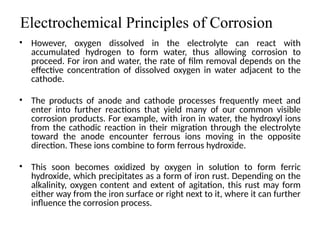
• However, oxygen dissolved in the electrolyte can react with
accumulated hydrogen to form water, thus allowing corrosion to
proceed. For iron and water, the rate of film removal depends on the
effective concentration of dissolved oxygen in water adjacent to the
cathode.
• The products of anode and cathode processes frequently meet and
enter into further reactions that yield many of our common visible
corrosion products. For example, with iron in water, the hydroxyl ions
from the cathodic reaction in their migration through the electrolyte
toward the anode encounter ferrous ions moving in the opposite
direction. These ions combine to form ferrous hydroxide.
• This soon becomes oxidized by oxygen in solution to form ferric
hydroxide, which precipitates as a form of iron rust. Depending on the
alkalinity, oxygen content and extent of agitation, this rust may form
either way from the iron surface or right next to it, where it can further
influence the corrosion process.
5
6
Book explanation
8
Book figure
slide figure
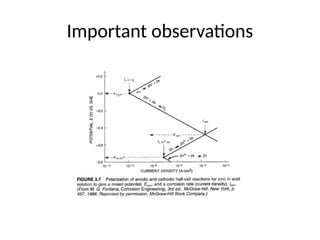
Polarization and Its Effect on Corrosion
• Polarization is the change of potential from a stabilized state, e.g. from the open-
circuit electrode potential as the result of the passage of current. It also refers to the
change in the potential of an electrode during electrolysis, such that the potential of
an anode becomes more noble, and that of a cathode more active, than their
respective reversible potentials. Often accomplished by formation of a film on the
electrode surface.
• In the context of corrosion, polarization refers to the potential shift away from the
open circuit potential (free corroding potential) of a corroding system.
• For all metals and alloys in any aqueous environment, cathodic polarization always
reduce the corrosion rate. Cathodic protection is essentially the application of a
cathodic polarization to a corroding system.
• For a non-passive system (e.g. steel in seawater), anodic polarization always increases
the corrosion rate. For systems showing active-to-passive transition, anodic
polarization will increase the corrosion rate initially and then cause a drastic reduction
in the corrosion rate. Anodic protection is essentially the application of anodic
polarization to a corroding system.
• The cathode is polarized by the hydrogen atoms producing a
film covering the cathode surface. The film affects the process
kinetic: it slows down the reaction between the electrons and
hydrogen ions dissolved in the electrolyte.
• At the equilibrium (non-polarized) state the rates of oxidation
and reduction reactions proceeding at any electrode are
equal. For example the ions of Cu are receiving electrons on
the electrode surface and transfer from the electrolyte to the
copper deposit. In parallel the same number of copper atoms
give up their electrons and dissolve in the electrolyte.
Activation Polarization
• Concentration polarization of an electrode is a result of formation of a
Diffusion layer adjacent to the electrode surface where there is a gradient
of the ion concentration.
Diffusion of the ions through the layers controls the electrochemical
reaction (corrosion, Electroplating).
Concentration Polarization
Important observations

1-Electrochemical Corrosion presentation.pptx

  • 2.
    Electrochemical Principles ofCorrosion • Corrosion is essentially an electrochemical process resulting in part or all of the metal being transformed from the metallic to ionic state. • Corrosion requires a flow of electricity between certain areas of a metal surface through an electrolyte. An electrolyte is any solution that contain ions. Ions are electrically charged atoms or group of atoms. • Pure water , for example, contains positively charged hydrogen ions and negatively charged hydroxyl ions in equal amounts. Electrolyte may be plain water, salt water, or acidic or alkaline solutions of any concentration. To complete the electric circuit, there must be two electrodes, an anode and a cathode, and they must be connected. Electrodes may be two different kinds of metals or they may be different areas on the same piece of metal. 2
  • 3.
    Electrochemical Principles ofCorrosion • The connection between the anode and the cathode may be a metallic bridge, but in corrosion it is usually achieved simply by contact. In order for electricity to flow there must be a potential difference between the electrodes. • If a piece of ordinary iron is placed in a solution of HCl, vigorous bubbling of hydrogen gas is observed. On the surface of the metal there are numerous tiny anodes and cathode areas caused by the inclusions in the metal, surface imperfections, localized stresses, orientation of the grains, or perhaps variations in the environment (See figure). • At the anode, positive charged iron atoms detach themselves from the solid surface and enter the solution as positive ions, while the negative charges, in the form of electrons, are left behind in the metal. 3
  • 4.
    Electrochemical Principles ofCorrosion • At the cathode the electrons meet and neutralize some positively charged hydrogen ions which have arrived at the surface through the electrolyte. In losing their charge the positive ions become neutral atoms again and combine to form hydrogen gas. • So, as this process continues, oxidation and corrosion of iron occurs at the anodes, and plating out of hydrogen occurs at the cathode. The amount of metal which dissolves is proportional to the number of electrons flowing, which in turn is dependent on the potential and the resistance of the metal. • In order for corrosion to continue it is necessary to remove the corrosion products from the anode and cathode. In some cases, the evolution of the hydrogen gas at the cathode is very slow, and the accumulation of a layer of hydrogen on the metal slows down the reaction. This is known as cathodic polarization. (See figure) 4
  • 5.
    Electrochemical Principles ofCorrosion • However, oxygen dissolved in the electrolyte can react with accumulated hydrogen to form water, thus allowing corrosion to proceed. For iron and water, the rate of film removal depends on the effective concentration of dissolved oxygen in water adjacent to the cathode. • The products of anode and cathode processes frequently meet and enter into further reactions that yield many of our common visible corrosion products. For example, with iron in water, the hydroxyl ions from the cathodic reaction in their migration through the electrolyte toward the anode encounter ferrous ions moving in the opposite direction. These ions combine to form ferrous hydroxide. • This soon becomes oxidized by oxygen in solution to form ferric hydroxide, which precipitates as a form of iron rust. Depending on the alkalinity, oxygen content and extent of agitation, this rust may form either way from the iron surface or right next to it, where it can further influence the corrosion process. 5
  • 6.
  • 7.
  • 8.
  • 9.
    Polarization and ItsEffect on Corrosion • Polarization is the change of potential from a stabilized state, e.g. from the open- circuit electrode potential as the result of the passage of current. It also refers to the change in the potential of an electrode during electrolysis, such that the potential of an anode becomes more noble, and that of a cathode more active, than their respective reversible potentials. Often accomplished by formation of a film on the electrode surface. • In the context of corrosion, polarization refers to the potential shift away from the open circuit potential (free corroding potential) of a corroding system. • For all metals and alloys in any aqueous environment, cathodic polarization always reduce the corrosion rate. Cathodic protection is essentially the application of a cathodic polarization to a corroding system. • For a non-passive system (e.g. steel in seawater), anodic polarization always increases the corrosion rate. For systems showing active-to-passive transition, anodic polarization will increase the corrosion rate initially and then cause a drastic reduction in the corrosion rate. Anodic protection is essentially the application of anodic polarization to a corroding system.
  • 10.
    • The cathodeis polarized by the hydrogen atoms producing a film covering the cathode surface. The film affects the process kinetic: it slows down the reaction between the electrons and hydrogen ions dissolved in the electrolyte. • At the equilibrium (non-polarized) state the rates of oxidation and reduction reactions proceeding at any electrode are equal. For example the ions of Cu are receiving electrons on the electrode surface and transfer from the electrolyte to the copper deposit. In parallel the same number of copper atoms give up their electrons and dissolve in the electrolyte. Activation Polarization
  • 11.
    • Concentration polarizationof an electrode is a result of formation of a Diffusion layer adjacent to the electrode surface where there is a gradient of the ion concentration. Diffusion of the ions through the layers controls the electrochemical reaction (corrosion, Electroplating). Concentration Polarization
  • 13.

Editor's Notes

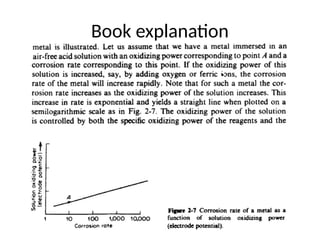
  • #7 In normal metals, the increase in oxidation power is the increase in oxidation potential i.e. more reactive capacity of the solution, (the solution actually provides species for cathodic rreactions i.e. reduction occurs, but we talk in terms of oxidizing power because, the solution species itself will reduce but cause oxidation/corrosion of the anode. More cathodic the solution,higher will be its power to oxidize anode) This high reactivity of the solution (could be due to the possibility of more than one cathodic reaction) results in increased corrosion rate. We can also denote corrosion rate in terms of current density. As corrosion is actually flow of electrons from anode to cathode. For normal materials the relation between the oxidizing power and corrosion rate is exponential (with increase in oxidizing power corrosion will also increase.)
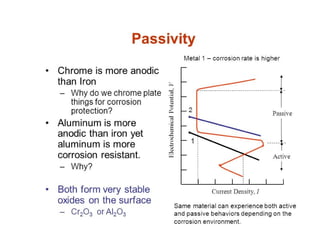
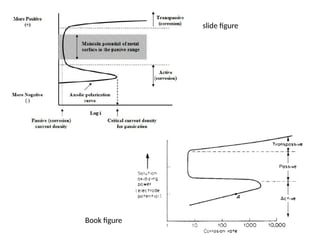
  • #8 Corrosion begins in the material and initially passive materials show identical behavior with the normal metals. i.e. with increase in oxidizing power of the solution, corrosion rate increases) .s corrosion proceeds, electron are released and they begin to flow towards the cathode, hence current density increase (current flowing per unit area). As corrosion proceeds I,e, oxidation proceeds due to increase in Oxidation power/electrode potential, an oxide film is formed on the surface of metal as corrosion product. This film is impervious. At certain potential/oxidizing power, the entire surface is covered by this film. This oxide layer is protective, hence further corrosion doesn’t occur. The oxidation power at which protective film is completely formed, is marked with a certain corrosion rate/current density. This is know as critical current density for passivation, as after this no further corrosion occurs and the metal becomes inert/passive. No further corrosion means there is no flow of electrons, hence the current density is shown to rapidly decrease. (actually the curve should be straight, there shouldn’t be this large slope, see the figure in book). Now, the metal is protected. With further increase in oxidation power/electrode potential, little to no corrosion will occur, and the underlying metal remains protected. This passive behavior is shown over a large range of oxidizing powers. However, for highly corrosive solutions, with high oxidizing power, the layer is debonded or damaged and corrosion proceeds rapidly. And again corrosion rate begins to increase with the increasing oxidizing power. This behavior is similar to that of active region and is termed as trans passive region.
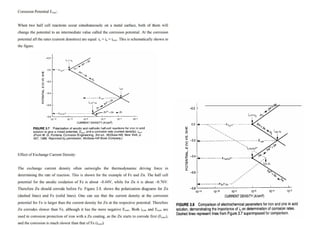
  • #13 Zn has more electronegative potential so its, current density is more, higher electronegativity = more tendency to oxidize/corrode. H has a comparatively more electropositive potential, thus, it has a low current density. During corrosion anode becomes more electropositive and cathode becomes more electronegative.