Diuretics excrete excesswater and ions from the body. They
increase diuresis. Urine formation includes 3 processes: glomerular
filtration, tubular reabsorption and secretion.
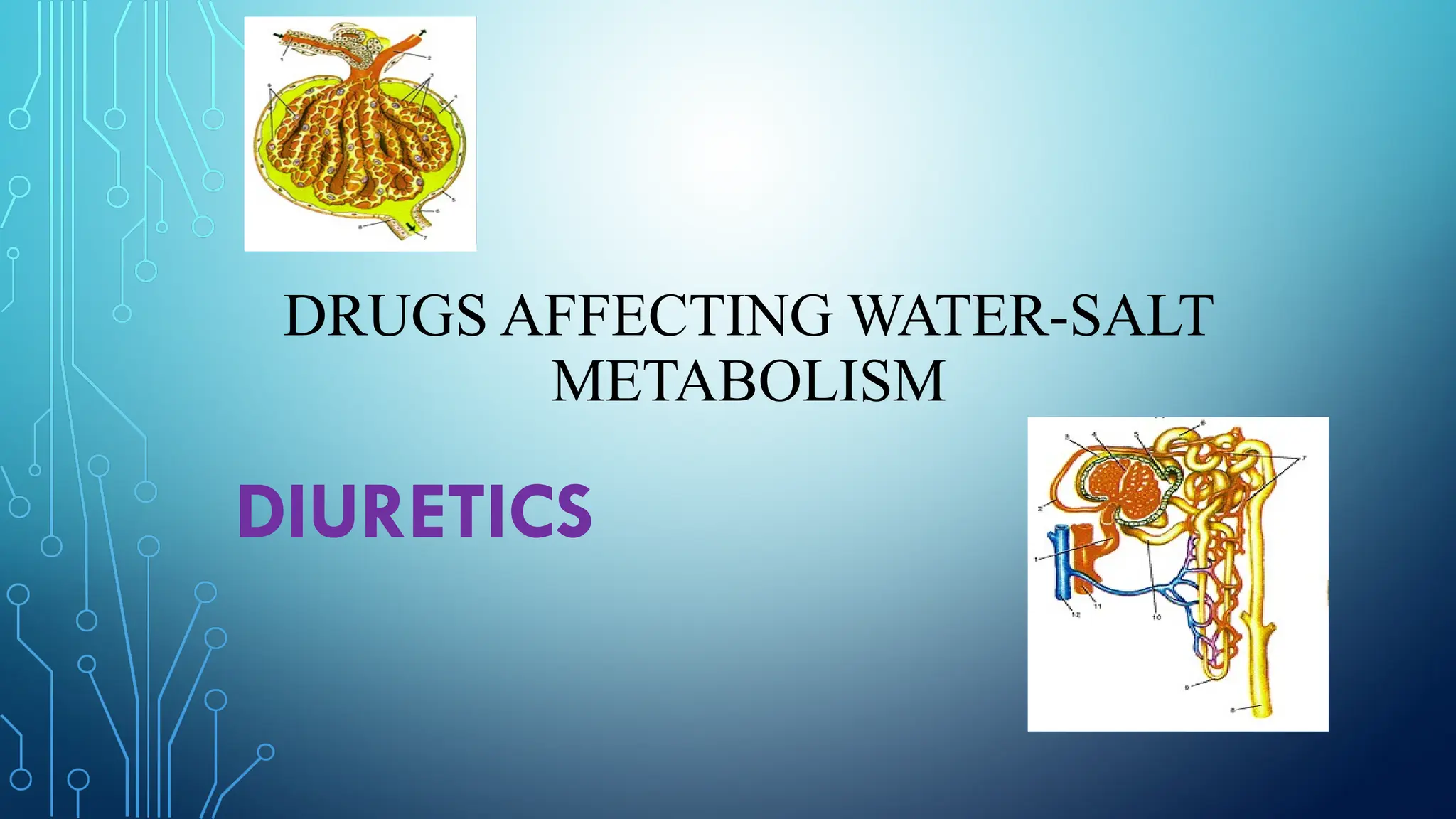
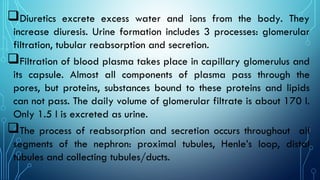
Filtration of blood plasma takes place in capillary glomerulus and
its capsule. Almost all components of plasma pass through the
pores, but proteins, substances bound to these proteins and lipids
can not pass. The daily volume of glomerular filtrate is about 170 l.
Only 1.5 l is excreted as urine.
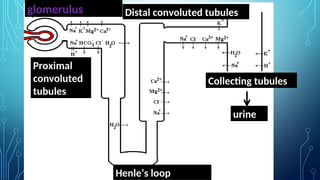
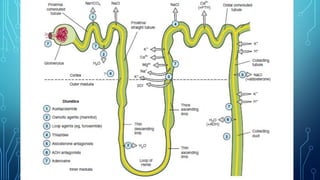
The process of reabsorption and secretion occurs throughout all
segments of the nephron: proximal tubules, Henle’s loop, distal
tubules and collecting tubules/ducts.
Mechanisms of reabsorptionof Na and H O
₂
•ATP-dependent membrane pump sodium in the proximal and distal tubules.
•Exchange sodium for H+, formed with the participation of carbonic
anhydrase (Н+НСО ↔Н СО ↔Н О+СО
₃ ₂ ₃ ₂ ₂) and dehydrogenases in the
proximal and distal tubules.
•Energy-dependent chloride pump in the thick segment of the ascending part
of loop of Henle
•Aldosterone-dependent sodium reabsorption in the distal tubule and
collecting tubule/ducts.
•The vasopressin-dependent reabsorption of water in collecting tubules/ducts.
5.
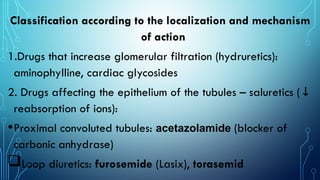
Classification according tothe localization and mechanism
of action
1.Drugs that increase glomerular filtration (hydruretics):
aminophylline, cardiac glycosides
2. Drugs affecting the epithelium of the tubules – saluretics (↓
reabsorption of ions):
•Proximal convoluted tubules: acetazolamide (blocker of
carbonic anhydrase)
Loop diuretics: furosemide (Lasix), torasemid
6.
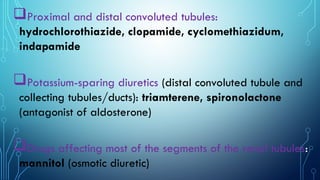
Proximal and distalconvoluted tubules:
hydrochlorothiazide, clopamide, cyclomethiazidum,
indapamide
Potassium-sparing diuretics (distal convoluted tubule and
collecting tubules/ducts): triamterene, spironolactone
(antagonist of aldosterone)
Drugs affecting most of the segments of the renal tubules:
mannitol (osmotic diuretic)
8.
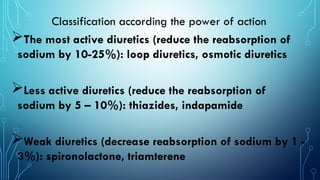
Classification according thepower of action
The most active diuretics (reduce the reabsorption of
sodium by 10-25%): loop diuretics, osmotic diuretics
Less active diuretics (reduce the reabsorption of
sodium by 5 – 10%): thiazides, indapamide
Weak diuretics (decrease reabsorption of sodium by 1 -
3%): spironolactone, triamterene
9.
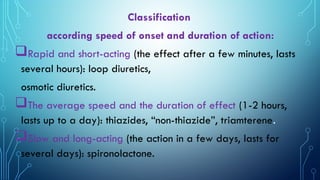
Classification
according speed ofonset and duration of action:
Rapid and short-acting (the effect after a few minutes, lasts
several hours): loop diuretics,
osmotic diuretics.
The average speed and the duration of effect (1-2 hours,
lasts up to a day): thiazides, “non-thiazide”, triamterene.
Slow and long-acting (the action in a few days, lasts for
several days): spironolactone.
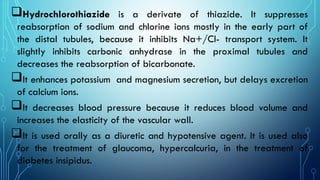
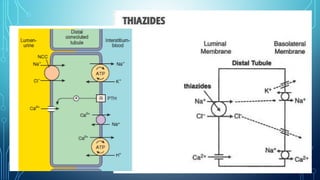
Hydrochlorothiazide is aderivate of thiazide. It suppresses
reabsorption of sodium and chlorine ions mostly in the early part of
the distal tubules, because it inhibits Na+/Cl- transport system. It
slightly inhibits carbonic anhydrase in the proximal tubules and
decreases the reabsorption of bicarbonate.
It enhances potassium and magnesium secretion, but delays excretion
of calcium ions.
It decreases blood pressure because it reduces blood volume and
increases the elasticity of the vascular wall.
It is used orally as a diuretic and hypotensive agent. It is used also
for the treatment of glaucoma, hypercalcuria, in the treatment of
diabetes insipidus.
13.
The speed ofonset of action – 0.5-1 h, duration of action – 8-
12 h.
The main side effects are hypokalemia, hypomagnesemia.
Prevention and treatment of these condition are based on
administration of drugs containg K+ and Mg2+ (potassium
chloride, “Asparcam”, “Pananginum”).
Other adverse effects: hypochloraemic metabolic alkalosis,
hyperuricaemia, hyperglycaemia, hyperlipidemia, nausea,
vomiting, fatigue.
14.
Cyclomethiazidum is 50times as active as
hydrochlorothiazide.
Clopamide acts slowly but longer. The drug begins to
act in 1-2 h, and its effect lasts for 24 h.
Indapamide is used orally once a day for the treatment
of arterial hypertension. Indapamide decreases blood
pressure. The effect develops slowly. Possible side effects
include hypokalemia, prolongation of Q-T (on ECG),
allergic reaction. It does not cause hyperlipidemia.
15.
Furosemide is avery efficacious agent. Its effect begins in
glomerulus because it increased the concentration of
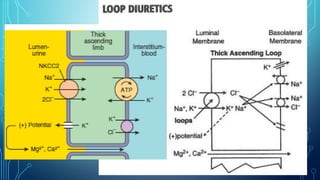
prostaglandins there. Furosemide inhibits active reabsorption
of chlorine and sodium ions in the thick ascending limb of
Henle’s loop by blocking Na+/K+/2Cl- transport system.
Furosemide also reduces sodium absorption in the proximal
tubules. It also enhances excretion of calcium and
magnesium. It increases diuresis.
It possesses moderate hypotensive activity.
17.
When administered intravenously,the drug begins to act in 3-5 min
after infusion. The effect lasts 1-2 h. In case of oral use the effect is
observed after 20-30 min and is maintained for 3-4 h.
It is used as a diuretic, antihypertensive drug.
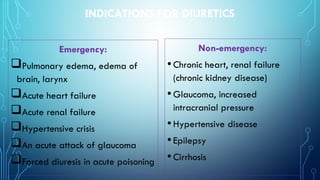
Indications for use: the treatment of pulmonary edema, brain edema,
hypercalcaemia in case of ergocalciferol overdose or
hyperparathyroidism. It is used to provide forced diuresis in cases of
acute poisoning.
Adverse effects: potassium depletion, hypomagnesemia, hypokalemic
metabolic alkalosis, dyspepsia, headache, hearing disorder,
hyperglycemia, hyperuricemia, dizziness, allergic reactions.
18.
Torasemide’s effect lastslonger. Maximal effect develops
in 2-3 h. The duration of effect is 6-8 h.
It is prescribed when edema are caused by chronic heart
failure, kidneys failure, hepatic failure. It is used for the
treatment of arterial hypertension. It is taken orally once a
day.
Adverse effects: hypokalemia, hyperuricemia, increased
creatinine and urea in blood plasma, thrombocytopenia,
dryness in a mouth, vertigo, allergic reaction.
19.
Triamterene is a“potassium-and magnesium-sparing diuretic”. It
retain potassium and magnesium in the body.
The main sites of action are the collecting tubules and the distal
tubules. The agent reduces permeability of sodium channels. So it
decreases the reabsorption of sodium and chlorine ions. It
increases the elimination of uric acid also. It is mild diuretic. It is
usually administered in a combination with the potent potassium
depleting drugs.
Side effects: dyspepsia, headache, dizziness, hyperkalemia,
azotemia, leg cramps.
20.
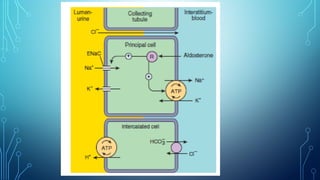
Spironolactone is aantagonist of mineralocorticoid
aldosterone. It eliminates its effects on renal tubular
function. Aldosterone decreases sodium ions excretion but
increases potassium secretion. These processes take place in
the distal renal tubules and the collecting ducts.
Spironolactone blocks receptors of aldosterone. It enhances
excretion of sodium and chlorine ions and water.
Spironolactone diminishes secretion of potassium ions. It
also spares magnesium.
22.
It is aweak diuretic. It is effective in cases of
edema that resulted from aldosterone
overproduction.
Its effect develops slowly. It is administered orally
together with diuretics causing hypokalemia.
Side effects: dizziness, sleepiness, skin rashes,
hyperkalemia, gynecomastia.
23.
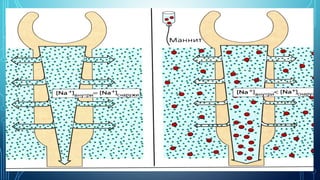
Mannitol is osmoticdiuretic. Its effect begins in blood. It is injected
intravenously and it increases osmotic pressure in the blood. So
fluid from the tissues enters the bloodstream. Mannitol increases
the circulating blood volume.
Mannitol reaches renal tubules lumen, causes a rise of osmotic
pressure. The reabsorption of the water is considerably
diminished. So reabsorption of sodium is diminished also. Mannitol
acts in the proximal, distal tubules, descending limb of Henle’s
loop.
24.
Mannitol is usedas a diuretic, as a dehydrating
agent in the treatment of brain edema, glaucoma
(reducing intraocular pressure), in the treatment of
acute poisoning.
The side effects: headache, nausea, vomiting,
dizziness, chest pain.
Mannitol is contraindicated in patients with impaired
renal function, high blood pressure, heart failure.
26.
Euphylline is xanthinederivate. It has a
vasodilating effect. It increases renal blood
flow and glomerular filtration rate.
It impairs reabsorption of sodium and chlorine
ions in the proximal and distal tubules, slightly
increases calcium excretion. It is a weak
diuretic, and it is used as broncholytic.