Post operative dressing
(PART 2)
Abhishek Tripathi
Lecturer, Prosthetics
abhishekpo2013@gmail.com
Ref:
1. Orthotics and Prosthetics in Rehabilitation, Lusardi 3rd edition
2. Immediate Post-Surgical Prosthetics, by Ernest M. Burgess, M.D., and Joseph H. Zettl, C.P.; Presented at the
1966 AOPA Assembly, Palm Springs, California
Preface
Continue from the (part 1)
contents
• Conventional Post operative management approaches:
• Soft dressing
• Semi-rigid dressing
• Removable Semi-rigid dressing
• Rigid dressing (without IPOP)
• Removable rigid dressing (RRD)
Soft dressing
• It consist of
• Sterile Gauze,
• Sterile Cotton padding (non-elastic)
• Elastic and or non-elastic bandage
• Advantages:
• Simple and low cost
• Ease of application
• Easy inspection of wound site
• Disadvantages:
• Poor control of edema, may result in bulbous stump
• Slippage over the wound may create pain and blister formation
• Inadequate trauma protection
• Chances of tourniquet effect if not applied evenly
Elastic property of soft dressing
• Based on Elastic property, there are two types of
bandages:
• Non-elastic: having no or minimal extensibility
• Elastic:
• Short stretch (stretch ability < 70%)
• Medium stretch ( 70% < stretch ability < 140%)
• Long stretch (> 140% stretch ability)
Ref: Medical bandages and stockings; Yimin Qin, in Medical Textile Materials, 2016
Basic principle of compression using soft
dressing
• When a patient is in recumbent (lying down) position after the amputation,
the capillary pressure is approx. 15-20mm of Hg.
• If the bandage pressure be less than this, very little resistance to edema is
provided.
• Conversely, if the bandage pressure is too tight, blood flow may be
impeded.
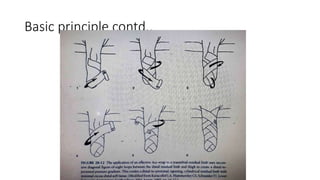
• Strips of bandage should be applied from posterior to anterior at distal end
to prevent pressure at distal bony end
• Figure of 8 and diagonal stripping (crisscross) should be used in such a way
so that more pressure be distal and gradually should decrease proximally
for proper shaping of residual stump.
Basic principle contd..
• The medial and lateral aspect of the residual stump should not be
covered in the same turn as it may cause slippage
• Bandage should be applied every 4 hours and should never remain by
more than 24 hours
• Wrinkles should always be avoided specially on bony prominences
• The metal clip should be avoided on insensitive skin instead tape
should be used
• If bandage causes numbness, aching, burning than it should be
immediately removed
Basic principle contd..
Semi-rigid dressing
• This semi-rigid dressing uses an self-adhesive inelastic Unna gauge roll- bandage
impregnated with ZnO2,gelatin, tri-glycerin and calamine.
• Unna is most often used in management of chronic venous stasis ulcer known as Unna
boot and therefore because of its edema controlling effect, it is also used in post-op Trans-
tibial stump.
• This dressing is often placed over thin layer of Non-Adhesive sterile gauge that covers the
incision. Cotton pads may be used as cushion at bony prominences.
• Once dried, the semi-rigid dressing acts as non-elastic external support that maintain the
shape of the residual limb.
• Finally the Unna bandage is covered with stockinette to protect the patient
clothing.
• It is changed every 5 to 7 days.
Semi-rigid contd..
• The suspension happens itself due to adhesive character of bandage.
• Semi-rigid dressing is used for 2-3 weeks on a good residual limb
healing.
• And the residual limb can become ready for prosthetic socket
application with in 5 weeks.
• Often unna bandage is used in combination with polyethylene foam
for better cushion effect
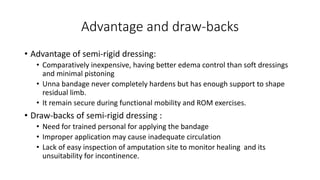
Advantage and draw-backs
• Advantage of semi-rigid dressing:
• Comparatively inexpensive, having better edema control than soft dressings
and minimal pistoning
• Unna bandage never completely hardens but has enough support to shape
residual limb.
• It remain secure during functional mobility and ROM exercises.
• Draw-backs of semi-rigid dressing :
• Need for trained personal for applying the bandage
• Improper application may cause inadequate circulation
• Lack of easy inspection of amputation site to monitor healing and its
unsuitability for incontinence.
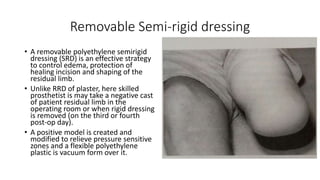
Removable Semi-rigid dressing
• A removable polyethylene semirigid
dressing (SRD) is an effective strategy
to control edema, protection of
healing incision and shaping of the
residual limb.
• Unlike RRD of plaster, here skilled
prosthetist is may take a negative cast
of patient residual limb in the
operating room or when rigid dressing
is removed (on the third or fourth
post-op day).
• A positive model is created and
modified to relieve pressure sensitive
zones and a flexible polyethylene
plastic is vacuum form over it.
Rigid dressing
• Closed wound of an amputee can be subjected to even, controlled
and firm pressure by rigid dressing , carefully relieved for bony
prominences and proximal restriction of circulations.
• With this immediate post-surgical rigid dressing properly applied and
contoured, it is feasible to incorporate into it a light, adjustable pylon
and foot, which is called as immediate post operative/surgical
Prosthesis/fitment (IPOP/IPOF/IPSF etc.).
• If overall condition permitting, a patient could bear limited and
controlled weight through this Prosthesis gradually the day after the
amputation by using some sort of upper limb support.
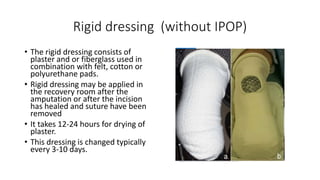
Rigid dressing (without IPOP)
• The rigid dressing consists of
plaster and or fiberglass used in
combination with felt, cotton or
polyurethane pads.
• Rigid dressing may be applied in
the recovery room after the
amputation or after the incision
has healed and suture have been
removed
• It takes 12-24 hours for drying of
plaster.
• This dressing is changed typically
every 3-10 days.
Rigid dressing (Advantage and Disadvantage)
• Advantages
• Control of edema hence residual limb shaping
• Better wound healing and less pain specially in amputation due to arteriosclerosis
• Disadvantages:
• Difficult to access for inspection of the incision site hence not suitable of
incontinence
• Need highly skilled personnel to apply and remove dressing, plaster cutter is required
for removal
• Patient with precarious circulation are not candidates for rigid dressings as wound
and surrounding area cant be inspected
• May require immediate removal of the dressing in case of increased fever, pain and
elevated wbc count
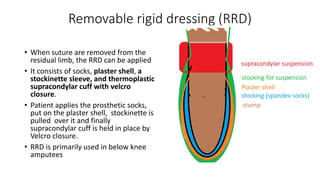
Removable rigid dressing (RRD)
• When suture are removed from the
residual limb, the RRD can be applied
• It consists of socks, plaster shell, a
stockinette sleeve, and thermoplastic
supracondylar cuff with velcro
closure.
• Patient applies the prosthetic socks,
put on the plaster shell, stockinette is
pulled over it and finally
supracondylar cuff is held in place by
Velcro closure.
• RRD is primarily used in below knee
amputees
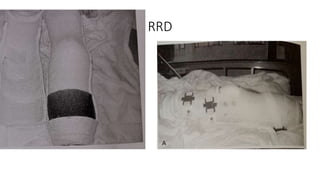
RRD
RRD
• Advantages:
• Easy inspection of surgical site and distal end
• Good shrinkage possible
• Protects the residual limb against sudden trauma
• The weight bearing with RRD against any raised platform or chair seat will prepare the stump
for prosthesis use
• Can be worn by patient himself and is removed only during bathing and during inspection
• They are not extended above the knee level so that flexion contracture chances are avoided
• As the residual limb shrinks, number of socks ply are needed to be increased for snug fit of
RRD, so that RRD helps in maturation of the residual limb by promoting faster limb shrinkage
• It also helps in reducing chances of skin breakdown and distal end edema development so
that shortens the time to ambulation, which is possible with in 90 days.
Draw backs of RRD
• Not suitable for incontinence
• Require care-giver for proper application and removal of the RRD
• Improper application may delay prosthetic fitment.
Advantage of SRD over RRD
• Light in weight but durable
• Easy to clean
• Easy to done and doff due to flexibility
• Do not react with water
• Pre-prosthetic training regarding socks uses within socket can be
given
To be contd..
THANK YOU

POST-OPERATIVE DRESSING CARE (part2).pptx

  • 1.
    Post operative dressing (PART2) Abhishek Tripathi Lecturer, Prosthetics abhishekpo2013@gmail.com Ref: 1. Orthotics and Prosthetics in Rehabilitation, Lusardi 3rd edition 2. Immediate Post-Surgical Prosthetics, by Ernest M. Burgess, M.D., and Joseph H. Zettl, C.P.; Presented at the 1966 AOPA Assembly, Palm Springs, California
  • 2.
  • 3.
    contents • Conventional Postoperative management approaches: • Soft dressing • Semi-rigid dressing • Removable Semi-rigid dressing • Rigid dressing (without IPOP) • Removable rigid dressing (RRD)
  • 4.
    Soft dressing • Itconsist of • Sterile Gauze, • Sterile Cotton padding (non-elastic) • Elastic and or non-elastic bandage • Advantages: • Simple and low cost • Ease of application • Easy inspection of wound site • Disadvantages: • Poor control of edema, may result in bulbous stump • Slippage over the wound may create pain and blister formation • Inadequate trauma protection • Chances of tourniquet effect if not applied evenly
  • 5.
    Elastic property ofsoft dressing • Based on Elastic property, there are two types of bandages: • Non-elastic: having no or minimal extensibility • Elastic: • Short stretch (stretch ability < 70%) • Medium stretch ( 70% < stretch ability < 140%) • Long stretch (> 140% stretch ability) Ref: Medical bandages and stockings; Yimin Qin, in Medical Textile Materials, 2016
  • 6.
    Basic principle ofcompression using soft dressing • When a patient is in recumbent (lying down) position after the amputation, the capillary pressure is approx. 15-20mm of Hg. • If the bandage pressure be less than this, very little resistance to edema is provided. • Conversely, if the bandage pressure is too tight, blood flow may be impeded. • Strips of bandage should be applied from posterior to anterior at distal end to prevent pressure at distal bony end • Figure of 8 and diagonal stripping (crisscross) should be used in such a way so that more pressure be distal and gradually should decrease proximally for proper shaping of residual stump.
  • 7.
    Basic principle contd.. •The medial and lateral aspect of the residual stump should not be covered in the same turn as it may cause slippage • Bandage should be applied every 4 hours and should never remain by more than 24 hours • Wrinkles should always be avoided specially on bony prominences • The metal clip should be avoided on insensitive skin instead tape should be used • If bandage causes numbness, aching, burning than it should be immediately removed
  • 8.
  • 9.
    Semi-rigid dressing • Thissemi-rigid dressing uses an self-adhesive inelastic Unna gauge roll- bandage impregnated with ZnO2,gelatin, tri-glycerin and calamine. • Unna is most often used in management of chronic venous stasis ulcer known as Unna boot and therefore because of its edema controlling effect, it is also used in post-op Trans- tibial stump. • This dressing is often placed over thin layer of Non-Adhesive sterile gauge that covers the incision. Cotton pads may be used as cushion at bony prominences. • Once dried, the semi-rigid dressing acts as non-elastic external support that maintain the shape of the residual limb. • Finally the Unna bandage is covered with stockinette to protect the patient clothing. • It is changed every 5 to 7 days.
  • 10.
    Semi-rigid contd.. • Thesuspension happens itself due to adhesive character of bandage. • Semi-rigid dressing is used for 2-3 weeks on a good residual limb healing. • And the residual limb can become ready for prosthetic socket application with in 5 weeks. • Often unna bandage is used in combination with polyethylene foam for better cushion effect
  • 11.
    Advantage and draw-backs •Advantage of semi-rigid dressing: • Comparatively inexpensive, having better edema control than soft dressings and minimal pistoning • Unna bandage never completely hardens but has enough support to shape residual limb. • It remain secure during functional mobility and ROM exercises. • Draw-backs of semi-rigid dressing : • Need for trained personal for applying the bandage • Improper application may cause inadequate circulation • Lack of easy inspection of amputation site to monitor healing and its unsuitability for incontinence.
  • 12.
    Removable Semi-rigid dressing •A removable polyethylene semirigid dressing (SRD) is an effective strategy to control edema, protection of healing incision and shaping of the residual limb. • Unlike RRD of plaster, here skilled prosthetist is may take a negative cast of patient residual limb in the operating room or when rigid dressing is removed (on the third or fourth post-op day). • A positive model is created and modified to relieve pressure sensitive zones and a flexible polyethylene plastic is vacuum form over it.
  • 13.
    Rigid dressing • Closedwound of an amputee can be subjected to even, controlled and firm pressure by rigid dressing , carefully relieved for bony prominences and proximal restriction of circulations. • With this immediate post-surgical rigid dressing properly applied and contoured, it is feasible to incorporate into it a light, adjustable pylon and foot, which is called as immediate post operative/surgical Prosthesis/fitment (IPOP/IPOF/IPSF etc.). • If overall condition permitting, a patient could bear limited and controlled weight through this Prosthesis gradually the day after the amputation by using some sort of upper limb support.
  • 14.
    Rigid dressing (withoutIPOP) • The rigid dressing consists of plaster and or fiberglass used in combination with felt, cotton or polyurethane pads. • Rigid dressing may be applied in the recovery room after the amputation or after the incision has healed and suture have been removed • It takes 12-24 hours for drying of plaster. • This dressing is changed typically every 3-10 days.
  • 15.
    Rigid dressing (Advantageand Disadvantage) • Advantages • Control of edema hence residual limb shaping • Better wound healing and less pain specially in amputation due to arteriosclerosis • Disadvantages: • Difficult to access for inspection of the incision site hence not suitable of incontinence • Need highly skilled personnel to apply and remove dressing, plaster cutter is required for removal • Patient with precarious circulation are not candidates for rigid dressings as wound and surrounding area cant be inspected • May require immediate removal of the dressing in case of increased fever, pain and elevated wbc count
  • 16.
    Removable rigid dressing(RRD) • When suture are removed from the residual limb, the RRD can be applied • It consists of socks, plaster shell, a stockinette sleeve, and thermoplastic supracondylar cuff with velcro closure. • Patient applies the prosthetic socks, put on the plaster shell, stockinette is pulled over it and finally supracondylar cuff is held in place by Velcro closure. • RRD is primarily used in below knee amputees
  • 17.
  • 18.
    RRD • Advantages: • Easyinspection of surgical site and distal end • Good shrinkage possible • Protects the residual limb against sudden trauma • The weight bearing with RRD against any raised platform or chair seat will prepare the stump for prosthesis use • Can be worn by patient himself and is removed only during bathing and during inspection • They are not extended above the knee level so that flexion contracture chances are avoided • As the residual limb shrinks, number of socks ply are needed to be increased for snug fit of RRD, so that RRD helps in maturation of the residual limb by promoting faster limb shrinkage • It also helps in reducing chances of skin breakdown and distal end edema development so that shortens the time to ambulation, which is possible with in 90 days.
  • 19.
    Draw backs ofRRD • Not suitable for incontinence • Require care-giver for proper application and removal of the RRD • Improper application may delay prosthetic fitment.
  • 20.
    Advantage of SRDover RRD • Light in weight but durable • Easy to clean • Easy to done and doff due to flexibility • Do not react with water • Pre-prosthetic training regarding socks uses within socket can be given
  • 21.