Presenting Prosthetic/Orthotic case during
Clinical case presentation by BPO fourth year
students
Abhishek Tripathi, Lect. Prosth., NILD Kolkata.
Email: abhishekpo2013@gmail.com
Ref:
• AAOS atlas of orthoses and assistive devices, fourth edition
• https://cvirendovasc.springeropen.com/submission-guidelines/preparing-your-manuscript/case-report
Main objective and specific objective
• The main objective is to learn the art of presenting Prosthetic and Orthotic cases
• Specific objectives:
A. General Case-report format
B. Content of the clinical presentations (as per latest Syllabus, BPO)
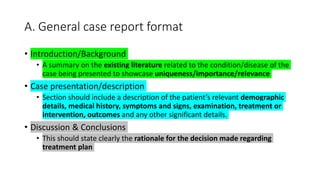
A. General case report format
• Introduction/Background
• A summary on the existing literature related to the condition/disease of the
case being presented to showcase uniqueness/importance/relevance
• Case presentation/description
• Section should include a description of the patient’s relevant demographic
details, medical history, symptoms and signs, examination, treatment or
intervention, outcomes and any other significant details.
• Discussion & Conclusions
• This should state clearly the rationale for the decision made regarding
treatment plan
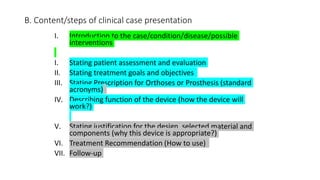
B. Content/steps of clinical case presentation
I. Introduction to the case/condition/disease/possible
interventions
I. Stating patient assessment and evaluation
II. Stating treatment goals and objectives
III. Stating Prescription for Orthoses or Prosthesis (standard
acronyms)
IV. Describing function of the device (how the device will
work?)
V. Stating justification for the design, selected material and
components (why this device is appropriate?)
VI. Treatment Recommendation (How to use)
VII. Follow-up
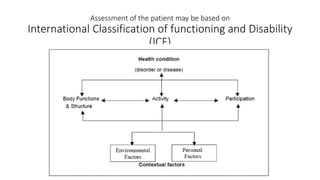
I. Patient assessment and
evaluation
International Classification of functioning
and Disability (ICF) provides a holistic
model to assesses and set goal for
individual health conditions.
A clear understanding of the patient’s
disease process is the foundation for
generating the appropriate prescription.
Assessment of the patient may be based on
International Classification of functioning and Disability
(ICF)
II. Stating treatment goal/objective
• The goal could be short/medium or long term based on type of
treatment/intervention
• ICF can again be utilized for set the goals:
• Participation related goals
• Activity related goals
• Structure and function related goals
• Prosthesis or orthosis related goals
III. Writing prescription
• The main body of the prescription should include details of the orthosis, starting
with the basic ISO acronyms using universal terminology.
• Each segment or component of the orthosis ideally should be described in a
preprinted menu format to avoid any concerns about illegible handwriting
• These descriptors should include generic materials specification, such as
thermoplastics, metals, or carbon fiber, and specific descriptions of joint controls
to be used.
• The range of motion or limitation at each joint should be indicated clearly on the
prescription.
• Any corrective straps, flanges, or wedges should be included for complete
specification of the desired configuration.
• Special features, such as tone-reducing contours or inversion control extensions,
should be included
• Refer to the Chapter 1; AAOS atlas of orthoses and assistive devices, fourth edition
IV. Describing function of the device
• The function of the device is affected by individual components, so
that individual component must be described such as:
i. Interface components :
ii. Articulating components
iii. Structural components
iv. Cosmetic components
• Refer to the Chapter 1; AAOS atlas of orthoses and assistive devices,
fourth edition
V. Justification/rationale for the design, selected
material and components
• Justification includes why of design, components/parts, materials
being prescribed
• It is based on
• Clinical judgement (experience),
• Knowledge of existing literature (evidence based)
• Focused on patient/parents values
VI. Treatment Recommendation (How to use?)
• The purpose of the device, including advantage and disadvantage
• When and how long the device should be worn
• How to put on and remove the device
• What exercises to be done in conjunction with the device
• How to determine if the device is positioned properly
• How to care and clean the device
• How to check the skin for pressure areas.
VII. Follow-up
• The follow-up period will depend upon many factors
• Critical cases should be closely followed (should be with in month)
• Child cases should be closely followed
• Orthotic cases should be more followed more frequently depending upon its
purpose
• Definitive prosthesis cases should be followed once a year, but a new
prosthesis should be followed with in three months for the first time, so that
to check the device condition.
Thank you!

Clinical case presentation_BPO_Fourth year.pptx

  • 1.
    Presenting Prosthetic/Orthotic caseduring Clinical case presentation by BPO fourth year students Abhishek Tripathi, Lect. Prosth., NILD Kolkata. Email: abhishekpo2013@gmail.com Ref: • AAOS atlas of orthoses and assistive devices, fourth edition • https://cvirendovasc.springeropen.com/submission-guidelines/preparing-your-manuscript/case-report
  • 2.
    Main objective andspecific objective • The main objective is to learn the art of presenting Prosthetic and Orthotic cases • Specific objectives: A. General Case-report format B. Content of the clinical presentations (as per latest Syllabus, BPO)
  • 3.
    A. General casereport format • Introduction/Background • A summary on the existing literature related to the condition/disease of the case being presented to showcase uniqueness/importance/relevance • Case presentation/description • Section should include a description of the patient’s relevant demographic details, medical history, symptoms and signs, examination, treatment or intervention, outcomes and any other significant details. • Discussion & Conclusions • This should state clearly the rationale for the decision made regarding treatment plan
  • 4.
    B. Content/steps ofclinical case presentation I. Introduction to the case/condition/disease/possible interventions I. Stating patient assessment and evaluation II. Stating treatment goals and objectives III. Stating Prescription for Orthoses or Prosthesis (standard acronyms) IV. Describing function of the device (how the device will work?) V. Stating justification for the design, selected material and components (why this device is appropriate?) VI. Treatment Recommendation (How to use) VII. Follow-up
  • 5.
    I. Patient assessmentand evaluation International Classification of functioning and Disability (ICF) provides a holistic model to assesses and set goal for individual health conditions. A clear understanding of the patient’s disease process is the foundation for generating the appropriate prescription.
  • 6.
    Assessment of thepatient may be based on International Classification of functioning and Disability (ICF)
  • 7.
    II. Stating treatmentgoal/objective • The goal could be short/medium or long term based on type of treatment/intervention • ICF can again be utilized for set the goals: • Participation related goals • Activity related goals • Structure and function related goals • Prosthesis or orthosis related goals
  • 8.
    III. Writing prescription •The main body of the prescription should include details of the orthosis, starting with the basic ISO acronyms using universal terminology. • Each segment or component of the orthosis ideally should be described in a preprinted menu format to avoid any concerns about illegible handwriting • These descriptors should include generic materials specification, such as thermoplastics, metals, or carbon fiber, and specific descriptions of joint controls to be used. • The range of motion or limitation at each joint should be indicated clearly on the prescription. • Any corrective straps, flanges, or wedges should be included for complete specification of the desired configuration. • Special features, such as tone-reducing contours or inversion control extensions, should be included • Refer to the Chapter 1; AAOS atlas of orthoses and assistive devices, fourth edition
  • 9.
    IV. Describing functionof the device • The function of the device is affected by individual components, so that individual component must be described such as: i. Interface components : ii. Articulating components iii. Structural components iv. Cosmetic components • Refer to the Chapter 1; AAOS atlas of orthoses and assistive devices, fourth edition
  • 10.
    V. Justification/rationale forthe design, selected material and components • Justification includes why of design, components/parts, materials being prescribed • It is based on • Clinical judgement (experience), • Knowledge of existing literature (evidence based) • Focused on patient/parents values
  • 11.
    VI. Treatment Recommendation(How to use?) • The purpose of the device, including advantage and disadvantage • When and how long the device should be worn • How to put on and remove the device • What exercises to be done in conjunction with the device • How to determine if the device is positioned properly • How to care and clean the device • How to check the skin for pressure areas.
  • 12.
    VII. Follow-up • Thefollow-up period will depend upon many factors • Critical cases should be closely followed (should be with in month) • Child cases should be closely followed • Orthotic cases should be more followed more frequently depending upon its purpose • Definitive prosthesis cases should be followed once a year, but a new prosthesis should be followed with in three months for the first time, so that to check the device condition.
  • 13.