Wound care
Dressing and
Products
BY
Ranganathan.D
B.Sc.,operation theatre technology
JIPMER.
OBJECTIVES
• State the three primary classifications of wound care
products in maintaining the wound bed
• Identify three criteria in choosing a wound care product
• Explain at least four wound care products that should be
in a basic wound care formula
• Describe three products that can be used for treatment
of a pressure ulcer
• Identify at least two resources for wound care product
information
Wound Care Product Classification
Based on Wound Base Color
• Red (Granulation)
• Maintain wound moisture and protect
tissue
• Pink (Healing Epithelial)
• Protect new tissue
• Yellow (Devitalize Slough or Non-viable
Fibrin)
• Remove/Debride
• Purple (Ecchymotic/DTI)
• Protect intact skin
• Black (Eschar or Necrotic Tissue)
• Remove/Debride
Wound Care Product Classification
Based on Wound Moisture Level
• Dry
• Re-hydrate
• Reduce pain
• Wet
• Remove excess fluid/exudate
• Prevent hypertrophic tissue formation
• Reduce bacterial load/odor
• Balanced
• Maintain a moist wound environment
• Maintain to prevent tissue dryness or
maceration
Wound Care Product Classification
Based on Wound Depth
• Partial Thickness
• Shallow Abrasions/Denuded Skin/Excoriations
• Skin Tears
• Stage 2 pressure ulcers (Including blisters)
• Protect tissue from further damage
• Maintain moisture balance
• Approximate skin edges if appropriate
Wound Care Product Classification
Based on Wound Depth
• Full Thickness
• Deep cavity/Dead space
• Undermining
• Tunneling/tracking
• Stage 3 & 4
• Exposed bone, tendon
• Biofilm present
• Fill in wound spaces (cavity/tunnel/undermining)
• Maintain moisture level
• Remove non-viable tissue/debride and/or biofilm
• Protect exposed bone, tendon
• Control odor
Wound Care Product Selection
• Easy to handle
• Rapid application
• Inexpensible
• Less infection
• Good cosmetic result
• Patient comportable
Principles of “MEASURES”
• M = minimize trauma to wound bed
• E = eliminate dead space (tunnels, tracts, undermining)
• A = assess and manage the amount of exudate
• S = support the body’s tissue defense mechanism
• U = use non-toxic wound cleansers
• R = remove infections, debris, and necrotic tissue
• E = environment of wound is maintained including
thermoregulation and moisture
• S = surrounding tissue is protected from injury and bacteria
Barnanoski, S. (1999, January) Wound Dressings:
Challenging Decisions, Home Healthcare Nurse
Characteristics of an Ideal Dressing
• Maintain moisture balance
• Facilitate autolytic debridement
• Be comfortable for the patient and eliminate pain
• Eliminate dead space
• Be absorbent
• Provide thermal regulation
• Act as a bacterial barrier
• Be cost effective
• Ease of dressing application and removal and maintenance
• Ease of understanding for caregiver to use
• Available in numerous shapes and size or can be cut into an
appropriate shapes.
Basic Wound Care Formulary
• Absorptive dressing
• Alginates (Calcium)/Hydrofibers
• Contact layers
• Foams
• Gauze
• Hydrocolloids
• Hydrogels
• Skin Barriers
• Tape
• Transparent film
• Wound Cleansers
Absorptive Dressings
• Description: Multilayer dressings that consist of fiber
layers such as cellulose, cotton or rayon that can
manage moderate to heavy drainage usually for full
thickness wounds
• Advantage:
• Can be used as a primary or secondary dressing and
are easy to apply and remove
• Help with autolytic debridement
• Disadvantage: May adhere to base causing pain
• Examples: Abdominal (ABD) pad, Exu-Dry
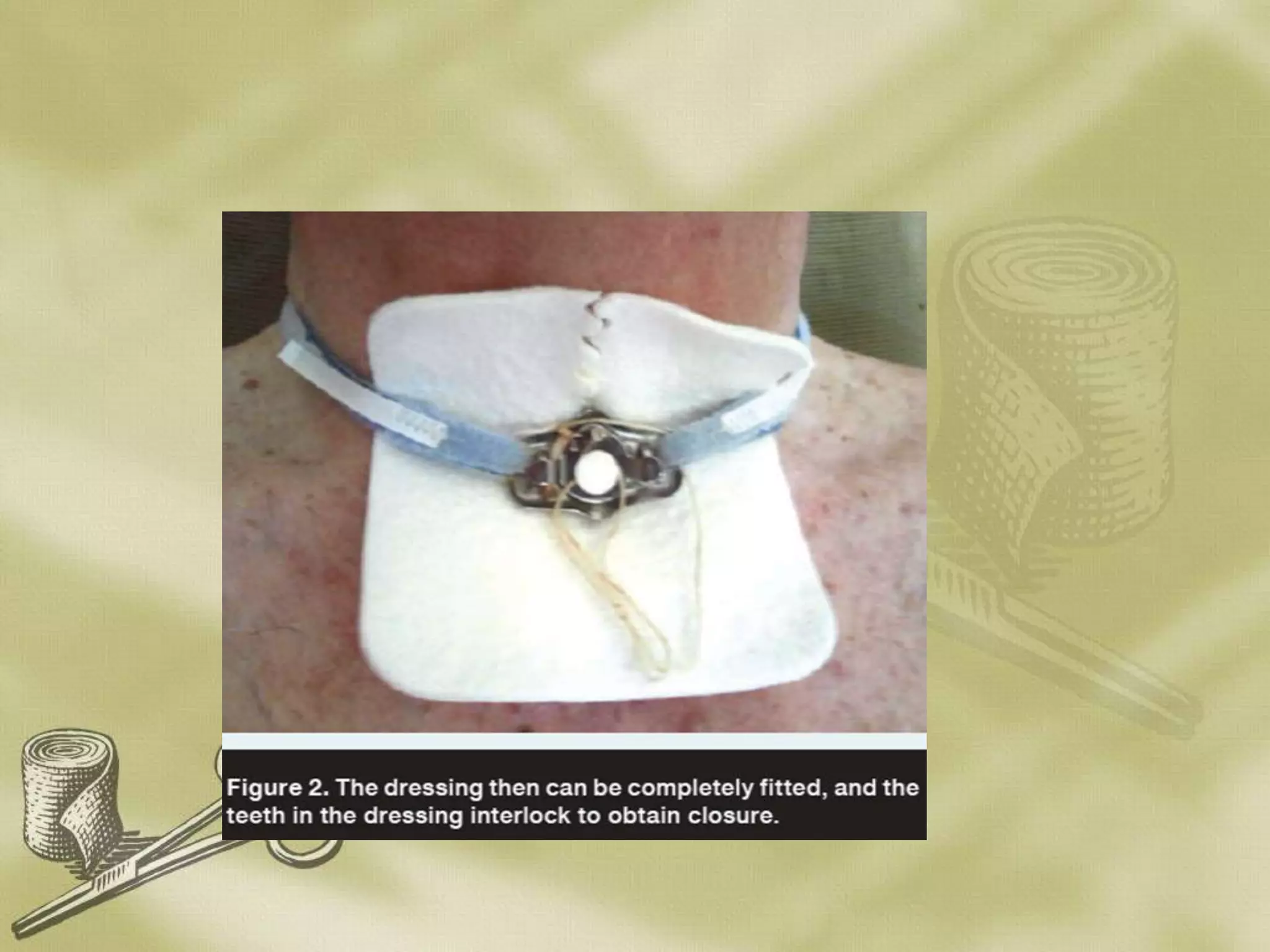
Foams
• Description: Hydrophilic polyurethane or gel film-coated dressing that is
highly absorptive that come in a variety of thickness with or without an
adhesive/silicone border that fill a wound cavity and is designed for non-
traumatic removal. Designed for maintaining moist wound environment and
thermal regulation.
• Advantages:
• Non-adherent reducing pain for friable tissue/fragile skin
• Easy to apply and remove
• Can leave in place up to seven days
• Good for partial thickness wounds
• Foam
• Disadvantages:May Disadvantages:
• May need a secondary dressing, tape or gauze
wrap
• Not for dry/eschar wounds
• May cause maceration
• Examples: Mepilex, Allevyn, Polymem, Tielle,
Lyofoam, 3M need a secondary dressing, tape or
gauze wrap
Foam conti.,,
Tape
• Description: Tape is one way of securing a cover
dressing to the skin to keep dressing in place over
wound. Tape are made with a variety of materials
(paper, plastic, cloth, foam) and come in different
widths, shapes, adhesives and hypoallergenic and
antimicrobial property.
• Indication: primary closure,staple
closure,complement sutures,subcuticular suture,skin
closure
• contraindication: deep wound,bleeding
o wounds, deep tissue
wounds.
Tape conti.,,
• Advantages:
• Can be inexpensive
• Can be used to approximate wound edges
• Rapid application
• Cost cost ,no risk of needle stick injuries
• Donot cause any tissue ischaemia,necrosis.
• Least drainage to host defence
Tape conti.,,
• Disadvantages:
• Can cause skin stripping/blistering
• Can cause allergic reactions
• May not adhere to skin
• Requires a skin protectant barrier before
application
• Can contribute to wound infection
Examples: Medipore, Hypafix, Transpore,
Micropore, Dermapore, Steristrips
Transparent Films
• Description: A polyurethane or co-polymer with a porous
adhesive layer that allows oxygen to pass through the
semipermeable membrane between wound and environment. It
act as a moisture vapor barrier by being impermeable to water,
leaking of wound fluids and entry of bacteria as long as it
remains intact to the skin. Used as a primary or secondary
dressing.
• Advantages:
• Aids in autolytic debridement
• Can visualize wound base for inspection
• Prevents or reduces friction/shear
• Waterproof for bathing
Tansparent films conti.,,
• Disadvantages:
• Not to be used on heavy exudating wounds
• May cause skin shear on fragile skin and
dislodge on high-friction areas
• May need a skin protectant for some
adhesives
• May be difficult to apply or handle
• Examples: Tegaderm, Mefilm, Opsite, Comfeel
Thank you

Wound care dressing and products

  • 1.
  • 2.
    OBJECTIVES • State thethree primary classifications of wound care products in maintaining the wound bed • Identify three criteria in choosing a wound care product • Explain at least four wound care products that should be in a basic wound care formula • Describe three products that can be used for treatment of a pressure ulcer • Identify at least two resources for wound care product information
  • 3.
    Wound Care ProductClassification Based on Wound Base Color • Red (Granulation) • Maintain wound moisture and protect tissue • Pink (Healing Epithelial) • Protect new tissue • Yellow (Devitalize Slough or Non-viable Fibrin) • Remove/Debride • Purple (Ecchymotic/DTI) • Protect intact skin • Black (Eschar or Necrotic Tissue) • Remove/Debride
  • 4.
    Wound Care ProductClassification Based on Wound Moisture Level • Dry • Re-hydrate • Reduce pain • Wet • Remove excess fluid/exudate • Prevent hypertrophic tissue formation • Reduce bacterial load/odor • Balanced • Maintain a moist wound environment • Maintain to prevent tissue dryness or maceration
  • 5.
    Wound Care ProductClassification Based on Wound Depth • Partial Thickness • Shallow Abrasions/Denuded Skin/Excoriations • Skin Tears • Stage 2 pressure ulcers (Including blisters) • Protect tissue from further damage • Maintain moisture balance • Approximate skin edges if appropriate
  • 6.
    Wound Care ProductClassification Based on Wound Depth • Full Thickness • Deep cavity/Dead space • Undermining • Tunneling/tracking • Stage 3 & 4 • Exposed bone, tendon • Biofilm present • Fill in wound spaces (cavity/tunnel/undermining) • Maintain moisture level • Remove non-viable tissue/debride and/or biofilm • Protect exposed bone, tendon • Control odor
  • 7.
    Wound Care ProductSelection • Easy to handle • Rapid application • Inexpensible • Less infection • Good cosmetic result • Patient comportable
  • 8.
    Principles of “MEASURES” •M = minimize trauma to wound bed • E = eliminate dead space (tunnels, tracts, undermining) • A = assess and manage the amount of exudate • S = support the body’s tissue defense mechanism • U = use non-toxic wound cleansers • R = remove infections, debris, and necrotic tissue • E = environment of wound is maintained including thermoregulation and moisture • S = surrounding tissue is protected from injury and bacteria Barnanoski, S. (1999, January) Wound Dressings: Challenging Decisions, Home Healthcare Nurse
  • 9.
    Characteristics of anIdeal Dressing • Maintain moisture balance • Facilitate autolytic debridement • Be comfortable for the patient and eliminate pain • Eliminate dead space • Be absorbent • Provide thermal regulation • Act as a bacterial barrier • Be cost effective • Ease of dressing application and removal and maintenance • Ease of understanding for caregiver to use • Available in numerous shapes and size or can be cut into an appropriate shapes.
  • 10.
    Basic Wound CareFormulary • Absorptive dressing • Alginates (Calcium)/Hydrofibers • Contact layers • Foams • Gauze • Hydrocolloids • Hydrogels • Skin Barriers • Tape • Transparent film • Wound Cleansers
  • 11.
    Absorptive Dressings • Description:Multilayer dressings that consist of fiber layers such as cellulose, cotton or rayon that can manage moderate to heavy drainage usually for full thickness wounds • Advantage: • Can be used as a primary or secondary dressing and are easy to apply and remove • Help with autolytic debridement • Disadvantage: May adhere to base causing pain • Examples: Abdominal (ABD) pad, Exu-Dry
  • 13.
    Foams • Description: Hydrophilicpolyurethane or gel film-coated dressing that is highly absorptive that come in a variety of thickness with or without an adhesive/silicone border that fill a wound cavity and is designed for non- traumatic removal. Designed for maintaining moist wound environment and thermal regulation. • Advantages: • Non-adherent reducing pain for friable tissue/fragile skin • Easy to apply and remove • Can leave in place up to seven days • Good for partial thickness wounds • Foam
  • 14.
    • Disadvantages:May Disadvantages: •May need a secondary dressing, tape or gauze wrap • Not for dry/eschar wounds • May cause maceration • Examples: Mepilex, Allevyn, Polymem, Tielle, Lyofoam, 3M need a secondary dressing, tape or gauze wrap Foam conti.,,
  • 16.
    Tape • Description: Tapeis one way of securing a cover dressing to the skin to keep dressing in place over wound. Tape are made with a variety of materials (paper, plastic, cloth, foam) and come in different widths, shapes, adhesives and hypoallergenic and antimicrobial property. • Indication: primary closure,staple closure,complement sutures,subcuticular suture,skin closure • contraindication: deep wound,bleeding o wounds, deep tissue wounds.
  • 17.
    Tape conti.,, • Advantages: •Can be inexpensive • Can be used to approximate wound edges • Rapid application • Cost cost ,no risk of needle stick injuries • Donot cause any tissue ischaemia,necrosis. • Least drainage to host defence
  • 18.
    Tape conti.,, • Disadvantages: •Can cause skin stripping/blistering • Can cause allergic reactions • May not adhere to skin • Requires a skin protectant barrier before application • Can contribute to wound infection Examples: Medipore, Hypafix, Transpore, Micropore, Dermapore, Steristrips
  • 20.
    Transparent Films • Description:A polyurethane or co-polymer with a porous adhesive layer that allows oxygen to pass through the semipermeable membrane between wound and environment. It act as a moisture vapor barrier by being impermeable to water, leaking of wound fluids and entry of bacteria as long as it remains intact to the skin. Used as a primary or secondary dressing. • Advantages: • Aids in autolytic debridement • Can visualize wound base for inspection • Prevents or reduces friction/shear • Waterproof for bathing
  • 21.
    Tansparent films conti.,, •Disadvantages: • Not to be used on heavy exudating wounds • May cause skin shear on fragile skin and dislodge on high-friction areas • May need a skin protectant for some adhesives • May be difficult to apply or handle • Examples: Tegaderm, Mefilm, Opsite, Comfeel
  • 23.