OPEN BITE
Malocclusions can occur in three planes i,e.
sagittal, transverse and in the vertical plane.
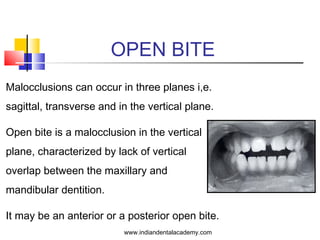
Open bite is a malocclusion in the vertical
plane, characterized by lack of vertical
overlap between the maxillary and
mandibular dentition.
It may be an anterior or a posterior open bite.
www.indiandentalacademy.com
Classification
OPEN BITE
ANTERIO
R
POSTERIOR
SKELETA
L
DENTAL SKELETAL DENTAL
www.indiandentalacademy.com
Anterior open bite –
Is a condition where there is no
vertical overlap between the upper and
lower incisors.
Posterior open bite –
Is a condition characterized by lack of contact
Between the posteriors when the teeth are in
centric occlusion. www.indiandentalacademy.com
The etiology is multifactorial.
No single factor can account for most open bites.
Can occur due to a variety of hereditary and non-hereditary
factors.
Epigenetic and environmental factors both are of concern.
Etiologic considerations
www.indiandentalacademy.com
1. Prolonged Thumb-sucking.
2. Tongue thrusting.
3. Nasopharyngeal airway obstruction and associated
mouth breathing.
4. Inherited factors such as increased tongue size, and
abnormal skeletal growth pattern of the maxilla and
mandible.
Some of the etiologic factors responsible for
anterior open bite :
www.indiandentalacademy.com
Posterior open bites are very rare.
The etiologic factors responsible for posterior
open bite :
1. Mechanical interferences with the tooth eruption, either
before or after the tooth emerges from the alveolar bone.
2. Failure of the eruptive mechanism of the tooth so that the
expected amount of eruption does not occur.
www.indiandentalacademy.com
 In cases of open bites due to thumb or finger sucking
habit , the open bite is usually assymetrically
shaped.
 In cases of open bites caused by the positioning of
the tongue between the incisal edges of the
mandibular incisors and the lingual surfaces of the
maxillary incisors symmetrical.
www.indiandentalacademy.com

An open bite can be encountered in all
distinguishable types of jaw relations and occlusal
conditions. It is frequently associated with a class II/1
malocclusion.
 The size of the open bite may vary considerably and
may range from a few millimeters to more than one
centimeter.
www.indiandentalacademy.com
• Increased lower anterior facial height.
• Decreased upper anterior facial height.
• Increased anterior and decreased
posterior facial height.
• A steep mandibular plane angle.
• Small mandibular body and ramus.
Features of skeletal anterior open bite :
www.indiandentalacademy.com
• The patient may have a short
upper lip with excessive maxillary
incisor exposure.
• The patient often has a long and
narrow face.
• Divergent cephalometric planes.
• Steep anterior cranial base.
• Downward and forward rotation of
mandible. www.indiandentalacademy.com
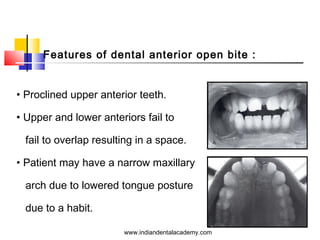
• Proclined upper anterior teeth.
• Upper and lower anteriors fail to
fail to overlap resulting in a space.
• Patient may have a narrow maxillary
arch due to lowered tongue posture
due to a habit.
Features of dental anterior open bite :
www.indiandentalacademy.com
Esthetic Considerations

The dentoalveolar open-bite is esthetically
unattractive, particularly during speech when the
tongue is pressed between the teeth and the lips.
 In evaluating the esthetics following relationships are
of special interest :
a) Balance between nose, lips, and chin profile.
b) Nasolabial angle.
c) Configuration of the lips.
d) Length of the lower third of the face.
www.indiandentalacademy.com
Functional considerations
 Tongue posture and function should be primary
consideration.
 Differentiation between primary causal and
secondary adaptive or compensatory dysfunction is
essential.
 Functional analysis also must bassess the magnitude
of force ( i,e simple pressing versus strong protractive
action).
 Cephalometric analysis can localise the nature of
open bite – Skeletal/Dental.
www.indiandentalacademy.com
 According to Bahr and Holt, four varieties of tongue
thrust activity may be differentiated:
1) Tongue thrust without deformation.
2) Tongue thrust causing anterior deformation –
A Simple Open Bite (Termed by MOYERS 1964)
3) Tongue thrust causing buccal segment
deformation.(Posterior open bite often seen)
4) Combined tongue thrust, causing both anterior
and posterior open bite –
A Complex Open Bite (Termed by MOYERS )
www.indiandentalacademy.com
Clinical Considerations
Depending on the severity of the malocclusion, various
forms of anterior open bites may be observed:
 Pseudo-open bite.
 Simple open bite.
 Complex open bite.
 Compound or infantile open bite.
 Iatrogenic open bite.
www.indiandentalacademy.com
Cephalometric Criteria
A proper cephalometric analysis enables a classification
of open-bite malocclusions.
 Extent of dentoalveolar open bite depends upon
a) The extent of the eruption of the teeth.
b) The Growth pattern.
www.indiandentalacademy.com
 Skeletal open bite shows:
a) Excessive anterior face height.(Lower third)
b) Posterior face height is short.(Ramus height)
c) Mandibular base is usually narrow.
d) Symphysis is narrow and long and the ramus is
short.
e) Gonial angle particularly the lower section will be
large.
www.indiandentalacademy.com
Depending on the inclination of the maxillary base, or
Palatal plane, the following variations may be observed:
 A vertical growth pattern with upward tipping of the
forward end of the maxillary base.
 A vertical growth pattern with downward tipping of the
anterior end of the maxillary base.
 A horizontal growth direction with an open bite
caused by upward and forward tipping of the
maxillary base.
www.indiandentalacademy.com
Therapeutic Considerations

Therapy depends on the localization and the etiology
of the malocclusion.
 Habit control and the elimination of the abnormal
perioral muscle function are therapeutic approaches
in the treatment of dentoalveolar open-bite problems.
 In skeletal open-bite problems a redirection of growth
is possible during the active growth period.
 Later, only compensatory therapy with extraction and
tooth movement or orthognathic surgery is possible.
www.indiandentalacademy.com
 In addition, a combined skeletodental type exist that
requires a combined therapeutic approach.
 Proper time to institute the treatment depends on the
etiology of the malocclusion.
www.indiandentalacademy.com
Treatment
Anterior open bite Posterior open bite
• Removal of cause
Removable or fixed type
habit breaking appliance.
• Myofunctional appliances
Skeletal anterior open bite –
F.R.IV or a modified activator
• Fixed Orthodontic therapy
• Surgical correction
• Removal of cause
Lateral tongue spikes for
lateral tongue thrust.
• If due to infra occlusion
of ankylosed teeth, it is
best treated by crowns.
www.indiandentalacademy.com

Open bite 1

  • 1.
    OPEN BITE Malocclusions canoccur in three planes i,e. sagittal, transverse and in the vertical plane. Open bite is a malocclusion in the vertical plane, characterized by lack of vertical overlap between the maxillary and mandibular dentition. It may be an anterior or a posterior open bite. www.indiandentalacademy.com
  • 2.
  • 3.
    Anterior open bite– Is a condition where there is no vertical overlap between the upper and lower incisors. Posterior open bite – Is a condition characterized by lack of contact Between the posteriors when the teeth are in centric occlusion. www.indiandentalacademy.com
  • 4.
    The etiology ismultifactorial. No single factor can account for most open bites. Can occur due to a variety of hereditary and non-hereditary factors. Epigenetic and environmental factors both are of concern. Etiologic considerations www.indiandentalacademy.com
  • 5.
    1. Prolonged Thumb-sucking. 2.Tongue thrusting. 3. Nasopharyngeal airway obstruction and associated mouth breathing. 4. Inherited factors such as increased tongue size, and abnormal skeletal growth pattern of the maxilla and mandible. Some of the etiologic factors responsible for anterior open bite : www.indiandentalacademy.com
  • 6.
    Posterior open bitesare very rare. The etiologic factors responsible for posterior open bite : 1. Mechanical interferences with the tooth eruption, either before or after the tooth emerges from the alveolar bone. 2. Failure of the eruptive mechanism of the tooth so that the expected amount of eruption does not occur. www.indiandentalacademy.com
  • 7.
     In casesof open bites due to thumb or finger sucking habit , the open bite is usually assymetrically shaped.  In cases of open bites caused by the positioning of the tongue between the incisal edges of the mandibular incisors and the lingual surfaces of the maxillary incisors symmetrical. www.indiandentalacademy.com
  • 8.
     An open bitecan be encountered in all distinguishable types of jaw relations and occlusal conditions. It is frequently associated with a class II/1 malocclusion.  The size of the open bite may vary considerably and may range from a few millimeters to more than one centimeter. www.indiandentalacademy.com
  • 9.
    • Increased loweranterior facial height. • Decreased upper anterior facial height. • Increased anterior and decreased posterior facial height. • A steep mandibular plane angle. • Small mandibular body and ramus. Features of skeletal anterior open bite : www.indiandentalacademy.com
  • 10.
    • The patientmay have a short upper lip with excessive maxillary incisor exposure. • The patient often has a long and narrow face. • Divergent cephalometric planes. • Steep anterior cranial base. • Downward and forward rotation of mandible. www.indiandentalacademy.com
  • 11.
    • Proclined upperanterior teeth. • Upper and lower anteriors fail to fail to overlap resulting in a space. • Patient may have a narrow maxillary arch due to lowered tongue posture due to a habit. Features of dental anterior open bite : www.indiandentalacademy.com
  • 12.
    Esthetic Considerations  The dentoalveolaropen-bite is esthetically unattractive, particularly during speech when the tongue is pressed between the teeth and the lips.  In evaluating the esthetics following relationships are of special interest : a) Balance between nose, lips, and chin profile. b) Nasolabial angle. c) Configuration of the lips. d) Length of the lower third of the face. www.indiandentalacademy.com
  • 13.
    Functional considerations  Tongueposture and function should be primary consideration.  Differentiation between primary causal and secondary adaptive or compensatory dysfunction is essential.  Functional analysis also must bassess the magnitude of force ( i,e simple pressing versus strong protractive action).  Cephalometric analysis can localise the nature of open bite – Skeletal/Dental. www.indiandentalacademy.com
  • 14.
     According toBahr and Holt, four varieties of tongue thrust activity may be differentiated: 1) Tongue thrust without deformation. 2) Tongue thrust causing anterior deformation – A Simple Open Bite (Termed by MOYERS 1964) 3) Tongue thrust causing buccal segment deformation.(Posterior open bite often seen) 4) Combined tongue thrust, causing both anterior and posterior open bite – A Complex Open Bite (Termed by MOYERS ) www.indiandentalacademy.com
  • 15.
    Clinical Considerations Depending onthe severity of the malocclusion, various forms of anterior open bites may be observed:  Pseudo-open bite.  Simple open bite.  Complex open bite.  Compound or infantile open bite.  Iatrogenic open bite. www.indiandentalacademy.com
  • 16.
    Cephalometric Criteria A propercephalometric analysis enables a classification of open-bite malocclusions.  Extent of dentoalveolar open bite depends upon a) The extent of the eruption of the teeth. b) The Growth pattern. www.indiandentalacademy.com
  • 17.
     Skeletal openbite shows: a) Excessive anterior face height.(Lower third) b) Posterior face height is short.(Ramus height) c) Mandibular base is usually narrow. d) Symphysis is narrow and long and the ramus is short. e) Gonial angle particularly the lower section will be large. www.indiandentalacademy.com
  • 18.
    Depending on theinclination of the maxillary base, or Palatal plane, the following variations may be observed:  A vertical growth pattern with upward tipping of the forward end of the maxillary base.  A vertical growth pattern with downward tipping of the anterior end of the maxillary base.  A horizontal growth direction with an open bite caused by upward and forward tipping of the maxillary base. www.indiandentalacademy.com
  • 19.
    Therapeutic Considerations  Therapy dependson the localization and the etiology of the malocclusion.  Habit control and the elimination of the abnormal perioral muscle function are therapeutic approaches in the treatment of dentoalveolar open-bite problems.  In skeletal open-bite problems a redirection of growth is possible during the active growth period.  Later, only compensatory therapy with extraction and tooth movement or orthognathic surgery is possible. www.indiandentalacademy.com
  • 20.
     In addition,a combined skeletodental type exist that requires a combined therapeutic approach.  Proper time to institute the treatment depends on the etiology of the malocclusion. www.indiandentalacademy.com
  • 21.
    Treatment Anterior open bitePosterior open bite • Removal of cause Removable or fixed type habit breaking appliance. • Myofunctional appliances Skeletal anterior open bite – F.R.IV or a modified activator • Fixed Orthodontic therapy • Surgical correction • Removal of cause Lateral tongue spikes for lateral tongue thrust. • If due to infra occlusion of ankylosed teeth, it is best treated by crowns. www.indiandentalacademy.com
  • 22.