Still Birth
Intrauterine Fetal Death
Introduction:
Death of fetus after the period of viability in utero this death may
during antepartum period and intra partum period.
Antepartum death result in the delivery of the macerated baby.
After death fetal will undergo aseptic necrosis which is known as
maceration.
Intrapartum death result in the delivery of the fresh still birth.
Definition:
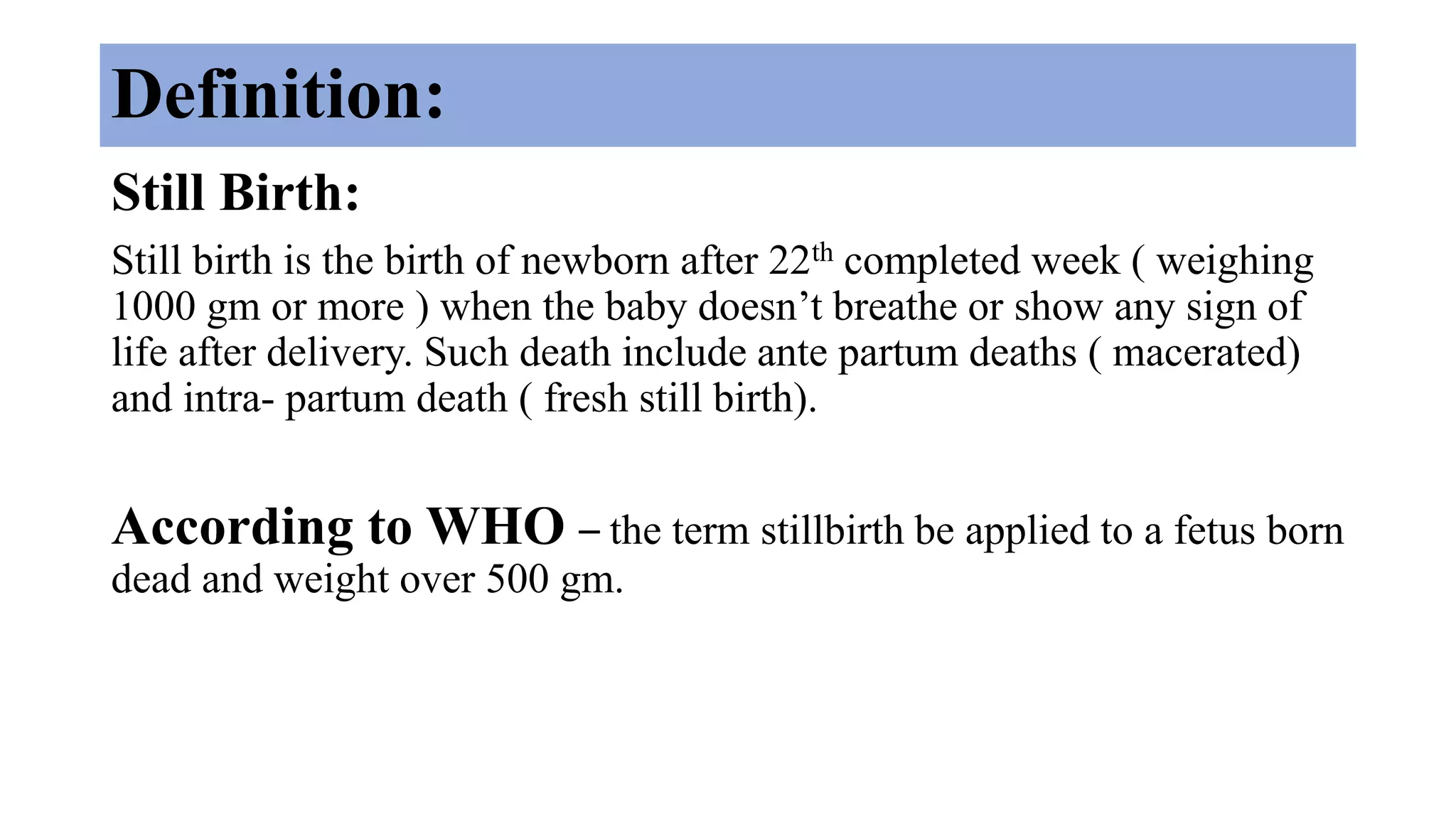
Still Birth:
Still birth is the birth of newborn after 22th completed week ( weighing
1000 gm or more ) when the baby doesn’t breathe or show any sign of
life after delivery. Such death include ante partum deaths ( macerated)
and intra- partum death ( fresh still birth).
According to WHO – the term stillbirth be applied to a fetus born
dead and weight over 500 gm.
Contd...
Intra uterine fetal death ( IUFD):
IUFD refers to the babies with no sign of life in utero.
Incidence:
According to NDHS data 2016
Total still birth cases: 96 cases
According to sex:
• Male: 62.3%
• Female: 37.7%
Residence:
• Urban: 52.5%
• Rural: 47.5%
Province:
Province 1 : 17.7%
Province 2 : 29.2%
Province 3 : 16.1%
Province 4 : 6.5%
Province 5 : 15.3%
Province 6 : 7.1%
Province 7 : 8.0%
Causes according to NDHS:
• Complication of pregnancy, labor, and delivery: 41.0%
• Disorder related to length of gestation and fetal growth: 4.3%
• Congenital malformation and deformations: 0.9%
• Unspecified cause: 53.9%
Place of delivery:
- Home: 42.4%
- Private health facility: 11.9%
- Government health facility: 34.4%
- Others: 11.3%
Causes:
1. Idiopathic 25 – 35 %
2. Maternal
3. Fetal
4. placental
Maternal:
• Prolonged pregnancy: greater than 42 WOG
• Diabetic (poorly controlled): the exact cause is unknown. Possibly due
to hypoxia, polyhydramnios etc.
• Maternal infection: TORCH
• Hypertensive disorder: spasm of the uteroplacental circulation leads to
placental insufficiency, fetal death
• Severe anemia: due to maternal hypoxia
Contd...
• Anti phospholipid syndrome: in SLE two antiphospholipid antibodies
e.g., lupus anticoagulant and anti-cardiolipin antibodies are important.
They cause dysregulation of coagulation pathway, thrombosis of
utero-placental vessels and poor placental perfusion may lead to fetal
death.
• Hyperpyrexia: acute fever of mother over 39.4°c can kill fetus
directly (placental insufficiency)
• Antepartum hemorrhage: both placenta previa and abruptio cause
actual placental insufficiency.
• Maternal death
Fetal:
• Multiple pregnancy
• Intra uterine growth restriction
• Fetal infection
• Rh – incompatibility: excessive hemolysis of fetal blood by antibody
formed in the mother produce fetal anemia and hypoxia and death.
Placental:
• Cord accident: true knot, cord around the neck,
• Abruptio placenta
• Premature rupture of membrane
• Placental insufficiency
Important causes of still birth:
• Birth asphyxia and trauma
• Pregnancy complication ( placental abruptio, pre eclampsia, diabetes
mellitus)
• Fetal chromosomal anomalies
• infection
Sign and symptoms of IUFD :
• Bleeding or spotting during pregnancy.
• Absence of fetal movement.
• Dark brown vaginal discharge.
• Absence of FHS during auscultation.
• Decrease the size of breast and change.
• Fundal height is less.
Diagnosis:
• History taking
- Previous history of IUFD
- Absence of fetal movement history
- Disease condition/ infection
• Physical examination:
- Monitor FHS
- Abdominal palpation
Contd...
• findings:
- Gradual retrogression of the fundal height.
- Uterine tone is diminished.
- Fetal movement are not felt during palpation.
- Fetal heart sound is absent.
- Cardiotocography flat trace
- Egg shell crackling feel of the fetal head is a late feature.
Investigation:
• Sonography (USG)
1. Lack of fetal movement ( including cardiac) during a 10 minutes
period of careful observation.
2. Later sign:
- oligohydramnios
- Collapsed cranial bone
Contd...
• Straight X- ray:
(Rarely done at present )
-Spalding sign: irregular overlapping of the cranial bone due to
liquefaction of brain ( usually appears 7 days after death)
- Hyper flexion of spine in some case hyper extension of neck seen
- Crowding of the ribs shadow
- Robert’s sign : Appearance of gas shadow in chamber of heart and
great vessels may appear
Contd...
• Hematological investigation:
ABO and Rh grouping, VDRL, post prandial blood sugar, HbA1C,
TORCH screening, lupus anticoagulant and anti cardiolipin antibodies.]
• Urine examination for casts and pus.
• Karyotyping study in congenital malformation
• Naked eye examination of placenta (abnormalities) and cord(
knot, vessels)
Prevention:
• Pre- conceptional counselling
• Regular antenatal check up and care with advice regarding health, diet,
and rest.
• Screen out the ‘at risk mother’ those of poor socio economic or high
parity, extremes of age and twins etc.. And encourage for mandatory
hospital delivery.
• Detection and correction of anemia and prevention of pre- eclampsia
and TD vaccination should be done as routine.
• Careful monitoring in labour and avoidance of traumatic vaginal
delivery.
• Skilled birth attendant – at delivery
Contd...
• ‘6 clean’ methods to minimize sepsis.
• Provision of referral neonatal services especially to look after the
preterm.
• Health care education to mother about the care of newborn early and
exclusive breast feeding, prevention of hypothermia.
• Educating the community to utilize family planning ( FP) services and
to utilize the available maternity services.
• Autopsy study( forensic study) of perinatal death.
Assignment:
• Write down the diagnostic investigation of IUFD/ Still Birth.
References:
• Ranabhat R. D. Niraula H. Textbook of Midwifery & Reproductive
Health Professions Education, IOM, TU
• Dutta DC. Textbook of Obstetrics, 8th ed. New Central Book Agency
(P). Ltd. Calcutta, India
• Bennet, V.R. & Brown, L.K.(2001). Myles Textbook For Midwives.
13th ed. Churchill Livingstone; Sydney Toronto
• Bruce, E., & Schultz, C. (2001). Noninfinite Loss and Grief. London:
Jessica Kingsley.
• Bobac, Jensen.(1985). Maternity and gynecologic care: the nurse and
family . 3rd edition , the C.V. Mosby company, St. Louis, Missouri
Still Birth 1.pptx

Still Birth 1.pptx

  • 1.
  • 2.
    Introduction: Death of fetusafter the period of viability in utero this death may during antepartum period and intra partum period. Antepartum death result in the delivery of the macerated baby. After death fetal will undergo aseptic necrosis which is known as maceration. Intrapartum death result in the delivery of the fresh still birth.
  • 4.
    Definition: Still Birth: Still birthis the birth of newborn after 22th completed week ( weighing 1000 gm or more ) when the baby doesn’t breathe or show any sign of life after delivery. Such death include ante partum deaths ( macerated) and intra- partum death ( fresh still birth). According to WHO – the term stillbirth be applied to a fetus born dead and weight over 500 gm.
  • 5.
    Contd... Intra uterine fetaldeath ( IUFD): IUFD refers to the babies with no sign of life in utero.
  • 6.
    Incidence: According to NDHSdata 2016 Total still birth cases: 96 cases According to sex: • Male: 62.3% • Female: 37.7% Residence: • Urban: 52.5% • Rural: 47.5% Province: Province 1 : 17.7% Province 2 : 29.2% Province 3 : 16.1% Province 4 : 6.5% Province 5 : 15.3% Province 6 : 7.1% Province 7 : 8.0%
  • 7.
    Causes according toNDHS: • Complication of pregnancy, labor, and delivery: 41.0% • Disorder related to length of gestation and fetal growth: 4.3% • Congenital malformation and deformations: 0.9% • Unspecified cause: 53.9% Place of delivery: - Home: 42.4% - Private health facility: 11.9% - Government health facility: 34.4% - Others: 11.3%
  • 8.
    Causes: 1. Idiopathic 25– 35 % 2. Maternal 3. Fetal 4. placental
  • 9.
    Maternal: • Prolonged pregnancy:greater than 42 WOG • Diabetic (poorly controlled): the exact cause is unknown. Possibly due to hypoxia, polyhydramnios etc. • Maternal infection: TORCH • Hypertensive disorder: spasm of the uteroplacental circulation leads to placental insufficiency, fetal death • Severe anemia: due to maternal hypoxia
  • 10.
    Contd... • Anti phospholipidsyndrome: in SLE two antiphospholipid antibodies e.g., lupus anticoagulant and anti-cardiolipin antibodies are important. They cause dysregulation of coagulation pathway, thrombosis of utero-placental vessels and poor placental perfusion may lead to fetal death. • Hyperpyrexia: acute fever of mother over 39.4°c can kill fetus directly (placental insufficiency) • Antepartum hemorrhage: both placenta previa and abruptio cause actual placental insufficiency. • Maternal death
  • 11.
    Fetal: • Multiple pregnancy •Intra uterine growth restriction • Fetal infection • Rh – incompatibility: excessive hemolysis of fetal blood by antibody formed in the mother produce fetal anemia and hypoxia and death.
  • 12.
    Placental: • Cord accident:true knot, cord around the neck, • Abruptio placenta • Premature rupture of membrane • Placental insufficiency
  • 13.
    Important causes ofstill birth: • Birth asphyxia and trauma • Pregnancy complication ( placental abruptio, pre eclampsia, diabetes mellitus) • Fetal chromosomal anomalies • infection
  • 14.
    Sign and symptomsof IUFD : • Bleeding or spotting during pregnancy. • Absence of fetal movement. • Dark brown vaginal discharge. • Absence of FHS during auscultation. • Decrease the size of breast and change. • Fundal height is less.
  • 15.
    Diagnosis: • History taking -Previous history of IUFD - Absence of fetal movement history - Disease condition/ infection • Physical examination: - Monitor FHS - Abdominal palpation
  • 16.
    Contd... • findings: - Gradualretrogression of the fundal height. - Uterine tone is diminished. - Fetal movement are not felt during palpation. - Fetal heart sound is absent. - Cardiotocography flat trace - Egg shell crackling feel of the fetal head is a late feature.
  • 17.
    Investigation: • Sonography (USG) 1.Lack of fetal movement ( including cardiac) during a 10 minutes period of careful observation. 2. Later sign: - oligohydramnios - Collapsed cranial bone
  • 18.
    Contd... • Straight X-ray: (Rarely done at present ) -Spalding sign: irregular overlapping of the cranial bone due to liquefaction of brain ( usually appears 7 days after death) - Hyper flexion of spine in some case hyper extension of neck seen - Crowding of the ribs shadow - Robert’s sign : Appearance of gas shadow in chamber of heart and great vessels may appear
  • 19.
    Contd... • Hematological investigation: ABOand Rh grouping, VDRL, post prandial blood sugar, HbA1C, TORCH screening, lupus anticoagulant and anti cardiolipin antibodies.] • Urine examination for casts and pus. • Karyotyping study in congenital malformation • Naked eye examination of placenta (abnormalities) and cord( knot, vessels)
  • 20.
    Prevention: • Pre- conceptionalcounselling • Regular antenatal check up and care with advice regarding health, diet, and rest. • Screen out the ‘at risk mother’ those of poor socio economic or high parity, extremes of age and twins etc.. And encourage for mandatory hospital delivery. • Detection and correction of anemia and prevention of pre- eclampsia and TD vaccination should be done as routine. • Careful monitoring in labour and avoidance of traumatic vaginal delivery. • Skilled birth attendant – at delivery
  • 21.
    Contd... • ‘6 clean’methods to minimize sepsis. • Provision of referral neonatal services especially to look after the preterm. • Health care education to mother about the care of newborn early and exclusive breast feeding, prevention of hypothermia. • Educating the community to utilize family planning ( FP) services and to utilize the available maternity services. • Autopsy study( forensic study) of perinatal death.
  • 22.
    Assignment: • Write downthe diagnostic investigation of IUFD/ Still Birth.
  • 23.
    References: • Ranabhat R.D. Niraula H. Textbook of Midwifery & Reproductive Health Professions Education, IOM, TU • Dutta DC. Textbook of Obstetrics, 8th ed. New Central Book Agency (P). Ltd. Calcutta, India • Bennet, V.R. & Brown, L.K.(2001). Myles Textbook For Midwives. 13th ed. Churchill Livingstone; Sydney Toronto • Bruce, E., & Schultz, C. (2001). Noninfinite Loss and Grief. London: Jessica Kingsley. • Bobac, Jensen.(1985). Maternity and gynecologic care: the nurse and family . 3rd edition , the C.V. Mosby company, St. Louis, Missouri