The relationship between surface data and satellite data Rudy Husar Erin Robinson
Abstract The land surface has optical properties that can change significantly over time and can be affected by particles in the air. Using data extracted from SEAWiFS satellite images with Sean Raffuse's programs, we are now looking at the relationship between satellite data and data monitored from the ground. One specific way we are doing this is by creating a program that reads in a list of latitudes and longitudes for stations collecting PM data and the particular value for that day, this program then finds the correlating pixel on the Aerosol Optical Thickness image (AOT) for the same day. This value is then written out and further analysis can take place. It is interesting to study this relationship because some aerosols travel close to the surface like smog, while other particulate matter like smoke can travel very high up being seen by the satellite, but not by the PM stations on the ground. By looking at both from the ground up and from the satellite down a more complete picture of the aerosol can be obtained.
August 8, 2000:  Idaho Smoke Event
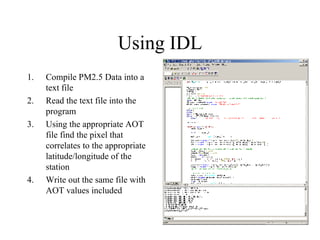
Using IDL Compile PM2.5 Data into a text file Read the text file into the program Using the appropriate AOT file find the pixel that correlates to the appropriate latitude/longitude of the station  Write out the same file with AOT values included
Output from PM_AOTmatch
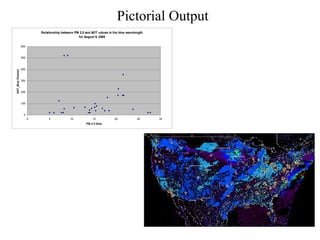
Pictorial Output
Conclusions and Future Research

Poster Nov19

  • 1.
    The relationship betweensurface data and satellite data Rudy Husar Erin Robinson
  • 2.
    Abstract The landsurface has optical properties that can change significantly over time and can be affected by particles in the air. Using data extracted from SEAWiFS satellite images with Sean Raffuse's programs, we are now looking at the relationship between satellite data and data monitored from the ground. One specific way we are doing this is by creating a program that reads in a list of latitudes and longitudes for stations collecting PM data and the particular value for that day, this program then finds the correlating pixel on the Aerosol Optical Thickness image (AOT) for the same day. This value is then written out and further analysis can take place. It is interesting to study this relationship because some aerosols travel close to the surface like smog, while other particulate matter like smoke can travel very high up being seen by the satellite, but not by the PM stations on the ground. By looking at both from the ground up and from the satellite down a more complete picture of the aerosol can be obtained.
  • 3.
    August 8, 2000: Idaho Smoke Event
  • 4.
    Using IDL CompilePM2.5 Data into a text file Read the text file into the program Using the appropriate AOT file find the pixel that correlates to the appropriate latitude/longitude of the station Write out the same file with AOT values included
  • 5.
  • 6.
  • 7.