Agricultural Smoke Detection with Satellite and Surface Sensors Erin Robinson Advisor, Rudolf Husar Center for Air Pollution Impact and Trend Analysis
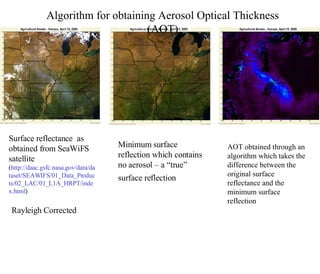
Surface reflectance  as obtained from SeaWiFS satellite  ( http://daac.gsfc.nasa.gov/data/dataset/SEAWIFS/01_Data_Products/02_LAC/01_L1A_HRPT/index.html ) Rayleigh Corrected   Minimum surface reflection which contains no aerosol – a “true” surface reflection   AOT obtained through an algorithm which takes the difference between the original surface reflectance and the minimum surface reflection Algorithm for obtaining Aerosol Optical Thickness (AOT)
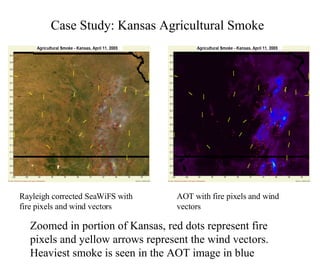
Case Study: Kansas Agricultural Smoke   Zoomed in portion of Kansas, red dots represent fire pixels and yellow arrows represent the wind vectors. Heaviest smoke is seen in the AOT image in blue  Rayleigh corrected SeaWiFS with fire pixels and wind vectors AOT with fire pixels and wind vectors
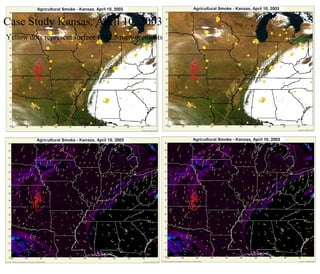
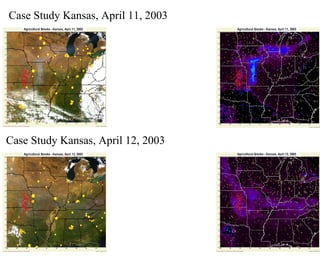
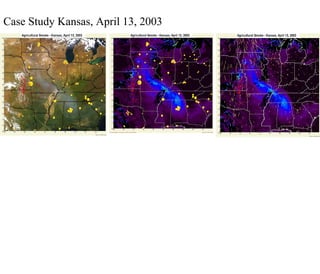
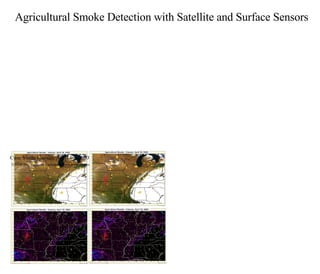
Case Study Kansas, April 10, 2003  Surface reflectance   Yellow dots represent surface PM2.5 measurements taken at 12:00pm, AIRNOW AOT and wind vectors
Case Study Kansas, April 11, 2003  Case Study Kansas, April 12, 2003
Case Study Kansas, April 13, 2003
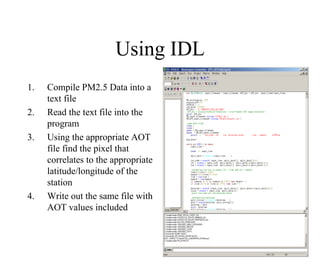
Using IDL Compile PM2.5 Data into a text file Read the text file into the program Using the appropriate AOT file find the pixel that correlates to the appropriate latitude/longitude of the station  Write out the same file with AOT values included
Agricultural Smoke Detection with Satellite and Surface Sensors

Poster Nov19 V2

  • 1.
    Agricultural Smoke Detectionwith Satellite and Surface Sensors Erin Robinson Advisor, Rudolf Husar Center for Air Pollution Impact and Trend Analysis
  • 2.
    Surface reflectance as obtained from SeaWiFS satellite ( http://daac.gsfc.nasa.gov/data/dataset/SEAWIFS/01_Data_Products/02_LAC/01_L1A_HRPT/index.html ) Rayleigh Corrected Minimum surface reflection which contains no aerosol – a “true” surface reflection AOT obtained through an algorithm which takes the difference between the original surface reflectance and the minimum surface reflection Algorithm for obtaining Aerosol Optical Thickness (AOT)
  • 3.
    Case Study: KansasAgricultural Smoke Zoomed in portion of Kansas, red dots represent fire pixels and yellow arrows represent the wind vectors. Heaviest smoke is seen in the AOT image in blue Rayleigh corrected SeaWiFS with fire pixels and wind vectors AOT with fire pixels and wind vectors
  • 4.
    Case Study Kansas,April 10, 2003 Surface reflectance Yellow dots represent surface PM2.5 measurements taken at 12:00pm, AIRNOW AOT and wind vectors
  • 5.
    Case Study Kansas,April 11, 2003 Case Study Kansas, April 12, 2003
  • 6.
    Case Study Kansas,April 13, 2003
  • 7.
    Using IDL CompilePM2.5 Data into a text file Read the text file into the program Using the appropriate AOT file find the pixel that correlates to the appropriate latitude/longitude of the station Write out the same file with AOT values included
  • 8.
    Agricultural Smoke Detectionwith Satellite and Surface Sensors